
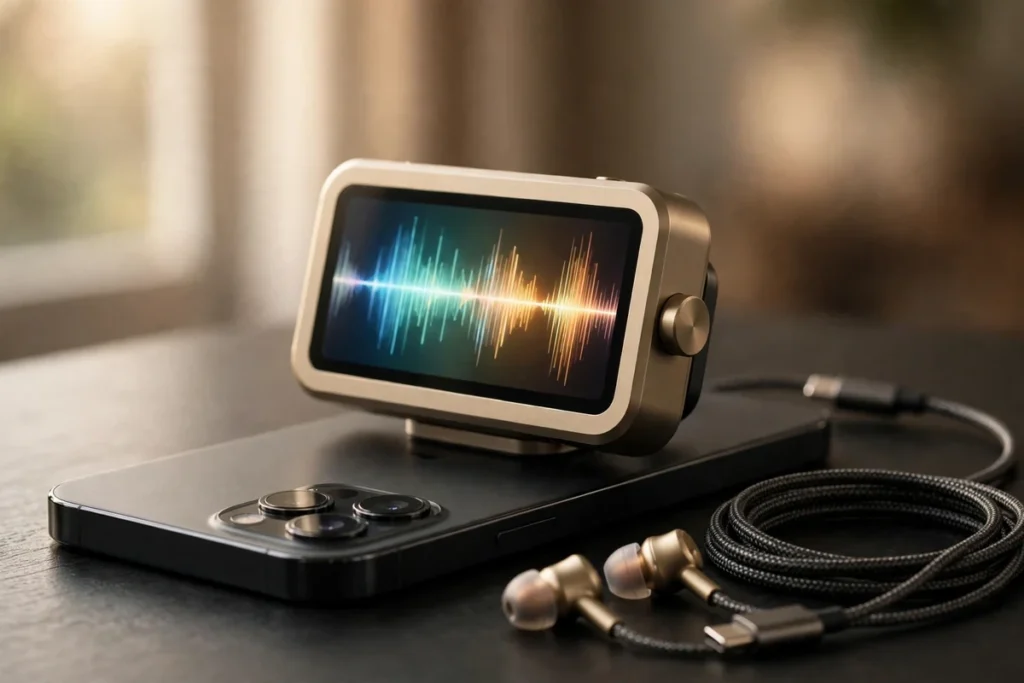
The FiiO QX13 is the flagship of FiiO’s Q series: a pocket USB DAC and headphone amplifier built around the 8-channel ESS ES9027SPRO chip, with a 1.99-inch colour display, up to 900mW per channel on external power, and a magnetic leather case that snaps it onto the back of a phone. FiiO released it in July 2025, a year ahead of the smaller FiiO QX11 gaming dongle we covered this month. US specialist retail widened on November 2, 2026, when Apos listed it, and it is now listed on Amazon US.
A note on what this page is. This is a launch review: a paper analysis built from FiiO’s published specifications and the first independent reviews, summarised below. We have not had a unit on the desk, so there is no hands-on verdict or score from us yet. This page updates as more coverage appears.

Launch review On sale now
What it is: The top model in FiiO’s Q series: an ES9027SPRO 8-channel dongle DAC amp with 3.5mm and 4.4mm outputs, a 1.99-inch colour display, a 10-band PEQ and a magnetic leather case.
Watch out: There is no battery inside. The headline 900mW needs external power via the second USB-C port (Desktop Mode). On phone or laptop power alone, balanced output is 605mW per channel.
ESS ES9027SPRO 8-channel DAC900mW + 900mW balanced (Desktop Mode)10-band PEQPCM 768kHz / DSD512 / MQA
FiiO QX13 quick facts
| Product | FiiO QX13 portable USB DAC/headphone amplifier |
| DAC chip | ESS ES9027SPRO (8-channel, fully differential parallel) |
| Output power | 900mW + 900mW balanced (Desktop Mode), 605mW + 605mW (USB power), 32Ω |
| Released | July 2025; US specialist retail expanded November 2, 2026 (Apos) |
| Launch price | $219.99 (US, Apos; the carbon fibre version lists higher at some retailers) |
| Status | On sale now |
| Where to buy | Amazon US, Apos, Bloom Audio and FiiO’s official AliExpress store |
| Amazon US | Listed, ASIN B0FGJ5PWPM (checked November 5, 2026) |
What the QX13 is
FiiO’s Q series sits above its KA dongle line, and the QX13 was the first model in it: the series flagship, built purely for music. The QX11 followed as the smaller sibling with a gaming mode and microphone; the QX13 skips both, and spends the size and money on conversion quality, output power and the biggest screen FiiO has put on a dongle. A magnetic ecosystem does the carrying: the bundled leather case snaps the QX13 onto an iPhone, a magnetic ring is included for Android phones, and FiiO’s ESTICK mini power bank can feed it on the move.
Two finishes share the same hardware. The black version has a shell of up to 21 stacked carbon fibre layers and weighs 33.7 grams; the Titanium Gold version linked here is aluminium and weighs 39.2 grams. In the box: the QX13, the magnetic leather case, an 8-strand USB-C cable, a screen protector and paperwork.
Architecture: an 8-channel ESS flagship and six TI op-amps
The ES9027SPRO belongs to ESS’s Sabre Pro line, the family behind desktop flagships such as the ES9038PRO and ES9039PRO. It is a single 8-channel chip run fully differentially, four channels in parallel per side, fed by a pair of ultra-low-noise ES9312 regulators. The analogue stage uses six Texas Instruments chips: four INA1620 precision amplifiers on the output, arranged to keep crosstalk down, and two OPA1692 op-amps ahead of them. Digital and analogue boards are separated and shielded, and an XMOS XU316 processor with dual femtosecond oscillators handles USB audio.
Power works the same way as on the QX11, one step further. On host power, balanced output tops out at 605mW per channel into 32 ohms. Feed the second USB-C port from a charger, power bank or ESTICK and Desktop Mode raises that to 900mW per channel; at 300 ohms the balanced output still delivers 125mW per channel. A built-in power meter reads what the host port can supply and adjusts gain and output to match, FiiO’s patented adaptive regulation. Those are FiiO’s design figures; independent bench results are still thin.
Display, PEQ and controls
The 1.99-inch IPS display sits under third-generation Corning glass and runs FiiO’s themed interfaces in portrait or landscape: playback format, volume and settings at a glance. The 10-band parametric EQ is adjusted in the Android FiiO Control app or in a web interface, and works on material up to 192kHz/24-bit. Volume comes in 60-step or 120-step scales, there is a maximum volume limit for sensitive IEMs, and a UAC1.0 mode covers the Switch and PS5. The 3.5mm socket doubles as an S/PDIF output for feeding a desktop DAC.
Who a flagship dongle DAC is actually for
The clearest case: a listener with full-size headphones that a phone cannot drive, who wants one small device for the phone, the laptop and the desk. The QX13 has more balanced power than most battery portables, and the PEQ plus display make it a tuning tool for an IEM collection as well. The magnetic case suits MagSafe iPhone owners who already carry their phone as the source.
Skip it if you want a battery inside the DAC (the rivals below cover that), voice chat or gaming profiles (that is the QX11’s job), or any wireless input: the QX13 is USB-only. Our best portable DACs and dongles guide maps the rest of the field.
QX13 vs QX11 and the KA13
The obvious cross-shop is FiiO’s own range. The QX11 is smaller and cheaper, and answers with a microphone and genre sound presets the QX13 does not have. The KA13 stays the balanced dongle pick in our best DACs guide: simpler, lighter, and well below both Q models on price.
| FiiO QX13 | FiiO QX11 | FiiO KA13 | |
|---|---|---|---|
|  |  | |
| DAC | ESS ES9027SPRO (8-channel) | Dual ESS ES9069Q | Dual Cirrus Logic CS43198 |
| Output power | 900mW + 900mW balanced (Desktop Mode, 32Ω); 605mW + 605mW on USB power | 800mW + 800mW balanced (Desktop Mode, 32Ω); 360mW + 360mW on USB power | 550mW (32Ω) |
| Headphone outputs | 3.5mm + 4.4mm balanced | 3.5mm + 4.4mm balanced | 3.5mm + 4.4mm balanced |
| Max format | PCM 768kHz / DSD512 / MQA | PCM 768kHz / native DSD512 | PCM 384kHz / DSD256 |
| Extras | 1.99-inch display, 10-band PEQ, magnetic case | 1.14-inch display, built-in mic, gaming presets | App filters, gain |
| Check Price | Check Price | Check Price |
FiiO QX13 full specifications
| Product | FiiO QX13 Check Price |
| DAC chip | ESS ES9027SPRO (8-channel, fully differential parallel; ES9312 regulators) |
| USB processor | XMOS XU316 (16-core), dual femtosecond oscillators |
| Op-amps | 2 × TI OPA1692; 4 × TI INA1620 (headphone stage) |
| Headphone outputs | 3.5mm single-ended (also S/PDIF out), 4.4mm balanced |
| Output power (32Ω) | Balanced ≥900mW + 900mW (Desktop Mode), ≥605mW + 605mW (USB power); single-ended ≥310mW + 310mW (Desktop Mode), ≥250mW + 250mW (USB power); balanced ≥125mW + 125mW at 300Ω (Desktop Mode) |
| Max sampling rate | PCM 32-bit/768kHz, native DSD512, MQA full decoding (USB); PEQ up to 192kHz/24-bit |
| Display | 1.99-inch IPS, Corning third-generation glass |
| Battery | None; powered by the host device, or by external power via the second USB-C port |
| USB ports | 2 × USB-C (data; power in for Desktop Mode) |
| SNR / noise / THD+N | SNR ≥124dB (A-weighted); noise floor <2µV single-ended, <3.4µV balanced; THD+N <0.0004% (1kHz, 32Ω) |
| Dimensions | Approx. 64.2 × 30.7 × 13mm |
| Weight | Approx. 33.7g (carbon fibre), 39.2g (aluminium) |
| Launch price | $219.99 (US) |
Early coverage and what is still unknown
Reviews have appeared since the July 2025 release. TechRadar’s two-minute review covered the QX13 as a flagship dongle proposition, and Audiophile Heaven’s full review praised the output power and carbon fibre build, finding it drove demanding full-size headphones while staying under 30 percent on the volume scale. Notebookcheck covered the launch and the magnetic phone attachment. Independent bench measurements remain scarce, and long-term reports on firmware and app polish are thin, so the measurement picture rests mostly on FiiO’s own figures for now.
Should you buy the QX13, or wait?
The buy case is focus: if music is the whole job and you want the most powerful pocket DAC FiiO makes, with a flagship ESS chip, a proper display and PEQ in one magnetic package, the QX13 is the end of that particular search inside FiiO’s range.
Choose differently if your listening includes voice chat or console sessions with a headset mic: the QX11 was built for that and costs less. Choose a battery-powered rival if all-day phone drain is the worry. And since the QX13 has been on sale since July 2025, there is no launch-window reason to rush: stock and pricing have settled.
Also consider
Portable DACs we have already reviewed and scored.

Our top portable DAC: custom FPGA conversion, its own battery, and optical and coaxial inputs beside USB.

Battery-powered, so it never drains your phone: 400mW balanced output, XBass, iEMatch.
Our balanced dongle pick: dual CS43198 chips and 550mW, the simple FiiO option without the screen.
FiiO QX13 FAQ
How much does the FiiO QX13 cost?
The US launch price is in the quick facts box above. The card’s Check Price button shows the current Amazon figure, and the carbon fibre version lists higher at some retailers.
When was the FiiO QX13 released?
FiiO released the QX13 in July 2025. In the US, Apos added it on November 2, 2026, and the Amazon US listing is live now.
What is the QX13’s Desktop Mode?
A second USB-C port takes external power. With it connected, balanced output rises to 900mW per channel; a built-in power meter reads what the host port can supply and adjusts gain and output to match.
Does the FiiO QX13 have a battery?
No. It draws power from the phone or computer it is plugged into, or from an external source such as a power bank or FiiO’s ESTICK via the second USB-C port.
How does the QX13 differ from the QX11?
The QX13 is the larger, music-only flagship: a bigger 1.99-inch display, the ES9027SPRO DAC and more output power. The QX11 is smaller and adds a gaming mode with a built-in microphone, which the QX13 does not have.
Where can I buy the FiiO QX13?
It is listed on Amazon US now (ASIN B0FGJ5PWPM, checked November 5, 2026), at Apos and Bloom Audio, and in FiiO’s AliExpress store. Check the listing is the QX13 itself, in Titanium Gold or Black carbon fibre, not the smaller QX11.

I am the founder of Sound Mavericks, where I provide the polite truth about audio equipment. I started this site because consumer electronics reviews are often too technical. Instead of using a silent lab, I test headphones, earbuds, and Bluetooth speakers in the real world – like on a noisy subway or in a busy coffee shop.
To stay independent, I buy my own review units (mostly from the United States) rather than accepting free gifts from brands. Once I finish testing a product, I sell it locally to our community. My goal is to help you understand sound quality, active noise cancellation (ANC), and battery life without the marketing hype.

