
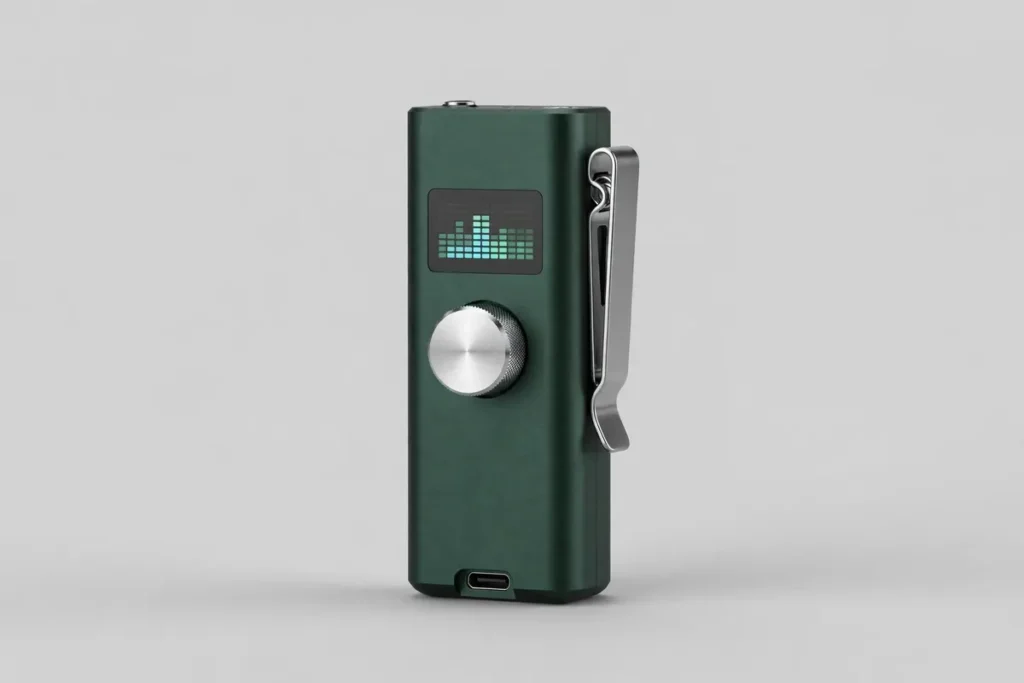
The FiiO BTR25 is a portable Bluetooth DAC and headphone amplifier: a pocket box that takes the audio off your phone wirelessly, converts it with a proper DAC chip, and drives your wired headphones or IEMs harder and cleaner than a phone output can. This fiio btr25 review covers the launch in full: what is inside, what it costs, when it ships, and who should wait for it.
A note on what this page is. This is a research review and launch briefing built from FiiO’s published specifications and launch details, plus the verified Amazon US listing. We have not had a unit on the desk, so there is no hands-on verdict or score from us yet.

Launch review Listing live, December release
Why you: you own wired headphones or IEMs you rate and want them off your phone properly: an ESS DAC, a balanced output with real drive, and LDAC plus aptX Lossless over Bluetooth 6.2.
Trade-off: battery life is modest at around ten hours, and the full release lands in December, so early listings are a pre-order proposition.
ESS ES9069Q DACBluetooth 6.2, LDAC, aptX Lossless3.5mm + 4.4mm balanced460mW per channel balanced
FiiO BTR25 quick facts
| Product | FiiO BTR25 portable Bluetooth DAC and headphone amplifier |
| Price | $109.99 official US price; Amazon US listing $119.99 at the time of writing |
| Status | Listing live ahead of its December release; retailer pre-orders are shipping ahead of the full launch |
| Amazon US | Listed on Amazon US now (green finish verified) |
| DAC | ESS ES9069Q with two ES9603Q headphone amplifier chips |
| Bluetooth | 6.2 (Qualcomm QCC3095): LDAC, aptX Lossless, aptX Adaptive, aptX HD, aptX, LC3, SBC |
| Outputs | 3.5mm single-ended and 4.4mm balanced |
What it is, and where it sits
The BTR line is FiiO’s Bluetooth receiver range: small DAC/amps that clip to a shirt or slip into a pocket, take a wireless feed from a phone, and drive wired headphones. The BTR25 is the smaller sibling of the BTR19, which sits above it in the range with a bigger build and a flagship brief. The BTR25 keeps the formula compact and simpler: one DAC chip instead of a dual-chip layout, a small colour display, a volume knob, playback controls, and a detachable magnetic clip on the back.
It also works as more than a Bluetooth receiver. A mode switch on the body selects between Bluetooth, a wired USB DAC mode for a computer or phone, and a phone mode. That three-mode arrangement means the same box covers the commute over Bluetooth and the desk over USB, which is the job most buyers actually need done. Our best Bluetooth DAC amps guide covers the field it joins, and the older FiiO BTR7 shows where this design language started.
The audio hardware
Conversion is handled by an ESS ES9069Q DAC, and the output stage uses two ES9603Q headphone amplifier chips, one working each channel in the fully differential layout FiiO made the theme of this launch. The measurable result is output power: the balanced 4.4mm output delivers at least 460mW per channel into 32 ohms, and more into 16 ohms, with an output impedance under 0.3 ohms. In plain terms, that is enough drive for nearly any IEM and the great majority of portable headphones, and the low output impedance means sensitive multi-driver IEMs keep their intended tuning instead of having it bent by the source.
Over USB, decoding runs to PCM 384kHz/32-bit with native DSD256. Over Bluetooth, the Qualcomm QCC3095 chip runs Bluetooth 6.2 and a codec list that covers the bases that matter: LDAC for Android hi-res streaming, aptX Lossless for phones that support it, aptX Adaptive and aptX HD below that, LC3 for LE Audio, and SBC as the universal fallback. iPhone owners connect over the standard Bluetooth audio path, and anyone chasing the last word in fidelity can plug in over USB instead, a route our portable DAC for iPhone guide explains.
Battery, controls and the daily carry
Battery life is the modest part of the specification. FiiO rates up to 10 hours over Bluetooth on the single-ended output with SBC, 9 hours on the balanced output, and up to 11 hours in phone mode. Those are laboratory figures and real use with LDAC at high volume will land lower. A full day of listening is realistic; a full week is not, and the BTR25 will live on a charger rota in a way its bigger siblings do not demand.
The rest of the daily-use package looks well judged. The 1.3-inch colour display shows the track, codec and sample rate, so you can confirm at a glance that LDAC or aptX Lossless actually engaged instead of guessing. A real volume knob, separate playback and EQ buttons, and the mode switch keep control on the body rather than inside an app. Three finishes are offered, black, silver and green, and the magnetic clip detaches when you would rather keep the box loose in a pocket.
FiiO BTR25 full specifications
| Product | FiiO BTR25 Check Price |
| Type | Portable Bluetooth DAC and headphone amplifier with USB DAC and phone modes |
| Price | $109.99 official US price; Amazon US listing $119.99 at the time of writing |
| Bluetooth chip | Qualcomm QCC3095, Bluetooth 6.2 |
| Codecs | SBC, aptX, aptX HD, aptX Adaptive, aptX Lossless, LDAC, LC3 (LE Audio) |
| DAC | ESS ES9069Q |
| Amplifiers | Two ESS ES9603Q headphone amplifier chips, fully differential layout |
| Outputs | 3.5mm single-ended, 4.4mm balanced |
| Output power | Balanced: at least 460mW + 460mW into 32 ohms; at least 570mW + 570mW into 16 ohms (THD+N under 1%) |
| Output impedance | Under 0.3 ohms at 32 ohms |
| USB decoding | PCM up to 384kHz/32-bit, native DSD256, DoP128 |
| Battery life | Up to 10 hours Bluetooth single-ended (SBC), 9 hours balanced, 11 hours phone mode (FiiO laboratory figures) |
| Display and controls | 1.3-inch colour display, volume knob, playback and EQ buttons, PC/BT/PHONE mode switch |
| Colours | Black, silver, green; detachable magnetic clip |
Who it is for, and who should skip it
Buy the BTR25 if your listening runs through wired IEMs or portable headphones and your phone has no headphone socket worth using. The balanced output and the output power on offer cover hard-to-drive sets that smaller receivers struggle with, and LDAC plus aptX Lossless mean the wireless link is no longer the weak point of the chain. Desk-and-commute listeners get the most from it, because the USB mode makes it two devices in one.
Skip it if battery life is your first concern: ten hours is workable, not generous, and longer-running receivers exist in the same guide linked above. Skip it too if you need a unit in hand this week from a domestic listing with full stock; the release is a December one, and early listings amount to pre-orders. The BTR19 above it in the range is the step up for buyers who want the bigger flagship box when it arrives.
Frequently asked questions
When is the FiiO BTR25 released?
The BTR25 is a December release. Retailer pre-orders opened ahead of it and the Amazon US listing is already live, so stock is arriving in stages rather than on a single launch day.
What DAC chip does the FiiO BTR25 use?
An ESS ES9069Q handles conversion, with two ES9603Q headphone amplifier chips behind it in a fully differential layout. Bluetooth comes from a Qualcomm QCC3095 running Bluetooth 6.2.
Does the BTR25 have a balanced output?
Yes. Alongside the 3.5mm single-ended socket there is a 4.4mm balanced output rated at least 460mW per channel into 32 ohms, enough for demanding IEMs and most portable headphones.
Which Bluetooth codecs does the BTR25 support?
LDAC, aptX Lossless, aptX Adaptive, aptX HD, aptX and SBC, plus LC3 for LE Audio. Your phone needs to support a codec for the BTR25 to use it.
How long does the BTR25 battery last?
FiiO rates up to 10 hours over Bluetooth on the single-ended output, 9 hours balanced, and 11 hours in phone mode, all under laboratory conditions. Expect less with LDAC at high volume.

I am the founder of Sound Mavericks, where I provide the polite truth about audio equipment. I started this site because consumer electronics reviews are often too technical. Instead of using a silent lab, I test headphones, earbuds, and Bluetooth speakers in the real world – like on a noisy subway or in a busy coffee shop.
To stay independent, I buy my own review units (mostly from the United States) rather than accepting free gifts from brands. Once I finish testing a product, I sell it locally to our community. My goal is to help you understand sound quality, active noise cancellation (ANC), and battery life without the marketing hype.

