
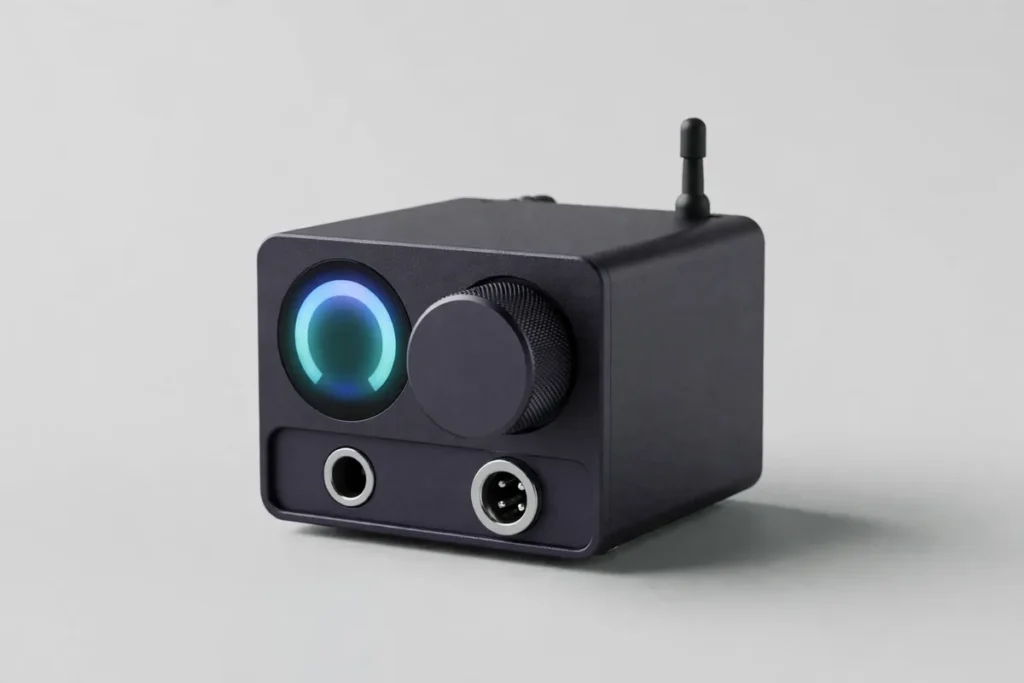
The HiBy BD100 is a compact desktop DAC and headphone amplifier from HiBy Digital, built to cover two jobs at once: hi-fi listening and gaming voice chat. It pairs dual Cirrus Logic CS43198 DAC chips with Bluetooth 5.4, four inputs, a balanced headphone output rated above one watt, and something desktop DACs almost never offer, a dedicated microphone input. This HiBy BD100 review covers its full specifications, US release status and where to buy it. The Amazon US listing is live early.
This is a research review: a launch briefing built from published specifications and launch material. We have not had a unit on the desk, so there is no hands-on verdict and no score yet.

Launch briefing Amazon US listing live
Why you: dual CS43198 decoding, over a watt of balanced power, Bluetooth 5.4 with LDAC and aptX Lossless, and a proper mic input, in a box the size of a stack of coasters.
Trade-off: a small desktop unit: no remote, no streaming apps, no balanced line output. If you need chat mixing or sidetone controls, dedicated gaming hardware still wins.
Dual CS43198 DACsBluetooth 5.4 · LDAC · aptX Lossless4.4mm balanced · 1,087 mWDedicated mic input
HiBy BD100 quick facts
| Product | HiBy Digital BD100 desktop DAC and headphone amplifier |
| US price | $129 official US price; Amazon US listing $139.00 at the time of writing |
| Release status | On sale now through HiBy’s own store; Amazon US listing live ahead of the wider year-end retail release |
| Amazon US | Listed on Amazon US |
| DAC | Dual Cirrus Logic CS43198, one per channel |
| Headphone power | 281 mW single-ended / 1,087 mW balanced, into 32 ohms |
| Microphone | Independent 3.5mm microphone input for voice chat |
What the BD100 is
Most budget desktop DAC amps are one-trick boxes: a USB input, a volume knob and a headphone socket. The BD100 takes a wider brief. HiBy Digital aimed it at the desk where music listening and gaming happen on the same machine, so it adds Bluetooth reception for a phone, coaxial and optical inputs for a console or TV, an RCA line output for powered speakers, and a microphone input so a headset or a standalone mic can run through the same unit. Nothing about the layout is exotic, and that is the point: every control and socket sits where a desk user reaches for it without thinking.
The front panel is dominated by a single control: a knob that combines the volume dial, push-button controls and a small circular colour display in one unit. The box itself is small at 116.8 × 100.6 × 39.7 mm, and it comes in two finishes, an aluminium alloy version at about 302.5 g and a walnut version with side panels and a leather-covered front at about 242 g. The electronics are identical either way.
The DAC and amplifier section
Two Cirrus Logic CS43198 chips handle conversion, one assigned to each channel. HiBy rates the USB input at up to 32-bit/768 kHz PCM with native DSD512, while the optical and coaxial inputs top out at 24-bit/192 kHz. Dual femtosecond-grade oscillators feed the digital section, which is the kind of clock hardware usually reserved for pricier desktop units.
The amplifier side uses two TI OPA1612 chips and four SGM8262 op-amps in a dual parallel layout. HiBy’s rated output is 281 mW into 32 ohms from the 3.5mm single-ended socket and 1,087 mW into 32 ohms from the 4.4mm balanced socket. That balanced figure is generous for a unit this small: on paper it covers demanding full-size headphones as well as sensitive IEMs. These are HiBy’s published figures, and independent measurements will confirm how the amp behaves into real loads. The dual parallel layout is HiBy’s stated route to that output, splitting the load so neither channel’s amplifier stage works at its limit.
Bluetooth, inputs and the microphone
Wireless input runs on Qualcomm’s QCC5181 platform, giving Bluetooth 5.4 with LDAC, aptX Adaptive, aptX Lossless, aptX HD, aptX, AAC and SBC. A dedicated Bluetooth antenna sits at the back. That makes the BD100 a workable way to get phone audio into a wired desktop setup without another cable across the desk. For a desk that already runs a PC, a console and a phone, the input count is the practical point of the design: one box stays wired to the headphones, and everything else takes turns feeding it.
The microphone input is the feature that separates the BD100 from most of its class. It is an independent 3-pole 3.5mm socket, separate from the headphone outputs, so a gaming headset or a standalone mic plugs in alongside your headphones and voice chat runs through the same box as game audio. HiBy is explicit that this is aimed at gaming and streaming setups, where the usual alternative is splitting audio duties between a DAC and a separate USB interface. It also means a streamer can monitor voice and game audio through one pair of headphones, with the one unit handling both directions at once.
HiBy BD100 full specifications
| Product | HiBy Digital BD100 |
| US price | $129 official US price; Amazon US listing $139.00 at the time of writing |
| Type | Desktop DAC and headphone amplifier |
| DAC | Dual Cirrus Logic CS43198 |
| Amplifier chips | 2 × TI OPA1612 + 4 × SGM8262 op-amps; dual femtosecond-grade oscillators |
| Inputs | USB-C, coaxial, optical, Bluetooth |
| Max formats (USB) | PCM up to 768 kHz/32-bit; native DSD512 |
| Bluetooth | Qualcomm QCC5181, Bluetooth 5.4; LDAC, aptX Adaptive, aptX Lossless, aptX HD, aptX, AAC, SBC |
| Headphone outputs | 3.5mm single-ended; 4.4mm balanced |
| Output power (32 ohms) | 281 mW (3.5mm); 1,087 mW (4.4mm balanced) |
| Line output | RCA line out |
| Microphone input | 3.5mm, 3-pole, independent of the headphone outputs |
| Display and controls | Circular colour display integrated with the volume knob |
| Finishes | Aluminium alloy; walnut with leather-covered front |
| Dimensions | 116.8 × 100.6 × 39.7 mm, excluding antenna |
| Weight | Approx. 302.5 g (aluminium); approx. 242 g (walnut) |
Who the BD100 is for
Buy the BD100 if your desk does double duty. It suits the listener in our best DACs roundup territory who also games with voice chat, and it covers the ground of our best headphone amps guide for anyone driving full-size headphones from a small footprint. The Bluetooth receiver makes it a tidy upgrade for a powered-speaker desk setup too, through the RCA line output.
Skip it if you need a streamer: there is no Wi-Fi, no app platform and no network playback, so a phone or computer stays the source. Skip it if your headphones need more than the rated output on paper, or if you want balanced line outputs for studio monitors. And skip the early listing if you prefer to buy on measurements: no independent bench tests exist yet, so the cautious move is to wait for the first reviews.
Where to buy the BD100
The BD100 is on sale now through HiBy’s own store and specialist retailers, and the Amazon US listing is live ahead of the wider year-end retail release. Both finishes, aluminium and walnut, carry the same electronics. Launch stock tends to move in waves, so the listing is worth checking back on if a finish sells through.
HiBy BD100 FAQ
When is the HiBy BD100 released?
It is on sale now through HiBy’s own store and specialist retailers, and the Amazon US listing is live. HiBy positioned the wider retail release toward the year end, so availability widens over the coming weeks.
How much does the HiBy BD100 cost?
The current US figure is in the quick facts box at the top of this page, and the Amazon listing shows live pricing. Both finishes carry the same US price.
How powerful is the BD100 headphone amplifier?
HiBy rates it at 281 mW into 32 ohms from the 3.5mm output and 1,087 mW into 32 ohms from the 4.4mm balanced output. On paper that covers sensitive IEMs and most full-size headphones.
Can I use a microphone with the BD100?
Yes. It has an independent 3.5mm microphone input alongside the headphone outputs, so voice chat for gaming or streaming runs through the same unit as your game and music audio.
Does the BD100 work with powered speakers?
Yes. The RCA line output feeds powered speakers or a separate amplifier, and the Bluetooth input means a phone can act as the source for a desktop speaker setup.

I am the founder of Sound Mavericks, where I provide the polite truth about audio equipment. I started this site because consumer electronics reviews are often too technical. Instead of using a silent lab, I test headphones, earbuds, and Bluetooth speakers in the real world – like on a noisy subway or in a busy coffee shop.
To stay independent, I buy my own review units (mostly from the United States) rather than accepting free gifts from brands. Once I finish testing a product, I sell it locally to our community. My goal is to help you understand sound quality, active noise cancellation (ANC), and battery life without the marketing hype.

