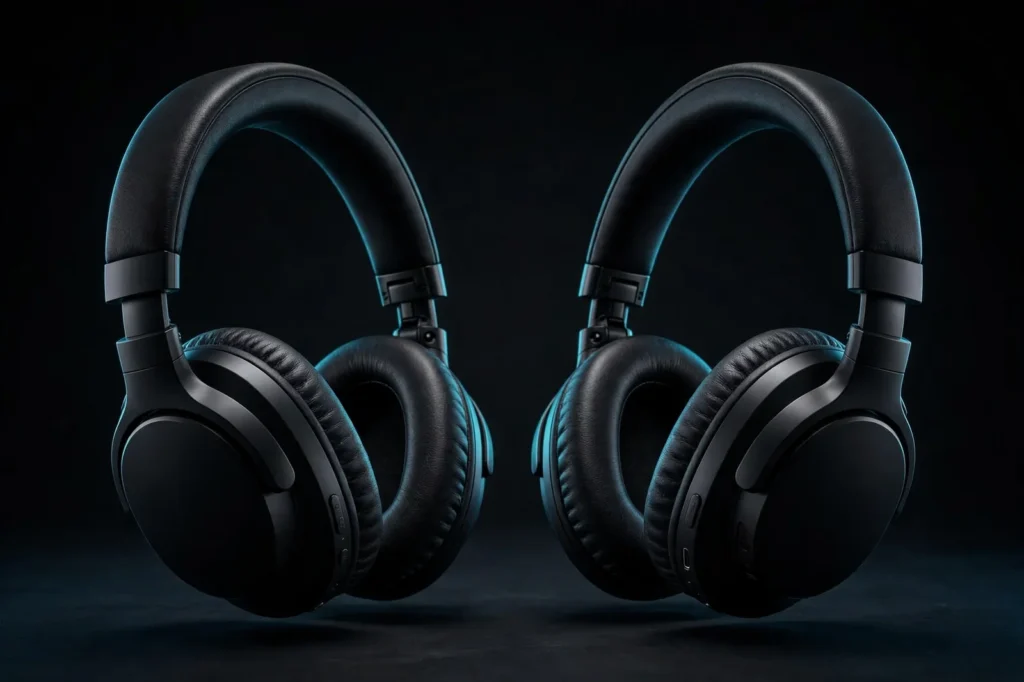
First, Which K361 Are We Talking About?
AKG sells the K361 in two forms that share the same 50mm drivers and tuning, but behave very differently when it comes to lossless audio:
- K361 (wired) — the standard studio model. Analog 3.5mm connection, detachable cable. Everything we say about lossless playback applies in full.
- K361-BT — adds Bluetooth 5.0 (AAC and SBC codecs only) plus a battery, but keeps the wired cable as an option. Bluetooth is the bottleneck here, not the drivers.

What “Lossless Audio” Actually Means
Lossless refers to how the music file is compressed, not to any feature of the headphone. Formats like FLAC, ALAC, and WAV preserve every bit of the original studio master. Lossy formats like MP3 and standard AAC throw away data to save space.
The honest context: above about 256–320 kbps, the difference between lossy and lossless is genuinely hard to hear for most listeners. Lossless matters most as a guarantee that nothing was discarded before the sound ever reaches your ears — and the K361’s detailed, neutral tuning is exactly the kind of headphone that lets you appreciate clean masters.
To actually hear lossless, you need lossless files (or a lossless streaming tier such as Apple Music, Tidal, Qobuz, or Amazon Music HD) and a source that passes the full signal to your headphones — which brings us to the DAC.
The Wired K361: Fully Lossless-Capable
A wired headphone does not “support” or “not support” file formats — it converts whatever electrical signal it receives into sound. Since the K361 wired connects via plain analog cable, it will reproduce exactly what your source sends it: lossless file in, lossless sound out. There is no codec, no re-encoding, and nothing to limit the signal between your DAC and the drivers.
AKG’s published specs for the K361 (from AKG’s official product page) confirm it’s engineered well beyond the demands of lossless playback:
| Driver | 50mm dynamic, titanium-coated diaphragm, pure OFC voice coil |
| Frequency response | 15Hz – 28kHz (extends well past the audible range) |
| Impedance | 32 ohms |
| Sensitivity | 114 dB SPL/V @ 1kHz |
| Connection | Detachable 3.5mm cable (1.2m & 3m included) + 6.5mm adapter |
That extended 28kHz top end is worth noting: the drivers can resolve detail far beyond what any lossless file even contains, so the headphone itself is never the weak link.
The K361-BT: No True Lossless Over Bluetooth
The K361-BT is where expectations need adjusting. Its Bluetooth 5.0 radio supports AAC and SBC — both lossy codecs. When you listen wirelessly, your lossless FLAC file gets re-encoded into a lossy stream before it ever reaches the headphones. The drivers are identical, but the wireless pipeline discards data regardless of how pristine your source file is.
The fix is simple: the K361-BT ships with the same detachable cables as the wired model. Plug the cable in and the Bluetooth bottleneck disappears — you’re back on a fully lossless analog path. This is why the hybrid design is genuinely useful: wireless for convenience, wired for critical listening.
If you want to understand exactly which codecs do and don’t carry lossless audio, our Bluetooth audio codecs explainer breaks down LDAC, aptX Lossless, and LE Audio in detail — neither of which the K361-BT supports.
What You Actually Need for a Lossless Chain
Since the headphone is never the bottleneck, here’s the honest checklist for hearing lossless audio on the K361:
- Lossless files. FLAC/ALAC/WAV downloads or a lossless streaming tier. Without these, nothing downstream matters.
- A decent DAC. This is the one upgrade that actually counts. Many phone and laptop headphone outputs resample or degrade the signal — a dedicated USB-C DAC dongle like the FiiO KA13 below decodes up to 32-bit/384kHz and DSD256, comfortably beyond anything lossless streaming delivers.
- The cable, not Bluetooth. As covered above: wired = bit-perfect path; Bluetooth = lossy re-encode.
- No amp required. At 32 ohms and 114dB sensitivity, the K361 is easy to drive — a phone or dongle DAC gets it plenty loud. If you’re curious about when an amp does matter, see our guide on headphone impedance and whether you need an amp, and our best headphone amps roundup if your chain grows.

Common Misconceptions, Cleared Up
- “My headphone needs a lossless certification.” No. Wired headphones don’t process files — they can’t be lossless- or lossy-“certified.” That marketing language applies to wireless codecs and streaming services.
- “Bluetooth can sound lossless with the right codec.” Standard Bluetooth audio (SBC, AAC) cannot. Newer codecs like aptX Lossless and LC3 promise bit-perfect wireless, but the K361-BT doesn’t support them — and neither does any device from its generation.
- “The K361-BT sounds worse than the wired K361.” Not inherently. The drivers are the same. Over Bluetooth it’s limited by the codec; over the cable it’s identical to the wired model.
- “Lossless always sounds dramatically better.” Often the difference is subtle versus a good 320kbps encode. Don’t buy lossless files expecting a revelation — buy them to guarantee nothing was lost in the first place.
SoundMavericks’ Verdict
The AKG K361 is an excellent vehicle for lossless audio — its neutral tuning and extended response make it easy to hear what a clean master actually sounds like. But give the credit where it’s due: the lossless magic lives in your files and your DAC, not in the headphone. Buy the K361 for its studio-grade sound and comfort, pair it with a lossless library and a solid DAC, and use the cable when it matters. That’s the whole formula.
Frequently Asked Questions
Does the AKG K361 support lossless audio?
Yes. The wired K361 connects via analog cable and reproduces whatever your source sends it, so paired with lossless files (FLAC/ALAC/WAV) and a capable DAC, you get full lossless playback. “Support” is determined by your source chain, not the headphone.
Does the AKG K361-BT support lossless audio over Bluetooth?
No. The K361-BT’s Bluetooth supports only the lossy AAC and SBC codecs, which re-encode your audio before transmission. For lossless playback on the K361-BT, use the included cable.
Do I need a DAC or amp for the AKG K361?
A DAC helps if your phone or laptop has a noisy or limited headphone output — it’s the key upgrade for a true lossless chain. An amp is generally unnecessary: at 32 ohms impedance and 114dB sensitivity, the K361 is easy to drive to full volume from almost any source.
What files count as lossless?
FLAC, ALAC, and WAV are the common lossless formats. Lossless streaming tiers — including Apple Music, Tidal, Qobuz, and Amazon Music HD — deliver lossless audio as well. Standard Spotify and YouTube streams are lossy.
Will I hear a difference between lossless and high-bitrate MP3 on the K361?
Sometimes, but it’s often subtle. The K361’s neutral, detailed tuning makes it a good headphone for critical comparisons, yet even trained listeners struggle to distinguish lossless from a well-encoded 320kbps file. Think of lossless as a guarantee of fidelity rather than an automatic sound upgrade.

I am the founder of Sound Mavericks, where I provide the polite truth about audio equipment. I started this site because consumer electronics reviews are often too technical. Instead of using a silent lab, I test headphones, earbuds, and Bluetooth speakers in the real world – like on a noisy subway or in a busy coffee shop.
To stay independent, I buy my own review units (mostly from the United States) rather than accepting free gifts from brands. Once I finish testing a product, I sell it locally to our community. My goal is to help you understand sound quality, active noise cancellation (ANC), and battery life without the marketing hype.