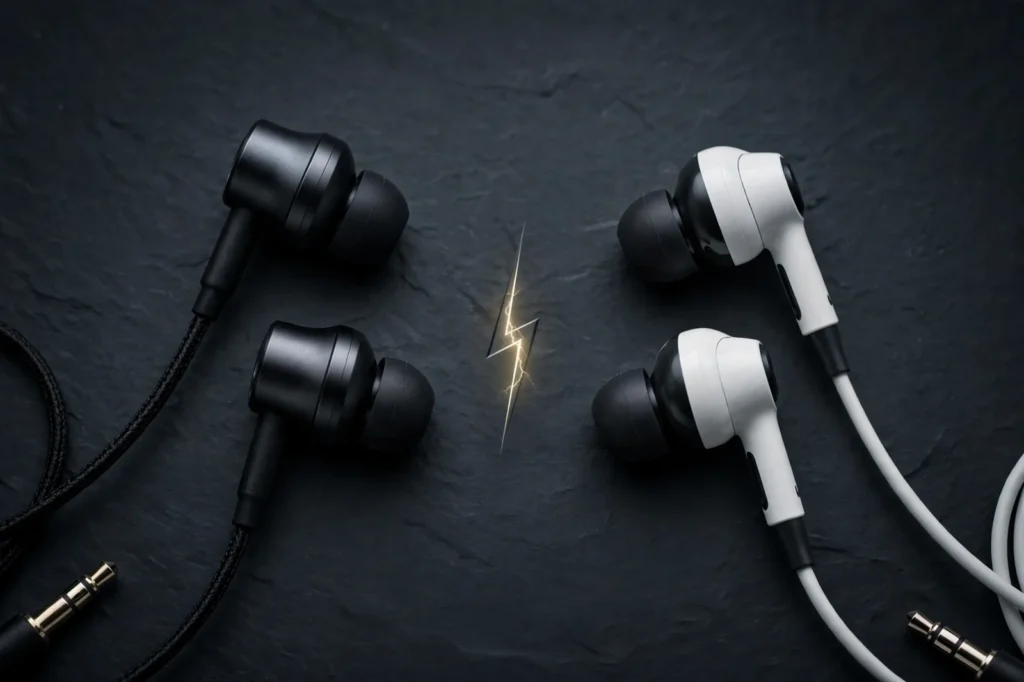
Shopping for wired earbuds on a tight budget? The search term “Betron earbuds vs Sony” tells us exactly where you are: you’re weighing Betron — the no-name brand with suspiciously good Amazon reviews — against Sony’s cheapest wired earbuds. Is the brand premium worth it, or does the budget pick win?
In this comparison, we put Betron’s best-selling budget earbud, the Betron BS10, head-to-head with Sony’s entry-level wired earbud, the Sony MDR-EX14AP. Both are wired in-ear earphones with an inline mic, both target the same ultra-affordable shopper, and both live or die on one question: which gives you more for your money?
After comparing specs, build, comfort, and owner feedback, the Sony MDR-EX14AP is the safer buy — its 9mm neodymium drivers deliver cleaner, more balanced sound and its 3-gram featherweight design disappears in your ears. The Betron BS10 is the value play — bigger 12mm drivers with heavier bass, an inline volume control, and a carrying case included, aimed at bass lovers who want every accessory in the box. Choose Sony for accuracy and comfort; choose Betron for bass and extras.
The Contenders at a Glance


Betron BS10 vs Sony MDR-EX14AP: Spec Comparison
| Specification | Betron BS10 | Sony MDR-EX14AP |
|---|---|---|
| Driver | 12mm dynamic | 9mm neodymium dynamic |
| Frequency response | 20Hz – 20kHz | 8Hz – 22kHz |
| Impedance | 16Ω | 16Ω |
| Sensitivity | 112dB | 102dB/mW |
| Microphone | Yes + volume control | Yes + multifunction button |
| Cable | 1.2m tangle-free, 3.5mm | 1.2m Y-shape, 3.5mm |
| Weight | 16g | 3g |
| Build | Aluminum housing, moisture resistant | Plastic, closed-back |
| In the box | 3 ear tip sizes + carry case | 3 ear tip sizes (S/M/L) |
| Warranty | 1 year | 1 year |
Sound Quality: Bass vs Balance
This is the heart of the comparison, and the two earbuds take opposite approaches.
The Betron BS10 leads with its headline spec: a large 12mm driver tuned for “powerful bass-driven sound.” Owners consistently report a warm, bass-heavy signature — the kind of tuning that flatters hip-hop, EDM, and pop. The trade-off is clarity: mids and highs take a back seat, and detail retrieval is modest compared to what Sony achieves. If you like your music with a thump, Betron delivers it.
The Sony MDR-EX14AP takes the refinement route. Its 9mm neodymium drivers — paired with an 8Hz–22kHz frequency range that extends deeper on both ends — produce a more balanced, cleaner presentation. Bass is present but controlled; vocals and highs come through with better separation. It’s not an exciting tuning, but it’s a more accurate one, and it handles a wider range of genres without fatigue.
Our take: For critical listening or all-day variety, Sony’s balanced tuning wins. For bass-heavy genres on a tight budget, the BS10’s big drivers are genuinely fun. Neither will challenge earbuds from our best wired earbuds roundup, but at this end of the market both punch their weight.
Design and Build Quality
The Betron BS10 looks and feels like the pricier product. Its housings are machined from aluminum, the cable is tangle-resistant, and the whole package is rated moisture resistant — a nod to gym and commute use. The metal construction adds weight (16g), but it also adds durability.
Sony keeps things simple: lightweight plastic housings and a Y-shaped cable. There’s no metal, no moisture rating, no premium feel. What you get instead is engineering minimalism — the EX14AP weighs just 3g, among the lightest wired earbuds we’ve seen. Less to break, less to feel in your ears.
Our take: Betron wins on materials and perceived durability; Sony wins on featherweight design. If your earbuds live in a gym bag, the BS10’s metal build inspires more confidence.
Comfort and Fit
Both are in-ear designs with three sizes of silicone tips, so fit depends largely on your ear shape. The difference is weight: the Sony’s 3g barely registers, making it the better pick for long sessions, side-sleeping, or smaller ears. The Betron’s 16g aluminum housings are still light, but you’ll notice them more over a full day. Not sure which style suits you? Our in-ear vs earbuds vs over-ear guide breaks it down.
Our take: Sony for comfort, comfortably. Weight is the single biggest comfort factor in wired earbuds, and the EX14AP is in a different class.
Controls, Mic, and Calls
Both earbuds include an inline microphone for calls and a single-button remote. The Betron BS10 goes one better with a dedicated inline volume control in addition to the multifunction button — genuinely useful if your phone’s buttons are hard to reach during a workout.
Call quality on both is basic: fine for quick calls, not built for long conference sessions. If clear calls are a priority, see our best earbuds for phone calls guide instead.
Our take: Betron edges this round — the volume control is a small but real convenience the Sony lacks.
Extras and Warranty
Betron clearly studied the unboxing experience: the BS10 ships with a compact protective carrying case plus three ear tip sizes, and carries a 1-year manufacturer warranty. Sony ships the standard S/M/L tips and a 1-year warranty — no case, no extras.
Our take: Betron wins the box contents. A carry case is exactly the kind of accessory that protects a budget buy from an early death in a backpack.
Final Verdict: Which Should You Buy?
Here’s how we’d split it:
- Buy the Sony MDR-EX14AP if you want the most balanced, refined sound for the money, the lightest possible fit for all-day wear, and the reassurance of a major brand’s tuning. It’s the audiophile-leaning choice at an entry-level price.
- Buy the Betron BS10 if you want maximum bass, a tougher metal build, an inline volume control, and a carry case in the box. It’s the feature-packed value choice for bass lovers and commuters.
Our overall pick remains the Sony MDR-EX14AP: sound quality and comfort are the two things that matter most in earbuds you wear daily, and Sony wins both. But the Betron BS10 is no consolation prize — for bass-forward listeners, it’s the more fun buy.
Frequently Asked Questions
Are Betron earbuds better than Sony earbuds?
Not overall. Betron earbuds like the BS10 offer bigger bass and more accessories for the money, but Sony’s entry-level earbuds (such as the MDR-EX14AP) deliver more balanced sound, better comfort, and more consistent quality control. Betron wins on value-per-dollar; Sony wins on sound refinement.
Do Betron BS10 earbuds have a microphone?
Yes. The Betron BS10 (model BS10BVC) includes an inline microphone plus a volume control and multifunction button for calls and music playback.
Are the Sony MDR-EX14AP good for calls?
They’re adequate for short calls thanks to the inline mic, but they’re not designed for heavy call use. For frequent work calls, dedicated call-focused earbuds will perform noticeably better.
Do I need a headphone jack for these earbuds?
Yes — both the Betron BS10 and Sony MDR-EX14AP are wired earbuds with a standard 3.5mm plug. Phones without a headphone jack will need a USB-C or Lightning adapter (sold separately).
Which is more comfortable: Betron BS10 or Sony MDR-EX14AP?
The Sony MDR-EX14AP, by a clear margin. At roughly 3g it’s one of the lightest wired earbuds available, while the Betron’s aluminum housings weigh about 16g. Both include three ear tip sizes for fit adjustment.

I am the founder of Sound Mavericks, where I provide the polite truth about audio equipment. I started this site because consumer electronics reviews are often too technical. Instead of using a silent lab, I test headphones, earbuds, and Bluetooth speakers in the real world – like on a noisy subway or in a busy coffee shop.
To stay independent, I buy my own review units (mostly from the United States) rather than accepting free gifts from brands. Once I finish testing a product, I sell it locally to our community. My goal is to help you understand sound quality, active noise cancellation (ANC), and battery life without the marketing hype.