
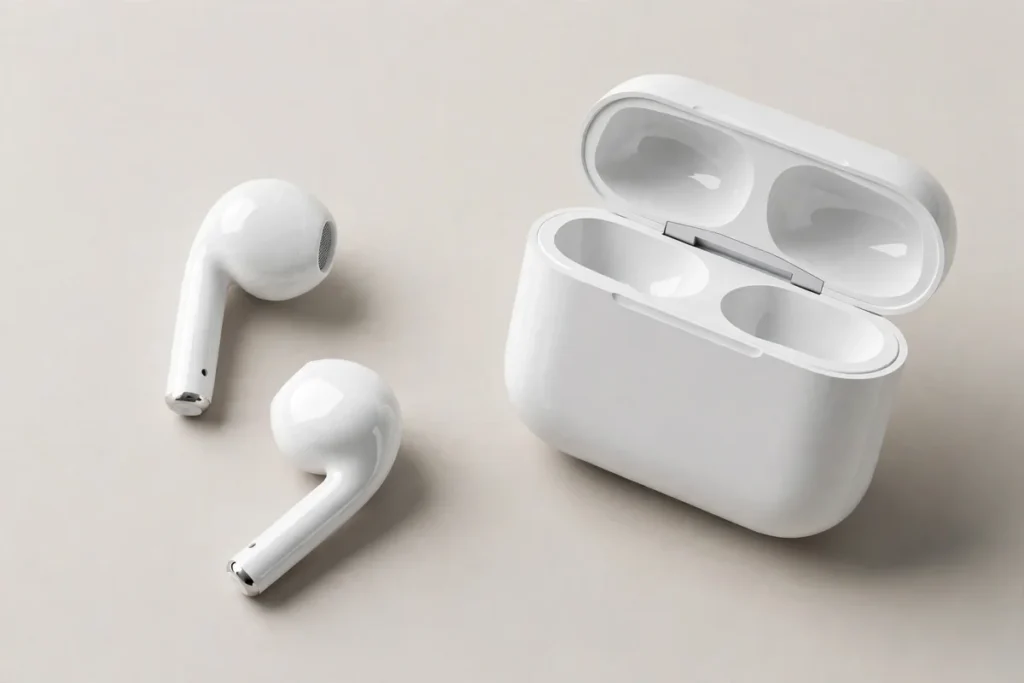
This Apple AirPods 4 review covers both versions of the same earbud, because the buying decision is the whole story here. The two variants share one open, tip-free shell, the same H2 chip and the same driver, and they split on a single question: how much is noise cancelling worth to you? The version with active noise cancelling is the one most people should buy, and we score it 8.0 out of 10. The base version drops the cancelling, keeps the fit and sound, and scores 7.0 out of 10. Here is where those numbers come from, and which variant fits your routine.
This review is research-based. We have not tested the AirPods 4 hands-on, so the scores come from Apple’s published specifications and the consensus of published hands-on reviews, on the same six-category scale we use across the site. Both variants carry published SoundMavericks scores from our tip-free earbuds roundup, reused here unchanged.

Apple AirPods 4 with ANC 8.0/10
Why you: you dislike ear tips but still want noise cancelling, Adaptive Audio and a case that charges wirelessly and beeps when you lose it.
Trade-off: open-fit ANC cannot match a sealed bud on a plane, and battery life halves to 4 hours with ANC running.
H2 chip · Open-fit ANC · 4 h buds, 20 h case (ANC on) · IP54 · Wireless charging
Apple AirPods 4 7.0/10
Why you: you want the AirPods shape, sound and call quality for quiet rooms and dog walks, and you would rather hear the world than cancel it.
Trade-off: there is no noise cancelling at all, no wireless charging and no speaker in the case, so a lost case stays lost quietly.
H2 chip · No ANC · 5 h buds, 30 h case · IP54 · USB-C case
One shell, two variants: what the extra money buys
Hold the two versions side by side and you cannot tell them apart. The buds are identical: same contoured open shell, same short stem, same driver, same H2 chip, same IP54 rating against dust and sweat. Every difference sits in the electronics switched on inside and in the case the buds ship with.
The ANC version adds four things. Active noise cancelling comes first, with Adaptive Audio that blends cancelling and transparency as your surroundings change, plus Conversation Awareness, which dips your music when you start talking to someone. Second, its case charges wirelessly on Qi pads and Apple Watch chargers as well as over USB-C. Third, the case carries a speaker, so Find My can make it beep when it slides behind a sofa. Fourth, it gets a small battery trade: with cancelling running, the buds last four hours per charge instead of five.
The base version keeps the same sound hardware and the same call features, and its case charges over USB-C only, with no speaker. Nothing about the fit or the tuning changes. If you want the deep dive on the cancelling model alone, our AirPods 4 with ANC review goes further into its noise control; this page exists to settle the choice between the two.
Design, fit and comfort
Both variants score 8.8 for comfort, and the reason is what the AirPods 4 leave out. There are no silicone tips and nothing seals your ear canal. The bud rests in the bowl of your ear, shaped from thousands of ear scans, so there is no pressure deep in the canal and none of the plugged-up feeling that makes people pull sealed buds out after an hour. For desk work, calls and long listening sessions, that open fit is the main reason to buy these over the sealed Pro line.
The risk is the same one every fixed-shape bud carries. There are no tip sizes to swap, so the fit Apple chose either suits your ears or it does not. A bud that sits well disappears; a bud that sits loose shifts when you chew, smile or run for a bus, and a shifting open bud also lets in more noise, which weakens the cancelling on the ANC version. Test the fit on a walk before the return window closes. The AirPods 4 are among the few scored models in our guide to the best earbuds without silicone tips, where fit decides things too.
Noise cancelling: the one real dividing line
Score the ANC version against its own class and it impresses: 7.8, strong cancelling from a bud with no seal. Office air conditioning, background chatter and street hum all drop to a level that music at moderate volume comfortably covers. Adaptive Audio helps because an open bud’s fit shifts as you move your jaw, and the system keeps adjusting instead of assuming a seal that was never there. Published lab testing puts its reduction at roughly 20 dB through the mid and high frequencies, which is where office and street noise live.
The limits are physical. Low rumble gets through, because there is no seal blocking sound before the microphones and processing start work. On a plane, engine drone remains present underneath your music, and the sealed AirPods Pro models cancel far more. The base version, meanwhile, has no cancelling at all. Our 2.0 noise cancelling score is the rating we give a model with the feature absent: your ears stay open to everything, which is either the point or the problem, depending on where you listen. Our head-to-head on AirPods 4 with vs without noise cancellation walks through the difference scenario by scenario.
Sound quality
The two variants share one driver and one tuning, so this section is short by design. Sound scores 8.2 on the ANC version and 8.0 on the base, and the small gap is not a hardware difference. With cancelling running, the ANC version lowers the noise floor of the room around you, so detail and bass weight survive at lower volumes in real rooms. In a silent room, the two are effectively the same earbud.
The tuning itself is fuller than the older standard AirPods managed. Bass lands with real presence for an open bud, vocals sit forward and stay clear, and Adaptive EQ adjusts the low and mid range to your ear shape in real time. Personalized Spatial Audio with head tracking works on both versions for films and supported music. The open fit still sets the ceiling: deep bass leaks away in noise, and a sealed bud keeps a weight and isolation advantage that no tuning closes. Judged against open buds, the sound is strong; judged against sealed rivals, it plays by different rules.
Calls and microphones
Calls are a shared strength. Voice Isolation runs on both variants, using the H2 chip to pull your voice forward and push background noise down, and published testing rates call clarity on the pair highly for open-fit buds. The ANC version scores 8.4 and the base 8.2, close enough that calls should not decide your purchase. Wind is the weak spot for both, as it is for most stem buds with no seal. For desk calls, video meetings and phone calls on the move, either variant does the job well, and automatic iCloud switching moves them between Apple devices without a pairing ritual.
Battery life
Battery is where the base version quietly wins a round. It runs up to five hours per charge and 30 hours in total with its case, and it never pays a cancelling tax because there is no cancelling to run. The ANC version matches those figures with noise control off: five hours per charge, 30 with the case. Switch the cancelling on and the rating drops to four hours per charge and 20 hours with the case: the honest cost of the feature.
Four hours is enough for most commutes and work sessions, and a five-minute charge adds roughly an hour of listening. It is not enough for a full workday away from the case, and heavy ANC users will visit the case more often than they expect. If your listening happens in long, quiet stretches, the base version’s simpler stamina argument is real.
Which AirPods 4 should you buy?
Buy the ANC version if your listening happens anywhere with a noise floor: open-plan offices, buses, trains, city streets, shared houses. The cancelling, the wireless charging case and the Find My speaker together justify the step up for most people, and the four-hour battery is a manageable price. It is the variant we score highest.
Buy the base version if your earbuds live in quiet rooms, on dog walks and under podcasts, and you value hearing the world around you over muting it. You give up nothing in fit, sound or call quality, and you gain the longer case life. Skip both and look at a sealed model if you fly often or need serious isolation; inside Apple’s range that means the Pro line, and our guide to which AirPods to buy maps the full line-up against these two.
Apple AirPods 4 specifications
| Spec | Apple AirPods 4 with ANC | Apple AirPods 4 |
|---|---|---|
| Chip | Apple H2 | Apple H2 |
| Fit | Open-ear, one size, no silicone tips | Open-ear, one size, no silicone tips |
| Noise cancelling | Active, with Adaptive Audio, Conversation Awareness and Transparency mode | None |
| Driver | Custom Apple driver, Adaptive EQ | Custom Apple driver, Adaptive EQ |
| Battery, buds | Up to 5 hours; up to 4 hours with ANC on | Up to 5 hours |
| Battery, with case | Up to 30 hours; up to 20 hours with ANC on | Up to 30 hours |
| Bluetooth | 5.3, AAC, iCloud automatic switching | 5.3, AAC, iCloud automatic switching |
| Charging | USB-C; Qi and Apple Watch wireless charging | USB-C only |
| Find My | Speaker in the case | No case speaker |
| Water and dust resistance | IP54 (buds and case) | IP54 (buds and case) |
| Controls | Force sensor on the stem | Force sensor on the stem |
| Extras | Voice Isolation, Personalized Spatial Audio, hands-free Siri | Voice Isolation, Personalized Spatial Audio, hands-free Siri |
| Check Price | Check Price on Amazon | Check Price on Amazon |
| Sound | 8.2 |
| Noise Cancelling | 7.8 |
| Calls & Mic | 8.4 |
| Comfort | 8.8 |
| Battery Life | 6.8 |
| Value | 7.8 |
| Sound | 8.0 |
| Noise Cancelling | 2.0 |
| Calls & Mic | 8.2 |
| Comfort | 8.8 |
| Battery Life | 6.8 |
| Value | 8.4 |
Frequently Asked Questions
What is the difference between the two AirPods 4 versions?
The buds are identical: same shell, same driver, same H2 chip. The ANC version adds active noise cancelling, Adaptive Audio and Conversation Awareness, and its case charges wirelessly and has a speaker for Find My. The base version drops all of that, charges over USB-C only, and runs longer per charge because there is no cancelling to power.
Do the base AirPods 4 have noise cancelling?
No. The base AirPods 4 have no noise cancelling and no transparency mode. Your ears stay open to the room, which suits quiet spaces and outdoor awareness. Noise cancelling is the main reason to step up to the ANC version.
How long does the AirPods 4 battery last?
The base version runs up to five hours per charge and 30 hours in total with the case. The ANC version matches that with noise control off, and drops to four hours per charge and 20 hours with the case while cancelling is running. A five-minute charge adds roughly an hour of listening on both.
Are the AirPods 4 water resistant?
Yes. Both versions and their cases are rated IP54, which covers dust and splashes. Sweat, rain and gym use are within the rating; swimming and showering are not.
Do the AirPods 4 work with Android phones?
They pair over Bluetooth and handle music and calls, but the features that justify them are Apple-only: automatic switching, Adaptive Audio, Conversation Awareness, Voice Isolation and Personalized Spatial Audio all need Apple devices. Android owners get a comfortable open bud and leave most of the value unused.
Do the AirPods 4 have ear tips?
No. Both versions use an open, tip-free design that rests in the bowl of your ear. Nothing enters or seals the ear canal, which is why they stay comfortable for long sessions and why their noise cancelling, on the ANC version, cannot match a sealed earbud.
Final verdict
The AirPods 4 are one earbud sold at two feature levels, and the honest answer is that the ANC version earns its premium for anyone who listens outside quiet rooms. It keeps the open-fit comfort that defines the line, adds cancelling that genuinely works on streets and in offices, and rounds out the case with wireless charging and a speaker. The base version is the same comfortable bud with the noise left in, and for home listening and dog walks that trade is fair. Pick by your surroundings, not by the spec sheet.

I am the founder of Sound Mavericks, where I provide the polite truth about audio equipment. I started this site because consumer electronics reviews are often too technical. Instead of using a silent lab, I test headphones, earbuds, and Bluetooth speakers in the real world – like on a noisy subway or in a busy coffee shop.
To stay independent, I buy my own review units (mostly from the United States) rather than accepting free gifts from brands. Once I finish testing a product, I sell it locally to our community. My goal is to help you understand sound quality, active noise cancellation (ANC), and battery life without the marketing hype.
