Quick Verdict: The Best-Sounding Open Earbuds Get Louder, Longer-Lasting and Easier to Live With
Our bose ultra open earbuds 2nd gen review verdict: Bose took the open-ear cuff design it pioneered and fixed nearly every first-generation complaint. The 2nd Gen sounds fuller with deeper bass and higher volume from a newly engineered driver, lasts up to 9 hours per charge instead of 7.5, adds wireless charging to the case, a Cinema Mode for video, and SpeechClarity call technology — while keeping the full situational awareness that is the entire point of open earbuds. There is still no noise cancelling, by design. If you want premium sound without sealing your ears shut, this is the open-ear benchmark. If you fly often or work somewhere loud, you still need a sealed ANC pair alongside it.
Check Price on Amazon — Bose Ultra Open Earbuds (2nd Gen)Open earbuds ask you to accept a trade: give up the seal, the isolation and the thump of in-ear buds, and in return you hear your music and your surroundings at the same time. The first-generation Bose Ultra Open Earbuds proved the trade could sound genuinely good. The second generation, announced on September 17, 2026 and on sale from October 1, 2026, sets out to prove it can sound great — louder, bassier, and with the battery and charging upgrades owners of the original asked for.
SoundMavericks has not hands-on tested this model. This review is based on Bose’s published specifications, Amazon listing data and aggregated launch coverage from multiple independent reviewers, and our scores reflect that evidence base rather than in-ear listening sessions. Where launch reviewers agree, we score with confidence; where the open-ear format itself sets the ceiling — bass depth and isolation most obviously — we score against other open earbuds, not against sealed ANC flagships.

Bose Ultra Open Earbuds (2nd Gen)
| Sound Quality (for open earbuds) | 8.8 |
| Comfort & Fit | 9.0 |
| Awareness & Safety | 9.5 |
| Battery Life | 8.2 |
| Call Quality | 8.0 |
| Value | 7.2 |
For context on the sealed alternative, our best noise cancelling earbuds guide covers the ANC flagship field, while runners should cross-check our best running headphones roundup. If you are weighing open against cancelling, our explainer on active noise cancellation vs passive isolation explains what each approach can and cannot do.
Bose Ultra Open Earbuds (2nd Gen): Specs
| Spec | Ultra Open Earbuds (2nd Gen) | Ultra Open Earbuds (1st Gen) |
|---|---|---|
| Design | Open-ear cuff, clips around the ear, nothing in the canal | Open-ear cuff, clips around the ear |
| Audio | Bose OpenAudio, newly engineered driver — deeper bass, higher volume | Bose OpenAudio, first-generation driver |
| Noise cancelling | None — open design, full situational awareness | None — open design |
| Spatial audio | Immersive Audio plus Cinema Mode (TrueSpatial head tracking) | Immersive Audio, no Cinema Mode |
| Battery (buds) | Up to 9 hours (up to 5 hours with Immersive Audio) | Up to 7.5 hours |
| Battery (with case) | Up to 28.5 hours total (case adds up to 19.5 hours) | Shorter total; case without wireless charging |
| Case charging | USB-C and wireless charging; 10-min quick charge ≈ 2 hours | USB-C only |
| Calls | SpeechClarity call technology | Standard Bose call processing |
| Bluetooth and codecs | Bluetooth 5.4, multipoint (2 devices), SBC, AAC, aptX Adaptive (Snapdragon Sound), Google Fast Pair | Earlier Bluetooth generation, SBC, AAC, aptX Adaptive |
| Water resistance | IPX4 | IPX4 |
| App features | Adjustable 3-band EQ, Auto Volume in Bose app | Bose app EQ and controls |
| Colours | Black, White Smoke, plus limited Cherry Chocolate, Olive Green, Sky Pink | Black, White Smoke and earlier colourways |
| Check Price | Check Price — 2nd Gen | Check Price — 1st Gen |
Design and Comfort: The Cuff, Refined
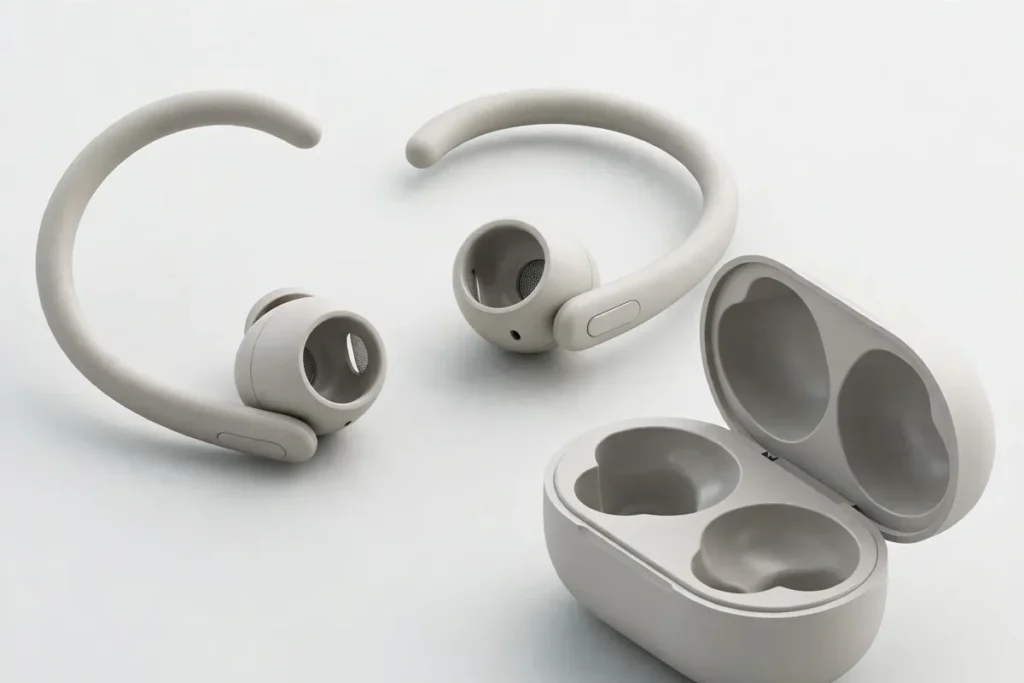
The 2nd Gen keeps the idea that made the original distinctive: each bud is a cuff that clips gently around the outer ear, with the speaker sitting outside the ear canal and firing sound inward. Nothing goes in your canal, nothing seals, and there are no tips to size, twist or lose. Bose refined the cuff’s shape and grip for this generation, and launch reviewers consistently describe a tighter, more stable fit that stays put through movement without the slow creep some first-generation owners reported.
Comfort is where this format earns its keep. With no canal pressure and no seal, the Ultra Open can be worn for a full working day by people who find in-ear buds fatiguing within the hour — glasses wearers included, since the cuff coexists with frames far better than over-ear hooks do. The IPX4 rating covers sweat and splashes for training and wet commutes. SoundMavericks scores comfort 9.0: the only honest caveat is fit variance — cuffs depend on ear shape more than tip-sized buds do, so a small minority of ears will find the grip either loose or pinch-prone, and a returns-friendly purchase is wise for a first open-ear buy.
Open-Ear Sound: Deeper Bass, Real Volume
Sound is the headline upgrade. A newly engineered driver behind Bose’s OpenAudio technology delivers what launch listening tests describe as a clear step up: deeper bass than any open bud has a right to produce, more nuance across the frequency range, and — critically for this format — substantially higher maximum volume. Open earbuds compete with the world around you, so headroom is not a spec-sheet vanity; it is the difference between hearing your podcast on a busy street and giving up on it.
Set expectations correctly and the 2nd Gen impresses. Vocals are present and bright, instruments separate cleanly, and bass is genuinely in the mix rather than implied — while never reaching the depth a sealed in-ear bud produces, because physics will not allow it. Auto Volume adapts output to your surroundings, raising the level as ambient noise climbs so you are not constantly riding the volume control. The adjustable 3-band EQ in the Bose app lets you push bass or treble to taste. Against its own category, SoundMavericks scores sound 8.8 — the open-ear class leader on launch evidence. Against sealed flagships in a quiet room, a good in-ear pair still wins on detail and low end; that is the format talking, not a flaw in this product.
Cinema Mode and Immersive Audio
Bose’s Immersive Audio spatialises stereo content, and the 2nd Gen adds a feature the original lacked: Cinema Mode, using TrueSpatial head tracking tuned for video. Dialogue stays anchored to your screen as you move your head, and film and TV soundtracks gain a sense of width that plain stereo from two ear-level speakers cannot fake. Launch impressions are mixed on how essential it is — several reviewers found the spatial modes the most skippable part of the package for music — but for commuters who watch video on phones and tablets, Cinema Mode is a legitimate reason to prefer this generation. Note the battery cost: Immersive Audio listening is rated at up to 5 hours per charge against 9 hours in standard stereo, so spatial video is best treated as a per-session choice rather than an always-on default.
Calls: SpeechClarity Does the Heavy Lifting
Open earbuds live or die on calls, because their wearers are exactly the people taking calls while walking, working and moving through the world. The 2nd Gen introduces SpeechClarity technology, which isolates vocal frequencies from background noise for the person on the other end. Launch call tests are encouraging: callers reported voices coming through clearly from busy streets, with at least one reviewer told they sounded indoors while walking a main road. Heavy wind remains the weak spot, as it is for nearly every open design, and your own incoming call volume can feel modest in very loud surroundings because nothing seals the environment out. For office, home and street calls, SoundMavericks scores call quality 8.0 — a real upgrade over the first generation, without pretending an open bud can match a sealed bud’s isolation for the listener.
Battery and Case: The Fix Owners Asked For
Battery life moves from up to 7.5 hours on the first generation to up to 9 hours here, with the case adding up to 19.5 hours for 28.5 hours total. A 10-minute quick charge returns about 2 hours of playback. Just as significant is what the case gained: wireless charging, new for this generation, so the case can drop onto the same pad as your phone instead of hunting for a cable. The original’s wired-only case was one of its most-cited annoyances at this level, and Bose has simply removed it. For multi-day trips the total figure trails the biggest sealed rivals, but for the daily rhythm of desk, commute and workout, 9 hours per session with a wirelessly chargeable case is the right side of enough.
App and Controls
Bluetooth 5.4 brings multipoint connection to two devices at once — laptop and phone without re-pairing — and Google Fast Pair makes Android setup near-instant. Codec support spans SBC and AAC for universal compatibility, plus aptX Adaptive under Snapdragon Sound for Android listeners who want lower latency and higher quality where their phone supports it. In the Bose app, the adjustable 3-band EQ, Auto Volume control, mode selection and control customisation cover the essentials without bloat. On-bud controls handle playback, volume and calls, and voice assistant access is configurable — though launch reviewers noted assistant shortcuts can be fiddly to trigger, a minor wart on an otherwise tidy control scheme.
Gen 1 vs Gen 2: Is the Upgrade Worth It?
Side by side, the second generation is a refinement in every column of the spec table above: 9 hours against 7.5, wireless charging added, Cinema Mode and SpeechClarity new, a new driver with deeper bass and higher volume, Bluetooth 5.4 with multipoint, and a more secure cuff. If you own the Bose Ultra Open Earbuds (1st Gen) and are happy with their sound and fit, the upgrade is worthwhile mainly for the battery, the wireless charging case and call clarity — meaningful, but not transformative. If you skipped the first generation because of those exact complaints, Bose has answered them, and the 2nd Gen is the one to buy. First-generation stock also remains a legitimate value alternative while it lasts, with the same core open-ear experience.
Runners and gym-first buyers should also know about the sibling Bose Sport Open Earbuds, Bose’s sport-focused open alternative with a workout-first fit — compare both in our best running headphones guide before deciding.
Who Should Buy the Bose Ultra Open Earbuds (2nd Gen)?
Buy them if you want sound all day without sealing your ears: office workers who need to hear colleagues, parents who need to hear the house, runners and cyclists who need traffic awareness, and anyone whose ear canals simply reject in-ear buds. The combination of class-leading open-ear sound, 9-hour battery, wireless charging and proper multipoint makes this the most complete open earbud available at launch.
Skip them if your listening happens on planes, loud trains or in open-plan noise you want gone — no open design can help you there, and a sealed pair from our best noise cancelling earbuds guide is the right tool. Many owners will end up in both camps, running the Ultra Open as the daily pair and an ANC pair for travel. Judged on what it sets out to do, the 2nd Gen does it better than anything else in its format.
Bose Ultra Open Earbuds (2nd Gen): FAQ
Do the Bose Ultra Open Earbuds (2nd Gen) have noise cancelling?
No. They are an open-ear design that deliberately lets sound in, giving you full situational awareness. There is no active noise cancelling and no seal. If you need to block noise — on flights or loud commutes — you need sealed ANC earbuds instead.
What is new in the Bose Ultra Open Earbuds 2nd Gen vs 1st Gen?
A newly engineered driver with deeper bass and higher volume, battery life up to 9 hours (from 7.5), a case with wireless charging, Cinema Mode with TrueSpatial head tracking for video, SpeechClarity call technology, Bluetooth 5.4 with multipoint, and a refined, more secure cuff fit.
How long does the Bose Ultra Open Earbuds (2nd Gen) battery last?
Up to 9 hours on the buds in standard stereo, or up to 5 hours with Immersive Audio on. The case adds up to 19.5 hours, for 28.5 hours total. A 10-minute quick charge gives about 2 hours of playback.
Are the Bose Ultra Open Earbuds (2nd Gen) good for running?
Yes, for awareness-first running: the cuff fit stays secure, the IPX4 rating covers sweat, and you hear traffic and surroundings fully. They will not block wind or gym noise, and Bose’s Sport Open Earbuds are the sport-tuned sibling to compare if workouts are your main use.
Do the Bose Ultra Open Earbuds (2nd Gen) support wireless charging?
Yes. Wireless case charging is new for the 2nd Gen — the first-generation case charged by USB-C only. The 2nd Gen case supports both USB-C and wireless charging.
Can the Bose Ultra Open Earbuds (2nd Gen) connect to two devices?
Yes. Bluetooth 5.4 multipoint keeps two devices connected at once, such as a laptop and a phone, and Google Fast Pair speeds up Android pairing. Codecs are SBC, AAC and aptX Adaptive with Snapdragon Sound.

I am the founder of Sound Mavericks, where I provide the polite truth about audio equipment. I started this site because consumer electronics reviews are often too technical. Instead of using a silent lab, I test headphones, earbuds, and Bluetooth speakers in the real world – like on a noisy subway or in a busy coffee shop.
To stay independent, I buy my own review units (mostly from the United States) rather than accepting free gifts from brands. Once I finish testing a product, I sell it locally to our community. My goal is to help you understand sound quality, active noise cancellation (ANC), and battery life without the marketing hype.