
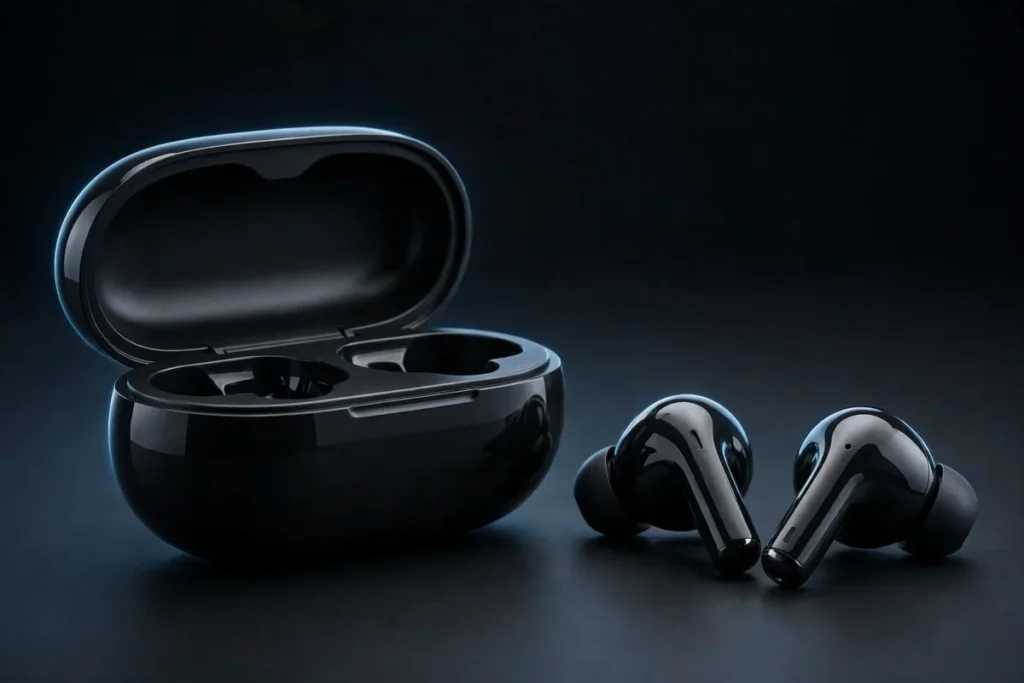
This Bose QuietComfort Ultra Earbuds review covers the second-generation model, the current flagship in Bose’s earbud range. One distinction matters before anything else: these are the Ultra earbuds, not the standard QuietComfort Earbuds. The standard model sits a tier below, costs less and has its own review on this site. The Ultra line is where Bose puts its strongest noise cancelling, its Immersive Audio spatial mode and its best call processing, and the second generation adds a case with wireless charging built in.
Our scores below are provisional, built from Bose’s published specifications, the verified Amazon US listing and independent measured results rather than hands-on testing. The short version: the QC Ultra Earbuds score 9.1 out of 10, carried by an ANC mark of 9.6, the highest earbud noise cancelling score in our database. Battery is where the flagship formula costs you.

Bose QuietComfort Ultra Earbuds (2nd Gen) 9.1/10
Why you: you want the deepest silence an earbud can produce. The adaptive cancelling leads our database, CustomTune calibrates the sound to your ear canal, and the fit system offers nine combinations of tips and stability bands to lock the buds in place.
Trade-off: battery is the weak point. Six hours per charge falls to about four with Immersive Audio on, and the value score reflects a flagship tier that sits above every direct rival.
6 h buds · 24 h with case · Bluetooth 5.3 · aptX Adaptive · IPX4 · Qi case charging
Noise cancelling first, because that is the product
Bose sells these earbuds on silence, and the 9.6 ANC score says the claim holds. Three modes divide the work. Quiet Mode runs the cancelling at full strength. Aware Mode lets the outside world in, and its ActiveSense layer reacts when a sudden loud sound arrives, pulling the cancelling up for a moment and then releasing it; the second-generation model improves how smoothly that reaction happens. Immersion Mode pairs full cancelling with Immersive Audio for music that stays put around your head as you move.
Underneath the modes sits CustomTune. Each time you put the buds in, they play a short tone and measure your ear canal’s response, then shape both the sound and the cancelling to that measurement. It is the reason the Bose seal feels less fussy than rivals that depend on a perfect tip fit to reach their numbers. In our best noise cancelling earbuds coverage the Ultra sits at the top of the Bose range for the same reason: the cancelling adapts to the ear it is given, not the ear the lab imagined.
Sound and Immersive Audio
Sound scores 9.0. The tuning is full at the bottom and controlled at the top, with the bass weight Bose buyers expect and no hard edge on vocals. CustomTune’s calibration keeps that character consistent across tip sizes, which matters more than it sounds: a shallow fit on most earbuds thins the bass, and here the software pushes back against it.
Immersive Audio is the headline feature and the honest cost. In Still mode the soundstage stays fixed in front of you; in Motion mode it holds its position in the room as your head turns. On live recordings and film it adds real space. It also cuts battery life from six hours to about four per charge, which is the single sharpest trade-off in this review and the reason the battery score lands at 7.8. Treat Immersion as a mode you switch on for an album or a film, not a setting you leave running all day.
Codec support depends on your phone. With a Snapdragon Sound device the buds run aptX Adaptive, up to aptX Lossless on compatible handsets. Everything else gets SBC or AAC, and iPhone owners are in the AAC group, where the Bose still performs at its best on cancelling and fit.
Calls
Calls score 8.6. The second-generation model adds AI-based SpeechClarity filtering, which works on background noise and wind before your voice reaches the other end. Bose claims the filtering separates speech from the kind of noise that usually defeats earbud microphones, and independent call tests place it close to the best in the class without matching the very top. Multipoint Bluetooth 5.3 keeps two devices connected, so the buds can sit on a laptop through a meeting and still catch a phone call.
Fit and comfort
Comfort scores 9.0, built on the fit system rather than the shell alone. The box carries three eartip sizes and three stability band sizes, nine combinations in total, and the bands wrap the bud body to brace it against the ear. Work through the combinations before judging anything else about these earbuds, because the seal drives the cancelling, the bass and the stability at once. Earwax guards on the nozzles are a small detail that saves a common failure mode on earbuds at this level.
The IPX4 rating covers sweat and splashing rain. It is a commute and workout rating, not a swim rating, and the case carries no water protection worth relying on.
Battery and the new case
The second generation’s clearest upgrade is the case. It now charges over USB-C and on a Qi wireless pad, with the receiver built in rather than sold as an add-on cover, a gap owners of the first-generation Ultra complained about. Bose’s own over-ear flagship gets the same flagship treatment in our QC Ultra Headphones (2nd Gen) review, and the earbuds now match it on charging.
The numbers themselves are mid-pack. Six hours per charge, roughly 24 hours in total with the case’s three full charges, and a 20-minute top-up worth about 2 hours. Rivals in our database run longer, including Bose’s own standard QC Earbuds at 8.5 hours per charge. You are trading stamina for cancelling strength and the spatial mode, and the value score of 7.5 is where that trade shows up in print. Plan around it and the weakness fades: a case charge during lunch covers an afternoon, and the wireless pad most owners already own for a phone now keeps these topped up too.
App, controls and everyday use
The Bose app carries the settings the buds cannot: the equalizer, the ANC mode selection, Immersive Audio switching between Still and Motion, and the shortcut assignments for a long press on either bud. Touch controls on the buds themselves cover playback and calls, and a swipe on the stem adjusts volume, which saves pulling your phone out for the most common change of all. The app also runs the CustomTune calibration check and firmware updates.
Day to day, the buds behave like a mature flagship. They reconnect to the last devices without fuss, multipoint holds a laptop and a phone together and swaps to whichever one rings, and the case’s new wireless charging means a pad on the desk or nightstand keeps them topped up without a cable. The one habit they ask of you is charging awareness. Six hours is a working day for most people, but back-to-back calls and music will have you reaching for the case before the day ends, and the case itself is the only thing standing between the buds and a flat battery on a long trip.
Which Bose earbud should you buy?
The two Bose lines split on priorities rather than quality. Choose the standard QuietComfort Earbuds if your commute needs cancelling that is strong enough and battery that lasts 8.5 hours per charge, because on stamina the cheaper model wins outright. Choose the Ultra if silence is the point of the purchase: the cancelling measures stronger, the fit system gives you more ways to get the seal right, Immersive Audio adds a mode the standard model does not have, and aptX Adaptive matters if your phone supports it. The Ultra is the specialist. The standard model is the all-rounder, and Bose prices them exactly that way.
Bose QuietComfort Ultra Earbuds (2nd Gen) specs
| Spec | Bose QuietComfort Ultra Earbuds (2nd Gen) |
|---|---|
| Noise cancelling | Adaptive ANC with Quiet Mode, Aware Mode with ActiveSense, and Immersion Mode; CustomTune ear-canal calibration |
| Battery, earbuds | Up to 6 hours (about 4 hours with Immersive Audio) |
| Battery, with case | About 24 hours total; case holds 3 full charges; 20-minute charge adds about 2 hours |
| Charging | USB-C and built-in Qi wireless charging (case) |
| Codecs | SBC, AAC, aptX Adaptive via Snapdragon Sound (aptX Lossless on compatible devices) |
| Bluetooth | 5.3 with multipoint (two devices at once) |
| Water resistance | IPX4 (earbuds) |
| Fit | 9 fit combinations (3 eartip sizes x 3 stability band sizes), earwax guards on nozzles |
| Calls | AI-based SpeechClarity background and wind filtering |
Verdict
Buy the QC Ultra Earbuds if noise cancelling is the first line of your list. Nothing else in our earbud database scores higher for silence, the fit system makes that silence repeatable ear after ear, and the second-generation case fixes the charging gap that held the first model back. Against Apple’s flagship in our AirPods Pro 3 review, the Bose wins on cancelling and fit options and loses on battery and ecosystem polish.
Skip it if you need long days between charges, or if the standard QC Earbuds already cancel enough for your commute, because the gap between the two Bose models is smaller than the gap between their tiers suggests. At 9.1 the Ultra earns its flagship label on the strength of one outstanding score and no weak ones except stamina.
Frequently asked questions
What is the difference between the QC Ultra Earbuds and the standard QC Earbuds?
The Ultra is Bose’s flagship earbud, a tier above the standard QuietComfort Earbuds. It adds stronger noise cancelling, Immersive Audio spatial sound, aptX Adaptive support and, on the second-generation model, a case with built-in wireless charging. The standard model is the simpler, lower-tier buy.
Does the Bose QC Ultra Earbuds case charge wirelessly?
The second-generation case does. It adds built-in Qi wireless charging alongside USB-C, which the first-generation Ultra case lacked without an add-on cover.
How long does the Bose QC Ultra Earbuds battery last?
Up to 6 hours per charge, dropping to about 4 hours with Immersive Audio running. The case holds three full charges for roughly 24 hours in total, and a 20-minute charge adds about 2 hours of playback.
Do the Bose QC Ultra Earbuds support aptX?
Yes. Through Snapdragon Sound they support aptX Adaptive, including aptX Lossless on compatible phones. Devices without Snapdragon Sound fall back to SBC or AAC.
Are the Bose QC Ultra Earbuds waterproof?
They carry an IPX4 rating, which covers sweat and splashing rain. That is workout protection, not submersion, so they are not a swimming earbud.

I am the founder of Sound Mavericks, where I provide the polite truth about audio equipment. I started this site because consumer electronics reviews are often too technical. Instead of using a silent lab, I test headphones, earbuds, and Bluetooth speakers in the real world – like on a noisy subway or in a busy coffee shop.
To stay independent, I buy my own review units (mostly from the United States) rather than accepting free gifts from brands. Once I finish testing a product, I sell it locally to our community. My goal is to help you understand sound quality, active noise cancellation (ANC), and battery life without the marketing hype.
