
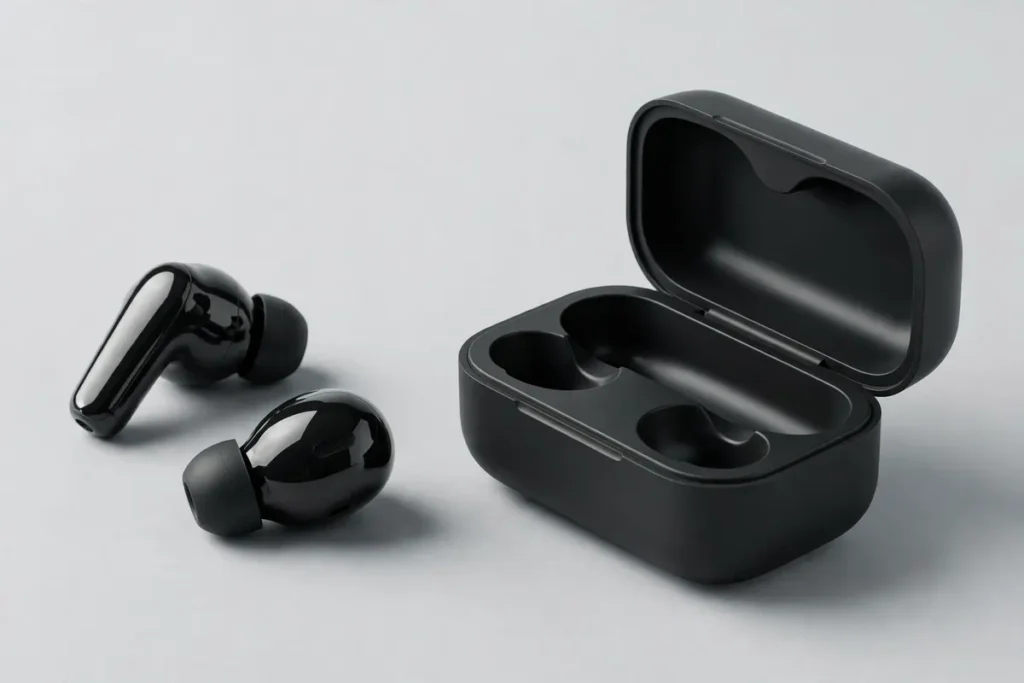
This Bose QuietComfort Earbuds review covers the current standard model in Bose’s true wireless range: the QuietComfort Earbuds with built-in voice control and the lowest price point of the three QuietComfort earbuds Bose sells. It is not the older QuietComfort Earbuds II, and it is not the flagship QuietComfort Ultra. The pitch is narrower and, for a lot of buyers, better judged: noise cancelling that still feels unmistakably Bose, the longest battery life in the range, and a shorter list of extras to pay for.
One note on method. This is a research review, and the scores below are the same scores our Headphone Finder database carries for this model. They are built from Bose’s published specifications, the verified Amazon US listing for this model, and the measurements and findings in the published review coverage, rather than from hands-on testing of our own.

Bose QuietComfort Earbuds 8.4/10
Why you: you want Bose-grade noise cancelling and the longest battery in the Bose earbud range, without paying flagship money.
Trade-off: no Immersive Audio and no aptX, the charging case is bulky, and voice control needs the Bose QCE app running in the background.
Bluetooth 5.3 · Multipoint · IPX4 · SBC / AAC · 3 mics per bud · Qi wireless charging
Which QuietComfort Earbuds are these?
Bose’s naming makes this model easy to confuse with two others, so it is worth pinning down before anything else. The standard QuietComfort Earbuds are the current entry point to the range. Their tells: model numbers in the 888507 series, a dedicated Bose QCE app instead of the main Bose app, voice control built in, and a charging case that works on a Qi wireless pad. If a listing talks about CustomTune calibration or Immersive Audio, you are looking at a different, pricier model.
The QuietComfort Earbuds II are the earlier flagship. They personalise noise cancelling and sound to your ears with CustomTune, but they run for fewer hours per charge and have no built-in voice control of their own. The QuietComfort Ultra Earbuds sit at the top of the range: the strongest cancelling Bose sells, Immersive Audio spatial sound, and aptX Adaptive support for Android phones with Snapdragon Sound. Our Bose noise cancelling earbuds roundup works through the full lineup.
| Model | Standout feature | Battery (buds / total) | Codecs | Check Price |
|---|---|---|---|---|
| Bose QuietComfort Earbuds | Built-in voice control; longest battery in the range | 8.5 hrs / 31.5 hrs | SBC, AAC | Check Price |
| Bose QuietComfort Earbuds II | CustomTune personalised ANC and sound | 6 hrs / 24 hrs | SBC, AAC | Check Price |
| Bose QuietComfort Ultra Earbuds (2nd Gen) | Immersive Audio; strongest ANC Bose sells | 6 hrs / 24 hrs | SBC, AAC, aptX Adaptive | Check Price |
Bose QuietComfort Earbuds specs
| Product | Bose QuietComfort Earbuds (888507 series) |
| Noise cancelling | Active noise cancelling; Quiet, Aware and Off modes; level adjustable in the app |
| Bluetooth | 5.3 with multipoint (two devices connected at once) |
| Codecs | SBC, AAC |
| Battery life | Up to 8.5 hours per charge; up to 31.5 hours total with the case |
| Quick charge | 20 minutes adds up to 3 hours of playback |
| Charging | USB-C; case also charges on Qi wireless pads |
| Water resistance | IPX4 (splash and sweat resistant) |
| Microphones | 3 per earbud |
| App | Bose QCE app: 5-band EQ, voice control, sidetone, touch control customisation |
| Fit kit | Multiple sizes of eartips and stability bands included |
| Colours | Black, White Smoke, Chilled Lilac, plus limited-edition colours |
Two spec-sheet details deserve a sentence each. Bose does not publish a driver size for this model, which is normal for the company and tells you little either way. And the codec list stops at SBC and AAC: there is no aptX and no LDAC, so high-resolution streaming over Bluetooth is off the menu even on phones that support it.
Sound quality
The tuning is classic Bose: a warm, full low end, clear vocals, and a top end that stays polite rather than sharp. Bass has real weight without swamping the midrange, which makes these an easy listen for long stretches and forgiving of badly mastered tracks. The five-band EQ in the Bose QCE app is the useful part. It gives you proper control over bass, mids and treble instead of a row of presets, so if the stock sound feels too thick you can pull the low end back a step and open things up.
What you do not get is the Ultra’s Immersive Audio, Bose’s spatial processing. Music stays in a conventional stereo image, presented cleanly. For podcasts, calls and ordinary streaming that is no hardship. Listeners who want spatial effects or hi-res codecs need to step up to the Ultra or shop outside the Bose range; everyone else is well served by what is here.
Noise cancelling
Cancellation is the reason this model exists, and it does not feel like a budget compromise. In Quiet mode the low drone of aircraft cabins, trains and air conditioning drops away hard, and office chatter loses its edge. You can adjust the cancelling level in the app, switch to Aware mode when you need traffic and announcements back, or turn it off entirely to save battery.
The honest gap to the Ultra is adaptability. The flagship recalibrates itself to your ears with CustomTune and adjusts as your surroundings change. The standard model holds the setting you choose. In practice the difference shows up in awkward, shifting noise rather than steady drone, and it is smaller than the price gap suggests. Against the wider field this is still among the strongest cancelling you can buy at its level, which is why the model sits in our best noise cancelling earbuds coverage as the Bose value pick.
Fit, comfort and controls
Each bud ships with multiple sizes of eartips and stability bands, and the fit kit matters: the seal decides both bass and cancelling, so the two minutes spent swapping tips is the cheapest upgrade in this review. Once sealed, the buds sit securely enough for gym work and stay comfortable through long listening sessions. The shape is less bulky than the Ultra’s, which smaller ears tend to prefer.
Controls are touch based, with taps and tap-and-hold gestures for playback, volume, calls and noise modes, and the QCE app lets you reassign the shortcuts. Owner feedback flags the usual touch-control gripe: the panels can be fussy until the gestures become habit. The case is the bigger physical compromise. It is chunky next to the slimmest rivals and you will notice it in a jeans pocket, a trade Bose made to fit the larger battery.
Voice control and the Bose QCE app
Voice control is this model’s signature extra, and it is genuinely handy. Once set up, you can speak to play and pause, skip tracks, change the volume, switch noise cancelling modes, and answer or end calls without touching the buds or your phone. A Voice ID setup step in the app calibrates the system to your voice, so it responds to you rather than to the room. Bose is upfront about the catch: the QCE app has to be open in the background for voice control to work.
The QCE app itself is a separate download from the main Bose app used by Bose’s headphones and the Ultra earbuds, which is an annoyance if you own other Bose gear. Inside it you get the five-band EQ, ANC level adjustment, touch control customisation and firmware updates, plus a sidetone control that lets you hear your own voice on calls. There is also a remote selfie shutter, a small feature that turns out to be useful more often than you would expect.
Calls
Three microphones per earbud handle calls, and indoors or at a desk your voice comes through clearly. The sidetone helps you judge your own volume, which matters in shared offices. Outdoors the performance drops to mid-pack: wind and traffic push your voice backwards in the mix, and callers may ask you to repeat yourself on a loud street. For a phone-and-laptop workday the multipoint connection is the bigger win, keeping both devices paired so a call can interrupt music without a dive into settings. We rank the stronger call performers in our noise cancelling earbuds for phone calls guide.
Battery life and charging
Battery is where the standard model beats the flagship outright. Bose rates the buds at up to 8.5 hours per charge with cancelling on, and the case holds two and a half further charges, giving up to 31.5 hours in total. A 20-minute quick charge adds up to three hours of playback, enough to rescue a forgotten overnight charge before a commute. The case charges over USB-C and on Qi wireless pads, a convenience the range used to reserve for pricier models.
Set against the Ultra’s six hours per charge, the gap is not marginal. It is the difference between earbuds that cover a long-haul flight plus the airport at both ends, and earbuds that need a case break halfway across the ocean.
Verdict: who should buy the QuietComfort Earbuds?
Buy these if you want the Bose noise cancelling experience at the friendliest price in the range, with battery life that embarrasses the flagship and voice control that earns its place. Commuters, frequent flyers and desk workers who split time between a phone and a laptop are the natural audience.
Step up to the QuietComfort Ultra instead if you want the strongest cancelling Bose can make, Immersive Audio, or aptX Adaptive. Consider the older QuietComfort Earbuds II only if you find them priced well below this model and value CustomTune over battery life and voice control. For most buyers landing on this page, the standard QuietComfort Earbuds are the sensible Bose buy: the silence is real, the stamina beats the flagship’s, and the money saved stays in your pocket.
Frequently asked questions
What is the difference between the QuietComfort Earbuds and the QuietComfort Earbuds II?
The Earbuds II are the earlier flagship: they personalise noise cancelling and sound to your ears with CustomTune, but run for up to 6 hours per charge and use the main Bose app. The standard QuietComfort Earbuds are the current value model in the range, with up to 8.5 hours per charge, built-in voice control and the separate Bose QCE app, but no CustomTune.
QuietComfort Earbuds vs Ultra: what do you give up?
You give up Immersive Audio spatial sound, aptX Adaptive support and the Ultra’s CustomTune adaptive cancelling, which is a step stronger in shifting noise. In return you get two and a half extra hours per charge, a wireless charging case, voice control, and a lower price.
How long does the battery last?
Up to 8.5 hours per charge with noise cancelling on, and up to 31.5 hours in total once the case’s extra charges are counted. A 20-minute quick charge adds up to 3 hours of playback.
Does the charging case charge wirelessly?
Yes. The case charges over USB-C and on Qi wireless charging pads, so any pad that works with your phone will top it up.
Do the QuietComfort Earbuds work with iPhone and Android?
Yes. They pair over Bluetooth 5.3 with both, and multipoint keeps a phone and a laptop connected at the same time. Both platforms get SBC and AAC audio; there is no aptX or LDAC, so Android phones cannot use their high-resolution Bluetooth modes with these earbuds.

I am the founder of Sound Mavericks, where I provide the polite truth about audio equipment. I started this site because consumer electronics reviews are often too technical. Instead of using a silent lab, I test headphones, earbuds, and Bluetooth speakers in the real world – like on a noisy subway or in a busy coffee shop.
To stay independent, I buy my own review units (mostly from the United States) rather than accepting free gifts from brands. Once I finish testing a product, I sell it locally to our community. My goal is to help you understand sound quality, active noise cancellation (ANC), and battery life without the marketing hype.
