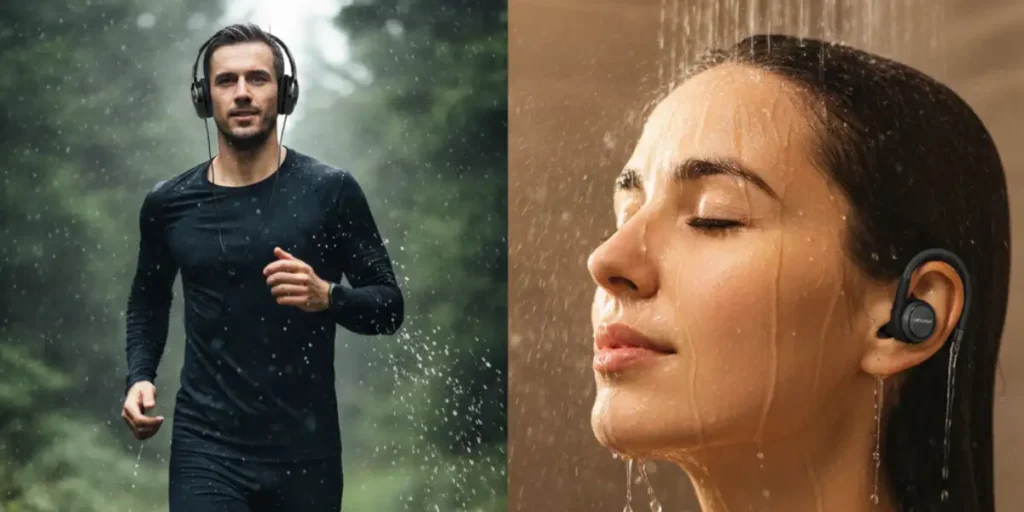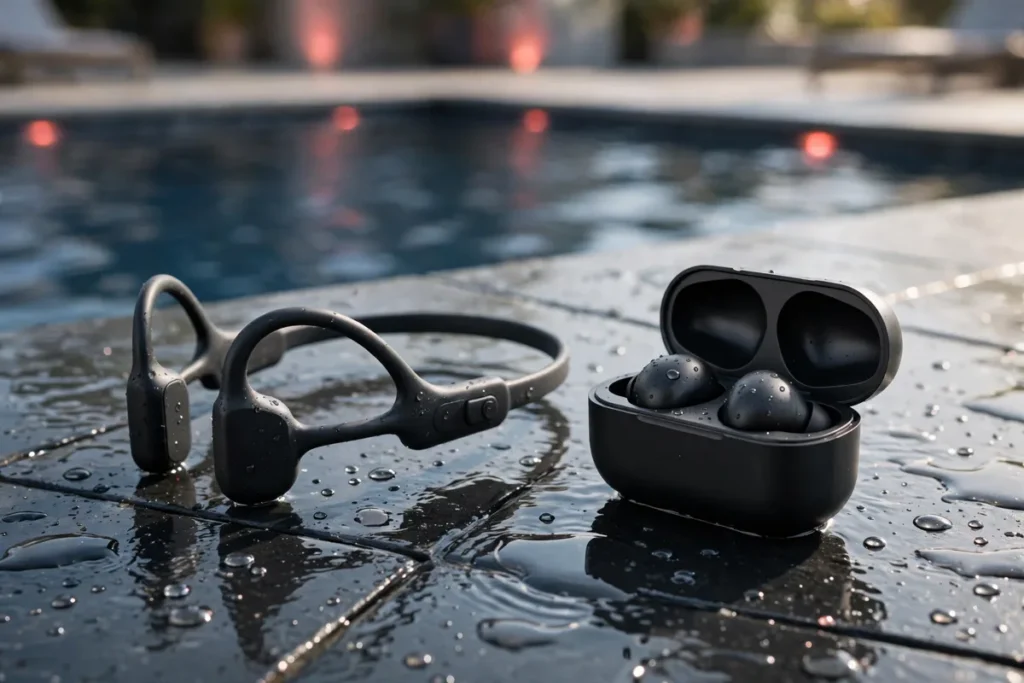
The best waterproof headphones are a much smaller group than the marketing suggests. Most headphones sold as waterproof are only water-resistant: they shrug off sweat and light rain, then fail the first time they go under. The picks below take a stricter line. Every model here carries at least an IP67 rating, and the swim picks carry onboard music storage, because that is what actually working in water requires.
Read the IP code first. The first digit after IP covers dust, and an X there means dust was never rated. The second digit covers water: IPX4 handles splashes, IPX5 handles jets, and IPX7 and IPX8 certify survival under water. A full IP68 code adds complete dust sealing. Our guide to IP ratings walks through each level. Two more facts shape this list: Bluetooth dies within inches under water, so swim headphones must store music on the device, and the case almost never shares the earbuds’ rating.
Best for swimming: Shokz OpenSwim Pro: IP68 sealing rated for two metres for two hours, plus 32GB of onboard storage so laps get music with no phone nearby. Check Price on Amazon
Best waterproof earbuds for training: JBL Endurance Race 2: a full IP68 rating on a sealed earbud with active noise cancelling and a wing that twists into place. Check Price on Amazon
Best rugged ANC earbuds: Jabra Elite 8 Active Gen 2: IP68 buds tested to a military durability standard, with the strongest noise cancelling in this roundup. Check Price on Amazon
Best for streaming swimmers: H2O Audio TRI 2 PRO: IPX8 rated to 3.6 metres, and its app captures streaming playlists onto the headset for the pool. Check Price on Amazon
Best value for swimming: Mojawa Run Plus: the same IP68 and 32GB storage spec as the Shokz swim flagship, from a smaller brand at a lower tier. Check Price on Amazon
Best for rain and road running: Shokz OpenRun: IP67 sealing on a 26g open-ear band that keeps traffic audible on wet roads. Check Price on Amazon
Best budget pick: TOZO T10: IPX8 sealing and long case stamina at a budget level, with wireless charging in the case. Check Price on Amazon
The best waterproof headphones, pick by pick
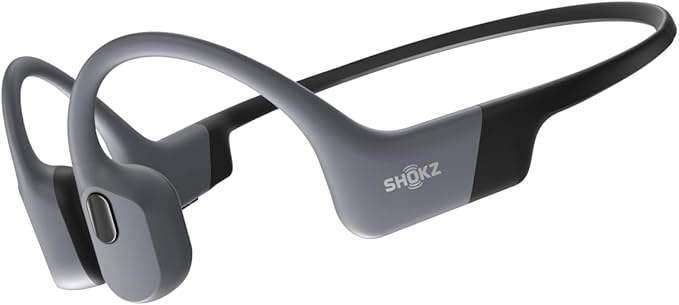
Why you: It is built for the pool first. IP68 sealing covers submersion to two metres for two hours, and 32GB of internal storage holds your music on the headset, so your phone stays in your locker.
Trade-off: Bone conduction sound stays thinner than a sealed earbud, and calls are the weak point, with wind and pool noise working against the microphones.
Swimming exposes fake waterproof claims, and the OpenSwim Pro is the headset here designed around it. In the water you switch to MP3 mode and play files stored on the device, in formats from MP3 to FLAC. On land it works as a normal sport headset, with Bluetooth 5.4 and multipoint pairing. The open-ear fit suits the pool too: nothing plugs the canal, water drains instead of getting trapped, and you can still hear a lifeguard.
It leads our dedicated best earbuds for swimming guide as well. The honest limits are sound and calls: bass arrives through your cheekbones, so it never hits like a sealed bud, and the ANC bar sits at the floor on purpose, since open ears let the world in by design.

Why you: A sealed in-ear bud with a full IP68 rating, dust included, plus active noise cancelling and JBL’s Smart Ambient mode for the walk back from the gym.
Trade-off: The rating covers the earbuds, not the case, and there is no onboard storage, so it is a rain and rinse headset, not a lap-swimming one.
Most people searching this term do not plan to swim laps. They want earbuds that survive a soaked run, a dropped bud in a puddle, and a rinse under the tap. The Endurance Race 2 is the strongest fit for that job. JBL rates the buds IP68 for submersion beyond a metre in fresh and salt water, the Twistlock wing stays in place under load, and the battery runs 12 hours per charge with 36 more in the case.
The sound is JBL’s Pure Bass tuning through 6.8mm drivers: low-end first, built for training playlists. Four microphones handle calls, and speed charging returns hours of play from a short plug-in. Treat the submersion rating as insurance rather than a swim feature, since the case is only splash-resistant and Bluetooth stops at the waterline.

Why you: IP68 earbuds that also passed military-standard durability testing, with adaptive hybrid noise cancelling and a ShakeGrip coating that holds the bud in place without a wing.
Trade-off: The case is rated IP54, a clear step below the buds, and the smart case’s wired-audio trick only pays off if your phone and gear support LE Audio.
Jabra built this model for abuse. Beyond the IP68 rating, the buds went through military-standard testing for drops, pressure and temperature, and Jabra backs dust and water failure with a two-year warranty when you register in the Sound+ app. The 2nd Gen case adds a trick the first version lacked: plug it into a USB-C or 3.5mm source, such as a treadmill screen or an in-flight system, and it streams that audio to the buds over LE Audio.
For daily training it is the most complete earbud here. The noise cancelling leads this roundup, six microphones keep calls clear, and battery runs up to eight hours with ANC on, 32 hours in total with the case. Keep the case caveat in mind: at IP54 it should live in a dry pocket while the buds take the weather.

Why you: Its Playlist+ app captures audio from streaming services and stores it on the headset, so your existing playlists reach the pool instead of only the MP3 files you own.
Trade-off: Storage is 8GB against 32GB on the Shokz and Mojawa swim picks, and the capture workflow takes setup time before your first session.
The TRI 2 PRO solves the problem that puts many swimmers off onboard storage: their music lives inside streaming apps, not in a folder of files. Playlist+ records from services such as Spotify, Pandora and Audible through the app and loads the result onto the headset for playback in the water. Its rating runs deeper than the Shokz flagship, at IPX8 submersion to 12 feet, and Bluetooth 5.3 takes over on land.
The costs are capacity and simplicity. Eight gigabytes fills fast with long podcasts, and capturing playlists is a chore you repeat as your library changes. If your music already exists as files, the OpenSwim Pro above is the cleaner route.

Why you: It matches the swim spec that matters, IP68 sealing with 32GB of onboard storage, so triathletes get pool-ready hardware without paying flagship money.
Trade-off: Fit and finish sit a step below Shokz, comfort scores lower in our card, and the smaller brand means a thinner support and accessory network.
Mojawa is the smaller name in this list, and the Run Plus earns its place on specifications. The swim hardware matches the Shokz flagship: IP68 sealing, 32GB of storage for MP3 playback in the water, and Bluetooth for dry land, with eight hours of battery.
Where the gap shows is polish. In our published best bone conduction headphones scoring, the Run Plus trails the OpenSwim Pro on sound, comfort and calls. None of that stops it working in the pool; it asks you to accept a rougher finish for the lower tier.

Why you: IP67 sealing on the lightest frame in this roundup at 26g, with open ears that keep traffic, bikes and training partners audible in bad weather.
Trade-off: It has no onboard storage, so the IP67 rating buys rain and rinse protection, not laps. Streaming stops the moment a headset like this goes under.
The OpenRun sits one tier down the water scale, and it earns its place by being honest about it. IP67 certifies immersion in a metre of water for 30 minutes, which in daily life means downpours, sweat, mud and a rinse clean under the tap hold no fear. It is also the most comfortable long-run pick here: 26 grams, no ear tips, and a frame that disappears under a cap or glasses arms.
Do not mistake it for a swim headset. With no internal storage, its music comes from your phone, and the phone connection ends at the surface. Buy it for the road in bad weather, where the open-ear design is a safety feature rather than a compromise.

Why you: A genuine IPX8 rating at a budget level, with up to 55 hours of total playtime from the case and wireless charging that budget rivals usually skip.
Trade-off: There is no active noise cancelling, the buds run slightly large for small ears, and TOZO itself steers swimmers away: the rating covers submersion, the Bluetooth link does not.
The T10 proves a real rating does not require a flagship budget. TOZO’s HydroGuard sealing carries an IPX8 certification, the 8mm drivers run the brand’s bass-forward OrigX 2.0 tuning, and the app adds a long list of EQ presets. It led the battery table in our best budget waterproof earbuds guide for the same reason: stamina plus sealing is a rare pair at this level.
Hold the line on what IPX8 promises here. Surviving a dunk or a post-workout rinse is a genuine daily benefit. Swimming with them is still a bad plan, because the music stops underwater and pool chemicals sit outside what the rating tests.
All seven picks compared
| Model | Water rating | Type | Onboard storage | Battery | Best for | Price |
|---|---|---|---|---|---|---|
| Shokz OpenSwim Pro | IP68, 2m for 2h | Bone conduction | 32GB | 9h / 6h MP3 | Swimming | Check Price |
| JBL Endurance Race 2 | IP68 | In-ear, ANC | None | 12h + 36h case | Training and rain | Check Price |
| Jabra Elite 8 Active Gen 2 | IP68 buds, IP54 case | In-ear, ANC | None | 8h ANC, 32h total | Rugged daily use | Check Price |
| H2O Audio TRI 2 PRO | IPX8 to 3.6m | Bone conduction | 8GB | 9h / 6h memory mode | Streaming swimmers | Check Price |
| Mojawa Run Plus | IP68 | Bone conduction | 32GB | 8h | Value swimming | Check Price |
| Shokz OpenRun | IP67 | Bone conduction | None | 8h | Rain running | Check Price |
| TOZO T10 | IPX8 | In-ear | None | 55h total with case | Budget | Check Price |
How to choose waterproof headphones
Match the rating to the water, not the adjective. Sweat and light rain need IPX4 or IPX5. Hard rain, rinsing and accidental drops in water need IPX7 as a floor. Swimming needs IPX8 or IP68 from a maker that states a depth and a time, plus onboard storage. Any product page that says waterproof in large type and hides the rating in small type is telling you something.
Separate the buds from the case. On earbuds, the headline rating belongs to the buds. Cases range from a light splash rating to none at all, and a soaked case can kill a healthy pair of buds at the charging contacts. Dry both parts before you close the lid, every time.
Plan for chemicals, not just water. IP tests use clean fresh water. Chlorine, salt and soap attack seals and coatings faster, and none of them is covered by the test conditions. Rinse swim and sea gear in fresh water after a session, and let it dry fully before charging.
Pick the delivery system for your sport. In the pool, bone conduction with onboard storage is the working format. On land, a sealed in-ear bud with a wing or hook gives better sound and real noise cancelling, and the rating becomes insurance for weather and workouts.
Frequently asked questions
Are any headphones truly waterproof?
A small number, yes. Headphones rated IPX8 or IP68 by the manufacturer, with a stated depth and time, are built and tested for submersion. Most products sold under the word waterproof carry IPX4 or IPX5 ratings, which cover splashes and jets only. The rating, not the label, decides which group a product belongs to.
What IP rating do I need for swimming?
IPX8 or IP68, from a maker that states the depth and duration, and onboard storage for your music. Bluetooth signals are absorbed by water within inches, so a streaming headset goes quiet on the first submersion no matter how strong its sealing is. The Shokz OpenSwim Pro, H2O Audio TRI 2 PRO and Mojawa Run Plus in this list are built to that full spec.
Can I shower with waterproof headphones?
With an IPX7, IPX8 or IP68 model, a shower is within the water exposure the rating covers, but soap, shampoo and hot water stress seals in ways the clean-water IP test does not. The safer habit is to treat shower use as occasional, rinse in clean water afterwards, and let the headphones dry before they go back in a case or on a charger. For picks chosen specifically for that job, see our guide to waterproof headphones for shower and running.
Does the charging case have the same waterproof rating?
Almost never. The Jabra Elite 8 Active Gen 2 pairs IP68 buds with an IP54 case, and the JBL Endurance Race 2 case is only splash-resistant. Read the case rating separately, keep the case dry, and never charge damp earbuds: moisture on the contacts is a common cause of charging faults.
Will salt water or pool chlorine damage waterproof headphones?
Over time, yes, if you let them sit on the seals. IP ratings are tested in clean fresh water. Rinse swim and beach headphones under a tap after use, shake out the water, and dry them fully. Models built for swimming, such as the OpenSwim Pro, are designed with that routine in mind.
Why do waterproof earbuds sound worse in the water?
Most swim models use bone conduction, which trades bass weight and detail for an open ear that drains and stays aware. Sealed in-ear buds keep their sound on land but lose their Bluetooth link under water. That trade is physical, not a flaw in a given product, and it is why this list splits its picks by sport instead of crowning one winner for everything.

I am the founder of Sound Mavericks, where I provide the polite truth about audio equipment. I started this site because consumer electronics reviews are often too technical. Instead of using a silent lab, I test headphones, earbuds, and Bluetooth speakers in the real world – like on a noisy subway or in a busy coffee shop.
To stay independent, I buy my own review units (mostly from the United States) rather than accepting free gifts from brands. Once I finish testing a product, I sell it locally to our community. My goal is to help you understand sound quality, active noise cancellation (ANC), and battery life without the marketing hype.