
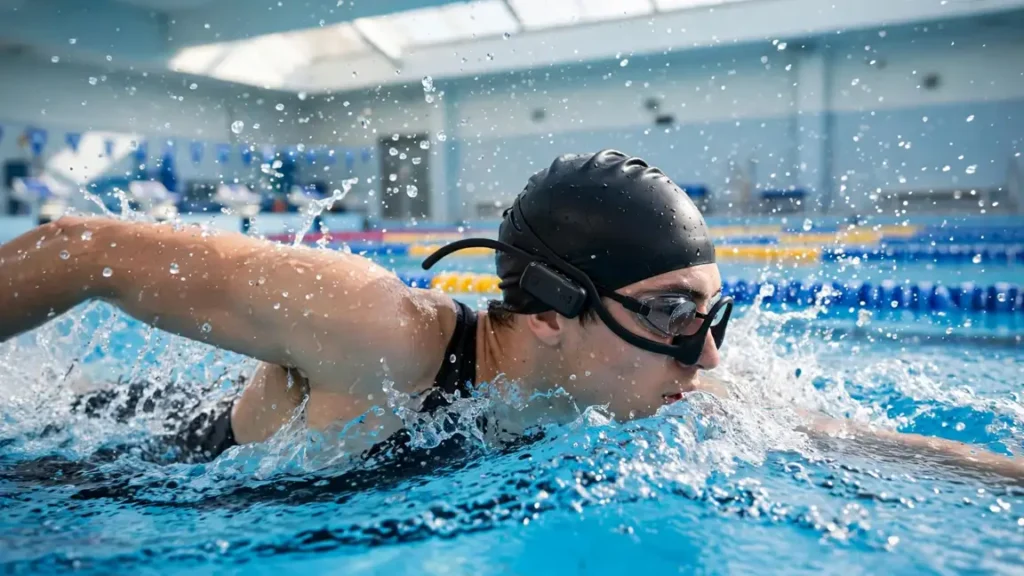
Here is the uncomfortable truth about the best swimming earbuds: your regular earbuds cannot do this job, no matter how good they are. Bluetooth runs on 2.4GHz radio waves, and water absorbs that signal almost instantly, so the connection dies the moment your head goes under. Splash-proof ratings do not save you either. Real swim audio needs two things working together — a fully submersible IPX8 or IP68 rating, and music stored on the headphones themselves. Every pick below has both: a submersible rating plus music stored on the headphones themselves.
Our verdict — the best earbuds for swimming laps:
Best overall: Shokz OpenSwim Pro — IP68 bone conduction with 32GB of onboard storage and Bluetooth 5.4 for dry land. The most complete swim-and-train package we found.
Best for streaming playlists: H2O Audio TRI 2 PRO — IPX8 bone conduction whose Playlist+ app captures streaming audio for offline playback in the water.
Best for open water and triathlon: Nank Runner Diver2 Pro — IP69 sealing, 32GB of storage and adjustable ear hooks that stay put under a cap.
Best sealed in-ear fit: Sony NW-WS623 Walkman — a self-contained MP3 Walkman rated for salt water, with a proper earbud seal and Ambient Sound Mode.
Best goggle-mounted design: H2O Audio Sonar Pro — bone conduction that clips to your goggle strap, IPX8 rated with 8GB of onboard storage.
Best budget pick: Tayogo Waterproof MP3 Headset — a simple IPX8 in-ear MP3 player with 8GB of storage and no Bluetooth complications at all.
Why Bluetooth doesn’t work underwater
This is the question that decides everything else in this guide, so it is worth answering properly. Bluetooth is a radio signal, and radio waves at Bluetooth frequencies are absorbed by water within inches. H2O Audio’s own spec sheet puts underwater Bluetooth range at roughly four inches. In practice, a phone sitting on the pool deck loses contact with your headphones on the very first submersion, and the audio stutters or drops every time your head dips below the surface during a stroke cycle.
That is why every credible swimming headphone works the same way: it carries the music on board. You load MP3 files — or, in H2O Audio’s case, captured streaming playlists — onto internal storage before you swim, then switch the headset into MP3 mode at the pool. Bluetooth still earns its place for the walk to the pool, dry-land training and calls, but underwater it is dead weight. Any product marketed for swimming that relies on a live Bluetooth connection alone is not a swimming product, whatever the listing claims. If the distinction between splash resistance and true submersion ratings is new to you, our guide to understanding IP ratings breaks down exactly what each code does and does not promise.
Best swimming earbuds compared
The six picks below split into two camps: open-ear bone conduction headsets, which sit on your cheekbones and leave your ear canals open, and sealed in-ear players, which block the canal with a watertight tip. Bone conduction generally sounds clearer underwater than most people expect, especially with swimming earplugs in, while sealed in-ear designs isolate more and can sound fuller. Here is how the shortlist compares on the specs that matter for laps.
| Product | Type | Water rating | Storage | Battery life | Buy |
|---|---|---|---|---|---|
| Shokz OpenSwim Pro | Bone conduction, open-ear | IP68 — 2 m for 2 hours | 32GB | Up to 9 hrs Bluetooth, 6 hrs MP3 | Check Price |
| H2O Audio TRI 2 PRO | Bone conduction, open-ear | IPX8 — up to 12 ft (3.6 m) | 8GB | Up to 9 hrs Bluetooth, 6 hrs memory mode | Check Price |
| Nank Runner Diver2 Pro | Bone conduction, open-ear | IP69 — rated to 10 m | 32GB | Up to 10 hrs total | Check Price |
| Sony NW-WS623 Walkman | Sealed in-ear Walkman | IPX5/8 — 2 m for 30 min, salt water safe | 4GB | Up to 12 hrs | Check Price |
| H2O Audio Sonar Pro | Bone conduction, goggle-mounted | IPX8 — up to 12 ft (3.6 m) | 8GB | Up to 7 hrs | Check Price |
| Tayogo Waterproof MP3 Headset | In-ear MP3 player | IPX8 — up to 3 m | 8GB | 6–8 hrs | Check Price |
1. Shokz OpenSwim Pro — best overall swimming earbuds

The OpenSwim Pro is the pick we would hand to most lap swimmers, because it solves the whole problem in one device. It is a bone conduction headset built on Shokz’s PremiumPitch 2.0+ transducers, rated IP68 for submersion up to 2 metres for 2 hours, with 32GB of internal storage — enough for roughly 8,000 songs in MP3, FLAC, WAV, AAC and other common formats. In the water you switch to MP3 mode and swim phone-free; on land, Bluetooth 5.4 with multipoint pairing takes over for streaming and calls.
Two details lift it above the original OpenSwim in our analysis. First, storage jumps from 4GB to 32GB, so audiobook and podcast listeners are no longer rationing space. Second, the dedicated Swimming EQ profile in MP3 mode is tuned for underwater listening, and the included swimming earplugs sharpen clarity further by keeping water out of the canal — a trick that works with any bone conduction headset, as we explain in how bone conduction works. Battery life is rated at up to 9 hours in Bluetooth mode and 6 hours in MP3 mode, and a 10-minute quick charge returns about 3 hours of playback. At 27.3 grams on a flexible nickel-titanium band, it sits comfortably under a swim cap, and physical buttons remain easy to find mid-set when touch controls would be useless.
2. H2O Audio TRI 2 PRO — best for streaming playlists

The TRI 2 PRO attacks the biggest friction in swim audio: getting streaming music onto a device that cannot stream. H2O Audio’s Playlist+ system uses the companion app to capture audio from services like Spotify, Pandora and Audible and store it on the headset for offline playback, so your existing playlists make the trip underwater instead of only the MP3 files you happen to own. For swimmers whose libraries live entirely inside streaming apps, that feature alone justifies shortlisting this headset.
The hardware backs it up. The TRI 2 PRO is an open-ear bone conduction design rated IPX8 for submersion up to 12 feet (3.6 metres) — a deeper rating than the OpenSwim Pro’s 2 metres — with Bluetooth 5.3 for running and cycling, 8GB of onboard memory, and battery life quoted at up to 9 hours in Bluetooth mode and around 6 hours in memory mode. As a multisport design it is built to move from pool to bike to run without swapping devices. In our assessment it is the strongest choice for triathletes who live in streaming apps and refuse to maintain a separate MP3 library.
3. Nank Runner Diver2 Pro — best for open water and triathletes

Nank — the brand previously sold as Naenka — builds the Runner Diver2 Pro around the highest waterproof rating in this roundup. Its IP69 construction combines a nano waterproof coating with ultrasonic sealing, and Nank rates the headset for depths up to 10 metres, well beyond anything lap swimming demands. That headroom matters more in open water, where a headset takes repeated dunkings, chop and the occasional knock rather than a calm pool lane.
Storage matches the OpenSwim Pro at 32GB, Bluetooth is version 5.4, and total playtime is rated up to 10 hours, with around 5 hours of continuous underwater playback in MP3 mode and a fast charge that returns roughly 2 hours from 10 minutes plugged in. The distinctive feature is the 35-degree adjustable ear hook, which lets you angle the transducers for a firmer, more sealed fit — Nank markets the firmer position as a noise-reduction mode for loud pool decks and windy rides. For open-water swimmers and swimrun athletes who found earlier bone conduction bands loose under a cap, that adjustability is the reason to pick this one.
4. Sony NW-WS623 Walkman — best sealed in-ear fit

Not everyone gets on with bone conduction. If you prefer a conventional sealed earbud — and the fuller, more isolated sound that comes with it — the Sony NW-WS623 remains the reference design. It is a complete Walkman MP3 player built into a wrap-around in-ear headset: 4GB of internal storage for MP3, WMA, AAC and Linear PCM files, with Bluetooth and NFC streaming on dry land. Fit the supplied swimming earbuds and it is rated IPX5/8, submersible to 2 metres for 30 minutes, and — unusually — rated for salt water as well as pool water, with IP6X dust-proofing for beach and trail use.
Battery life is the best in this guide at up to 12 hours, and a 3-minute quick charge adds about an hour. Ambient Sound Mode pipes in surrounding noise through the built-in microphones, handy for hearing a coach’s feedback or a training partner between sets without removing the buds. It is an older design than the bone conduction picks here, and 4GB is modest next to 32GB rivals, but for swimmers who want a proper seal and Sony’s mature Walkman controls, our analysis keeps coming back to it.
5. H2O Audio Sonar Pro — best goggle-mounted design

The Sonar Pro takes a different approach to fit: instead of a band wrapping around your head, the compact bone conduction unit clips directly onto your goggle strap. That eliminates ear hooks entirely, which removes the pressure points some swimmers feel when a band, a cap and goggle straps all compete for the same space. If you have ever finished a long set with sore ears from stacked straps, this design exists for you.
Specs are properly swim-grade: IPX8 waterproofing to 12 feet (3.6 metres), 8GB of built-in MP3 storage, Bluetooth streaming on land, the same Playlist+ app support as the TRI 2 PRO for capturing streaming playlists, and up to 7 hours of battery life. The trade-off is scope — clipped to goggles, it is a swim-only tool rather than a run-and-cycle companion, and it obviously requires goggles to work at all. Judged purely as a lap-swimming device, though, it is one of the least obtrusive ways to put music in the water, and in our view the smartest pick for swimmers who always train with goggles and a cap.
6. Tayogo Waterproof MP3 Headset — best budget pick
The Tayogo headset is the straightforward, low-cost route into swim audio, and its simplicity is the appeal. This is a wired-style in-ear MP3 player on a short neckband: 8GB of memory holding around 2,000 songs, an IPX8 rating good for submersion up to 3 metres, 6 to 8 hours of playback, an FM radio, and a shuffle mode for listeners happy to let the library surprise them. There is no Bluetooth on this model at all — which, underwater, costs you nothing, because Bluetooth would not work there anyway.
Expect compromises appropriate to a budget design that has been on the market for years: file management is basic drag-and-drop, controls are minimal, and there is no app, no streaming capture and no dry-land wireless mode. What you get is a light 32-gram headset that clips to a goggle strap or cap, survives flip turns, and plays your MP3 collection without fuss. As a first pair of swimming earbuds — or a spare set for your swim bag — it covers the essentials honestly.
How to choose the best swimming earbuds
Start with the waterproof rating — IPX8 or IP68 only
For laps, nothing below full submersion will do. IPX7 covers a static dip to 1 metre for 30 minutes, which sounds close to swimming but is tested in still water without the pressure spikes of strokes and flip turns; it is a rating for accidents, not for training. Look for IPX8, where the manufacturer states the depth and duration, or IP68, which adds dust-tightness to a submersion rating. Then read the fine print anyway: the OpenSwim Pro’s IP68 means 2 metres for 2 hours in fresh water, H2O Audio rates its IPX8 models to 12 feet, and Sony’s salt-water rating only applies with its swimming earbuds fitted. Chlorinated and salt water are also harder on seals than fresh water, so rinse every pair in clean water after a session and let the charging contacts dry fully before plugging in. For gear that only needs to survive showers and rainy runs rather than submersion, see our guide to the best waterproof headphones for shower and running.
Bone conduction vs in-ear: which is better for swimming?
Bone conduction keeps your ear canals open, so you stay aware of lane traffic, whistles and nearby swimmers, and there is no seal to break mid-stroke — which is why four of our six picks use it. The trade-off is bass: open-ear designs leak low end, though pairing them with swimming earplugs underwater noticeably improves fullness and clarity. Sealed in-ear players like the Sony Walkman and the Tayogo isolate more and sound more like ordinary earbuds, but the watertight tip fit is everything; a poor seal means water in the canal and muffled audio. If you also plan to run or cycle in the same headset, bone conduction’s awareness advantage carries over — the same logic we apply in our best running headphones picks.
Storage, battery and fit under a cap
Storage decides how much of your library reaches the pool: 4GB holds roughly 1,000 MP3s, which is fine for a few training playlists, while 32GB models swallow whole libraries, podcasts and audiobooks. Check swim-mode battery life specifically, not the headline Bluetooth figure — MP3 playback figures range from about 5 to 12 hours across this list, all comfortably beyond a single session. Finally, fit: put the headset on the way you will actually swim, with goggles and a cap over it. Bands should sit flat without lifting your goggle strap, and physical buttons beat touch panels every time with wet hands.
Can I listen to Spotify while swimming?
Not by streaming it live — your phone cannot reach your headphones underwater, and streaming apps do not download to most swim headsets directly. There are two workable routes. The first is Playlist+ on the H2O Audio TRI 2 PRO and Sonar Pro, which captures audio from streaming apps through the companion app and stores it on the headset for offline playback. The second is the traditional route: load audio files you own onto any onboard-storage model in this guide by USB before you swim. Either way, the playlist has to live on the headphones before your head goes under — plug in, sync and charge as part of your routine, and the session itself stays completely phone-free.
Frequently asked questions
Can you wear AirPods or regular earbuds for swimming?
No. AirPods and most regular earbuds carry IPX4 splash resistance at best, which protects against sweat and rain but not submersion. Swimming with them risks permanent water damage. For laps you need headphones rated IPX8 or IP68 with music stored on the device itself.
Do Bluetooth headphones work underwater?
No. Bluetooth uses 2.4GHz radio waves, which water absorbs within inches, so the connection drops as soon as your head submerges. That is why swimming headphones play music from onboard MP3 storage while you swim and reserve Bluetooth for dry land.
Can I listen to Spotify while swimming?
Not as a live stream, because Bluetooth cannot reach your headphones underwater. H2O Audio’s Playlist+ system captures streaming audio into the headset for offline playback, and other swim models play MP3 files you load by USB before swimming.
What IP rating do I need for swimming?
You need IPX8 or IP68 as a minimum. IPX8 means the manufacturer has tested continuous submersion beyond 1 metre and states the depth and duration, while IPX7 only covers a brief static dip. Always check the stated depth, and rinse the headphones in fresh water after swimming in chlorinated or salt water.
Are bone conduction headphones better for swimming than in-ear earbuds?
For most lap swimmers, yes. Bone conduction models leave your ears open, stay secure under a cap, and avoid broken seals, though they have less bass. Sealed in-ear players like the Sony Walkman sound fuller and isolate more, but depend on a perfect watertight tip fit.
How do I look after swimming headphones?
Rinse them in fresh water after every swim to remove chlorine or salt, shake off excess water, and let them dry completely before charging — wet charging contacts corrode quickly. Store them in their case rather than loose in a damp swim bag.

I am the founder of Sound Mavericks, where I provide the polite truth about audio equipment. I started this site because consumer electronics reviews are often too technical. Instead of using a silent lab, I test headphones, earbuds, and Bluetooth speakers in the real world – like on a noisy subway or in a busy coffee shop.
To stay independent, I buy my own review units (mostly from the United States) rather than accepting free gifts from brands. Once I finish testing a product, I sell it locally to our community. My goal is to help you understand sound quality, active noise cancellation (ANC), and battery life without the marketing hype.

