
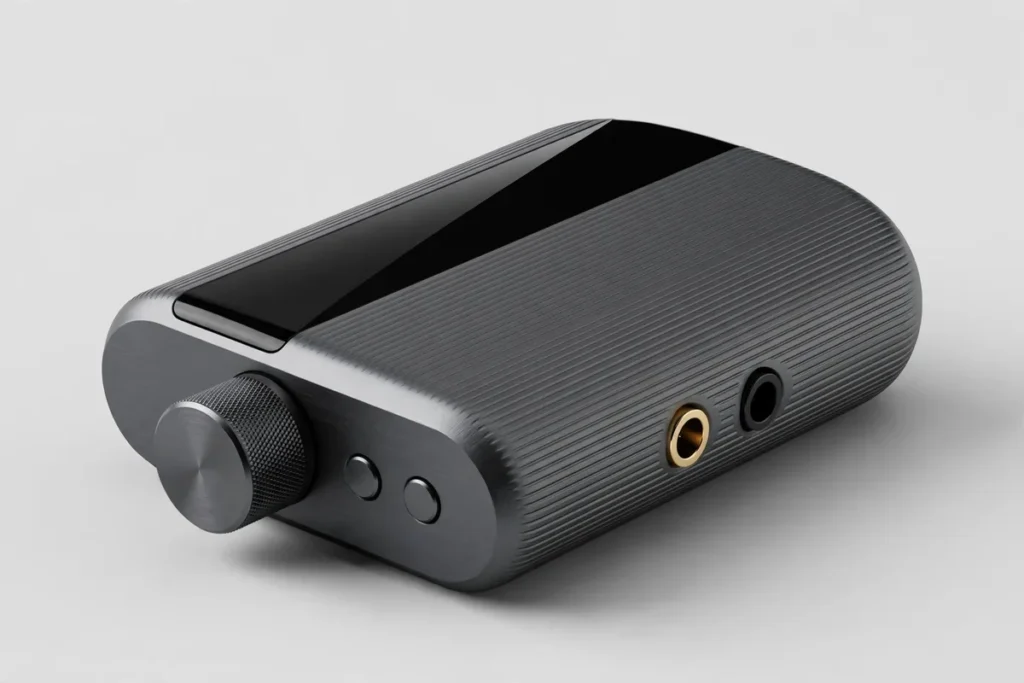
This iFi xDSD Gryphon review covers the most connection-hungry portable DAC and headphone amplifier iFi has made: a battery-powered unit that accepts Bluetooth 5.1, USB-C, S/PDIF and analogue line-in, drives headphones from balanced and single-ended sockets with more than 1,000mW on tap, and shows its working on an OLED screen, inside a 215 g aluminium flask.
The review is built from iFi’s published specifications and user manual, and the model’s review record, not from our own bench or listening time. The scores are provisional and research-based. One status point shapes everything below: iFi has discontinued the Gryphon in favour of the GR 2 generation, so the units on sale now are remaining retailer and marketplace stock.

iFi xDSD Gryphon 8.6/10 provisional
Why you: you move between a phone, a laptop and a desk rig, and want one portable box that accepts every source you own and drives almost any headphone you plug into it.
Trade-off: it is discontinued, so warranty cover depends on the seller; the battery charges slowly; and at 215 g it is a flask you carry in a bag rather than forget in a pocket.
Burr-Brown DAC · PCM 768kHz, DSD512, MQA decoder · Bluetooth 5.1 with LDAC and aptX Adaptive · 1,000mW balanced output
Buying note: iFi has discontinued the Gryphon. The Amazon US listing is genuine, but stock is marketplace and remaining retailer inventory, so check the seller and the warranty before you buy.
One flask, three jobs
The Gryphon is what happened when iFi merged its two portable lines into a single unit. The older xDSD was the DAC, the xCAN was the amplifier; the Gryphon is both, plus a Bluetooth receiver, in one ribbed aluminium shell. Inside, the three stages stay separate: a Qualcomm QCC5100 Bluetooth engine, a Burr-Brown DAC stage behind a 16-core XMOS processor, and a dual-mono PureWave amplifier. Each does one job, which is the design argument for the size: a small system, not a dongle with ambitions.
The OLED strip across the top reports the input, format and sample rate, volume, battery state and which sound-shaping circuits are live. Volume is a knurled analogue knob rather than a digital control, so channel balance holds at the low levels where sensitive IEMs live.
If a single dongle covers your listening, the Gryphon is more box than you need. If you run a phone on the train, a laptop at a desk and a streamer at home, it is one of very few portables that plugs into all three. Most picks in our best Bluetooth DAC/amps guide are smaller and simpler; the Gryphon is the step up.
Inputs: the longest list in the class
The back panel is where the Gryphon pulls away from the field. The USB-C data input is the full-fat route: PCM up to 768kHz and 32-bit, DSD up to DSD512, DXD and full MQA decoding. Next to it sits a second USB-C socket that does nothing but charge, so the battery refills while it plays. The 3.5mm S/PDIF socket takes coaxial and optical (mini-Toslink) feeds and tops out at 192kHz PCM; the catch is the non-standard connector, so keep the right lead with the unit.
The QCC5100 Bluetooth receiver speaks aptX, aptX HD, aptX Adaptive and aptX Low Latency, Sony’s LDAC, LHDC/HWA, AAC and SBC: the complete codec shelf, with LDAC and LHDC carrying up to 96kHz.
The fourth route is the one rivals skip: balanced 4.4mm and single-ended 3.5mm analogue inputs let the Gryphon work as a pure headphone amplifier, fed by a DAP or another DAC. Both headphone sockets also double as variable line outputs for powered speakers or a power amp. The iEMatch and XBass II mode switches live back here too.
Power: 1,000mW, honestly framed
The PureWave amplifier is dual-mono and fully balanced from the DAC stage out: the 4.4mm output is rated above 1,000mW into 32 ohms, 74mW into 600 ohms, with a 6.7V maximum swing. The 3.5mm S-Balanced output delivers above 320mW into 32 ohms and 3.5V maximum, Signal-to-noise is quoted under 116dB(A) balanced and 115dB(A) single-ended, with THD+N under 0.005%.
In practice it covers the realistic portable range, from current-hungry planars that leave dongles sounding thin to 300-ohm dynamics that need voltage. It drives full-size planars and high-impedance Sennheisers with headroom to spare on ordinary recordings. The honest limit is the extreme end: the least sensitive flagship planars still belong on a desktop amplifier, where the Gryphon can hand over through its line outputs. At the sensitive end, iEMatch on the 3.5mm output drops the noise floor for efficient IEMs; a few owners report a switch-on pop with very sensitive models, and iEMatch plus a low starting volume is the standard guard.
Sound: the Burr-Brown house character
The Gryphon’s presentation is warm-neutral: a smooth top end that takes the edge off bright headphones, a firm grip on bass, and detail that sits a small step behind the most incisive rivals. Head-Fi’s owner thread puts it in the same league as the Chord Mojo 2 with a softer treble. Nobody credible calls it sterile, and nobody calls it the last word in resolution. Our 9.1 sound mark reflects exactly that consensus.
Two analogue circuits shape the result without touching the digital signal. XBass II works in three modes set by the back-panel switch (Bass, Presence, or both) and adds low-end weight or upper-mid presence in the analogue domain, identically on every input. XSpace, the analogue soundstage circuit, pushes the image out of the centre of your head and flatters closed-back headphones. Both switch out entirely. Tone control that costs no bits and needs no app is a large part of why the features mark runs so high.
Battery and the portable reality
The 3,600mAh lithium-polymer battery is rated for around eight hours of typical use, less at high volume into demanding loads over balanced. That figure is mid-pack, and charging is the weak point: on the BC1.2 standard at up to 1.9A, a full charge takes roughly six hours from a high-power charger and around twelve from a standard one. A separate charging port softens the blow: it can play and charge at once.
At 123mm long and 215 g, the Gryphon is flask-sized: fine in a jacket pocket or a bag, noticeable in a trouser pocket. The ribbed case shrugs off desk knocks, but the portability mark of 7.8 is the price of the input list and the battery that feeds it.
iFi xDSD Gryphon vs Chord Mojo 2: the comparison that decides it
The Mojo 2 is the benchmark portable in our best DACs guide and the Gryphon’s natural rival: similar brief, opposite priorities. The Mojo 2 puts everything into conversion, with Chord’s FPGA and a lossless UHD DSP for tone control and crossfeed. The Gryphon spreads its budget across conversion, amplification and connections.
| iFi xDSD Gryphon | Chord Mojo 2 | |
|---|---|---|
| Type | Portable DAC and headphone amplifier with battery and Bluetooth | Portable DAC and headphone amplifier with battery |
| Conversion | Burr-Brown Bit-Perfect DAC, XMOS 16-core processor | Chord custom FPGA with UHD DSP (tone control, crossfeed) |
| Inputs | USB-C, Bluetooth 5.1, S/PDIF coaxial/optical, analogue line-in (4.4mm and 3.5mm) | USB-C, micro-USB, optical, coaxial. No Bluetooth, no analogue input |
| Headphone outputs | 4.4mm balanced and 3.5mm S-Balanced, both doubling as line outputs | 2x 3.5mm |
| Max format | 768kHz / 32-bit PCM, DSD512, MQA full decoder | 768kHz / 32-bit PCM, DSD256 |
| Output power | Above 1,000mW @ 32 ohm balanced; above 320mW @ 32 ohm single-ended | 600mW @ 30 ohm; 90mW @ 300 ohm |
| Battery | 3,600mAh, around 8 hours; slow charging (about 6 to 12 hours) | Up to 8 hours, desktop mode |
| Weight | 215 g | 185 g |
| Our published overall | 8.6 (this review) |  9.4 in our best DACs guide |
The Mojo 2’s higher overall is about focus: as a pure converter with DSP it is the finer instrument, and its Sound Quality mark in the guide is 9.6. The Gryphon wins the working day. It takes Bluetooth from a phone, a line feed from a turntable rig, drives a hungry planar and feeds desktop speakers; the Mojo does none of that. Choose the Mojo 2 for one source and the best conversion; choose the Gryphon when the source list is the problem.
Discontinued: buy the Gryphon, or step up to the GR 2?
iFi has replaced the Gryphon with its iDSD GR 2 generation, which adds a touchscreen, aptX Lossless Bluetooth and more output power; our iFi iDSD GR2 MT review covers the successor hardware in depth.
The case for it: the hardware is fully formed, the input list still has no portable equal, and remaining stock tends to soften in price once a successor lands. The case against: firmware support now belongs to the current line, the battery is a wear part, and your warranty is whatever the marketplace seller or remaining retailer offers. If you buy one, buy it from a seller whose warranty you can read. If you would rather own the supported product, the GR 2 generation is the same idea carried forward.
iFi xDSD Gryphon specifications
| Product | iFi xDSD Gryphon Check Price |
| Type | Portable DAC/headphone amplifier with battery and Bluetooth |
| DAC | Burr-Brown Bit-Perfect DSD & DXD DAC, XMOS 16-core processor |
| Formats (USB) | PCM up to 768kHz / 32-bit, DSD512, DXD up to 768kHz, MQA full decoder |
| Formats (S/PDIF) | PCM up to 192kHz |
| Formats (Bluetooth) | Up to 96kHz |
| Inputs | USB-C (data), Bluetooth 5.1, S/PDIF 3.5mm (coaxial and optical), analogue line-in (4.4mm, 3.5mm) |
| Bluetooth codecs | aptX, aptX HD, aptX Adaptive, aptX LL, LDAC, LHDC/HWA, AAC, SBC (Qualcomm QCC5100) |
| Headphone outputs | 4.4mm balanced, 3.5mm S-Balanced single-ended; both double as variable line outputs |
| Output power | Balanced: above 1,000mW @ 32 ohm, above 74mW @ 600 ohm, 6.7V max. Single-ended: above 320mW @ 32 ohm, above 40mW @ 300 ohm, 3.5V max |
| SNR | Balanced under 116dB(A), single-ended under 115dB(A) at 0dBFS |
| THD+N | Under 0.005% |
| Sound shaping | XBass II (Bass, Presence, Bass + Presence), XSpace, iEMatch on the 3.5mm output |
| Display | OLED |
| Battery | 3,600mAh lithium-polymer, around 8 hours typical. Separate USB-C charge port (BC1.2, up to 1.9A); about 6 to 12 hours to charge |
| Dimensions | 123 x 75 x 19 mm |
| Weight | 215 g |
A note on the scores
The five marks follow the categories we use for portable DACs in our best DACs guide, and the overall is their mean: Sound Quality 9.1, Features and Flexibility 9.4, Build Quality 9.0, Portability 7.8 and Value 7.9, giving 8.6 out of 10. The pattern matches the product: the feature list is the widest in portable audio, and the lower marks land on slow charging, flask dimensions and a discontinued model’s value story. These are research-based scores, not our own listening or bench tests.
FAQ
Is the iFi xDSD Gryphon discontinued?
Yes. iFi has replaced it with the iDSD GR 2 generation. Retailers and marketplace sellers still hold stock, so it remains buyable, but your warranty is the seller’s, not a current production line’s. Check the terms before ordering.
Can the Gryphon drive demanding planar headphones?
Most of them, yes. The balanced output delivers above 1,000mW into 32 ohms and 6.7V maximum, which covers current-hungry planars and 300-ohm dynamic headphones with headroom. The least sensitive flagship planars still suit a desktop amplifier better, and the Gryphon can feed one through its line outputs.
Can the Gryphon work as a standalone headphone amplifier?
Yes. The 4.4mm balanced and 3.5mm single-ended inputs on the back panel bypass the DAC, so it can amplify a DAP, a phono stage or another DAC. Both headphone sockets also work as variable line outputs.
Which Bluetooth codecs does the Gryphon support?
All of the major ones: aptX, aptX HD, aptX Adaptive, aptX Low Latency, LDAC, LHDC/HWA, AAC and SBC, over Bluetooth 5.1. Android phones can send LDAC or aptX Adaptive at up to 96kHz; iPhones send AAC, which the Gryphon handles natively.
iFi xDSD Gryphon or Chord Mojo 2?
The Mojo 2 is the better pure converter and carries our higher published overall, 9.4, with lossless DSP tone control. The Gryphon is the better system box: Bluetooth, analogue line-in, balanced output power above 1,000mW and line outputs for a desk rig. One source and maximum sound quality points to the Mojo 2; several sources point to the Gryphon.
How long does the Gryphon’s battery last, and how slow is charging?
Around eight hours of typical listening from the 3,600mAh cell, less into demanding loads. Charging is slow: about six hours on a high-power charger and twelve on a standard one. A separate USB-C charging port means it can keep playing while it charges.
Verdict
The Gryphon remains the portable DAC/amp that says yes: yes to Bluetooth, yes to a turntable feed, yes to a hungry planar, yes to your powered speakers. Its conversion is a half-step behind the class benchmark and its replacement is already on sale, but nothing else portable packs this much into one flask. Bought from a seller with a real warranty while stock lasts, it earns 8.6 out of 10, with Features and Flexibility at 9.4 carrying the case.

I am the founder of Sound Mavericks, where I provide the polite truth about audio equipment. I started this site because consumer electronics reviews are often too technical. Instead of using a silent lab, I test headphones, earbuds, and Bluetooth speakers in the real world – like on a noisy subway or in a busy coffee shop.
To stay independent, I buy my own review units (mostly from the United States) rather than accepting free gifts from brands. Once I finish testing a product, I sell it locally to our community. My goal is to help you understand sound quality, active noise cancellation (ANC), and battery life without the marketing hype.

