In a first-person shooter, your ears are a second crosshair. The player who hears a footstep half a second earlier — and places it correctly, left or right, above or below, near or far — wins fights that aim alone never decides. That is true in a Warzone end-circle, on a tense Tarkov raid where one scuffed boot can cost your whole kit, and in CS2, where a single step on catwalk gives away an entire execute.
The best headphones for FPS games are not the loudest or the bassiest. In SoundMavericks’ analysis, the headsets that actually help you climb share three things: precise stereo imaging, so direction is never a guess; a tuning that keeps footsteps, reloads and ability sounds clear instead of buried under explosions; and a microphone your teammates can understand the first time, because ranked comms are not optional. This guide covers all three jobs — the best headphones for competitive FPS, the best headsets for hearing footsteps, and the wired-versus-wireless trade-offs in between — with seven picks matched to how you play.
Our verdict — the short version
For pure footstep clarity, the open-back Drop + Sennheiser PC38X is the headset we would buy first. For wireless ranked play, the Razer BlackShark V2 Pro (2023) pairs pro-tuned FPS profiles with the clearest mic in this roundup. On a tighter budget, the wired HyperX Cloud III gets the fundamentals right for far less.
Quick comparison: the 7 best FPS headsets at a glance
| Headset | Best for | Connection | Driver | Check |
|---|---|---|---|---|
| Drop + Sennheiser PC38X | Hearing footsteps | Wired 3.5mm, open-back | 42mm dynamic | Check Price |
| Razer BlackShark V2 Pro (2023) | Competitive FPS, wireless | 2.4GHz + Bluetooth | 50mm TriForce Titanium | Check Price |
| HyperX Cloud III | Best value wired | Wired USB-C / USB-A / 3.5mm | 53mm angled | Check Price |
| SteelSeries Arctis Nova Pro Wireless | Premium pick, EQ control | 2.4GHz + Bluetooth + base station | 40mm Hi-Fi | Check Price |
| Logitech G Pro X 2 Lightspeed | Esports wireless | LIGHTSPEED + Bluetooth + 3.5mm | 50mm graphene PRO-G | Check Price |
| Beyerdynamic MMX 300 (2nd Gen) | Premium wired, closed-back | Wired 3.5mm | Dynamic, 32 ohm | Check Price |
| Turtle Beach Stealth Pro | Noisy rooms, ANC | 2.4GHz + Bluetooth | 50mm Nanoclear | Check Price |
What actually matters for FPS audio (and what is marketing)
Imaging beats everything. Imaging is how precisely a headset places a sound in space. A wide soundstage helps sounds feel spread out rather than inside your skull, but it is imaging — the accuracy of each placement — that tells you whether a step came from the doorway or the window beside it. Every pick here images cleanly in plain stereo; that is the baseline we selected for.
Tuning beats bass. Footsteps, reloads, pin pulls and defuse sounds live mostly in the mids and upper mids. Headsets tuned with a big bass shelf bury those cues under gunfire and explosions, which is why several famous “gaming” models with thunderous low end did not make this list. Controlled bass and clear mids are the competitive tuning.
Open-back vs closed-back is a room decision. Open-back designs like the PC38X below stage sound more naturally and are the classic footstep pick — but they leak sound in and out, so they only shine in a quiet room. Closed-back headsets isolate you from fans, housemates and LAN-hall noise. Our guide to open-back vs closed-back headphones breaks the trade-off down in full.
Virtual surround is optional, not essential. Warzone, Tarkov and CS2 all ship with their own binaural or HRTF audio designed for stereo headphones. Clean stereo imaging plus the game’s own audio engine does the positional work; a headset’s virtual-surround layer can help some players and smear detail for others. Treat it as a preference toggle, not a buying reason — this list is ranked on stereo performance first.
1. Drop + Sennheiser PC38X — best headset for hearing footsteps

If your one job is hearing footsteps first, this is our top recommendation. The PC38X is an open-back wired headset built on Sennheiser’s driver know-how, with angled drivers that present a wide, natural stage and the kind of precise imaging Tarkov and CS2 reward: vertical and distance cues read more clearly here than on any closed-back rival in this roundup. Its tuning is restrained in the bass and clear through the mids, so a crouch-walk or a reload stays audible under gunfire instead of disappearing into it.
The flip-to-mute boom mic is a genuine broadcast-style capsule — full-bodied rather than thin — and the velour pads keep it comfortable and cool across long sessions. The honest costs of open-back: it leaks sound both ways, offers no isolation in a noisy room, and there is no wireless option. In a quiet setup, though, nothing here tracks footsteps better. PC, PlayStation, Xbox, Switch and mobile all connect over 3.5mm.
2. Razer BlackShark V2 Pro (2023) — best wireless headset for competitive FPS

Make sure you are looking at the 2023 revision — it is a different, better headset than the 2020 original that shares its name. Razer rebuilt it around 50mm TriForce Titanium drivers, added pro-tuned FPS EQ profiles developed with competitive players, and fitted a detachable HyperClear Super Wideband microphone that captures a wider slice of your voice than most headset mics. In our assessment it is the clearest-sounding mic on this page, which matters when a callout has to land once, mid-fight.
HyperSpeed 2.4GHz wireless keeps latency low enough that we would not steer ranked players away from it, Bluetooth covers your phone, and battery life is rated up to 70 hours. At around 320g with breathable memory-foam cushions, it disappears during long sessions. The trade-offs: it is wireless-only with no 3.5mm fallback, and its leaner bass tuning — a plus for footsteps — will feel light if you also want cinematic rumble.
3. HyperX Cloud III — best value wired FPS headset
The Cloud III is the plug-in-and-forget pick, and the easiest recommendation here for most players. Its angled 53mm drivers deliver clean, well-separated imaging with a tuning that keeps the low end in check, so footsteps stay legible in Warzone’s cluttered audio mix without any software fiddling. The aluminium frame is properly durable, the memory-foam cushions hold up over marathon sessions, and the detachable 10mm boom mic is clear enough for ranked comms and casual streaming alike.
Connectivity is the flexibility story: USB-C, USB-A and 3.5mm in the box covers PC, PS5, Xbox Series X|S, Switch and mobile from one headset. You give up wireless freedom and open-back staging, and DTS Spatial Audio is there if you like it — though, as above, we would judge this headset on its stereo imaging, which needs no help. If you want one wired headset that simply does the FPS job well, this is it.
4. SteelSeries Arctis Nova Pro Wireless — best premium pick for EQ control

The Nova Pro Wireless is the tweaker’s headset. Its GameDAC Gen 2 base station and SteelSeries Sonar software give you parametric EQ precise enough to lift the exact frequency band where footsteps sit in your game of choice while pulling explosions down — per-game profiles included. Underneath the software, the hi-fi drivers image sharply, active noise cancellation handles a loud room, and the retractable ClearCast Gen 2 mic disappears into the earcup when you do not need it.
The Infinity Power System deserves its reputation: two hot-swappable batteries, one always charging in the base station, mean the headset effectively never dies mid-session. Simultaneous 2.4GHz and Bluetooth rounds out a genuinely flagship package. It is the most expensive pick here and the base station ties you to a desk setup — and note the PC/PlayStation and Xbox versions are separate SKUs, so buy the right one.
5. Logitech G Pro X 2 Lightspeed — best esports alternative

Logitech’s esports flagship earns its place on driver technology: the 50mm PRO-G drivers use graphene diaphragms, which are stiffer and lighter than conventional materials, and the audible result is low distortion and crisp separation of layered sounds — footsteps stay distinct even when a fight gets loud. Imaging in CS2 and Valorant-style play is exactly what you would hope for at this level.
LIGHTSPEED wireless is the low-latency connection to use in ranked play, with Bluetooth and a 3.5mm cable as fallbacks, and battery life is rated up to 95 hours — the longest here. The detachable 6mm boom mic with Blue VO!CE processing is serviceable rather than class-leading; if mic quality is your top priority, the BlackShark above edges it. Choose this one for the cleanest wireless audio and tournament-bred build, in black, white or magenta.
6. Beyerdynamic MMX 300 (2nd Gen) — best premium wired, closed-back

The MMX 300 is what happens when a studio-headphone maker builds a gaming headset: a closed-back design based on Beyerdynamic’s long-running driver platform, made in Germany, with a high-quality condenser boom microphone that sounds closer to a broadcast mic than a gaming accessory. At 32 ohms it runs happily from a controller or PC jack — no amp required.
For FPS play, the closed-back isolation is the point: in a shared flat, a dorm or a LAN environment, it shuts the room out in a way the open-back PC38X cannot, while still imaging precisely enough for serious Tarkov and Siege-style listening. The velour pads and solid build suit long sessions. There is no wireless, no software EQ and no surround processing — just excellent wired audio and an excellent mic. Players who want one premium headset for both shooters and music will get the most from it.
7. Turtle Beach Stealth Pro — best FPS headset for noisy rooms
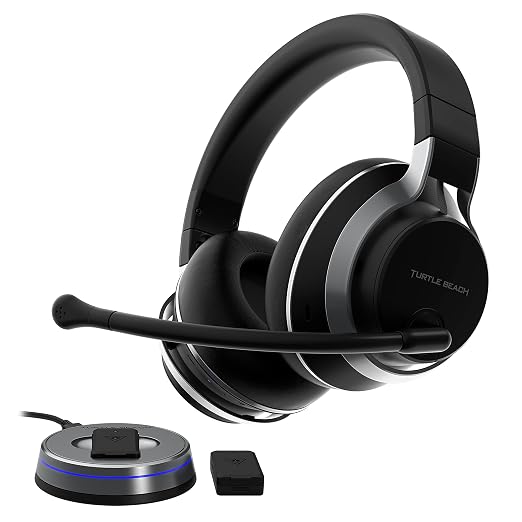
If your gaming room is not quiet — shared house, loud PC fans, a TV in the background — the Stealth Pro solves a problem the other picks do not: adjustable active noise cancellation, rated up to 25dB, that you can dial to the room. Its hand-matched 50mm Nanoclear drivers are detailed, and Turtle Beach’s Superhuman Hearing mode deliberately exaggerates footsteps and reloads; used in moderation it genuinely helps in Warzone, though pushed too far it flattens everything else, so treat it as a dial, not a switch.
Two swappable battery packs (around 12 hours each) charge in the transmitter base, so downtime is seconds. The removable TruSpeak boom mic adds noise-cancelling smarts, with hidden mics as backup, and the 10-band EQ in the Audio Hub app gives real tuning control. Buy the PlayStation or Xbox version that matches your platform — the listing linked here is the PlayStation/PC version.
Best headset settings by game: Warzone, Tarkov and CS2
Warzone. The mix is dense — vehicles, killstreaks, ricochets — so clarity beats volume. Use the game’s Home Theater or Headphones audio mix, keep any headset bass boost off, and favour picks with restrained low end like the Cloud III or PC38X. If you run the Stealth Pro, a light touch of Superhuman Hearing helps footsteps cut through the final circles.
Escape from Tarkov. Tarkov’s audio is unforgiving and heavily directional, with verticality that punishes muddy imaging. Stereo with no virtual-surround layer is the community-tested setup, an open-back headset in a quiet room is the ideal, and in-game headset choice matters as much as your real one. We go deeper in our guide to the best headset for Tarkov. The PC38X and MMX 300 are our two Tarkov picks here — open and closed versions of the same idea.
CS2. Enable the game’s own HRTF and leave it at that: CS2’s binaural mix is designed for plain stereo headphones, and stacking a headset’s virtual surround on top usually makes placement worse, not better. Crisp imaging and a mic your team hears cleanly — BlackShark V2 Pro or G Pro X 2 — matter more than any processing.
Wired vs wireless for FPS: the honest latency answer
Wired is still the zero-compromise connection: no latency worth measuring, no battery, no interference, nothing to charge before a ranked session — which is why three of our seven picks are wired. But modern 2.4GHz gaming wireless (Razer’s HyperSpeed, Logitech’s LIGHTSPEED, SteelSeries’ base-station link) has closed the gap to the point where the remaining delay sits below what decides gunfights for all but the most extreme cases; the pros who use wireless on stage are not handicapping themselves.
What you should avoid for competitive play is Bluetooth as your game connection — standard Bluetooth audio latency is noticeably higher and can smear the timing of fast cues; on these headsets, Bluetooth is for your phone, not your match. Our full breakdown of wired vs wireless gaming headsets covers the trade-offs if you are still deciding.
Frequently asked questions
What is the best headset for hearing footsteps?
For most players, the Drop + Sennheiser PC38X. Its open-back design, angled drivers and restrained tuning place footsteps with the clearest direction and distance information of any headset here — provided your room is quiet. In a noisy room, the closed-back Beyerdynamic MMX 300 or the noise-cancelling Turtle Beach Stealth Pro will serve you better in practice.
What is the best headset for competitive FPS?
The Razer BlackShark V2 Pro (2023) is our competitive pick: low-latency 2.4GHz wireless, pro-tuned FPS EQ profiles, a lightweight frame for long sessions and the clearest microphone in this roundup for ranked callouts. The Logitech G Pro X 2 Lightspeed is the closest alternative if you prefer its cleaner audio and longer battery life.
Are open-back or closed-back headphones better for FPS games?
Open-back headphones generally stage sound wider and more naturally, which helps footstep placement — the PC38X is the example here. Closed-back headphones isolate you from room noise and stop sound leaking to the people around you. Neither is automatically better: match the design to your room first, then to the game.
Do I need surround sound to hear footsteps in Warzone or CS2?
No. Warzone and CS2 both include binaural/HRTF audio built for stereo headphones, and precise stereo imaging does the positional work. A virtual-surround mode can change how spacious a game feels, but it does not add directional information the game did not already provide — and stacking it over the game’s own HRTF often blurs placement.
Is wireless latency a problem for ranked FPS play?
Not with a proper 2.4GHz gaming connection such as HyperSpeed or LIGHTSPEED — the delay is small enough that it does not decide fights at any realistic level of play. Standard Bluetooth is the exception: keep it for music and calls, and use the 2.4GHz dongle or a cable for matches.
Can EQ settings really help me hear footsteps better?
Yes, within limits. Footsteps sit mainly in the mid and upper-mid frequencies, so gently lifting that region while trimming boomy bass makes steps easier to pick out — headsets with real EQ control, like the Arctis Nova Pro Wireless with Sonar or the Stealth Pro’s 10-band EQ, make this easy. EQ sharpens what a headset already resolves; it cannot fix poor imaging.
The bottom line
The best headphones for FPS games are the ones that tell you the truth about where a sound came from — and let your team hear you clearly when you call it. Buy the PC38X for footsteps in a quiet room, the BlackShark V2 Pro (2023) for wireless ranked play, the Cloud III if you want the job done for less, and match the rest of the list to your room, your platform and whether you would rather tune EQ or never think about it again.

I am the founder of Sound Mavericks, where I provide the polite truth about audio equipment. I started this site because consumer electronics reviews are often too technical. Instead of using a silent lab, I test headphones, earbuds, and Bluetooth speakers in the real world – like on a noisy subway or in a busy coffee shop.
To stay independent, I buy my own review units (mostly from the United States) rather than accepting free gifts from brands. Once I finish testing a product, I sell it locally to our community. My goal is to help you understand sound quality, active noise cancellation (ANC), and battery life without the marketing hype.