
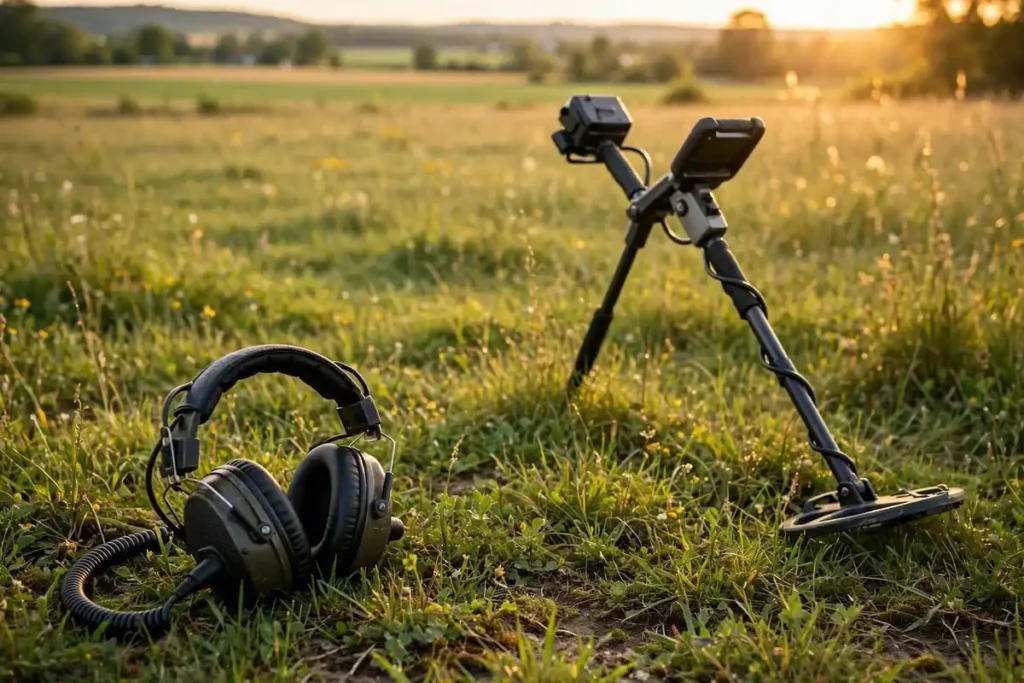
The best headphones for metal detecting are not the best-sounding headphones you own. They are the ones that connect to your detector, arrive with no delay, and make a faint, deep target audible over wind, traffic and surf. That is why this guide starts with compatibility, not sound quality. A standard Bluetooth headphone can be useless on a detector needing a proprietary transmitter, a waterproof Minelab plug will not fit a Garrett AT-series machine, and a perfect Fisher headphone may not work at all on a newer Minelab with a sealed 3.5mm socket.
Our SoundMavericks shortlist covers Garrett, Fisher and Minelab honestly: proprietary wireless where it is genuinely low-latency, wired 1/4-inch headphones where zero latency wins, a submersible option for surf work, and one universal studio headphone. Check your socket and wireless system first — every pick below names its connector and its limits.
🏆 Our Top Picks at a Glance
Best wired overall: DetectorPro Gray Ghost Original Platinum — 1/4-inch plug, up to 24 dB of ambient blocking, limiter circuit and a detector-compatibility switch.
Best wireless for Garrett: Garrett MS-3 Z-Lynk Wireless Headphones Kit — 17ms Z-Lynk audio, and the kit includes the WT-1 transmitter for detectors without built-in Z-Lynk.
Best wireless for Minelab: Minelab ML 105 — low-latency wireless made for the Manticore, Equinox 700/900, X-Terra Elite and X-Terra Pro only.
Compatibility First: Connectors, Wireless Systems and Impedance
Start with the socket. Many full-size detectors — most Garrett ACE machines, Fisher F-series, Bounty Hunter models other than Junior, and older Minelab machines such as the GPX 4500/4800/5000, E-Trac and X-Terra 305/505/705 — use a standard 1/4-inch (6.35mm) jack. Any wired pick here with a 1/4-inch plug connects directly. Our 1/4-inch headphone jack explainer covers why that plug survives field use.
Newer waterproof Minelab machines changed the rules. The Equinox series, Manticore, X-Terra Pro and X-Terra Elite use a sealed 3.5mm (1/8-inch) fitting for waterproof headphones. A normal 3.5mm plug may carry audio on land with an adapter, but it does not form the waterproof seal — and Garrett’s AT series is different again, using a proprietary 2-pin AT connector. Never assume a similar-looking plug is waterproof-compatible.
Wireless is brand-locked, and this is where most mistakes happen. Garrett’s Z-Lynk is not Bluetooth: an MS-3 will not pair with a Minelab or with a detector lacking Z-Lynk or the WT-1 transmitter. Minelab’s wireless headphones use low-latency audio tuned for Minelab detectors and do not pair with Z-Lynk machines. Standard consumer Bluetooth is worst of all: roughly 100–200ms of delay means the tone arrives after the coil has passed the target, wrecking pinpointing. See our guide to Bluetooth codecs explained for the background.
Impedance matters too. Detector outputs are modest, and detecting headphones are voiced for target tones, not music bass. Garrett’s MS-3 and MS-2 speakers are 8 ohms, the classic Minelab Koss UR-30 is 100 ohms, and DetectorPro publishes 150 ohms nominal for Gray Ghost-family models. A mismatch rarely stops audio, but it can leave a headphone quieter or duller on a given machine. You do not need an amplifier — see our headphone impedance guide — you need a model your detector can drive, ideally with its own volume control.
Best Headphones for Metal Detecting: Quick Comparison
| Headphone | Connection | Best for | Check Price |
|---|---|---|---|
| DetectorPro Gray Ghost Original Platinum | Wired 1/4-inch | Serious wired hunting, any 1/4-inch detector | Check Price |
| Garrett MS-3 Z-Lynk Wireless Kit | Z-Lynk wireless + WT-1 transmitter | Garrett users going cord-free | Check Price |
| Minelab ML 105 | Minelab low-latency wireless + wired AUX | Manticore, Equinox 700/900, X-Terra Pro/Elite | Check Price |
| Minelab Waterproof Headphones (Equinox) | Wired sealed 3.5mm Equinox connector | Surf and underwater Minelab hunting | Check Price |
| Bounty Hunter HEAD-PL | Wired 1/4-inch stereo | Fisher / Bounty Hunter value pick | Check Price |
| Garrett ClearSound Easy Stow | Wired 1/4-inch (also sold in 1/8-inch version) | Budget Garrett and ACE owners | Check Price |
| Sony MDR-7506 | Wired 3.5mm + 1/4-inch Unimatch plug | Universal studio-headphone route | Check Price |
1. DetectorPro Gray Ghost Original Platinum — Best Wired Headphones for Metal Detecting

If you hunt wired, this is the headphone the detecting community reaches for first, and our analysis agrees. The Gray Ghost Original Platinum is a dedicated detecting headphone, not a relabelled music model. Its muff design blocks up to 24 dB of ambient noise, letting a faint, deep signal stay audible beside a road, in wind or in surf noise. A built-in limiter stops a loud shallow target blasting your ears at the volume the whisper before it needed, and the rotary volume control has click positioning that stays set.
The detail that earns the top wired spot is the compatibility selector switch, designed for single-output detectors without adapters. With the 1/4-inch 90-degree plug and heavy-duty coiled cord, it moves between Garrett, Fisher, legacy Minelab and other 1/4-inch machines more gracefully than brand-locked rivals. DetectorPro tunes the Gray Ghost family around the detector-audio band — 200–3,200 Hz on its Deep Woods specification — rather than hi-fi extension. That focus is deliberate: target tones live in the midrange.
Trade-offs: it is wired, so the cord can snag; it is not submersible; and the Platinum speakers are a clarity refinement, so owners of a working Original gain only incrementally. For a first serious wired purchase, though, nothing else here combines this noise blocking, limiter, volume control and cross-brand fit.
- Connector: 1/4-inch 90-degree stereo plug, coiled cord
- Noise blocking: Up to 24 dB ambient reduction (manufacturer rating)
- Controls: Single rotary volume control, limiter circuit, compatibility switch
- Build: Heavy-duty polymer muffs, full-ear cushions, padded adjustable headband, foldable
2. Garrett MS-3 Z-Lynk Wireless Headphones Kit — Best Wireless for Garrett

The MS-3 solves the real wireless problem in detecting: delay. Garrett rates Z-Lynk audio delay at 17 milliseconds — six times faster than Bluetooth, in Garrett’s own comparison — which is fast enough that the tone still lines up with the coil position as you swing. That is the difference between pinpointing in one pass and re-sweeping because the audio felt detached from the ground.
Read the listing carefully: two products share the MS-3 name. The headphones alone (PN 1627710) have a built-in Z-Lynk receiver and pair directly with Z-Lynk detectors such as the AT Max and ACE Apex. The Kit linked here (PN 1627720) adds the WT-1 transmitter, a 2-pin AT cable, a 1/4-inch-jack cable and a mounting band — letting the same headphones work with any detector that has only a 1/4-inch jack. If your detector already has Z-Lynk, skip the transmitter; if it does not, the headphones alone connect to nothing. That distinction is the whole purchase.
Garrett specifies an 8-ohm speaker, 30–18,000 Hz response, earcup volume control, folding design and up to 30 hours per charge over USB. The rating is IP52 — light rain only, never submerge. For Garrett owners who kneel and dig dozens of times per hunt, cutting the cord is a genuine upgrade. For Minelab owners it is simply the wrong system: see the ML 105 below.
- Wireless: Z-Lynk, 2.4 GHz frequency hopping — not Bluetooth
- Delay: 17ms (manufacturer rating)
- Speaker: 8 ohms, 30–18,000 Hz
- Rating: IP52, light rain only — not waterproof
- Kit adds: WT-1 transmitter and cables for AT 2-pin and 1/4-inch detectors
3. Minelab ML 105 — Best Wireless for Minelab Manticore and Equinox

The ML 105 (part 3011-0445) is Minelab’s premium wireless headphone for its newest detectors — and only those: Manticore, Equinox 700/900, X-Terra Elite and X-Terra Pro. It is not the right pick for an Equinox 600/800, a Vanquish, or any Garrett or Fisher machine, and no transmitter changes that. That narrow list is how low-latency detector wireless works.
Within that list, the package is well judged: low-latency wireless for normal swing-speed pinpointing, an included AUX cable for wired use when the battery runs down, and USB-C charging. Minelab positions the ML 105 above the smaller ML 85, with a full over-ear fit that seals better against wind and surf noise — the conditions where faint tones vanish through a speaker.
Confirm your exact model first, because “Equinox” alone is not enough — the 700/900 generation is in; the 600/800 uses the earlier ML 80-era ecosystem and WM 08 module route. On the list, this is the cleanest cord-free option here. Off it, the wired Minelab waterproof set below will serve you better than a forced wireless mismatch.
- Compatibility: Manticore, Equinox 700/900, X-Terra Elite, X-Terra Pro only
- Connection: Low-latency wireless, plus included AUX cable for wired use
- Charging: USB-C cable included
- Part number: Minelab 3011-0445
4. Minelab Waterproof Headphones — Best for Surf and Underwater

Wireless does not transmit usefully underwater, so surf headphones are wired — and sealed as a system, connector included. Minelab’s waterproof headphones (part 3011-0372) use the sealed Equinox 3.5mm connector and are listed for the Manticore, Equinox series, X-Terra Elite and X-Terra Pro. Dealer specifications describe sealed speakers, drain holes to balance pressure, no metal parts to corrode, a heavy-duty coiled cord and submersibility to 200 feet. On land they can also connect via Minelab’s WM 08 wireless module.
Do not substitute a lookalike: a standard 3.5mm headphone on an adapter may produce sound, but it does not form this seal. Nor do these fit Garrett AT machines, which use Garrett’s own 2-pin waterproof system. Read our IP ratings explainer before trusting any “waterproof” claim — rainproof, splashproof and submersible are different promises.
On dry land they work, but the sealed design is less ventilated on a hot all-day hunt. Buy them because you hunt in water, not as a general-purpose pair.
- Connector: Sealed 3.5mm Equinox connector — Minelab machines listed above only
- Water rating: Waterproof and submersible (dealer specification: to 200 feet)
- Design: Sealed over-ear cups, drain holes, corrosion-free construction, coiled cord
- Power: None — wired, no battery, zero latency
5. Bounty Hunter HEAD-PL — Best Value for Fisher and Bounty Hunter

Fisher and Bounty Hunter share a parent — First Texas — and most of their detectors use a plain 1/4-inch stereo jack with nothing proprietary. The HEAD-PL is the factory headphone for that world: its listing states compatibility with Bounty Hunter detectors excluding Junior models, a 1/4-inch plug and padded cups. That standard jack also plugs directly into Fisher F-series machines and any other 1/4-inch detector — the compatibility is electrical, not brand magic.
You get padded cups, clear tones, and the usual benefit of shutting off the detector’s speaker, which extends battery life. You do not get the Gray Ghost’s 24 dB isolation, limiter or heavy-duty build — in a noisy park or on a windy beach the HEAD-PL leaks more ambient sound, and faint signals suffer first.
So the HEAD-PL suits a Fisher or Bounty Hunter owner, a beginner, or anyone wanting a correct-plug spare without premium money. If detecting becomes a weekly habit in noisy ground, upgrade to the Gray Ghost and keep this as the spare. Note the manufacturer’s exclusion: Bounty Hunter Junior models are not compatible.
- Connector: 1/4-inch stereo plug
- Compatibility: Bounty Hunter detectors except Junior; any 1/4-inch-jack detector, including Fisher F-series
- Design: Padded ear cups, adjustable headband
- Manufacturer: First Texas (Bounty Hunter / Fisher)
6. Garrett ClearSound Easy Stow — Best Budget Garrett Headphone
Not every Garrett owner needs Z-Lynk. The ClearSound Easy Stow (PN 1612700 in 1/4-inch form) is Garrett’s portable, affordable wired headphone: it folds flat, has padded ear pieces, in-line volume control, and a 41-inch coiled cord extending to 82 inches, per Garrett. A second version with a 1/8-inch plug serves newer compact machines — order the plug that matches your detector.
Garrett rates it land-only and non-submersible, without the MS-3’s IP52 rain rating — a fair-weather, light-duty headphone. Isolation and build sit a step below the Gray Ghost and MS family. For an ACE owner starting out, a car backup or a partner’s pair, though, it delivers the correct plug, a reachable volume control and a pack-flat shape that earns the “Easy Stow” name.
Skip it for surf, heavy rain or very noisy sites. Buy it as the simple, correct, inexpensive wired answer for land detecting.
- Connector: 1/4-inch phone plug (PN 1612700); separate 1/8-inch version also sold — match your jack
- Cord: 41-inch coiled, extends to 82 inches
- Controls: In-line volume control
- Use: Land only, non-submersible; folds flat
7. Sony MDR-7506 — Best Universal Studio Headphone Route

There is a legitimate non-specialist route, and the MDR-7506 is its strongest example. Sony’s studio headphone ships with a Unimatch plug covering 3.5mm and 1/4-inch, a coiled cord of about 9.8 feet, a 40mm driver, 10 Hz–20 kHz response and 63-ohm impedance, in a folding closed-back design. On a standard 1/4-inch detector it works with zero latency, no pairing and no charging — and its forward midrange suits detector tones well.
Now the honest limits. There is no detector limiter, so loud shallow targets are yours to manage; no field volume control; no water resistance; studio-grade isolation rather than a 24 dB muff seal; and a long cord that snags in brush. On a sealed-socket Minelab it is land-only via adapter at best, never waterproof.
Choose it to double for music, editing and field work on a standard-jack detector. Choose a dedicated headphone if the field is the only job. Both answers are defensible — pretending the Sony is a detecting headphone would not be.
- Connector: 3.5mm with 1/4-inch Unimatch plug included
- Specs: 40mm driver, 10 Hz–20 kHz, 63 ohms, coiled cord approx. 9.8 ft
- Design: Closed-back, folding, carry pouch included
- Limits: No limiter, no detector volume control, not water-resistant
Wired vs Wireless Headphones for Metal Detecting
Wired remains the reference: zero latency on every detector, no battery, no pairing. Wireless earns its place on freedom — no cord to snag when you kneel to dig — but only inside the correct system: Z-Lynk for Garrett, Minelab low-latency wireless for ML 105 models. Generic Bluetooth, earbuds included, is the one category we recommend against outright. Its delay is structural, not a quality tier you can pay past.
Comfort decides the rest over a long hunt. Full muffs seal best against wind and traffic; lighter folding designs travel better and run cooler. Insist on a physical volume control you can work with gloves on, and a water rating matched to the worst conditions you will actually hunt in.
Frequently Asked Questions
Can I use regular Bluetooth headphones with my metal detector?
Usually no, and we recommend against it. Standard Bluetooth typically adds roughly 100–200ms of delay, so the tone arrives after the coil has passed the target and pinpointing suffers. Use your detector maker’s low-latency system instead — Garrett Z-Lynk or Minelab’s low-latency wireless for supported models — or use wired headphones for zero delay.
What headphones work with Garrett metal detectors?
For wireless, Garrett detectors with built-in Z-Lynk pair with the MS-3; detectors without Z-Lynk need the MS-3 Kit’s WT-1 transmitter. Wired land options include the ClearSound Easy Stow in 1/4-inch and 1/8-inch versions, while AT-series submersible use requires Garrett’s proprietary 2-pin AT waterproof headphones.
What headphones work with the Minelab Equinox and Manticore?
The ML 105 provides low-latency wireless for the Manticore, Equinox 700/900, X-Terra Elite and X-Terra Pro. For water hunting, use Minelab’s waterproof headphones with the sealed Equinox 3.5mm connector. Equinox 600/800 setups use the previous wireless generation, so check your exact model before ordering.
Do I need special headphones for metal detecting, or will studio headphones work?
Studio headphones such as the Sony MDR-7506 work on detectors with a standard 1/4-inch jack and give zero-latency audio, but they lack a limiter, detector-style volume control, high ambient blocking and any water resistance. Dedicated detecting headphones add those field features, which is why most serious detectorists end up with a purpose-built pair.
Are waterproof headphones necessary for beach detecting?
Only if you wade, surf-hunt or submerge the headphones. For dry sand and wet sand above the waterline, a normal land headphone is fine. If the headphones or connector will go underwater, you need a fully sealed system matched to your detector — Minelab’s Equinox-connector waterproof headphones for supported Minelab models, or your brand’s equivalent proprietary waterproof set.
Why are my headphones quiet on my metal detector?
Impedance and output matching are the usual causes: detector outputs vary, and a headphone voiced for another system can sound quiet or dull. Use a model made for your detector with its own volume control, and where the manufacturer instructs it — Garrett does for the MS-3 — set detector volume to maximum and control listening level at the headphone.

I am the founder of Sound Mavericks, where I provide the polite truth about audio equipment. I started this site because consumer electronics reviews are often too technical. Instead of using a silent lab, I test headphones, earbuds, and Bluetooth speakers in the real world – like on a noisy subway or in a busy coffee shop.
To stay independent, I buy my own review units (mostly from the United States) rather than accepting free gifts from brands. Once I finish testing a product, I sell it locally to our community. My goal is to help you understand sound quality, active noise cancellation (ANC), and battery life without the marketing hype.

