EDM production makes one demand no other genre makes so brutally: your headphones have to tell the truth about the bottom octave. The kick and the sub-bass live between roughly 30Hz and 100Hz, they carry the entire track on a club system, and they are exactly where most studio headphones are least honest. A headphone that flatters the low end will have you mixing bass-light without knowing it. One that rolls off early will have you boosting sub you cannot actually hear — and the club rig will expose both mistakes in the first four bars.
This guide picks the best studio headphones for EDM production and beatmaking with that problem at the centre. Every pick was chosen for sub-bass extension, kick and bass separation, and long sessions — not for how exciting it makes finished tracks sound. Where a famous headphone genuinely cannot reproduce the sub region, we say so and explain what it is still good for.
Our Verdict: The Best Headphones for EDM Production
The Beyerdynamic DT 900 Pro X is our top pick for most EDM producers: an open-back mixing headphone with unusually usable low-end extension for its class, low 48-ohm impedance that runs happily from an interface, and the clarity to separate kick from bassline. Need isolation for tracking and producing in shared spaces? The closed-back DT 700 Pro X is its partner pick. On a tighter budget, the Audio-Technica ATH-M50x remains the beatmaking starter headphone that punches above its tier.
The Sub-Bass Problem: Why EDM Headphones Are a Special Case
Here is the honest part most roundups skip. A published frequency-response range that starts at 5Hz does not mean a headphone reproduces 30Hz at mix level. Nearly every dynamic-driver studio headphone — open-backs especially — rolls off in the sub-bass, many of them several decibels down by 40Hz and falling fast below it. The spec sheet tells you the driver can produce the frequency at some level; it does not tell you it produces it flat, and flat is what mixing decisions need.
That matters more in electronic music than anywhere else. In rock or acoustic production, the lowest fundamentals sit higher and the roll-off region carries mostly rumble you would cut anyway. In EDM, house, techno, dubstep and drum and bass, the sub is a lead instrument. If your headphones understate it, you over-boost it, and a track that felt controlled in your room arrives at a club system sounding swollen. If they hype it, you under-cook it, and it sounds thin everywhere that counts.
The working solutions are unglamorous and effective. Pick a headphone with the best genuine low-end extension you can get, learn its roll-off with reference tracks you know cold, use correction EQ if you want a flatter target, and always final-check the sub on something that physically moves air — monitors with a subwoofer, a club-style PA check, or a decent car system. Headphones alone can get an EDM mix remarkably far; they cannot prove the bottom octave by themselves.
Best Headphones for EDM Production at a Glance
| Product | Design | Frequency Response | Impedance | Best For | Buy |
|---|---|---|---|---|---|
| Beyerdynamic DT 900 Pro X | Open-back | 5Hz – 40kHz | 48Ω | Best overall for EDM mixing | Check Price |
| Beyerdynamic DT 1990 Pro | Open-back | 5Hz – 40kHz | 250Ω | Most revealing premium pick | Check Price |
| Beyerdynamic DT 700 Pro X | Closed-back | 5Hz – 40kHz | 48Ω | Beatmaking and tracking | Check Price |
| Audio-Technica ATH-M50x | Closed-back | 15Hz – 28kHz | 38Ω | Best value starter pick | Check Price |
| Sony MDR-7506 | Closed-back | 10Hz – 20kHz | 63Ω | Budget tracking classic | Check Price |
| Focal Listen Professional | Closed-back | 5Hz – 22kHz | 32Ω | Closed-back translation checks | Check Price |
| AKG K712 Pro | Open-back | 10Hz – 39.8kHz | 62Ω | Soundstage and arrangement | Check Price |
| Sennheiser HD 600 | Open-back | 12Hz – 39kHz | 300Ω | Midrange reference (sub caveat) | Check Price |
| Shure SRH1540 | Closed-back | 5Hz – 25kHz | 46Ω | Long-session comfort | Check Price |
1. Beyerdynamic DT 900 Pro X — Best Overall for EDM Mixing
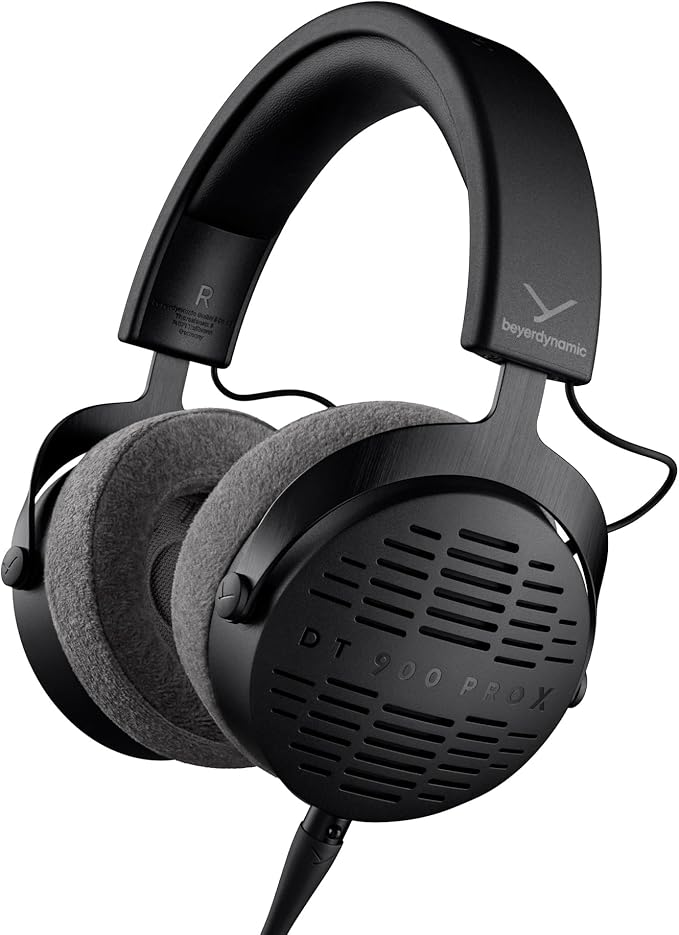
Specs: Open-back · STELLAR.45 driver · 5Hz – 40kHz · 48Ω · 345g · Detachable mini-XLR cable
The DT 900 Pro X earns the top spot because it solves the two problems that sink most open-backs for electronic music. First, its low end holds up further down than the classic open-back references: kick fundamentals and bassline weight stay readable instead of evaporating, so kick-versus-bass balance — the decision in EDM — can actually be made on it. Second, at 48 ohms a normal audio interface drives it properly, no specialist amp required.
Detail retrieval is the other half of the case. Sidechain pumping, reverb tails under a supersaw stack, and the click of a layered kick all sit in plain view, and the open-back stage keeps dense arrangements from collapsing into a wall. It is not a hyped headphone: if your low end is wrong, it will sound wrong, which is precisely the point.
2. Beyerdynamic DT 1990 Pro — Most Revealing Premium Pick

Specs: Open-back · 45mm Tesla driver · 5Hz – 40kHz · 250Ω · 370g · Two earpad sets (Balanced and Analytical) · Detachable mini-XLR cables
The DT 1990 Pro is the microscope of this roundup. Its Tesla driver delivers the fastest, most detailed presentation here, and the two included pad sets give you two tunings: the Balanced pads keep more low-end weight for production work, the Analytical pads flatten the picture further for mix checks. For hearing exactly where a sub note ends and a kick tail begins, nothing else here resolves the low end as cleanly.
Two honest warnings. The treble is forensic; harsh mixes sound harsh, and long sessions at volume can fatigue. And at 250 ohms it wants real power — a weak interface output under-drives it and thins out the very bass you bought it for. Pair it with a capable amp from our guide to the best headphone amp for mixing and it becomes the most trustworthy headphone here. Without one, buy the DT 900 Pro X instead.
3. Beyerdynamic DT 700 Pro X — Best Closed-Back for Beatmaking and Tracking

Specs: Closed-back · STELLAR.45 driver · 5Hz – 40kHz · 48Ω · 350g · Detachable mini-XLR cable · Velour pads
If your studio is a bedroom, a shared flat, or anywhere with a microphone in it, the closed-back DT 700 Pro X is the practical EDM pick. Isolation runs both ways: the room stays out of your beatmaking, and your cue stays out of the vocal take. The sealed design also firms up the low end — sub and kick arrive with more physical pressure than any open-back here, making it the best headphone on this list for judging how a drop will feel, not just how it measures.
That sealed pressure is also its caveat: closed-backs flatter low-end weight slightly, so final sub decisions still deserve a cross-check. Within those limits this is a superbly judged tuning — controlled rather than boomy, detailed up top, and comfortable in velour pads for long loop-building sessions.
4. Audio-Technica ATH-M50x — Best Value Beatmaking Pick

Specs: Closed-back · 45mm drivers · 15Hz – 28kHz · 38Ω · 285g · Three detachable cables · 90° swivelling earcups
The ATH-M50x is the headphone half the bedroom-producer world learned on, and for EDM it still makes sense as a first serious pick. Its tuning leans into the low end with a punch that makes beatmaking fun and helps you feel kick weight while you write, and the closed-back build isolates well enough for tracking.
Be clear-eyed about what it is not: it is not flat. The bass emphasis and slight treble lift mean finished mixes need reference-track discipline, because a mix balanced to sound neutral on the M50x can come out bass-light elsewhere. Producers who learn that bias — it is very learnable — produce perfectly translatable work on it.
5. Sony MDR-7506 — The Budget Tracking Classic
Specs: Closed-back · 40mm drivers · 10Hz – 20kHz · 63Ω · 230g · Fixed coiled cable · Folding design
The MDR-7506 has been a studio fixture for decades because it does one job relentlessly well: it shows you what is in the recording, brightly and without romance. For EDM producers its best use is tracking and detail-checking — edits, clicks, distortion artefacts and vocal takes are impossible to miss under its forward, treble-leaning presentation.
As a primary EDM mixing headphone it has real limits. The low end is lean rather than extended, so sub decisions made only on the 7506 tend to come out overcooked on bass-capable systems, and the fixed coiled cable is a known wear point. Buy it as the honest second opinion it has always been, not as your only window on the bottom octave.
6. Focal Listen Professional — Best Closed-Back for Translation Checks

Specs: Closed-back · 40mm Mylar/Titanium drivers · 5Hz – 22kHz · 32Ω · 280g · Two detachable cables · Folding design
Focal built the Listen Professional with a specific brief: a closed-back headphone that behaves like a small nearfield monitor. The result is the most even-handed closed-back tuning here — tight, fast low end that stops when the note stops, exactly what busy basslines and layered kicks need to stay intelligible. Dynamics are its party trick: compression decisions and sidechain depth read clearly, making it a favourite final-check headphone for electronic mixes.
The trade-offs are fit and forgiveness. The clamp is firm and the earcups run smaller than the Beyerdynamics, so long sessions suit smaller heads better, and the revealing tuning shows up sloppy low-mid build-up without mercy. At 32 ohms it runs from anything. For producers who must mix closed-back, this is the translation-first choice.
7. AKG K712 Pro — Best Soundstage for Arrangement and Stereo Work

Specs: Open-back · 10Hz – 39.8kHz · 62Ω · 235g · Flat-wire voice coil · Detachable cables (straight and coiled)
EDM is stereo theatre: wide supersaws, ping-pong delays, risers that sweep the full field. The K712 Pro has the widest stage in this roundup, and for arrangement decisions — what sits where, how wide a pad can go before it thins the centre — it is the most informative tool here. AKG also gives it a deliberate low-end lift over its studio predecessors (the manufacturer cites improved low-end performance of 3dB), so basslines keep more presence than classic AKG tuning suggests.
It is still an open-back with open-back physics: the deepest sub is suggested more than felt. Pair its spatial judgement with a sub-capable cross-check and it earns its place in a two-headphone workflow — a setup we also recommend in our guide to the best headphones for mixing and mastering.
8. Sennheiser HD 600 — Best Midrange Reference, With a Sub-Bass Caveat

Specs: Open-back · 12Hz – 39kHz · 300Ω · 260g · Detachable cable
No headphone in this roundup draws more loyalty, and for melodic EDM, progressive house and trance the reason is audible in seconds: the HD 600 midrange is a benchmark. Vocals, lead synths, plucks and pads sit in a natural, unforced balance that makes tonal EQ decisions reliable, and mixes balanced here famously travel well — in the midrange.
Now the caveat, stated plainly because EDM producers deserve it plainly: the HD 600 rolls off in the sub-bass. Below roughly 40Hz its output falls away, so it cannot judge your sub level, full stop. Producers who love it for everything else check the bottom octave elsewhere — monitors, a sub, or a closed-back from this list. It also needs a proper amp at 300 ohms. Buy it as the finest midrange reference in its class, not as a complete EDM mixing solution.
9. Shure SRH1540 — Best Closed-Back for Long Sessions

Specs: Closed-back · 40mm neodymium drivers · 5Hz – 25kHz · 46Ω · 286g · Alcantara ear pads · Dual detachable MMCX cables
The SRH1540 is the comfort pick for producers who write in long, unbroken stretches. The Alcantara pads and light, well-distributed clamp make it the closed-back here most likely to disappear on your head at hour three, and Shure includes a spare set of pads and a second cable in the box.
Sonically it is a warm, generous closed-back: extended low end with a full mid-bass that makes beatmaking pleasurable, and smooth treble that never fatigues. That warmth is also its mixing caveat — bass can read slightly fuller here than on a club rig, so reference tracks matter. As a writing headphone you can live in, it is a genuinely premium option.
Open-Back vs Closed-Back for EDM: Tracking, Mixing, and Writing
The open-versus-closed choice maps cleanly onto the three jobs in an EDM workflow — our explainer on open-back vs closed-back headphones covers the physics. Tracking belongs to closed-backs: the microphone should hear the vocalist, not the backing track bleeding through the headphones. Writing belongs to whichever you find comfortable, with closed-backs offering more low-end feel and open-backs less fatigue. Mixing belongs, first choice, to open-backs in a quiet room: the natural stage makes stereo and depth decisions more reliable.
The pattern most working producers land on is one of each: an open-back reference for mixing, a closed-back for tracking, late-night writing and sub-feel checks. If the budget only stretches to one headphone today, choose by your loudest constraint — a mic in the room or neighbours through the wall means closed-back first; a quiet room and mix accuracy above all means open-back first.
How to Make Headphone Mixes Translate to Club Systems
Translation is a workflow, not a product. Start by learning your headphone’s low end with five reference tracks in your genre that you know sound right on big systems; A/B your mix against them at matched volume, constantly, not just at the end. Second, use a spectrum analyser on your master: your ears may not hear 35Hz on headphones, but your eyes can confirm the sub is present and shaped. Third, if your headphone has a measured correction profile, try mixing with correction EQ applied — low-end decisions often get calmer and more consistent.
Finally, check on air-moving systems before release: monitors with a sub, a car, a function-room PA if you can borrow one. The lesson from producers whose tracks disappointed on a club rig is always the same — the mix was not wrong everywhere, just in the octave the headphones could not show them.
Frequently Asked Questions
What headphones do EDM producers use for mixing?
Open-back studio headphones with the most honest low-end extension available — here, the Beyerdynamic DT 900 Pro X and DT 1990 Pro. Many producers pair an open-back mixing headphone with a closed-back for tracking and for checking how sub-bass feels on a sealed design.
Can you mix EDM on headphones alone?
You can get most of the way there, and many releases are mixed primarily on headphones. The exception is the sub-bass octave below about 40Hz, where almost all headphones roll off. Learn your headphone’s roll-off with reference tracks, watch a spectrum analyser, and final-check the sub on monitors with a subwoofer before release.
Are open-back or closed-back headphones better for EDM production?
Open-backs are generally better for mixing decisions — wider, more natural soundstage and no sealed-cup bass pressure — but they leak sound and suit quiet rooms. Closed-backs are better for tracking with a microphone, producing in shared spaces, and feeling low-end weight. Most producers eventually own one of each.
Do you need a headphone amp for studio headphones?
It depends on impedance and your interface. Low-impedance picks here (48Ω and under) run properly from most audio interfaces. The 250Ω DT 1990 Pro and 300Ω HD 600 need a capable headphone amp to reach their designed performance — an under-powered output thins the bass and lowers detail.
How do you check sub-bass if your headphones roll off below 40Hz?
Use three supports together: reference tracks in your genre whose sub you trust, a spectrum analyser on the master bus so the lowest octave is visible even when barely audible, and a final check on a system that moves air — monitors with a subwoofer, a car system, or a PA. Correction EQ for your headphone model can also recover some low-end visibility.
The right EDM production headphone is the one whose low-end behaviour you understand. Start with the DT 900 Pro X in a quiet room, the DT 700 Pro X if isolation rules your space, and build the sub-check habit from day one — that habit is what makes headphone mixes survive the club.

I am the founder of Sound Mavericks, where I provide the polite truth about audio equipment. I started this site because consumer electronics reviews are often too technical. Instead of using a silent lab, I test headphones, earbuds, and Bluetooth speakers in the real world – like on a noisy subway or in a busy coffee shop.
To stay independent, I buy my own review units (mostly from the United States) rather than accepting free gifts from brands. Once I finish testing a product, I sell it locally to our community. My goal is to help you understand sound quality, active noise cancellation (ANC), and battery life without the marketing hype.