
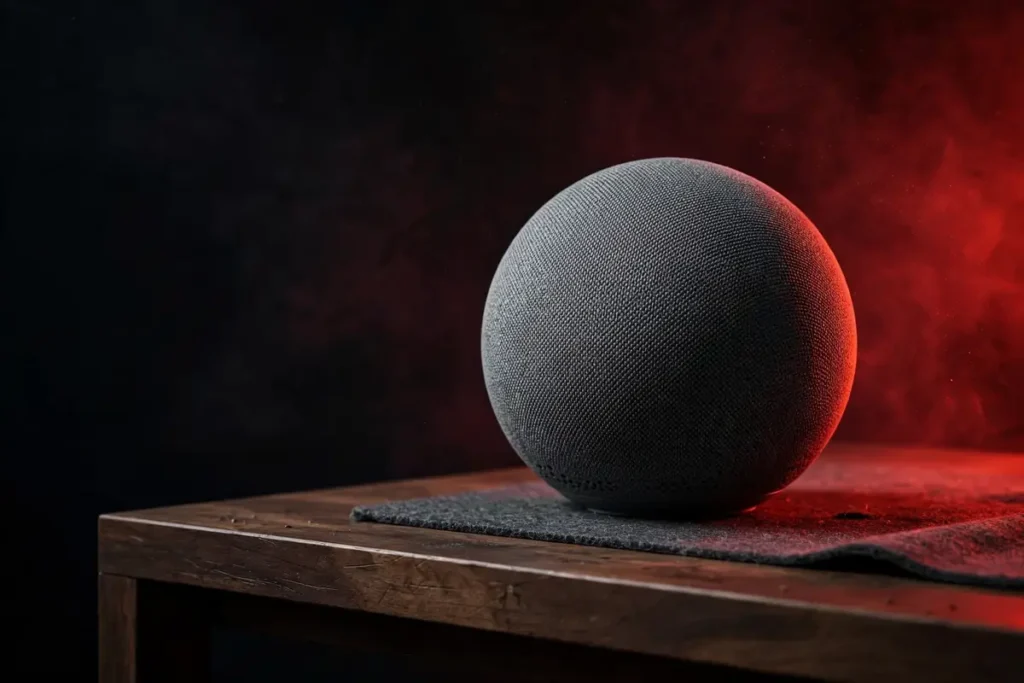
This Amazon Echo Studio review covers one generation only: the newest model Echo Studio, Amazon’s compact spherical redesign, in its Graphite listing on Amazon US, ASIN B0DMQ1QMVV, model P8Z7MN. It does not cover the original tall cylinder Echo Studio, and no specification from that older speaker is used here. The newest model packs three full-range drivers and a high-excursion woofer in a 3.1.1 layout with Dolby Atmos and spatial audio, the AZ3 Pro processor, Alexa+ support, and a built-in smart home hub, in a body about 40% smaller than the original.
A note on method. This is a research review, built from the manufacturer’s published specifications, the verified Amazon US listing for this exact model, and independent coverage. We have not had a unit on the desk, so nothing here claims hands-on testing, and speaker products on this site carry no scores.
The newest Echo Studio is the best-sounding Alexa speaker Amazon sells, and its smart home hub is the most complete in any single speaker: Zigbee, Matter and Thread in one box, with fast voice responses from the AZ3 Pro chip. As a pure music speaker it is a compromise. Reviewers who have tested both generations find the smaller cabinet gives up some of the original model’s bass weight, and the wired input is gone, so turntables and TVs connect only through streaming or a Fire TV pairing. As the centrepiece of an Alexa home it is an easy pick in our best smart speakers coverage; as a hi-fi speaker first, read the sound section closely. Check Price on Amazon
Why you: Dolby Atmos and spatial audio from a compact spherical cabinet, the AZ3 Pro chip for fast Alexa responses, and a built-in hub covering Zigbee, Matter and Thread.
Trade-off: It gives up the wired 3.5mm and optical input of the original tall model, and independent reviewers find its bass lighter than that first design.
Amazon Echo Studio specifications
| Spec | Amazon Echo Studio |
|---|---|
| Product | Amazon Echo Studio, newest model, Graphite finish, model P8Z7MN. This review covers this generation only |
| Drivers | Three 1.5-inch full-range drivers and one 3.75-inch high-excursion woofer, 3.1.1 layout |
| Audio formats | Dolby Atmos and spatial audio; automatic room adaptation |
| Processor | Amazon AZ3 Pro, built for Alexa+ |
| Smart home hub | Built-in Zigbee hub, Matter controller and Thread border router; temperature, light and presence sensing |
| Connectivity | Wi-Fi 6E, Bluetooth; pairs with compatible Fire TV for home theatre audio. No wired audio input |
| Size | 155 x 142 x 147 mm approx.; about 40% smaller than the original Echo Studio |
Which Echo Studio is this?
Amazon has sold two very different speakers under the Echo Studio name. The original was a tall cylinder with a 5.25-inch woofer and a combined 3.5mm and optical input. The newest model, the one listed and reviewed here, is a squat sphere with a fabric finish, a light ring at the base, and no wired audio input at all. Listings, prices and second-hand offers mix the two up, so check the shape and the model number before buying. Everything in this review, from the driver list to the verdict, describes the newest model only.
The redesign trades cabinet volume for placement freedom. A speaker 40% smaller fits on a kitchen counter, a desk or a bedside unit where the original looked oversized, and automatic room adaptation adjusts the sound to its position after setup and when it is moved. Buyers replacing the original should expect a tidier footprint and a different bass balance, not a like-for-like swap.
Sound: wide and clear, lighter at the bottom
The three full-range drivers fire left, right and upward, and the woofer handles the low end, which gives the Studio a wide, open presentation from a single box. Spatial audio tracks gain real height and spread, and stereo content sounds broader than the cabinet suggests. Vocals sit forward and dialogue stays clear, which suits the speaker’s double life as a Fire TV home theatre speaker.
The consistent note across independent reviews is inconsistency at the extremes. Bass is clean and controlled but does not dig as deep or hit as hard as the original model’s larger woofer, and some tracks sound thinner than others depending on the mix and the room correction. At high volume the small cabinet compresses. For pop, podcasts, TV and background listening it is a strong performer. For bass-led music at party volume, a larger speaker such as the Sonos Era 300 plays a different league, at a different price and without Alexa built in.
A stereo pair of Studios fixes the single-speaker limits. Two units give genuine left and right separation and a wider stage, and pairing two with a compatible Fire TV builds a tidy Dolby Atmos home theatre with no soundbar and no wires beyond power. That is the setup the design is aimed at.
Alexa+, the hub and everyday use
The AZ3 Pro chip makes Alexa responses noticeably quick, and Alexa+ support means generative features such as longer conversations and routine building roll out to this hardware first. Four microphones pick up commands across a room at normal music volumes, and tap gestures and presence sensing feed routines such as lights that follow you between rooms.
The hub is the practical headline. Zigbee control for lights and sensors, Matter over Wi-Fi and a Thread border router cover most smart home devices without a separate bridge, and the temperature sensor supports routines the basic Echo models cannot run alone. Buyers building a new smart home can reasonably start here and skip a standalone hub, which is a real saving that rivals like the Google Home Speaker match only in part.
The missing input is the everyday catch. There is no 3.5mm or optical socket, so a turntable, a CD player or a TV without Fire TV pairing cannot connect by cable. Bluetooth covers phone streaming, and Wi-Fi streaming covers the main music services through Alexa, but wired-source owners should look elsewhere.
Who should buy the newest Echo Studio
Buy it if your home runs on Alexa, you want the best sound the Echo range offers, and the built-in hub saves you a separate bridge. It is also the neatest route to wireless Fire TV home theatre audio, especially as a stereo pair.
Skip it if you own the original Studio and care most about bass weight, because the redesign is not an upgrade on that axis, or if you need a wired input for a turntable or a non-Fire TV. Music-first buyers who do not use Alexa should compare dedicated speakers before spending.
One more everyday point in the newest model’s favour: it doubles as the hub of a Fire TV setup without a soundbar taking over the TV stand. A single Studio under or beside the television handles dialogue clearly, and because the hub radios are built in, the same box that plays the film also runs the lights you dim before it starts. For flats and smaller living rooms, that consolidation is the strongest reason to choose the Studio over a similarly priced music-only speaker, and it is why we keep it as the default Alexa recommendation despite the bass trade-off against the original.
Frequently asked questions
Which Echo Studio generation does this review cover?
The newest model only: the compact spherical Echo Studio with the AZ3 Pro chip and Alexa+ support, model P8Z7MN. The original tall cylinder model is a different speaker and none of its specifications are used here.
Does the newest Echo Studio have a 3.5mm or optical input?
No. The newest model has no wired audio input. It streams over Wi-Fi and Bluetooth and pairs with compatible Fire TV devices for home theatre audio.
Can two Echo Studio speakers form a stereo pair?
Yes. Two newest-model Studios can run as a stereo pair, and a pair can also serve as Dolby Atmos home theatre speakers with a compatible Fire TV.
Does the Echo Studio work as a smart home hub?
Yes. It includes a Zigbee hub, a Matter controller and a Thread border router, plus temperature, light and presence sensing for Alexa routines, so many devices connect without a separate bridge.
How does the newest Echo Studio sound next to the original?
It sounds wider and cleaner in the mids, with strong spatial effects, but reviewers who tested both find its bass lighter than the original’s larger woofer delivered. It is a redesign with trade-offs, not a straight upgrade.

I am the founder of Sound Mavericks, where I provide the polite truth about audio equipment. I started this site because consumer electronics reviews are often too technical. Instead of using a silent lab, I test headphones, earbuds, and Bluetooth speakers in the real world – like on a noisy subway or in a busy coffee shop.
To stay independent, I buy my own review units (mostly from the United States) rather than accepting free gifts from brands. Once I finish testing a product, I sell it locally to our community. My goal is to help you understand sound quality, active noise cancellation (ANC), and battery life without the marketing hype.

