The short answer: the best noise cancelling you can get without ear tips
The Apple AirPods 4 with Active Noise Cancellation answer a question buyers have asked for years: can you get real noise cancelling from an open-ear earbud that never plugs your ear canal? Based on Apple’s published specifications, the H2 feature set, and the lab measurements and coverage collected for this review, the answer is a qualified yes. The AirPods 4 with ANC take the edge off offices, cafés, street noise and air-conditioning hum without a silicone tip anywhere near your ear — and they add Adaptive Audio, Conversation Awareness, Voice Isolation and a wireless-charging case with a Find My speaker. The qualification matters: with no seal, low-frequency rumble from planes and trains still leaks through, and battery life with ANC on is the shortest in Apple’s current earbud line.
This is a spec- and coverage-based review: SoundMavericks compiled Apple’s official tech specs, the Amazon listing details, and published test results from reviewers who measured these earbuds. We do not claim hands-on testing; our verdict, scoring and buying advice lead, and outside measurements are cited only where they add a number Apple doesn’t publish.
Our verdict

Buy the AirPods 4 with Active Noise Cancellation if you hate in-ear tips but still want noise cancelling, smart Adaptive Audio and the full H2 experience in an open, all-day-comfortable fit. Skip them if maximum silence on flights is the priority — a sealed design cancels far more low-end noise.
First, don’t buy the wrong AirPods 4
Apple sells two different earbuds both called AirPods 4, and confusing them is the easiest mistake in this category. They share the same open-ear shape, the same H2 chip and the same basic sound hardware. Everything else in this review belongs to the with-ANC model only:
- AirPods 4 with Active Noise Cancellation (this review): ANC, Adaptive Audio, Transparency mode, Conversation Awareness, and a USB-C case with wireless charging and a built-in speaker for Find My.
- AirPods 4 (standard): no noise cancelling of any kind, no Adaptive Audio or Transparency, and a USB-C case with no wireless charging and no speaker.
The boxes and the buds look near-identical on a shelf, so check the exact model name before you buy. Every specification, image and Amazon link in this article refers to the with-ANC version.
AirPods 4 with ANC: specifications
| Product | Apple AirPods 4 with Active Noise Cancellation Check Price |
| Design | Open-ear, no ear tips; one size; refined contour fit |
| Chip | Apple H2 headphone chip |
| Noise control | Active Noise Cancellation, Adaptive Audio, Transparency mode, Conversation Awareness |
| Audio | Custom low-distortion driver, high-dynamic-range amplifier, Adaptive EQ, Personalized Spatial Audio with dynamic head tracking |
| Microphones | Dual beamforming microphones, inward-facing microphone; Voice Isolation for calls |
| Controls | Force sensor on the stem (press to play/pause, answer calls, switch listening modes); Siri Interactions — nod or shake your head to respond |
| Battery (earbuds) | Up to 4 hours with ANC on; up to 5 hours with noise control off |
| Battery (with case) | Up to 20 hours with ANC on; up to 30 hours with noise control off; around 1 hour of listening from a 5-minute charge |
| Case | USB-C charging; wireless charging (MagSafe, Qi-certified chargers, Apple Watch charger); built-in speaker for Find My; USB-C cable sold separately |
| Resistance | IP54 dust, sweat and water resistance (earbuds and case) |
| Connectivity | Bluetooth 5.3; automatic switching between Apple devices signed into the same account |
| Size & weight | Each earbud 30.2 × 18.3 × 18.1 mm, 4.3 g; case 46.2 × 50.1 × 21.2 mm, 32.3 g |
| Sound Quality | 8.4 |
| Noise Cancelling | 7.8 |
| Comfort & Design | 9.0 |
| Battery Life | 7.5 |
| Call Quality | 8.6 |
| Value | 8.2 |
Design and comfort: the open-ear fit is the whole point
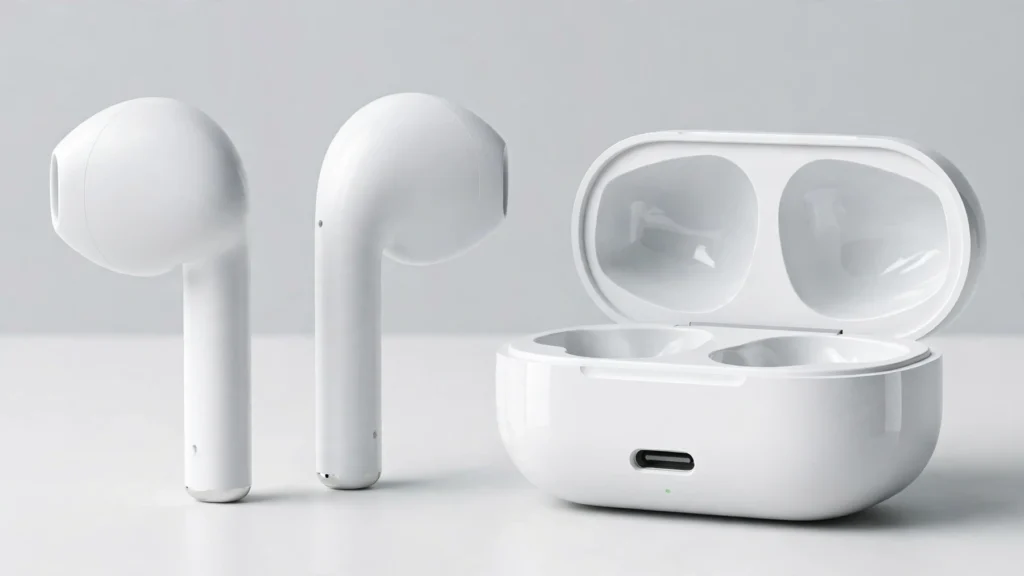
The AirPods 4 keep Apple’s classic open design: a hard, smooth bud that rests at the entrance of your ear, held by shape rather than by a tip pushed into the canal. Apple says the contour was refined using 3D mapping of thousands of ears, and at 4.3 grams per bud with a shorter stem than the previous generation, these are earbuds you can wear all day without the plugged, pressured feeling sealed earbuds cause. There is one size and nothing to adjust — the appeal and the risk in one: if the shape suits your ears, fit is effortless; if it doesn’t, there are no alternative tips to try.
The IP54 rating covers both the earbuds and the case — dust-protected and resistant to sweat and splashing water, which makes them fine for workouts and light rain, but not for swimming or showering. Controls live on the stem’s force sensor: squeeze to play or pause, answer a call, or press and hold to cycle listening modes. One genuine omission versus the Pro line: there is no swipe control for volume, so volume changes happen on your phone or via Siri.
How well does the ANC actually work with no ear tips?
This is the section the whole product stands or falls on, so let’s be precise about the physics. Active noise cancellation works in two layers: passive isolation from a physical seal, and active cancellation from anti-noise generated by the microphones and the H2 chip. The AirPods 4 with ANC have only the second layer. There is no seal, so sound — especially low-frequency sound, whose long wavelengths slip past an open bud — reaches your eardrum unimpeded, and the electronics have to do all the work.
Within that limit, the results in published lab testing are genuinely impressive for the format. SoundGuys measured the AirPods 4 with ANC reducing noise by up to roughly 20 dB at its strongest frequencies — a perceived drop they describe as around 75% in loudness — and reviewers consistently rate it the strongest cancellation yet achieved in an open-ear design. In practical terms, based on that coverage:
- What it handles well: office chatter, café noise, air-conditioning and fan hum, street ambience, and the mid-frequency clatter of daily life. Steady, predictable noise is where feedforward-style cancellation shines, seal or no seal.
- Where it falls short: engine and airplane-cabin rumble. Apple itself rates the AirPods Pro 2 as cancelling up to twice as much noise as the AirPods 4 with ANC, and the gap is widest exactly in the low frequencies an open design can’t block. On a long flight, these take the edge off; they do not create silence.
- Why fit variance is bigger here: because there’s no tip anchoring the bud, small differences in how the bud sits change both bass response and cancellation more than with a sealed earbud. Two listeners can honestly report different ANC results from the same product.
Our read: judge these against other open-ear earbuds, where they lead the class — not against sealed flagships. If your shortlist is really about maximum quiet, start from our guide to the best noise cancelling earbuds, where the sealed models set the ceiling.
The H2 feature set: Adaptive Audio, Conversation Awareness and more
The with-ANC model inherits almost the entire smart-feature stack that used to be Pro-only, all driven by the H2 chip:
- Adaptive Audio blends ANC and Transparency automatically, dialling cancellation up in loud environments and letting important sounds through in quieter ones, so you rarely need to touch the controls.
- Conversation Awareness detects when you start speaking, lowers your media volume and reduces background noise so you can hold a conversation without removing a bud — then restores your settings when you stop.
- Transparency mode pipes the outside world in naturally when you want full awareness — useful for announcements, traffic and office doorbells.
- Voice Isolation uses computational audio on calls to prioritise your voice and suppress wind and ambient noise around you, and published call tests rate the AirPods 4’s dual beamforming microphones among the clearest in the class.
- Personalized Spatial Audio with dynamic head tracking places sound around you for supported music, films and calls, tuned using a scan of your ears from your iPhone.
- Siri Interactions let you nod yes or shake your head no to answer Siri prompts hands-free.
Adaptive EQ rounds out the audio side, adjusting the tuning in real time to how the buds sit in your ears — particularly valuable in an open design, where fit shifts would otherwise change the sound.
Sound quality
Apple equips the AirPods 4 with a custom low-distortion driver and a high-dynamic-range amplifier, and the consensus across published reviews is a clear step up from the previous generation: cleaner highs, better-controlled bass and more detail. Set expectations by format, though — an open bud cannot move air against a sealed canal, so deep sub-bass is inherently lighter than on the AirPods Pro or any tip-sealed rival. For podcasts, calls, pop, acoustic and everyday listening, the tuning is balanced and fatigue-free; bass-first listeners should look at sealed designs.
Battery life and the case: small numbers, smart case
Battery is the with-ANC model’s clearest trade-off. Apple rates the earbuds at up to 4 hours of listening with ANC on (5 hours with noise control off), rising to 20 hours total with case recharges with ANC on and 30 hours with it off. Four hours covers a commute or a work session but not a long-haul flight on one charge; the saving graces are fast top-ups — around an hour from roughly five minutes in the case — and a case that, at 32.3 grams, is the most pocketable Apple makes for a noise-cancelling model.
The case is also where the ANC model pulls furthest ahead of the standard AirPods 4. You get USB-C charging plus wireless charging — MagSafe pads, Qi-certified chargers and even an Apple Watch charger all work — and a built-in speaker that plays a sound from the Find My app when you’ve misplaced it. The standard model’s case has none of that: no wireless charging, no speaker. One annoyance shared by both: no USB-C cable is included in the box, so you’ll use the one from your phone or laptop.
AirPods 4 with ANC vs AirPods Pro: who should buy which?
On paper these two lines look close — same H2 generation of features, same Adaptive Audio family, similar cases. The differences that actually decide the purchase are fit, isolation and endurance:
- Choose the AirPods 4 with ANC if ear tips irritate you, you wear earbuds for long stretches and want to stay loosely aware of your surroundings, or you mostly need the edge taken off offices, homes and streets. You also get the smaller case and the lower tier of Apple’s pricing ladder.
- Choose the AirPods Pro if you fly often, commute on trains, or want the strongest cancellation Apple sells — the sealed tips deliver up to twice the noise reduction, longer per-charge battery, swipe volume control, and the Pro line’s hearing-health features the AirPods 4 don’t offer.
For the current flagship end of that comparison, see our AirPods Pro 3 vs Sony WF-1000XM6 head-to-head, and for how the previous Pro generation stacks up against Sony’s sealed flagship, our Sony WF-1000XM5 vs AirPods Pro 2 comparison. Android owners should read the Pro decision differently again — most of the H2 smart features above are Apple-ecosystem features, so the cross-platform case is weaker; our Galaxy Buds 3 Pro vs AirPods Pro 2 comparison shows what the same money buys on the Samsung side.
Who should buy the AirPods 4 with ANC — and who should skip them
Buy them if: you use an iPhone; you dislike in-ear tips; you work in offices, cafés or shared homes; you take a lot of calls and want Voice Isolation; and you value a tiny case with wireless charging. Skip them if: you need maximum silence for flights and trains, you want more than four hours per charge with ANC on, you’re primarily an Android user, or deep bass is your priority. If none of the ANC features matter to you, the standard AirPods 4 share the same fit and core sound for less — minus the wireless-charging, speaker-equipped case.
Frequently asked questions
Are the AirPods 4 with ANC worth it over the standard AirPods 4?
For most iPhone owners, yes. The with-ANC model adds Active Noise Cancellation, Adaptive Audio, Transparency mode and Conversation Awareness, plus a case with wireless charging and a Find My speaker — none of which the standard AirPods 4 have. If you only ever listen in quiet rooms and always charge by cable, the standard model covers the basics, but the ANC version is the meaningfully more capable earbud.
How good is the noise cancelling on the AirPods 4 if they have no ear tips?
It’s the strongest yet measured in an open-ear design — published lab testing found reductions of up to roughly 20 dB at its best frequencies — but the missing seal sets a hard ceiling. Office, café and street noise are reduced effectively, while low-frequency engine and airplane rumble still comes through. Apple rates the sealed AirPods Pro 2 as cancelling up to twice as much noise.
Do the AirPods 4 with ANC have wireless charging?
Yes — and this applies only to the with-ANC model. Its USB-C case charges wirelessly on MagSafe and Qi-certified pads and on an Apple Watch charger, and it has a built-in speaker for Find My. The standard AirPods 4 case is USB-C only, with no wireless charging and no speaker.
How long does the battery last with ANC on?
Up to 4 hours of listening on a single charge with Active Noise Cancellation enabled, and up to 20 hours total with recharges from the case. With noise control off, those figures rise to 5 hours per charge and 30 hours with the case. A roughly 5-minute charge adds about an hour of listening.
Can you use the AirPods 4 with ANC with Android?
They pair with Android phones as standard Bluetooth 5.3 earbuds and the noise cancelling works, but the features that define this model — Adaptive Audio refinements, Conversation Awareness, Personalized Spatial Audio setup, automatic device switching, Siri Interactions and Find My — depend on Apple’s ecosystem. Android users get a notably thinner product.
Are the AirPods 4 with ANC waterproof?
No. The earbuds and case are rated IP54, meaning dust-protected and resistant to sweat and splashing water. They’re suitable for workouts and light rain, but should not be submerged, worn swimming or used in the shower.
What’s the difference between the AirPods 4 with ANC and the AirPods Pro?
Fit and isolation. The AirPods 4 are open-ear with no tips; the AirPods Pro seal your ear canal with silicone tips, which delivers up to twice the noise cancellation, stronger bass, longer battery life per charge and swipe volume control, plus hearing-health features the AirPods 4 don’t have. The AirPods 4 with ANC counter with all-day open comfort and a smaller case.
Final verdict
The AirPods 4 with Active Noise Cancellation are a genuinely new category of earbud: not the quietest noise cancelling you can buy, but the best available to people who refuse to plug their ears. SoundMavericks’ analysis of the specs and published testing gives them an 8.3/10 — class-leading open-ear comfort and call quality, a smart H2 feature set that finally escapes the Pro line, and a small but real battery compromise. If your noise problem is the everyday world rather than an airplane cabin, this is the AirPods model built for you — just make certain the box, the listing and the case all say with Active Noise Cancellation before you pay.

I am the founder of Sound Mavericks, where I provide the polite truth about audio equipment. I started this site because consumer electronics reviews are often too technical. Instead of using a silent lab, I test headphones, earbuds, and Bluetooth speakers in the real world – like on a noisy subway or in a busy coffee shop.
To stay independent, I buy my own review units (mostly from the United States) rather than accepting free gifts from brands. Once I finish testing a product, I sell it locally to our community. My goal is to help you understand sound quality, active noise cancellation (ANC), and battery life without the marketing hype.