
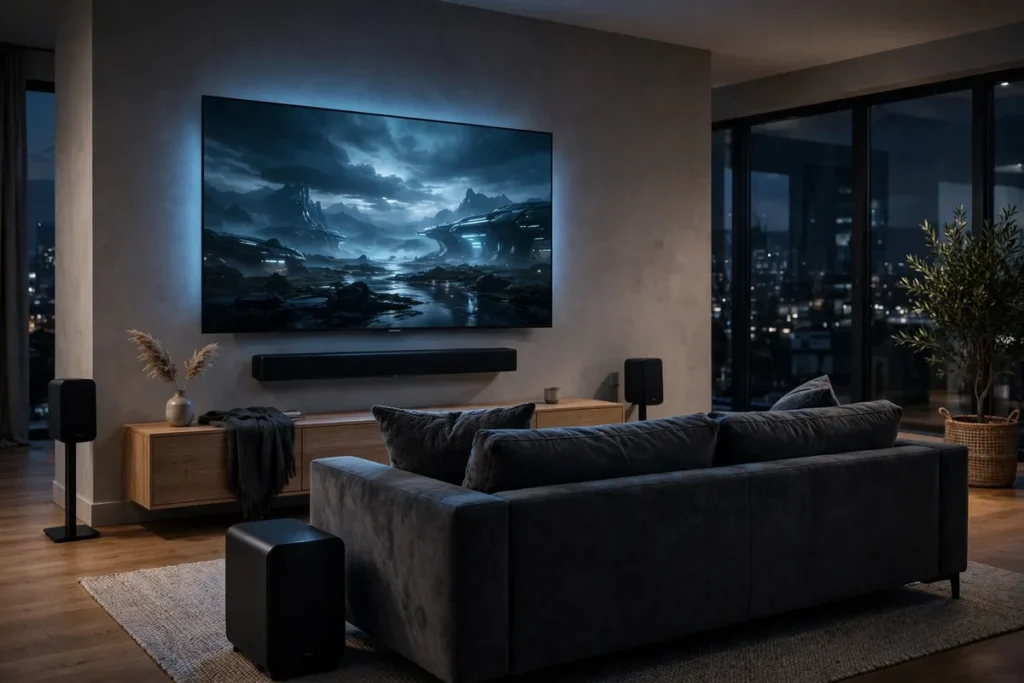
The best Dolby Atmos soundbar for your room depends on one decision: a single bar that simulates height and surround, or a system that puts real speakers behind you. Both routes can sound convincing, and both are represented here. Seven picks, from the Sonos Arc Ultra at the single-bar end to Samsung’s 11.1.4 system with physical rear speakers, each chosen for a defined setup rather than a vague claim of being the best for everyone.
This is a research-based roundup. Verdicts rest on manufacturer specifications, channel layouts, what ships in the box and published test coverage, not hands-on listening in our room. Atmos is easy to print on a carton and harder to deliver, so each pick states how its channels are produced: dedicated up-firing drivers, virtual processing, or separate speakers. That distinction drives everything below.
Best single-bar overall: Sonos Arc Ultra: a Sound Motion driver gives one bar an unusually wide and tall Atmos stage, with the Sonos ecosystem behind it. Check Price on Amazon
Best complete surround system: Samsung HW-Q990F: bar, wireless subwoofer and wireless rears with up-firing drivers in one box, so the 11.1.4 channels are physical. Check Price on Amazon
Best for dialogue clarity: Bose Smart Ultra Soundbar: A.I. Dialogue Mode balances voices against effects continuously, the easiest flagship bar to follow at low volume. Check Price on Amazon
Best for Sony TVs: Sony BRAVIA Theater Bar 9: thirteen speakers with 360 Spatial Sound Mapping build phantom channels, and Bravia TVs can act as the centre speaker. Check Price on Amazon
Most flexible surround: JBL Bar 1300X: battery-powered surround speakers detach from the bar ends for films, then dock back to recharge. Check Price on Amazon
Best single-bar immersion: Sennheiser AMBEO Soundbar Plus: AMBEO processing with dual built-in subwoofers builds a virtual 7.1.4 field with more bass than most single bars. Check Price on Amazon
Best for LG TVs: LG S95TR: wireless rears with an up-firing centre channel, plus WOW Orchestra pairing that blends the TV speakers into the stage. Check Price on Amazon
One bar, or speakers behind you?
Atmos adds height to surround sound: effects move overhead as well as around. A single bar creates that impression by bouncing up-firing drivers off the ceiling and steering the rest with processing. It works best in rooms with flat, low ceilings and a centred sofa, and it fails quietly in open-plan spaces with beams or vaulted ceilings, where the reflections scatter. A system with wireless rear speakers skips the guesswork by putting drivers where the sound is meant to come from.
Neither route is automatically better. The single bar keeps the room clean and the setup to one cable; the system needs power sockets near the rear speakers and more floor space. Our broader best soundbars guide covers non-Atmos bars and budget picks alongside these, and it is worth reading before deciding that height effects are a requirement rather than a bonus.
The best Dolby Atmos soundbars, pick by pick

Why you: Its Sound Motion driver gives a single bar an unusually wide and tall Atmos presentation, with the whole Sonos ecosystem behind it.
Trade-off: True surround and deep bass both require expensive Sonos add-ons.
Fourteen drivers in a 9.1.4 layout make the Arc Ultra the most capable single bar here, and the Sound Motion unit is the reason its bass surprises: a compact four-motor design that moves more air than a conventional slim woofer. Height effects come from up-firing drivers, and Trueplay tuning adapts the output to the room. Our Sonos Arc Ultra review breaks down the driver array and the tuning in full.
The ecosystem is the long-term argument. Era speakers can join as rears and a Sub can take over the low end, so the system can grow in stages. The counterweight is cost at every stage, plus a single HDMI eARC input: every source routes through the TV, and there is no spare socket for a console or player.
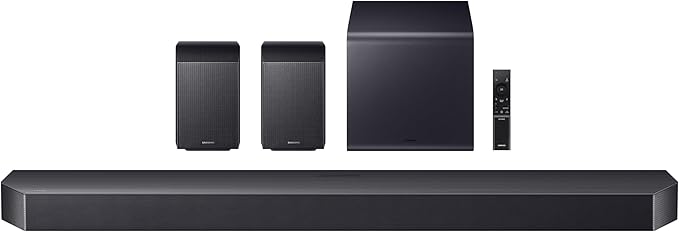
Why you: The box includes the bar, a wireless subwoofer and wireless rear speakers with up-firing drivers, so the 11.1.4 channels are physical, not virtual.
Trade-off: The rears still need power outlets, and its best features, Q-Symphony among them, are aimed at Samsung TV owners.
This is the reference point for what a soundbar system can be. Eleven ear-level channels, one subwoofer channel and four height channels, all from real drivers in real cabinets: the bar, a wireless sub and two wireless rears that fire both forward and up. Effects behind the sofa are sounds from behind the sofa, and no processing has to pretend otherwise. Wireless Dolby Atmos keeps the TV connection cable-light, and DTS:X support covers the discs and streams that use it.
Practical notes matter at this level. Each rear needs a mains socket, so the room layout has to cooperate, and Q-Symphony, which blends the TV’s own speakers into the front stage, only works with Samsung televisions. Owners of other TV brands still get the full 11.1.4 system; they just leave one feature unused.

Why you: A.I. Dialogue Mode continuously balances voices against effects, which makes it the easiest flagship bar to follow at low volume.
Trade-off: It creates its surround effect from one bar, so rear effects are simulated rather than physical.
Plenty of bars do spectacle. The Bose does conversation. A.I. Dialogue Mode watches the mix and holds voices forward, so a whispered scene stays intelligible without reaching for the remote, and ADAPTiQ calibration tunes the bar to the room it sits in. Atmos height comes from up-firing drivers and Bose’s PhaseGuide processing widens the stage beyond the cabinet. Our Bose Smart Ultra Soundbar review covers the calibration process and the app in detail.
Set expectations on surround: effects that should circle the room are suggested from the front, convincingly but not physically. Households that watch dialogue-heavy drama late at night will value what it does best. Action fans who want sound behind them should look at the Samsung or JBL systems on this page.

Why you: Thirteen speakers with 360 Spatial Sound Mapping build phantom channels around the room, and it integrates with Bravia TVs including using the TV as a centre speaker.
Trade-off: There is no subwoofer included, and the deepest integration benefits need a recent Bravia TV.
Sony takes the opposite approach to Samsung: instead of more boxes, more processing. Thirteen drivers and 360 Spatial Sound Mapping create phantom speaker positions around the listener, and the effect is among the most spacious any single bar produces. With a compatible Bravia TV, Acoustic Center Sync drafts the television’s own speakers into service as the centre channel, which anchors dialogue to the screen in a way a bar below it cannot quite match.
The gaps are bass and brand lock-in. There is no subwoofer in the box, so the low end is tidy rather than deep until a Sony wireless sub joins, and on a non-Sony TV the centre-sync feature disappears. Bravia owners get the best version of this bar; everyone else should compare it carefully against the Arc Ultra.
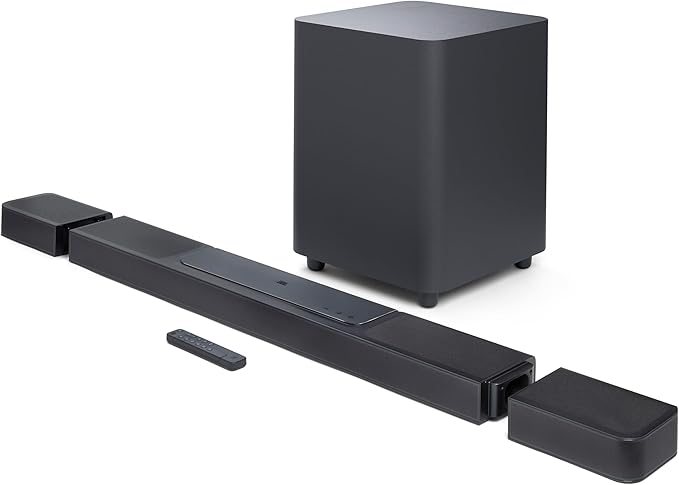
Why you: Its battery-powered surround speakers detach from the bar ends for films, then dock back to recharge and can even work as standalone Bluetooth speakers.
Trade-off: The detachable rears need recharging, and the bar is wide for smaller TV stands.
The 1300X solves the rear-speaker problem with a trick nobody else here attempts. The ends of the bar unclip to become battery-powered surround speakers: place them behind the sofa for a film, dock them afterwards to recharge. Docked, the bar works as a single wide unit with MultiBeam processing; undocked, it is a genuine 11.1.4 system with a wireless subwoofer handling the low end. Our JBL Bar 1300X review covers the docking system and battery behaviour closely.
Flexibility has a housekeeping cost. The rears run on their batteries, so a long film weekend means remembering to dock them, and the full-width bar needs a wide stand. Renters and anyone barred from running cables get the most from the design; permanent home-cinema rooms may prefer the Samsung’s always-on rears.

Why you: AMBEO processing with built-in dual subwoofers produces a convincing virtual 7.1.4 field with more bass than most single bars manage alone.
Trade-off: It is a large, heavy bar, and adding the separate AMBEO Sub is the only way to go deeper.
Sennheiser’s AMBEO processing is the most convincing virtualisation here. Nine drivers, including two built-in subwoofers, feed a system that measures the room and builds a 7.1.4 sound field from one cabinet. The bass deserves emphasis: where most single bars gesture at low frequencies, the Plus produces real weight, which keeps film scores and action scenes grounded without a separate subwoofer on the floor.
It asks for space in return. The cabinet is deep and heavy by soundbar standards, and it will dominate a slim TV stand. Streaming and format support are broad, covering Atmos and DTS:X, and the calibration is automatic. Buy it when one box must do everything and the room can take a substantial one.

Why you: It ships with wireless rear speakers including an up-firing centre channel and pairs with LG TVs through WOW Orchestra and WOW Interface.
Trade-off: Its headline integrations are LG-specific, so other TV brands get a more generic experience.
LG’s flagship system takes the full-system route: bar, wireless subwoofer and wireless rear speakers for 9.1.5 channels. The fifth height channel is the detail to notice, an up-firing centre in the rear array that sharpens overhead effects behind the listener. On an LG TV, WOW Orchestra lets the television’s speakers join the front stage and WOW Interface puts the soundbar’s settings inside the TV menu, controlled by the TV remote.
Away from an LG screen it remains a strong 9.1.5 system with both major immersive formats, though the Samsung offers two more channels and a broader feature set. The value of the LG rises sharply if the TV across from it already carries an LG badge.
All seven picks compared
| Model | Channels | In the box | Formats | Best for | |
|---|---|---|---|---|---|
| Sonos Arc Ultra | 9.1.4 | Bar only | Dolby Atmos | Single-bar overall | Check Price |
| Samsung HW-Q990F | 11.1.4 | Bar, wireless sub, wireless rears | Dolby Atmos, DTS:X | Complete surround system | Check Price |
| Bose Smart Ultra Soundbar | Atmos single bar | Bar only | Dolby Atmos | Dialogue clarity | Check Price |
| Sony BRAVIA Theater Bar 9 | 13 speakers | Bar only | Dolby Atmos, DTS:X | Sony TVs | Check Price |
| JBL Bar 1300X | 11.1.4 | Bar, wireless sub, detachable rears | Dolby Atmos | Flexible surround | Check Price |
| Sennheiser AMBEO Soundbar Plus | Virtual 7.1.4 | Bar only | Dolby Atmos, DTS:X | Single-bar immersion | Check Price |
| LG S95TR | 9.1.5 | Bar, wireless sub, wireless rears | Dolby Atmos, DTS:X | LG TVs | Check Price |
How to choose an Atmos soundbar
Check the TV first. Atmos from streaming apps and players reaches the bar in full quality over HDMI eARC, so the television needs an eARC socket to pass it. With plain ARC or optical the bar still plays, but height effects arrive compressed or not at all. Every bar here connects over eARC; the variable is the TV at the other end of the cable.
Then judge the room honestly. Flat ceilings at normal height flatter single bars, because the up-firing drivers have a predictable surface to bounce from. Vaulted ceilings, beams and open-plan layouts argue for physical rear speakers, which is why the Samsung, JBL and LG systems exist. Room size matters too: a compact room can overwhelm easily, and the Bose or a single bar at moderate volume often beats a full system turned down.
Last, weigh the brand features. Q-Symphony, WOW Orchestra and Acoustic Center Sync are real benefits, but only with the matching television. Format support cuts the other way: DTS:X matters for disc collections, so the Bose and Sonos, which skip it, suit streaming-first households better than collectors.
Frequently asked questions
Do I need eARC for Dolby Atmos?
For full-quality Atmos, yes. eARC carries the uncompressed formats that plain ARC cannot, including the lossless tracks on Blu-ray and some streaming services. Many TVs pass a compressed form of Atmos over plain ARC, which still works, but eARC is the connection every bar in this guide is built around.
Can a single soundbar do real Atmos?
It can do convincing Atmos. Up-firing drivers bounce height effects off the ceiling and processing widens the stage, so rain and flyovers register overhead. What it cannot do is place a speaker behind you: sounds from the rear are suggested, not sourced. Rooms with flat ceilings get the strongest version of the effect.
What does 11.1.4 actually mean?
The first number counts ear-level channels, the middle number counts subwoofer channels, and the last counts height channels. An 11.1.4 system has eleven speakers at ear level spread across the bar and rears, one subwoofer channel and four height channels. More channels only help when they come from real, well-placed drivers, which is why the box contents matter.
Do rear speakers need cables?
They need power, not signal cables. The Samsung and LG rears connect to the bar wirelessly but plug into mains sockets. The JBL Bar 1300X goes further: its rears run on batteries and dock into the bar to recharge, so they need no sockets at all, at the cost of remembering to dock them.
Will an Atmos soundbar work with any TV brand?
Yes, over HDMI the core sound works with every brand. What changes is the bonus layer: Q-Symphony needs a Samsung TV, WOW Orchestra an LG, and Acoustic Center Sync a Sony Bravia. Buy the bar for its sound first and treat a matching brand feature as a welcome extra, not the deciding factor.

I am the founder of Sound Mavericks, where I provide the polite truth about audio equipment. I started this site because consumer electronics reviews are often too technical. Instead of using a silent lab, I test headphones, earbuds, and Bluetooth speakers in the real world – like on a noisy subway or in a busy coffee shop.
To stay independent, I buy my own review units (mostly from the United States) rather than accepting free gifts from brands. Once I finish testing a product, I sell it locally to our community. My goal is to help you understand sound quality, active noise cancellation (ANC), and battery life without the marketing hype.

