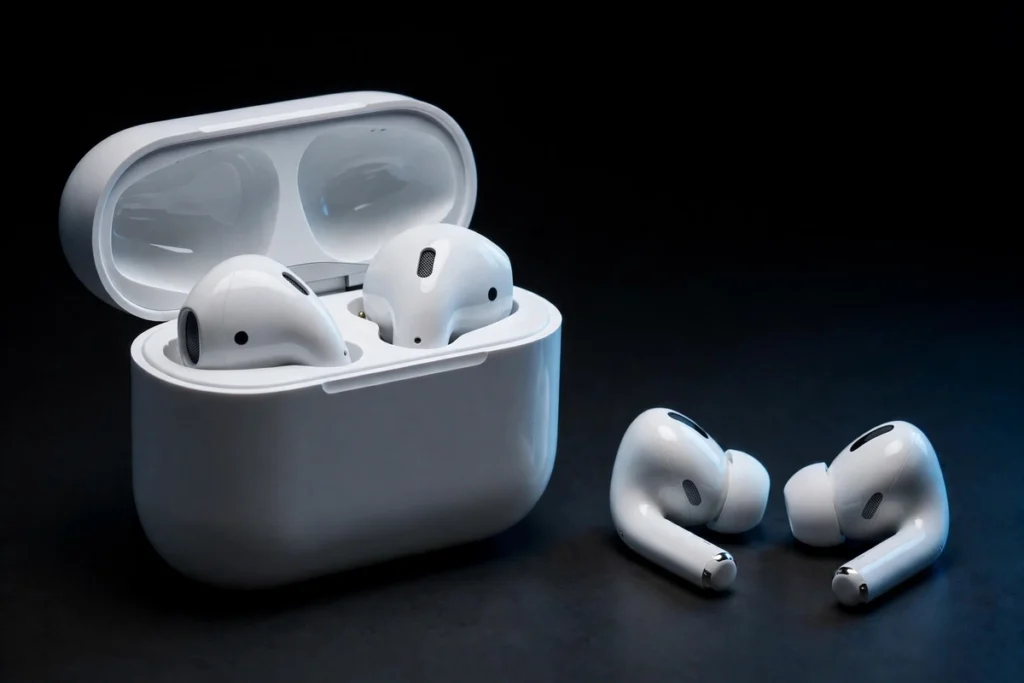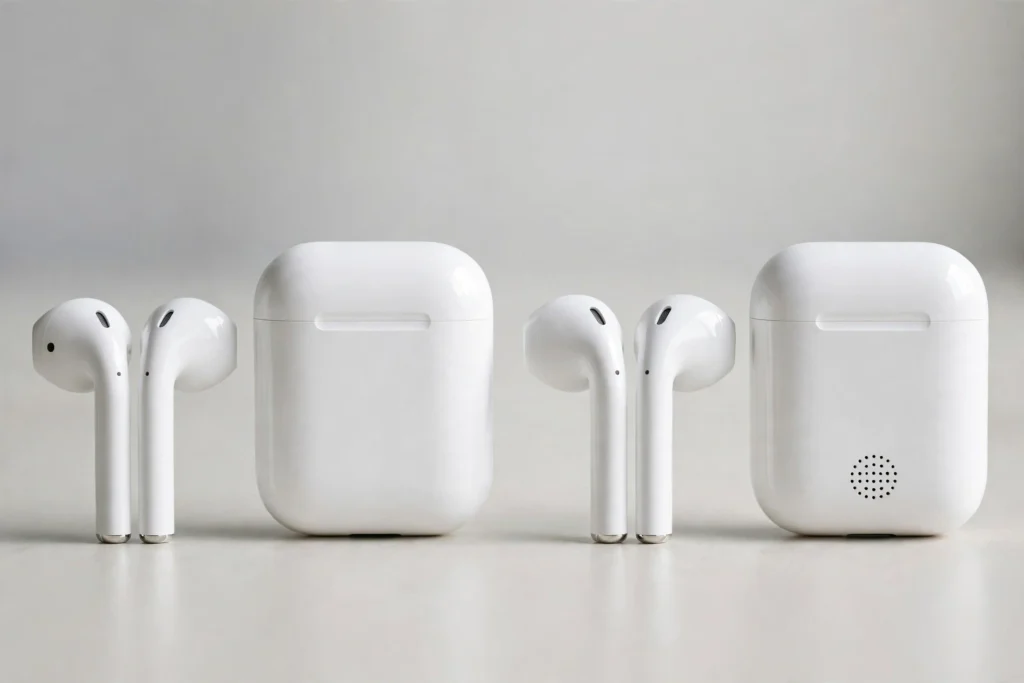
Apple sells two earbuds with the same name, the same shape and the same chip — and the airpods 4 with vs without noise cancellation decision is the one choice that actually separates them. The Apple AirPods 4 are open-ear earbuds with no noise control at all. The Apple AirPods 4 with Active Noise Cancellation add ANC and a whole suite of listening modes, plus a better charging case — and they cost more for it. Everything else, from the H2 chip to the drivers to the fit, is shared. Built from Apple’s published specifications and review coverage — SoundMavericks’ analysis leads; no hands-on testing is claimed.
The short version: in quiet rooms, or outdoors where hearing traffic matters, the base model’s identical sound hardware and longer uninterrupted battery rating make it the value pick. If you commute, fly, share an office or take calls in noisy places, buy the ANC model — its noise control modes cannot be added later.
Our verdict
Best for most iPhone owners: AirPods 4 with Active Noise Cancellation — ANC, Adaptive Audio, Transparency and Conversation Awareness, plus a wireless-charging case with a Find My speaker. Best value: the standard AirPods 4 — same chip, fit, sound hardware and headline battery rating, for quiet-place listening.

AirPods 4 vs AirPods 4 with ANC: Specs Compared
| Spec | Apple AirPods 4 | Apple AirPods 4 with Active Noise Cancellation |
|---|---|---|
| Chip | Apple H2 | Apple H2 |
| Active Noise Cancellation | No | Yes |
| Adaptive Audio / Transparency / Conversation Awareness | No | Yes — all three |
| Fit and sound hardware | Open-ear, no tips; custom low-distortion driver, high dynamic range amp, Adaptive EQ | Identical |
| Battery (earbuds) | Up to 5 hours per charge | Up to 5 hours (up to 4 hours with ANC on) |
| Battery (with case) | Up to 30 hours total | Up to 30 hours total (up to 20 hours with ANC on) |
| Case charging | USB-C only | USB-C plus wireless (MagSafe, Qi, Apple Watch charger) |
| Find My speaker in case | No | Yes |
| Controls | Force sensor on stem (press); no swipe volume | Force sensor on stem (press); no swipe volume |
| Bluetooth / IP rating | Bluetooth 5.3 / IP54 (buds and case) | Bluetooth 5.3 / IP54 (buds and case) |
| Check Price | Check Price on Amazon | Check Price on Amazon |
What Is Identical: Same Chip, Same Fit, Same Sound
Start with what the extra money does not buy, because it is most of the product. Both versions run Apple’s H2 chip, both use the same open-ear shape refined from thousands of ear scans, and both sit in the ear with no silicone tip and no seal. The acoustic hardware is shared too: a custom low-distortion driver, a high dynamic range amplifier, Adaptive EQ that tunes playback to your ear shape, and Personalized Spatial Audio with dynamic head tracking. Voice Isolation for calls, Siri Interactions (answer by nodding, decline by shaking your head), automatic switching between Apple devices and Audio Sharing are on both spec sheets, because all of them are H2 features rather than ANC features.
That parity has a practical consequence buyers miss: music sounds essentially the same on both models at the same volume in the same room. Published comparisons consistently treat the two as one product for sound quality. Where they diverge is not the audio itself but what the earbuds do about the noise around the audio — and one case upgrade. If your listening happens somewhere quiet, the base model is not a compromised version of the ANC model. It is the same earbud with the noise-control electronics left out.
Noise Cancellation: What the ANC Model Actually Adds
The upgrade is a bundle, not a single switch. The with-ANC model adds four listening behaviours the base model does not have at all:
- Active Noise Cancellation — the H2 chip and inward- and outward-facing microphones generate anti-noise that reduces environmental sound before it reaches you.
- Transparency mode — the microphones pipe the outside world back in, so announcements, traffic and conversation stay audible without removing an earbud.
- Adaptive Audio — blends ANC and Transparency dynamically, dialling cancellation up in a loud street and down in a quiet one without you touching a control.
- Conversation Awareness — detects when you start speaking and automatically lowers playback and reduces background noise so a quick exchange does not require pausing.
That last trio is why owners describe the ANC model as the smarter everyday earbud rather than just the quieter one. Adaptive Audio in particular removes the mode-switching chore that made earlier ANC earbuds fiddly. For a deeper look at how these modes relate, see our explainer on noise cancelling vs transparency mode, and our dedicated AirPods 4 with ANC review for the full feature-by-feature breakdown of the ANC model on its own.
How good is open-ear ANC, really?
Set expectations honestly. With no silicone tip, there is no passive seal doing half the work, so the AirPods 4 with ANC cannot match a sealed design: Apple itself rates the in-ear AirPods Pro line as cancelling substantially more noise. Published lab measurements of the AirPods 4 with ANC found reductions of up to roughly 20 dB at the frequencies where the system works best — a genuinely large cut for an open design, strongest on the steady, low-to-mid sounds of offices, air conditioning, café chatter and street hum. Sharp, irregular sounds and the deepest engine rumble still get through more than they would with a sealed bud. Our guide to active noise cancellation vs passive isolation explains why the missing seal sets that ceiling. Frequent flyers who want maximum hush should be shopping sealed earbuds instead; for everyone else, open-ear ANC takes the edge off the day without the plugged-ear feeling.
The Case Is a Bigger Difference Than It Looks
The second half of the upgrade is the charging case, and it is the difference buyers feel most often after the first week. The ANC model’s case charges over USB-C and wirelessly — on MagSafe and Qi pads and on an Apple Watch charger — and it contains a built-in speaker for Find My, so a misplaced case can play a sound to reveal itself from under a sofa cushion. The base model’s case is USB-C only, with no speaker: Find My can still show the earbuds’ location on a map, but the case itself cannot chime.
Neither case is large — both are more than ten percent smaller by volume than the previous generation’s case, and the ANC case is only slightly heavier. The real question is habit. If your desk, car or nightstand already has a wireless pad you use daily, the base model’s cable-only case will annoy you every single day. If you charge everything by cable anyway, this entire section is worth nothing to you, and that is a legitimate reason to save the money.
Battery Life: The One Place the Base Model Fights Back
On headline numbers the two models tie: Apple rates both at up to 5 hours of listening per charge and up to 30 hours total with case recharges. The catch is that the ANC model only reaches those figures with noise control switched off. Run it the way you bought it — ANC on — and Apple’s rating drops to up to 4 hours per charge and up to 20 hours with the case. The base model has no such penalty because it has nothing to switch on: its 5-hour and 30-hour ratings are simply what you get, every time.
In practice both cases refill the buds quickly enough that the gap matters mainly on long listening days without case access. But it reframes the value question neatly: part of what the extra money buys (noise cancelling) costs you battery, while the cheaper model quietly keeps the longest uninterrupted runtime in the pair.
Controls and Everyday Features: A Tie
Both models use the same force sensor in the stem: press once to play or pause and to answer calls, twice to skip forward, three times to skip back, and press and hold to summon Siri. Neither model has the swipe-to-adjust-volume control found on the Pro line — a shared omission worth knowing about, since it is sometimes assumed to be part of the ANC upgrade. It is not. Volume on both AirPods 4 versions means reaching for the phone or asking Siri.
Durability and connectivity also tie. Both earbuds and both cases are rated IP54 for dust, sweat and water resistance — fine for workouts and rain, not for swimming. Both run Bluetooth 5.3, both pair with the usual one-tap iPhone setup, and both work as ordinary Bluetooth earbuds with Android and Windows, with the smart features reserved for Apple’s ecosystem. There is no winner in this section, and that is the point: day to day, outside of noise control and charging, these are the same earbuds.
The Verdict: Is Active Noise Cancellation Worth the Extra Money?
Buy the AirPods 4 with Active Noise Cancellation if any of these sound like your week: a train, bus or open-plan office in it; regular flights; calls taken on busy streets; or a wireless charging pad already living on your desk. The noise control suite is the only functional gap between the two models, and it is a large one — Adaptive Audio and Conversation Awareness change behaviour you will notice daily, and the chime-able, wirelessly charging case removes two small frustrations permanently. It costs more, and for this buyer the premium earns its keep.
Buy the standard AirPods 4 if you listen mostly at home or in quiet spaces, run or walk outdoors where hearing your surroundings is a safety feature rather than a distraction, or know you would leave noise cancelling off anyway. You keep the identical H2 chip, fit, sound hardware and controls, the joint-best battery rating with no ANC penalty, and money in your pocket. What you give up is specific: the four noise-control modes, wireless case charging and the Find My speaker. If none of those three would change your routine, the base model is the smart buy, not the cheap one.
And if this comparison has convinced you that you want the strongest cancellation Apple makes rather than the most comfortable fit, neither of these is the endpoint — the sealed Pro line is. Our roundup of the best noise cancelling earbuds covers that tier across brands.
Frequently Asked Questions
What is the difference between AirPods 4 with and without ANC?
The earbuds themselves share the same H2 chip, open-ear fit, drivers and controls. The with-ANC model adds Active Noise Cancellation, Adaptive Audio, Transparency mode and Conversation Awareness, and its case adds wireless charging and a Find My speaker. The standard model has no noise control modes and a USB-C-only case.
Is AirPods 4 ANC worth it over the standard AirPods 4?
For commuters, flyers, office workers and anyone who takes calls in noisy places, yes — the noise control modes and the better case change daily use. For quiet home listening or outdoor exercise where awareness matters, the standard model delivers the same sound and battery for less money.
Do both AirPods 4 models sound the same?
Essentially, yes. Both use the same custom driver, high dynamic range amplifier, Adaptive EQ and Personalized Spatial Audio on the same H2 chip, so music reproduction is shared. The audible difference comes from how much outside noise each model lets reach you while you listen.
Does the standard AirPods 4 case support wireless charging?
No. The standard AirPods 4 case charges over USB-C only and has no Find My speaker. Wireless charging (MagSafe, Qi and Apple Watch chargers) and the chime-able case are exclusive to the AirPods 4 with Active Noise Cancellation.
How long does the battery last on each model?
Apple rates both at up to 5 hours per charge and 30 hours total with the case. With noise cancelling switched on, the ANC model’s rating falls to up to 4 hours per charge and 20 hours total with the case; the standard model has no noise control, so its ratings apply at all times.
Do either of the AirPods 4 models have swipe volume control?
No. Both models use a force sensor in the stem for play, pause, track skipping and calls, and neither offers the swipe volume gesture found on the AirPods Pro line. Volume is adjusted on the connected device or by asking Siri.

I am the founder of Sound Mavericks, where I provide the polite truth about audio equipment. I started this site because consumer electronics reviews are often too technical. Instead of using a silent lab, I test headphones, earbuds, and Bluetooth speakers in the real world – like on a noisy subway or in a busy coffee shop.
To stay independent, I buy my own review units (mostly from the United States) rather than accepting free gifts from brands. Once I finish testing a product, I sell it locally to our community. My goal is to help you understand sound quality, active noise cancellation (ANC), and battery life without the marketing hype.