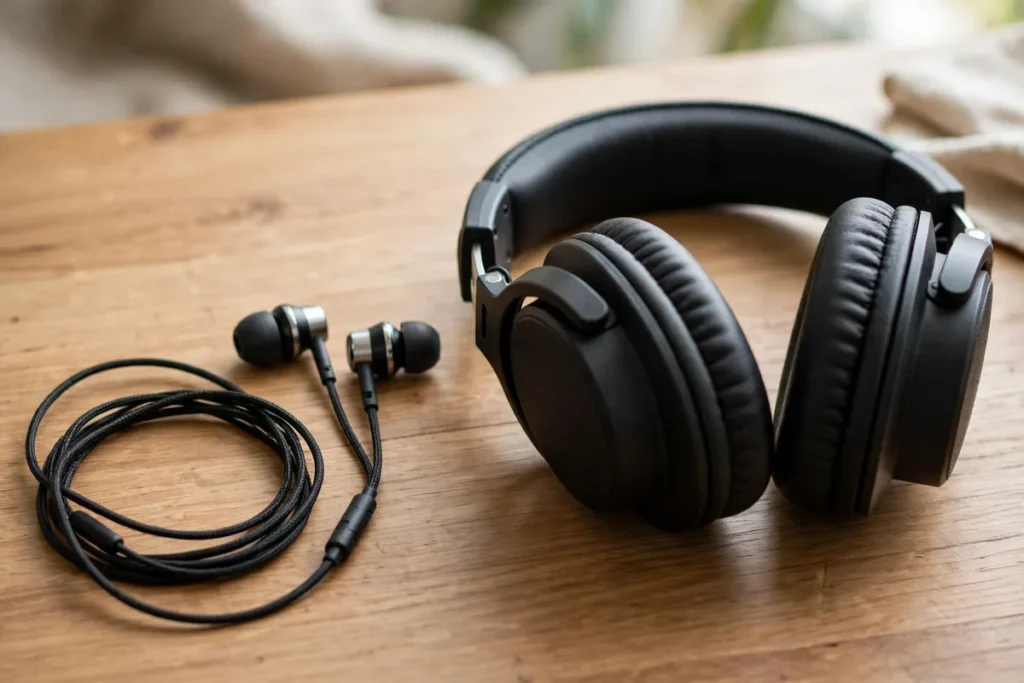
Play the same recording through both and the puzzle of why do in ear and over ear headphones sound so different arrives in seconds. The in-ears put the singer close and dry, every detail near the front. The over-ears spread the band out, softer at the edges, more like a room. Neither is broken, and neither is simply better. They sound different because they are built differently, they use your ears differently, and they sit at completely different distances from your eardrum. Three physical reasons explain most of the gap.
Reason one: the drivers are not the same size
What Hi-Fi?, in its explainer on exactly this question, puts the scale plainly: an in-ear driver is typically around four or five millimetres across, an over-ear driver 40mm or 50mm, which works out to roughly a hundred times the surface area. A big diaphragm moves a lot of air with small, controlled excursions, so it stays composed when the music gets loud and busy. A small in-ear driver has to work much harder per note.
Context rescues the small driver, though. It fires into a sealed canal, a tiny volume of air it can pressurise completely, so it needs only minute movements to produce full volume and deep bass. The over-ear driver fills a cup, leaks around a pad, and works in open air by comparison. Size explains the character, effortless scale from the big driver, intensity from the small one, but it does not crown a winner. Our head-to-head of IEMs vs headphones tests that trade-off across real models.
Reason two: one design uses your outer ear, the other skips it
Your outer ear is not decoration. Its folds filter sound in a pattern your brain learned in childhood, boosting some frequencies, cutting others, and using the differences to judge where a sound comes from. Over-ear headphones play through that filter: sound crosses the whole outer ear before entering the canal, so the brain receives familiar cues and places the music in a space around your head.
An in-ear sits past all of that. It seals into the canal and delivers sound that never touches the outer ear, so the filter is removed from the chain. What Hi-Fi? makes the same point with a piano: the same instrument sounds different through buds lodged in the canal than heard with the whole outer ear involved. That missing filter is a large part of why in-ears sound direct and close, and why their stereo image tends to sit inside the head rather than in front of it. It also explains why in-ear tuning targets differ from over-ear targets: the maker has to build the missing ear gain back into the earphone’s own response. The style categories behind this are laid out in our guide to in-ear vs earbuds vs over-ear headphone style.
Reason three: distance and the space around the driver
An in-ear driver sits millimetres from your eardrum. Almost nothing is lost on the way, which is why in-ears can sound fast and detailed: the full signal arrives, undisturbed. An over-ear driver sits centimetres away, across a cup of air, and that small journey changes the sound. The cup itself becomes part of the instrument. In a closed-back model its reflections add warmth and a slight boxiness; in an open-back model the sound escapes and arrives airier, at the cost of isolation. Our explainer on what soundstage is in headphones and our comparison of open-back vs closed-back headphones both start from this same centimetres-versus-millimetres fact.
Fit multiplies everything above. An in-ear with a shallow or loose tip loses its seal, and with it the bass and the isolation, so the same earphone can sound thin on Monday and full on Tuesday. An over-ear depends on pad seal and clamp; glasses arms leak bass in exactly the same spirit. When two people argue about the same headphone, they are often describing two different fits.
A fourth factor: each design is tuned to a different target
Because the two designs deliver sound so differently, they are not even tuned to the same goalposts. In-ear measurements are taken at a simulated eardrum, past the point where the outer ear would have shaped the sound, so in-ear makers build the ear’s missing boost into the product itself. Over-ear measurements include a simulated outer ear, so their targets assume that filtering is present. Put the two products on the same graph and they look wildly different; put each on a listener and both can sound balanced. This is also why copying an EQ setting from an over-ear to an in-ear disappoints: the numbers were answering different questions.
Electronics widen the gap further in wireless models. A big over-ear has room for larger batteries, more microphones and more processing, so its noise cancelling and spatial effects can be more ambitious. A wireless in-ear spends its tiny budget of space and power carefully, and leans on its seal instead. None of this is about one format being more advanced. It is about each format spending the same physics differently, which is the whole story of this article in one sentence.
Hear the difference: three reference points
These three models mark the positions clearly: a sealed in-ear, a sealed over-ear, and an open-back over-ear. Listening to the same track across all three is the fastest way to feel the three reasons above working.

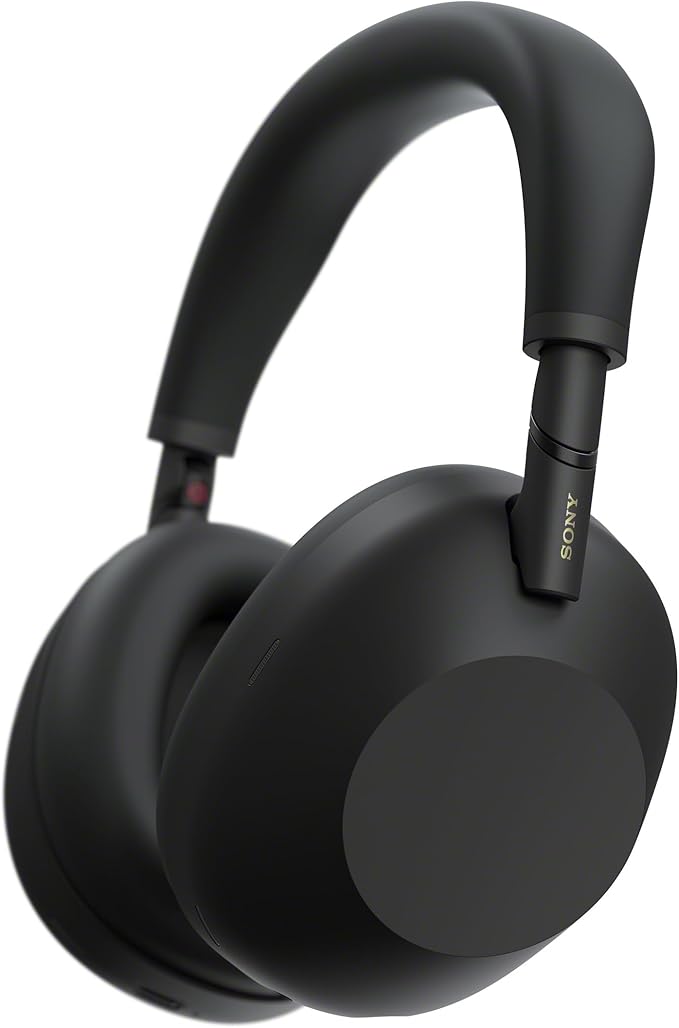

The Sundara’s open presentation is covered in full in our HiFiMan Sundara review. Notice, comparing the three, that the differences track this article exactly: proximity and detail from the IE 200, space and ease from the over-ears, and the open back trading isolation for air.
Which presentation will you prefer?
Choose in-ears if you listen on the move, want isolation without electronics, or love hearing fine detail pulled forward. Choose over-ears if you listen at a desk or sofa, prefer a wider and more relaxed picture, or wear headphones for hours at a stretch. Many listeners keep both, because the two presentations suit different music and different moods. The difference between them is not a flaw in either design. It is the sound of three physical facts, and once you hear them as facts, you can shop for the presentation you actually want.
Frequently asked questions
Do bigger drivers always sound better?
No. A large over-ear driver moves more air with less effort, which helps it stay clean at volume, but the sealed space an in-ear works in is so small that a tiny driver fills it completely. Tuning, fit and seal decide far more than diameter. Plenty of small in-ears out-resolve large, cheap over-ears.
Why does the same earphone sound different in my ears than in someone else’s?
Because no two ear canals match. Canal length and shape shift the resonance peak an in-ear produces, and tip depth changes it again, so the treble you hear is partly your own anatomy. Over-ears vary less between listeners because the outer ear shapes sound more consistently, though glasses and hair still break the seal and change the bass.
Why do in-ears feel like the music is inside my head?
Because the sound bypasses your outer ear and arrives with none of the spatial cues your brain uses to place sounds outside you. Both ears receive clean, separate signals with no crossfeed and no pinna filtering, so the image collapses to a line between your ears. Over-ears keep some of those cues, which is why they feel wider.
Can in-ear headphones have good bass with such small drivers?
Yes, and the seal is the reason. An in-ear pressurises a tiny, closed volume of air, so a small diaphragm moving a short distance builds strong low frequencies. Break the seal with a loose tip and the bass vanishes, which is why fit changes an in-ear’s sound more than any other single factor.
Which sounds better, in-ear or over-ear?
Neither, as a category. In-ears win on detail per gram, isolation and portability. Over-ears win on spaciousness, natural tone and long-session comfort. The better question is which presentation you prefer and where you listen, because a top model of either type will outplay a mediocre model of the other.

I am the founder of Sound Mavericks, where I provide the polite truth about audio equipment. I started this site because consumer electronics reviews are often too technical. Instead of using a silent lab, I test headphones, earbuds, and Bluetooth speakers in the real world – like on a noisy subway or in a busy coffee shop.
To stay independent, I buy my own review units (mostly from the United States) rather than accepting free gifts from brands. Once I finish testing a product, I sell it locally to our community. My goal is to help you understand sound quality, active noise cancellation (ANC), and battery life without the marketing hype.