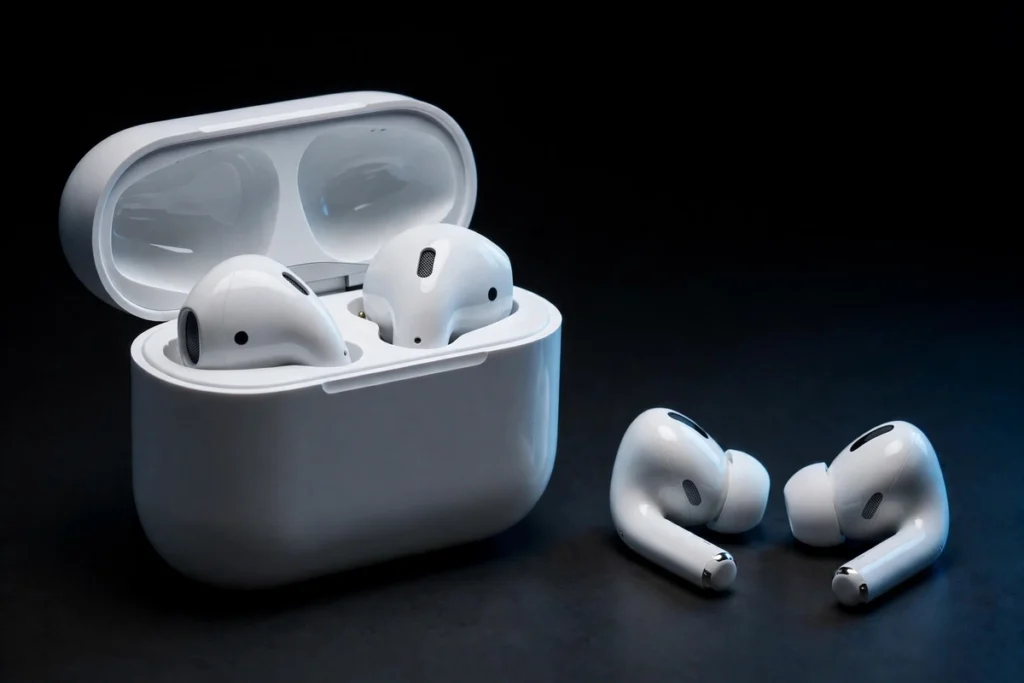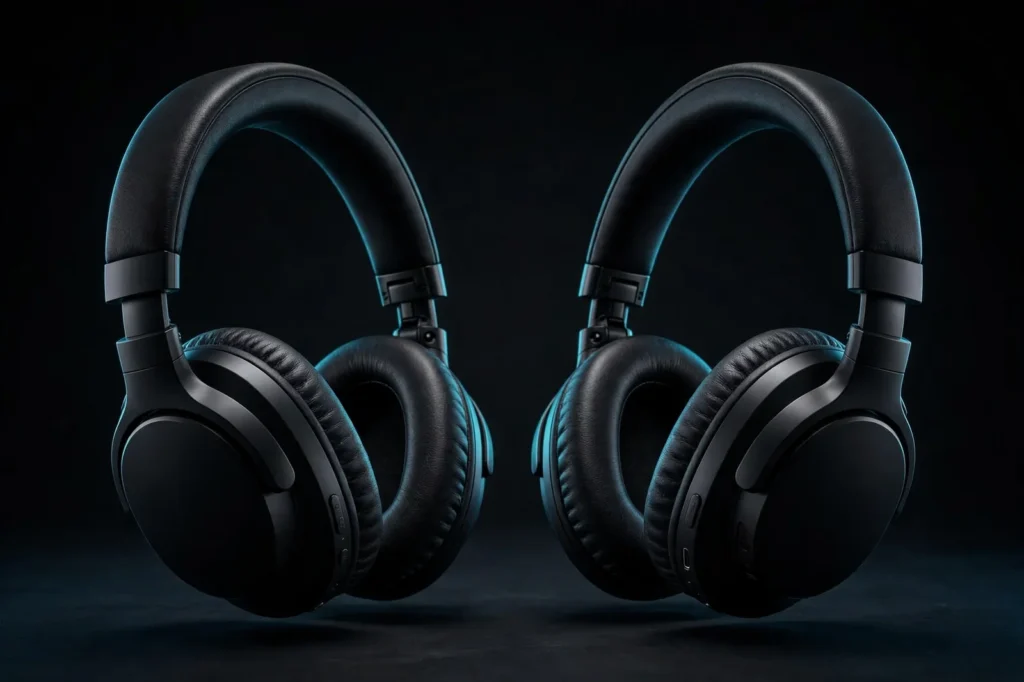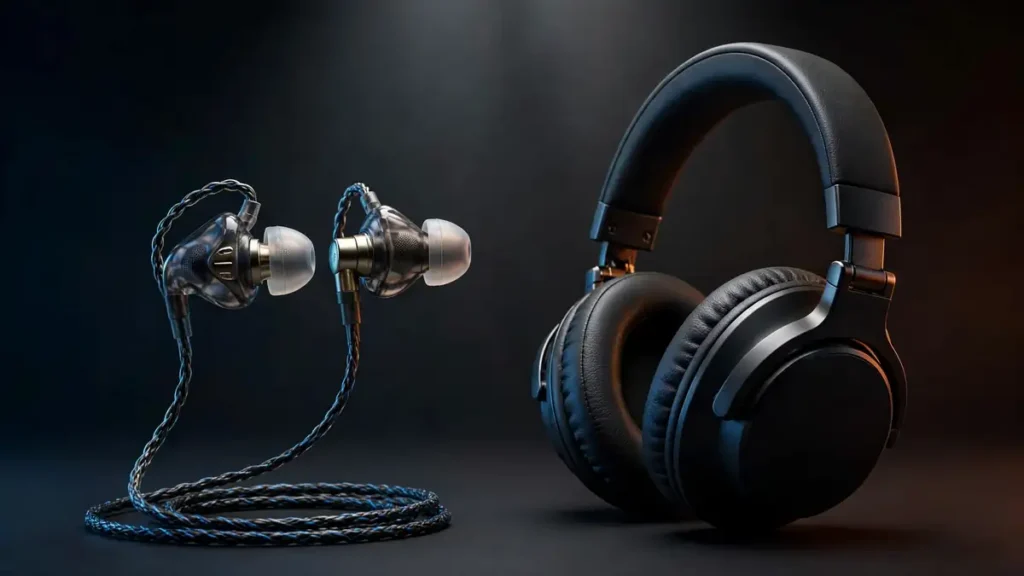
Neither is objectively better — they’re built for different jobs. IEMs (in-ear monitors) seal into your ear canal, giving you outstanding passive noise isolation, a detailed, intimate sound, and a fit you can wear on stage or on the move. Headphones (especially over-ears) deliver a bigger, more spacious soundstage, longer-wearing comfort, and stronger active noise cancelling. Choose IEMs for stage work, maximum portability, and value; choose headphones for immersion, long listening sessions, and serious ANC.
IEMs vs headphones is one of the most common debates in personal audio — and most comparisons answer it with vague generalities. This one won’t. Below, SoundMavericks breaks down exactly how in-ear monitors and traditional headphones differ in sound, isolation, comfort, and real-world use cases like live performance, commuting, and gaming, so you can buy the right tool for your ears.
IEMs vs Headphones: Quick Comparison
| Aspect | IEMs (In-Ear Monitors) | Headphones (Over-Ear / On-Ear) |
|---|---|---|
| Fit | Sit inside the ear canal with silicone or foam tips; seal is everything | Cups sit on or around the ears with a headband; no ear-canal insertion |
| Noise isolation | Excellent passive isolation — the seal physically blocks outside noise | Varies by design; ANC models actively cancel low-frequency drone |
| Soundstage | Intimate, “in your head”; imaging can be pinpoint precise | Wider and more spacious; open-backs feel the most speaker-like |
| Detail retrieval | Superb — the sealed canal coupling reveals micro-detail easily | Excellent on good models; planar and electrostatic designs compete at the top |
| Comfort (long sessions) | Light and unobtrusive once the fit is right; wrong tips cause fatigue | Generally easier for multi-hour listening; clamp force and heat are the tradeoffs |
| Portability | Pocket-sized; the clear winner for travel and stage bags | Bulkier, even when folding; needs a case or bag |
| Durability / maintenance | Tips and nozzles need regular cleaning; detachable cables extend lifespan | Pads and headbands wear over time; easier to share and wipe down |
| Best for | Live performers, commuters, gamers, detail-focused listeners | Home listening, frequent flyers, office work, long sessions |
What Are IEMs?
IEM stands for in-ear monitor. These are precision earpieces originally designed for live musicians, who needed to hear their own mix on a loud stage without wedge monitors blasting at them. An IEM inserts into the ear canal and seals it, turning your ear canal itself into part of the acoustic chamber. That seal is the whole game: it blocks ambient noise passively and lets even a tiny driver deliver full, detailed sound at lower volumes.
Modern IEMs range from single-dynamic-driver models to multi-driver hybrids — and they’ve gone far beyond the stage. Audiophiles, commuters, and gamers now use them as everyday headphones because the isolation and detail-per-dollar are hard to beat. If you’re shopping for a pair, our best IEMs guide breaks down the standouts by budget and use case.
What Are Headphones?
“Headphones” usually means the classic design: two earcups connected by a headband, worn on or around the ears. The main families are over-ear (cups surround the ear), on-ear (cups press on the ear), and open-back vs closed-back (whether the outer shell vents sound). Wireless noise-cancelling over-ears are the dominant mainstream choice today, while open-back models remain the reference for critical home listening. For a fuller breakdown of the form factors, see our in-ear vs earbuds vs over-ear style guide.
The fundamental difference from IEMs is distance: headphone drivers sit centimeters from your eardrum, firing into the open air of the earcup rather than sealing your canal. That changes everything about how the sound is presented — more on that next.
Sound Quality: The Real Differences
This is where the debate gets heated — and where most comparisons get lazy. Here’s SoundMavericks’ honest breakdown of the audible differences.
Soundstage and imaging
The single biggest sonic difference is presentation. Headphones — especially open-backs — create a wide, expansive soundstage that can feel like music is happening in a room around you. IEMs sound more intimate and “in your head.” For orchestral music, live recordings, and immersive gaming, most listeners prefer the spaciousness of headphones; premium IEMs can still image (place instruments precisely) just as accurately within a narrower stage.
Detail and resolution
Here’s the surprise for many first-time buyers: IEMs often reveal more fine detail than similarly priced headphones. Because the driver couples directly to your sealed ear canal, there’s no room reflection and far less ambient masking, so micro-detail — breath, string texture, reverb tails — comes through effortlessly. Headphones fight back at the top end: high-quality planar magnetic drivers and electrostatics resolve detail with a physicality small IEM drivers can’t fully match.
Bass
It’s a split decision. Headphones move more air, so they deliver a more visceral, felt-in-your-chest bass. IEMs, with their sealed fit, can produce extremely deep, controlled, and fast bass that sounds precise rather than boomy — many listeners find a well-sealed IEM’s sub-bass more satisfying than a headphone’s. If you want bass you feel, go headphones; if you want bass you can dissect, go IEMs.
Tuning variety
One underrated IEM advantage: the market’s sheer tuning diversity. From neutral studio-style signatures to thunderous V-shapes, there’s an IEM tuned for nearly every taste at every price. Headphones, particularly mainstream ANC models, tend to cluster around a few safe, crowd-pleasing tunings.
Noise Isolation: IEMs Win on Physics
A properly sealed IEM is one of the most effective passive noise blockers you can wear — a deep-insertion fit with foam tips can attenuate as much as dedicated earplugs in the mid and high frequencies. That’s why IEMs are the stage standard. This isolation works everywhere and never needs charging.
Headphones answer with active noise cancelling. ANC is unbeatable against constant low-frequency drone — airplane engines, train rumble, air conditioners. But it’s less effective against sudden sounds (voices, clatter) and needs battery power. Our take: IEMs isolate more total noise across more situations; ANC headphones are more comfortable for long flights where the drone never stops. Want the deeper science? Read our ANC vs passive isolation explainer.
Fit and Comfort
Comfort is the most personal part of this comparison, and the honest answer is that it depends on your ears.
IEMs win on weight and unobtrusiveness — a good pair practically disappears once inserted. The catch is the fit lottery: a bad seal means weak bass, poor isolation, and soreness within an hour. Trying different silicone and foam tips solves this for most people — but some listeners simply never tolerate anything inside the canal.
Headphones are more universally comfortable out of the box — nothing goes in your ears. The tradeoffs are clamping force (the headband squeezing your temples), heat buildup under the pads, and weight on long sessions. Lightweight models with soft pads fix most of this, which is why over-ears remain the default for desk workers and long-haul travelers.
Portability and Everyday Practicality
No contest here: IEMs win portability outright. A pair of IEMs coils into a pocket or a tiny case; even folding over-ears need a bag. For gym bags, stage kits, and minimalist carry, IEMs are the practical choice.
Maintenance differs too. IEM nozzles and tips collect earwax and need regular cleaning — neglect them and sound quality suffers. Headphone earpads absorb sweat and oils, eventually cracking or flattening, but pads are usually replaceable and the units are easier to share with a quick wipe.
IEMs vs Headphones by Use Case
On stage and live performance
IEMs, and it’s not close. They were invented for this: compact, secure under movement, and isolating enough to protect hearing in front of a drum kit. No headphone competes for stage monitoring — full-size cans fall off, leak sound into vocal mics, and can’t match the isolation.
Studio work
Split by task. For tracking (recording), closed-back headphones are the studio standard — they keep backing tracks from bleeding into microphones, and they’re easy to slip on and off between takes. IEMs earn their place for checking mixes on a “sealed, detailed” reference and for portable editing.
Commuting and travel
IEMs for the commute, headphones for the flight. On trains and buses, IEMs’ passive isolation kills chatter and brake squeal with zero battery drain, and they disappear into a pocket at your stop. On long flights, the sustained comfort and low-frequency ANC of over-ears usually wins.
Gaming
It depends on the game. Competitive FPS players increasingly swear by IEMs: the sealed fit reveals footsteps and reload cues with startling clarity. For cinematic single-player games, over-ear headsets deliver the wide soundstage and physical bass that make explosions land. Either way, a good microphone matters — see our best IEMs for gaming picks.
Calls and office work
Headphones, slightly. Over-ears with beamforming mics generally pick up voice more naturally, multipoint pairing juggles laptop and phone seamlessly, and wearing them signals “I’m in a meeting” to coworkers.
Who Should Buy IEMs?
- Live musicians and performers — the original and still best use case.
- Commuters and travelers who pack light — maximum isolation per cubic inch.
- Detail-obsessed listeners — hear deeper into recordings at any given price.
- Gamers who want precise positional audio without headset bulk.
- Anyone on a budget chasing flagship sound — the IEM market’s value curve is unmatched.
Who Should Buy Headphones?
- Home listeners who want the most spacious, speaker-like presentation.
- Frequent flyers — ANC plus long-wearing comfort is the winning combo.
- Desk and office workers — easy on/off, great mics, multipoint convenience.
- Listeners who dislike in-ear fit — no seal to fight with, ever.
- Bass lovers who want to feel the low end, not just hear it.
Two Concrete Examples: See the Difference for Yourself
Abstractions only go so far. Here are two benchmark products — one from each camp — that embody everything described above.

The IEM: Shure SE215 PRO
The stage classic. A single dynamic driver in a rugged over-ear-cable design, with a sealed fit Shure rates at up to 37 dB of isolation. Detachable cables mean it survives years of gig bags — detailed, focused, and unbothered by outside noise.

The Headphone: Sony WH-1000XM5
The flagship over-ear experience. Class-leading active noise cancelling that erases engine drone, a wide and refined soundstage, and all-day comfort. Where the SE215 PRO shuts the world out with a seal, the XM5 does it with processing — plus multipoint Bluetooth and strong call quality.
SoundMavericks’ Verdict
After laying the two side by side, our analysis lands here: most people should own both eventually — but buy in this order. Commute, stage, gym bag, and competitive gaming lean IEM; home listening, flights, office, and cinematic immersion lean headphones. Both categories now offer genuinely excellent sound at every tier, so there’s no wrong answer — only a wrong fit for your routine.
If you’ve decided IEMs are your next step, our best IEMs of 2026 guide is the natural place to continue.
Frequently Asked Questions
Are IEMs better than headphones for sound quality?
Not universally — they’re different. IEMs typically reveal more fine detail thanks to their sealed coupling with the ear canal, and they often sound more precise in the bass. Headphones, especially open-back and planar magnetic models, deliver a wider, more spacious soundstage and more physical bass. For pure detail-per-dollar, IEMs usually win; for immersion and spaciousness, headphones win.
Can IEMs damage your hearing?
IEMs are not inherently more dangerous than headphones — hearing damage comes from volume and duration, not form factor. In fact, their strong isolation often lets you listen at lower volumes in noisy environments, which is protective. The real risks are the same as with any earphone: cranking the volume to overcome noise and listening for very long stretches. Keep levels moderate and take breaks.
Do IEMs block more noise than ANC headphones?
A well-sealed IEM blocks more total noise across the frequency range, especially voices and sudden sounds, purely through physics. ANC headphones are superior against constant low-frequency drone like airplane engines. For the daily commute, IEMs usually isolate more; for long flights, ANC headphones feel more effective and comfortable.
Are IEMs good for gaming?
Yes — increasingly, they’re a top choice. The sealed fit delivers excellent positional detail for hearing footsteps and directional cues in competitive games, and they avoid the clamp and heat of bulky headsets during long sessions. For cinematic single-player games, over-ear headsets still deliver a bigger soundstage and more impactful bass. Pair either with a quality microphone for team chat.
Should I get IEMs or headphones for working out?
IEMs, in most cases. They’re lighter, stay secure during movement, resist sweat better, and their isolation keeps gym noise out. Over-ear headphones trap heat and can slip when you sweat. Just choose a model with a secure over-ear cable fit or true-wireless design rated for exercise.
What’s the difference between IEMs and regular earbuds?
IEMs insert into the ear canal and seal it, which is what gives them their strong isolation and detailed sound. Regular earbuds rest in the outer ear without sealing it, so they leak sound in and out and can’t match IEM bass or isolation. IEMs also tend to use higher-quality drivers and detachable cables, and they were originally designed for professional stage monitoring rather than casual listening.

I am the founder of Sound Mavericks, where I provide the polite truth about audio equipment. I started this site because consumer electronics reviews are often too technical. Instead of using a silent lab, I test headphones, earbuds, and Bluetooth speakers in the real world – like on a noisy subway or in a busy coffee shop.
To stay independent, I buy my own review units (mostly from the United States) rather than accepting free gifts from brands. Once I finish testing a product, I sell it locally to our community. My goal is to help you understand sound quality, active noise cancellation (ANC), and battery life without the marketing hype.