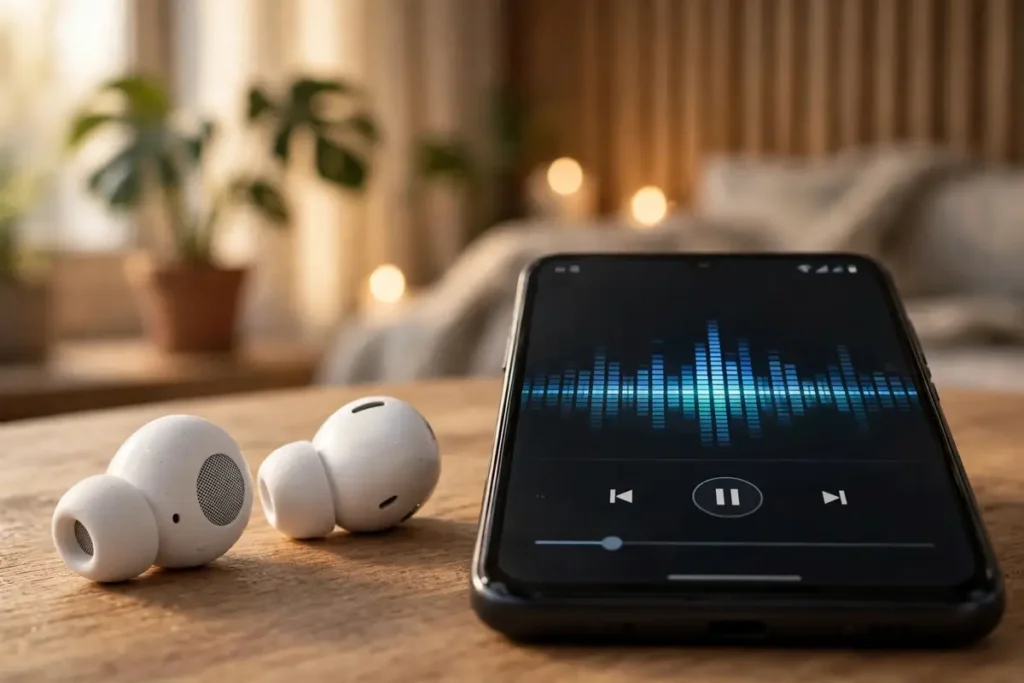
If you have seen a badge on a box and wondered what is snapdragon sound, the short answer is that it is not a codec. It is Qualcomm’s umbrella label for a set of audio technologies that only work when the phone and the earbuds both carry the right Qualcomm chips. Under that badge sit aptX Adaptive, the aptX Lossless mode, low-latency gaming audio, stronger Bluetooth connections and wideband call voice. The badge is a promise that both ends of the link were built to the same plan.
What the badge actually certifies
Snapdragon Sound is a certification as much as a feature list. Qualcomm tests and licenses the combination, so a phone and a pair of earbuds carrying the badge are meant to deliver the full stack together. Pocket-lint’s explainer puts the condition plainly: to benefit, both the phone or laptop and the headphones need to use Qualcomm hardware inside. One end alone is not enough, and that single fact explains most of the confusion around the label.
The headline feature: aptX Lossless
aptX Lossless is the part people actually hear about. Qualcomm describes it as mathematically bit-for-bit exact CD-quality audio, 16-bit at 44.1kHz, carried over Bluetooth at roughly 1Mbps. What Hi-Fi? reported Qualcomm’s figure of 1.1 to 1.2Mbps for that CD-quality stream, the highest rate Bluetooth audio had been asked to sustain. Every codec before it, including LDAC at its top setting and aptX HD, threw some data away. Lossless, at full link strength, throws none away.
How it scales when the signal weakens
The honest detail is the scaling. aptX Lossless is a mode inside aptX Adaptive, and it steps the bitrate down as the radio link gets worse, in a crowded station or a pocket full of keys. You keep the music, you may lose the lossless part for a while, and the earbuds do not always tell you. Qualcomm also lets listeners choose a 24-bit 96kHz lossy mode instead, which trades the bit-perfect claim for a higher sample rate.
More than music: latency and calls
The suite also targets gaming latency, cutting the delay between phone and earbuds so gunshots and dialogue land on time, and super wideband voice for calls, which carries more of your voice’s range than the old narrowband standard. Connection robustness is the third pillar: the link is tuned to hold in busy radio environments like airports. Our guide to Bluetooth codecs explained covers where aptX sits against AAC and LDAC in daily use.
What your phone needs
Your phone needs a Snapdragon platform that supports the suite, and the earbuds need a matching Qualcomm audio chip. There is no software update that adds it later; Pocket-lint noted that existing Snapdragon Sound devices without the Lossless hardware cannot be upgraded to it. Before paying extra for a badged earbud, check your phone’s spec sheet for the badge first. If the phone lacks it, a good LDAC earbud is often the smarter buy, as the picks below show.
Earbuds that show the alternatives
These three records from our scoring show the neighbouring ground: high-resolution LDAC support done well, and the low-latency gaming route taken with a dedicated dongle instead of a phone codec.


What the numbers mean in practice
A standard SBC stream runs at a fraction of the lossless rate, and AAC on most phones sits in a similar band. aptX HD pushed the rate higher, and LDAC at its top setting goes further again, which is why LDAC earbuds earned their high-resolution reputation. The lossless mode under this badge is the first to cross the line where the Bluetooth link stops being the bottleneck for a CD-quality file. Past that line, the file itself is the limit, and no codec can add detail the recording never had.
Lossless only matters with lossless files
That last point decides who should care. If your library is a standard streaming tier, your files arrive already compressed, and a lossless Bluetooth link faithfully delivers a lossy file. The badge pays off with lossless streaming tiers, local FLAC and CD rips. With ordinary files, the same earbuds will sound the same as they would over LDAC or AAC, because the source, not the link, is setting the ceiling.
There is a battery footnote too. Sustaining the top rate asks more of the radio in both devices, so buds tend to run a little shorter per charge in their highest-quality mode. It is a modest effect, not a deal-breaker, but heavy travellers chasing maximum hours may prefer the standard mode on long days and lossless at home.
Snapdragon Sound vs LDAC
Where each one wins
LDAC is Sony’s codec, it runs on a wide range of Android phones and earbuds, and its top rate comes close to lossless territory without the matched-badge requirement. Snapdragon Sound wins when both ends carry it: the bit-perfect mode, the gaming latency work and the certification testing are a package LDAC does not try to be. It loses on reach. Far fewer phones and earbuds carry the badge than carry LDAC.
Why the badge is rare on shelves
Walk a shop floor and you will find the badge on far fewer boxes than LDAC or plain aptX logos. The reason is structural. A headphone maker builds on many chip platforms, and certifying one model line for this suite while the rest of the range uses other chips splits their testing work. Phone makers face the same maths from the other side. The result is a badge that clusters on certain Android flagships and the earbuds designed to sit beside them, rather than spreading across whole catalogues. Rarity is not a verdict on quality. It is a sign that the matched-pair requirement, the very thing that makes the system work, also makes it harder to ship.
That clustering has a practical upside for buyers who do own a matching phone: the pairing is the tested one, so the lossless mode, the latency work and the call features arrive together instead of as separate gambles on separate spec lines.
Should you shop for the badge?
Shop for it if your phone already carries it and you listen to lossless files or a lossless streaming tier. In that one setup, the badge buys you the only bit-perfect Bluetooth path. Everyone else should treat it as a bonus, not a requirement: tuning, fit and ANC change what you hear far more than the last step of codec quality. Our best wireless earbuds for Android roundup ranks the Android field with that order of priorities applied.
One more check before you spend: open your current earbuds’ codec readout while music plays. If your phone already reports LDAC at its top rate and your files are ordinary streaming quality, the audible step from a badged replacement will be small. Spend the money on fit and cancelling first, and let the badge break a tie between two otherwise equal earbuds.
Frequently asked questions
What is Snapdragon Sound in one sentence?
It is Qualcomm’s certification and technology suite for phones and earbuds that use its chips at both ends, bundling aptX Adaptive and aptX Lossless audio, low gaming latency, stronger connections and clearer calls under one badge.
Do both devices need Snapdragon Sound?
Yes. The phone and the earbuds each need the supporting Qualcomm hardware. An aptX Lossless earbud paired with a phone that lacks the platform falls back to a lower codec, usually standard aptX, AAC or SBC.
Does Snapdragon Sound work with iPhone?
No. iPhones use Apple’s own chips and the AAC codec, so the badge and its lossless mode do not apply. iPhone owners lose nothing they had; the comparison that matters for them is AAC quality, which is a separate topic.
Is aptX Lossless really lossless?
At its best, yes. Qualcomm specifies bit-for-bit exact CD-quality audio at around 1Mbps, and the system scales the rate down when the radio link weakens, so a busy street can drop you below lossless without dropping the music.
How can I tell if my phone is using it?
Look for the Snapdragon Sound or aptX Lossless indicator in your Bluetooth device settings while the earbuds are connected. Some phones show the active codec on the earbud’s device page; others need the developer options Bluetooth codec readout.

I am the founder of Sound Mavericks, where I provide the polite truth about audio equipment. I started this site because consumer electronics reviews are often too technical. Instead of using a silent lab, I test headphones, earbuds, and Bluetooth speakers in the real world – like on a noisy subway or in a busy coffee shop.
To stay independent, I buy my own review units (mostly from the United States) rather than accepting free gifts from brands. Once I finish testing a product, I sell it locally to our community. My goal is to help you understand sound quality, active noise cancellation (ANC), and battery life without the marketing hype.