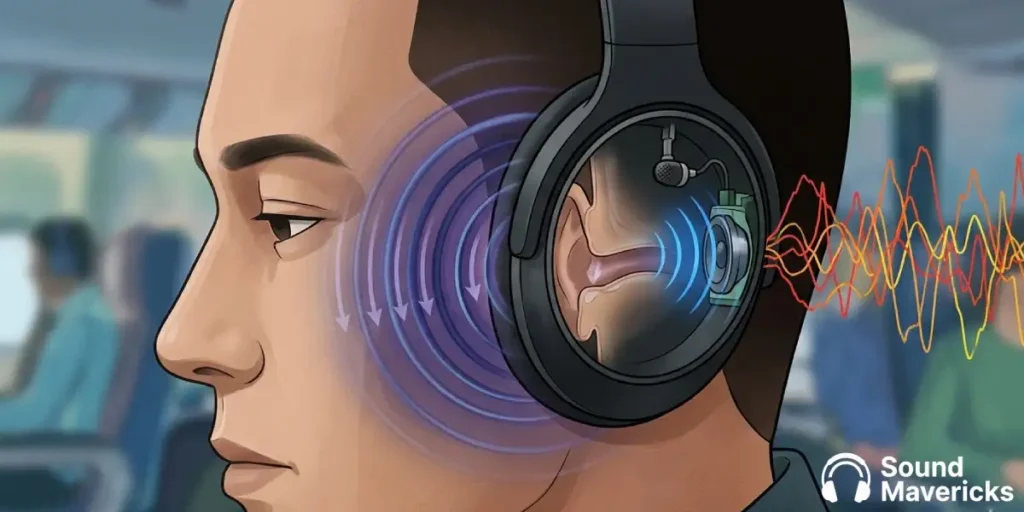
Ask is it illegal to drive with headphones on and the honest answer is: it depends where you live. There is no single rule. In the United States there is no federal ban, and state vehicle codes split three ways. Some states ban headphones or earbuds in both ears. Some allow one ear only, usually for calls. Many states have no headphone-specific law at all, and rely on general distracted-driving rules instead. This guide walks through each group, the exceptions that matter, and the safety question underneath the legal one.
The short answer
If both of your ears are covered by headphones or earbuds while you drive, you are breaking the law in a solid group of states, risking a ticket in more of them, and driving against safety advice everywhere. If one ear is open, you are legal in most places that regulate this at all. If your state has no specific law, you are not banned, but you are not protected either: distracted-driving enforcement can still reach you after a mistake or a crash.
States that ban both ears
LegalOverview, checking the actual statute text, lists California, Florida, New York, Ohio and Pennsylvania among the states that prohibit wearing audio devices in both ears, with wording built around headsets, earplugs or earphones covering or sitting in both ears. California Vehicle Code 27400 is the classic example: a headset covering, or earphones in, both ears is prohibited. Other state roundups add states such as Maryland, Minnesota, Virginia, Louisiana and Washington to the restricted list, with their own wording and exceptions.
Why the wording matters
These laws were mostly written for headsets and earplugs, and they describe the ear, not the product category. That is why earbuds, over-ear headphones and earplugs can all fall under the same sentence. A driver arguing that a modern earbud is not a headset is making an argument the statute text rarely supports.
States that allow one ear
The one-ear compromise is the most common middle position. Florida’s statute bans wearing a headset or headphone while driving, then carves out a single earpiece used with a phone. New York bars more than one earphone attached to an audio device. Ohio and Pennsylvania follow the same broad pattern in the statute checks cited above: both ears covered is the offence, one earpiece is the exception.
Practically, this is the rule most drivers picture. One bud for navigation prompts or a call, one ear open for traffic. Even where it is legal, keep the volume low enough that a siren reaches the open ear without competition.
States with no specific headphone law
A long list of states, including Texas and many others in the state-by-state tables published by The Zebra, have no headphone-specific statute. Legal there does not mean wise, and it does not mean consequence-free. The Zebra’s table notes that Texas drivers can still be fined for dangerous driving, and that pattern holds broadly: the charge attaches to the driving, not the device.
The distracted-driving backstop
Every state polices careless and distracted driving. If an officer watches you miss a siren, drift, or brake late while wearing earbuds, the absence of a headphone law will not help you. After a crash, audio in both ears can also be used as evidence that attention was divided, whatever the local statute says.
Exceptions worth knowing
The statutes carry carve-outs. Hearing aids are exempt everywhere in practice. Several states exempt one-ear phone headsets, navigation audio, or ear protection worn for work. Emergency and law-enforcement drivers working on duty sit outside the normal rule. SmartFinancial’s summary of state laws lists these exemption families across the restricted states, including hearing devices, GPS use and occupational ear protection.
Outside the United States
Other countries set their own rules, and several are stricter. Some European countries ban headphones for drivers outright, in one ear or both, and treat violations as a traffic offence with a fine. Others fold the question into general distraction rules, as many US states do. If you rent a car abroad, check the local rule before you drive. Your home state’s one-ear habit may not be legal where you land.
The safety question under the legal one
Driving runs on sound more than most drivers admit. Sirens, horns, a bicycle bell, the change in road noise when a tyre starts to fail: all of it arrives by ear. Sealed earbuds with noise cancelling remove exactly that channel. One specific scenario makes the point better than any statistic. An ambulance approaching from a side street is audible seconds before it is visible, and those seconds are when a driver decides whether to clear the junction. Anything that delays that decision is a safety problem before it is a legal one.
Open-ear options, framed honestly
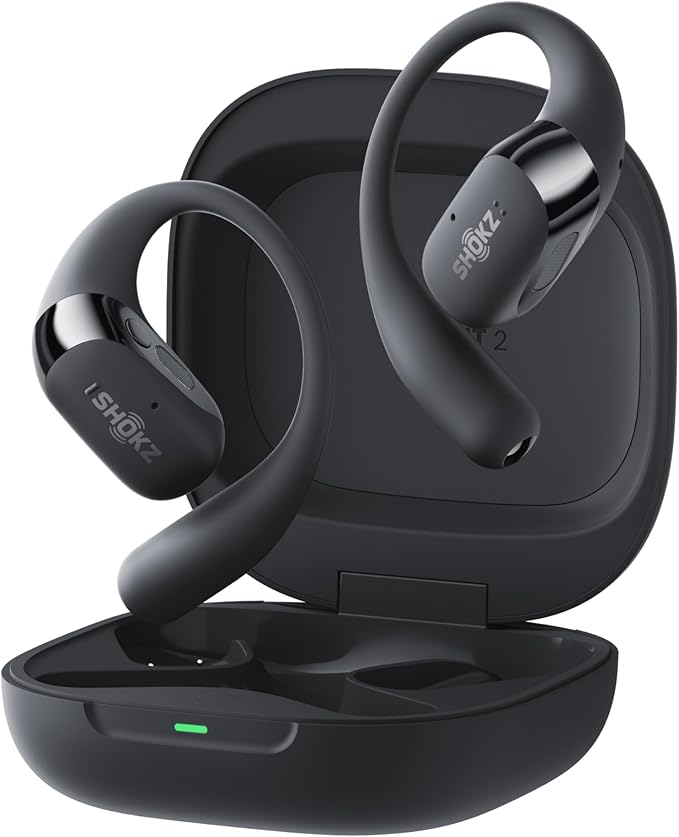
Open-ear designs leave the ear canal open, so traffic sound reaches you alongside your audio. That makes them the least-bad way to listen on the move, and the natural pick for running and cycling, where our best open-ear Bluetooth earbuds guide ranks them. But read this plainly: an open-ear product is not a legal loophole. Where both-ear wear is banned, do not treat any two-sided device as exempt. Check your state rule first, and where listening is allowed, keep the volume low and one ear’s worth of attention on the road.


Cyclists, runners and passengers
This guide is about drivers, and the distinctions matter. Passengers can wear what they like. Cyclists sit under different rules in most places, and in many states no headphone statute covers them at all, though some cities and countries restrict earbuds on a bike. Runners are not drivers under any of these vehicle codes. The open-ear picks below the safety section earn their keep with those road users most of all: they were built for people who move through traffic on foot or on two wheels and need their ears open by design, not by volume discipline.
What to do before your next drive
Check your state vehicle code, not a forum post. Set navigation audio to the car speakers where you can. If you use one earpiece where that is allowed, keep it for prompts and calls rather than music, and keep the volume low. On a bicycle or on foot, the open-ear picks above are the sensible shape. Behind the wheel, the safest headphone is usually the one left in the glovebox.
Frequently asked questions
Is there a federal law against driving with headphones?
No. There is no federal ban in the United States. The rules live in state vehicle codes, which is why the answer changes at state lines. Some states ban audio in both ears, some allow one ear, and many have no headphone-specific law at all.
Can I drive with one earbud in?
In many states, yes. One-ear use is the common carve-out: states such as Florida, New York, Ohio and Pennsylvania restrict both-ear wear while allowing a single earpiece, often for calls. Check your own state code, because the details and exceptions differ.
Are open-ear headphones legal to drive with?
The statutes generally regulate covering or inserting devices in the ears, not brand names or designs, so an open-ear model is not automatically exempt. Where both-ear wear is banned, treat any two-sided device as covered by the ban and check locally before relying on a design argument.
Can I be ticketed in a state with no headphone law?
Yes, under general distracted-driving or unsafe-driving rules. No specific ban does not mean no risk. If audio contributes to missed sirens, drifting lanes or a crash, an officer can act on the driving itself.
Do the rules differ outside the United States?
Yes. Many countries restrict or ban headphone use while driving under their own road rules, and some treat it as an offence even in one ear. Travellers should check the rule for the country they are driving in rather than assuming their home rule travels with them.

I am the founder of Sound Mavericks, where I provide the polite truth about audio equipment. I started this site because consumer electronics reviews are often too technical. Instead of using a silent lab, I test headphones, earbuds, and Bluetooth speakers in the real world – like on a noisy subway or in a busy coffee shop.
To stay independent, I buy my own review units (mostly from the United States) rather than accepting free gifts from brands. Once I finish testing a product, I sell it locally to our community. My goal is to help you understand sound quality, active noise cancellation (ANC), and battery life without the marketing hype.