
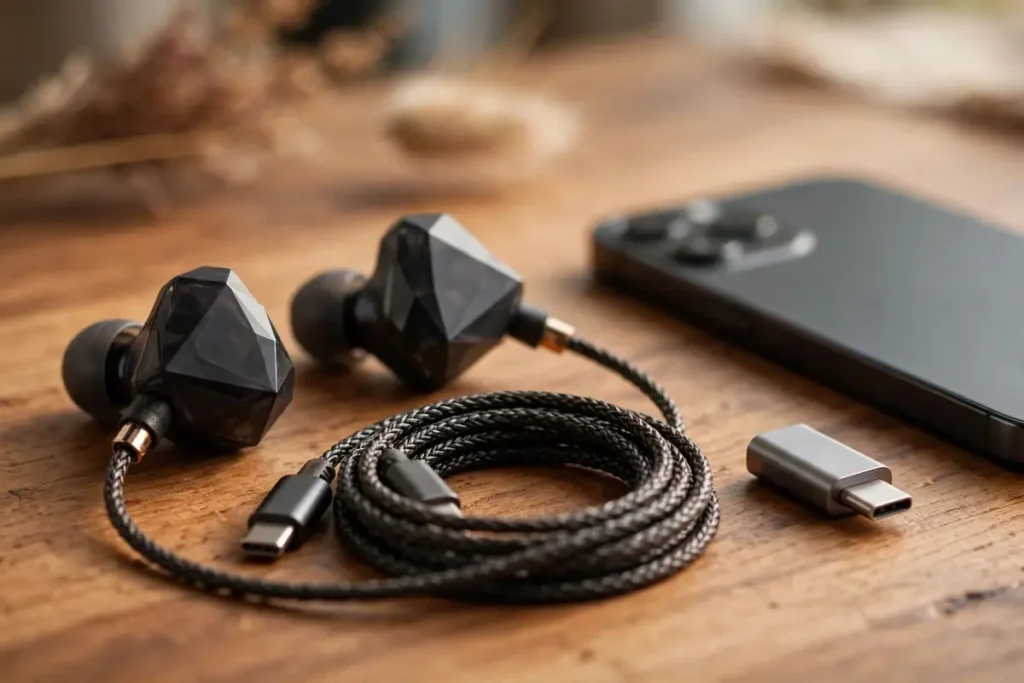
This truthear hexa review covers the hybrid in-ear monitor that reset expectations for neutral tuning at a budget price. The Hexa combines one dynamic driver with three balanced armature drivers in a 3D-printed shell, and it became the benchmark its rivals are measured against. Our provisional score set puts it at 6.2 overall, and the wired-model pattern applies again: Sound at 9.0 and Value at 9.2 carry the verdict, while calls, battery and ANC sit at the levels of a cable-only IEM with no microphone.
A note on method. This review is research-based. The scores are a provisional SoundMavericks verdict built from published measurements and reviewer consensus on this model, cross-checked against the listing and specifications below. The Hexa’s reputation rests on measurements anyone can inspect, which makes it a comfortable model to score from research: the tuning claims and the measured curves tell the same story.

Truthear Hexa 6.2/10
Why you: you want a neutral, measurement-friendly tuning at a budget price. Sound scores 9.0 and Value scores 9.2: the Hexa became the reference its rivals are compared against because it gets the balance right.
Trade-off: the tuning is honest rather than exciting. Bass quantity is modest, the nozzle is on the larger side for small ears, and there is no microphone on the stock cable, so calls need a cable swap.
In-ear · Wired · 1DD + 3BA hybrid · 20.5 ohms · Detachable 0.78mm 2-pin cable
Sound quality
Sound scores 9.0. The Hexa follows a neutral target with a controlled sub-bass lift, which means vocals, strings and piano arrive without a house flavour stamped over them. The dynamic driver handles the lows with a PU and LCP composite diaphragm, the balanced armatures take the mids and highs, and the crossover work is tidy enough that the handover is hard to hear. Reviewers who graph IEMs for a living made the Hexa their budget reference because the curve behaves.
That honesty cuts both ways. Bass quantity is modest, so hip-hop and electronic music sound leaner than on warmer rivals, and poor recordings get no cosmetic help. Treble is extended and clean rather than sparkling. Listeners who want excitement first often admire the Hexa and then buy something warmer; listeners who want to hear the recording keep it as the yardstick. Our best budget IEMs guide is organised around exactly that split.
Stage is respectable for an IEM, with imaging that places instruments cleanly, which serves gaming as well as music. Technical performance, meaning detail retrieval and separation in busy passages, is the area where the Hexa most clearly embarrasses cheaper single-driver rivals. Our best in-ear monitors roundup shows the wider field, and our Sennheiser IE 200 review covers the name-brand alternative at a higher price.
Fit and isolation
Comfort scores 8.4. The shell is printed using DLP 3D printing from ear-shape data, with a metal faceplate, and it sits securely for most ears with the included tip selection. The nozzle is moderately wide, so very small ear canals are the fit risk, and as with every IEM the seal decides the bass: a poor seal makes the Hexa sound thin, a good seal restores the intended balance.
Isolation is passive and genuinely useful, which is why ANC scores 2.5 here rather than the 1.0 to 1.5 of the open-back headphones in this batch. A sealed IEM blocks a meaningful share of office and street noise without any electronics. It will not silence a flight like a good ANC model, and our Shure SE215 review covers the stage-proven alternative for listeners who prioritise isolation and durability above tuning neutrality.
Cable and everyday use
The stock cable is a silver-plated copper design on a detachable 0.78mm two-pin connection, ending in a 3.5mm plug. Detachable matters at this price: a damaged cable is a small purchase, not a dead IEM, and swapping to a cable with an inline microphone fixes the Hexa’s one everyday gap. Calls score 3.0 by convention because the stock cable has no mic. Battery scores 5.0 as a neutral placeholder because there is nothing to charge.
At 20.5 ohms with high sensitivity, the Hexa runs from any dongle, phone or laptop at full volume. No amplifier is needed and none is missed. Everyday use is as simple as wired audio gets: plug in, get a seal, listen. The included case and tip assortment cover the rest of ownership.
Value
Value scores 9.2, the highest bar in this review and the reason the Hexa reshaped its bracket. It offers a hybrid driver array, a printed shell and a benchmark tuning at a price where single dynamic drivers used to be the whole menu. Rivals have since matched parts of that offer, which is the sincerest form of market flattery, but the Hexa remains the reference point reviewers reach for first.
Truthear Hexa specs
| Spec | Truthear Hexa |
|---|---|
| Design | In-ear monitor, wired |
| Drivers | 1 dynamic + 3 balanced armature hybrid |
| Dynamic diaphragm | PU + LCP composite |
| Impedance | 20.5 ohms |
| Sensitivity | 120 dB/Vrms at 1 kHz |
| Frequency response | 8 Hz – 40,000 Hz (free field) |
| Cable | Detachable 0.78mm 2-pin, 3.5mm |
| Microphone | None on stock cable |
Why the Hexa became the benchmark
Benchmarks are not declared; they accumulate. The Hexa became one because three things lined up at once: a tuning that follows a respected target closely enough for measurement sites to use it as a comparison anchor, a hybrid driver array at a price that used to buy a single dynamic driver, and availability through mainstream channels rather than hobbyist importers. Any one of those would have made it popular. Together they made it the default answer to the question of what a budget IEM should sound like.
That status changes how it should be bought. The Hexa is most valuable as a reference point: own it, and every future IEM purchase becomes a comparison against a known quantity rather than a leap between flavours. Listeners who start warmer often cannot describe what they are missing; listeners who start with the Hexa know exactly what a warmer set is trading away and what it is gaining. For a hobby built on subjective language, that shared reference is worth more than any single tuning preference.
It also sets a fair expectation for longevity. The detachable cable removes the most common IEM failure, the resin shell shrugs off daily handling, and replacement tips are universal. The Hexa will not replace a good over-ear for staging or a wireless bud for commuting, and it was never priced to. As the neutral anchor of a small collection, or as a single careful purchase for desk and study listening, it remains the budget IEM to beat.
Verdict
Buy the Hexa if you want to know what neutral sounds like, or if you want one IEM that judges every other IEM you try afterwards. The 9.0 Sound and 9.2 Value scores describe the budget benchmark accurately: it is the reference, not the party.
Skip it if you want bass weight, built-in call handling or a forgiving warmth over rough recordings. The 6.2 overall is the database shape of a wired specialist, and within its specialty the Hexa still sets the terms for everyone else.
Frequently asked questions
Is the Truthear Hexa good for beginners?
It is one of the most recommended first IEMs because its neutral tuning shows what a balanced presentation sounds like without punishing poor recordings. Beginners who discover they want more bass can equalise or move on with a clear reference point, which is exactly what a benchmark is for.
How is the Hexa bass?
Present, controlled and modest in quantity. The dynamic driver handles the low end with good texture, but the tuning targets neutrality, so bass-led genres sound leaner than on warmer budget rivals. Listeners who prioritise impact usually pair the Hexa with a second, warmer IEM rather than replacing it.
Does the Hexa fit small ears?
The shell is a 3D-printed resin design shaped from ear data, and comfort scores 8.4 here, but the nozzle is moderately wide. Most listeners get a good seal with the included tips; listeners with very small ear canals should check tip options, since seal decides both comfort and bass response on any IEM.
Can I use the Hexa for calls and gaming?
For gaming, yes: the neutral tuning and clear imaging suit long sessions, and the passive isolation helps focus. For calls, the stock cable has no microphone, so calls score 3.0 by our convention. A replacement 2-pin cable with an inline mic is a cheap fix because the cable is detachable.
Hexa or a warmer rival like the Truthear Zero line?
They answer different tastes. The Hexa is the neutral reference with a leaner low end; the Zero line targets a warmer, more bass-forward presentation. Many enthusiasts own the Hexa as the benchmark and add a warmer set for fun, rather than treating it as either-or.

I am the founder of Sound Mavericks, where I provide the polite truth about audio equipment. I started this site because consumer electronics reviews are often too technical. Instead of using a silent lab, I test headphones, earbuds, and Bluetooth speakers in the real world – like on a noisy subway or in a busy coffee shop.
To stay independent, I buy my own review units (mostly from the United States) rather than accepting free gifts from brands. Once I finish testing a product, I sell it locally to our community. My goal is to help you understand sound quality, active noise cancellation (ANC), and battery life without the marketing hype.
