
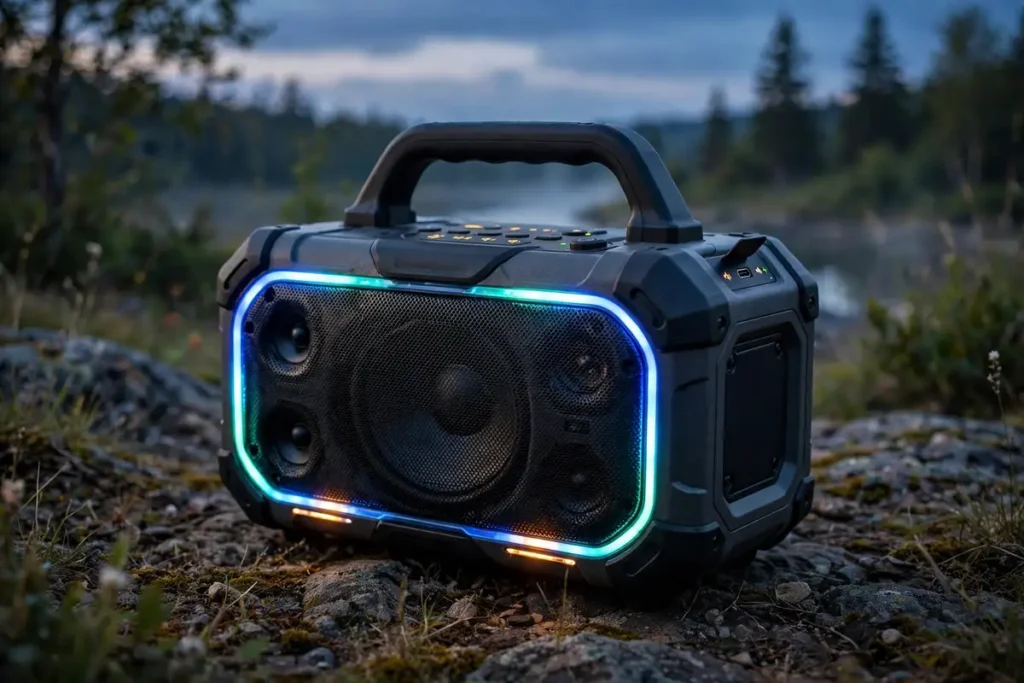
This Tribit StormBox Lava review covers Tribit’s large portable party speaker: an 80-watt, four-driver design with two 30-watt neodymium woofers and two 10-watt silk dome tweeters, IP67 sealing, and a rated 24 hours of playtime. The Lava sits a class above the pocket speakers in Tribit’s own range and aims straight at the big-name party cylinders, with a detachable handle and shoulder strap, a USB-A powerbank output, an AUX input, and app control with a multi-band equaliser. It is a speaker built to be carried to the noise rather than kept in one room. This review judges it on output, on battery honesty, and on how well the party features hold together outdoors.
A note on method. This is a research review, built from Tribit’s published specifications, the verified Amazon US listing for this exact model, and independent coverage. We have not had a unit on the desk, so nothing here claims hands-on testing, and speaker products on this site carry no scores.
The Lava is Tribit’s value play in the large portable class, and the spec sheet is hard to argue with: 80 watts across four drivers, a low end rated down to 43 Hz with XBass engaged, IP67 sealing against dust and immersion, and 24 hours of rated playtime with a powerbank output for your phone. Independent measurements credit it with very high maximum volume for its size, which is the party-speaker metric that matters most once a group is standing around it. The honest limits are weight and refinement: at about 2.4 kg it is a carry-with-intent speaker rather than a toss-in-a-bag one, and the sound gets rougher at the top of its range than the best big-name rivals. As the loud option in our best Bluetooth speaker coverage, it makes its case on output per pound spent. Check Price on Amazon

Why you: An 80W four-driver portable with IP67 sealing, 24 hours of rated playtime, app EQ and a phone-charging output, built for groups outdoors.
Trade-off: At about 2.4 kg it is a deliberate carry, and the sound roughens at maximum volume where pricier rivals stay cleaner.
Tribit StormBox Lava specifications
| Spec | Tribit StormBox Lava |
|---|---|
| Product | Tribit StormBox Lava, portable Bluetooth party speaker, Black finish on the linked listing |
| Output and drivers | 80W total: two 30W neodymium woofers and two 10W silk dome tweeters, TI amplifier chip, XBass mode |
| Frequency response | 43 Hz to 20 kHz (manufacturer rated, with XBass) |
| Battery | Up to 24 hours rated playtime; USB-C charging; USB-A output works as a phone powerbank |
| Connectivity | Bluetooth 5.4, 3.5mm AUX input, Tribit app with multi-band EQ, built-in microphone |
| Pairing | TWS stereo pairing with a second Lava; Party Mode syncs 160+ compatible speakers |
| Waterproofing | IP67 dustproof and waterproof |
| Size and weight | 310 x 147 x 152 mm; about 2.37 kg; detachable handle and shoulder strap included |
Sound: four drivers and a lot of headroom
Most portables at this size run a woofer and a tweeter and ask processing to do the rest. The Lava doubles up: two woofers and two tweeters, driven by a TI amplifier chip, which gives it genuine stereo hardware and more clean output before the limiter starts working. Independent measurement-based coverage puts its maximum volume well above the big-name cylinder it is most often compared with, and its low end reaches deeper, helped by the XBass mode that trades a little battery and headroom for bass weight. For a party speaker, those are the two numbers that decide the evening: how loud it stays clean, and how much low end survives outdoors where there are no walls to help.
The balance needs a word of honesty. Reviewers who spent time with the Lava describe strong, punchy sound at working volumes, with the app equaliser doing real work to tame the bass and lift the top end, and a rougher edge when the volume is pushed to the maximum, where the low end can crowd the midrange. That is a common shape in this class and the EQ is the correct answer to it: set the speaker up once in the Tribit app for the sound you want, then leave the top-panel controls for volume and playback. Buyers stepping up from Tribit’s own bigger box, covered in our Tribit StormBox Blast 2 review, will find the Lava the more portable half of that family, with the Blast 2 keeping the edge in sheer scale.
Battery, sealing and the outdoor brief
Tribit rates the Lava at up to 24 hours, the standard best-case figure at moderate volume; XBass and high outdoor volume shorten it, and the rating is still generous enough that a full day out is not a planning problem. The battery pack can also charge a phone through the USB-A output, a genuinely useful party feature when the playlist phone is dying, though it draws from the same reserve as the music. Charging is over USB-C.
IP67 means dust-tight and able to survive immersion in a metre of water for half an hour, which covers pool splashes, beach sand, rain and a rinse under the tap afterwards. The rugged body, the detachable handle and the shoulder strap all serve the same brief. At about 2.37 kg the Lava is not a speaker you forget in a bag; it is one you carry on purpose, and the strap is there because Tribit knows it. For buyers weighing that carry against smaller options, our best outdoor speakers coverage sorts the class by exactly that trade.
One more outdoor point in the Lava’s favour: the controls and ports are laid out for use with wet hands and in bright light, with large top-panel buttons and covered sockets, and the fabric-and-polymer body shrugs off the scuffs that come with being set down on concrete, sand and decking. Party speakers live a harder life than home speakers, and the Lava is dressed for it.
Pairing and app control
Two Lava units pair in TWS for true stereo, which is the upgrade that makes the biggest difference at a gathering: a stereo pair covers a space with less strain than one speaker at full tilt. Party Mode goes the other way and syncs a large number of compatible Tribit speakers, 160 or more by Tribit’s count, for spread-out events. Bluetooth 5.4 holds a stable link at long range, the built-in microphone takes calls, and the AUX input covers laptops and older players that lack Bluetooth. The Tribit app handles EQ, firmware and pairing settings, and firmware updates have already been used to revise the Lava’s tuning and presets, so installing the app is part of getting the speaker at its best.
Who should buy the Tribit StormBox Lava
Buy the Lava if you host outdoors, run music for a group at the beach, the campsite or the garden, and want maximum output and battery from a single carry without paying the big-brand premium in this class. The app EQ and the TWS option make it a system that can grow from one speaker to a pair.
Skip it if you mostly listen alone at home, where a smaller speaker or a powered pair will sound finer at low volume, or if every gram matters on a hike, because the pocket class exists for that. Buyers who want the cleanest sound at maximum volume regardless of cost should compare it against the flagship cylinders in our JBL Charge 6 review and the wider class before deciding.
Frequently asked questions
Is the Tribit StormBox Lava waterproof?
Yes. The Lava is rated IP67, so it is dust-tight and can be submerged in up to a metre of water for 30 minutes. Rinse off salt water or sand and let the ports dry before charging.
How long does the StormBox Lava battery last?
Tribit rates it at up to 24 hours at moderate volume. XBass, high volume and using the USB-A output to charge a phone all shorten that figure, so plan on less for a loud day outdoors.
Can the StormBox Lava charge a phone?
Yes. A USB-A output on the speaker works as a powerbank for a phone or other small device. It draws from the same battery as playback, so speaker playtime falls while it charges.
Can you pair two StormBox Lava speakers?
Yes. Two Lava units pair in TWS for stereo, and Tribit’s Party Mode can sync 160 or more compatible speakers together for large gatherings.
Does the StormBox Lava have an AUX input?
Yes. A 3.5mm AUX input sits alongside Bluetooth 5.4, so laptops, older players and anything with a headphone output can connect by cable.

I am the founder of Sound Mavericks, where I provide the polite truth about audio equipment. I started this site because consumer electronics reviews are often too technical. Instead of using a silent lab, I test headphones, earbuds, and Bluetooth speakers in the real world – like on a noisy subway or in a busy coffee shop.
To stay independent, I buy my own review units (mostly from the United States) rather than accepting free gifts from brands. Once I finish testing a product, I sell it locally to our community. My goal is to help you understand sound quality, active noise cancellation (ANC), and battery life without the marketing hype.

