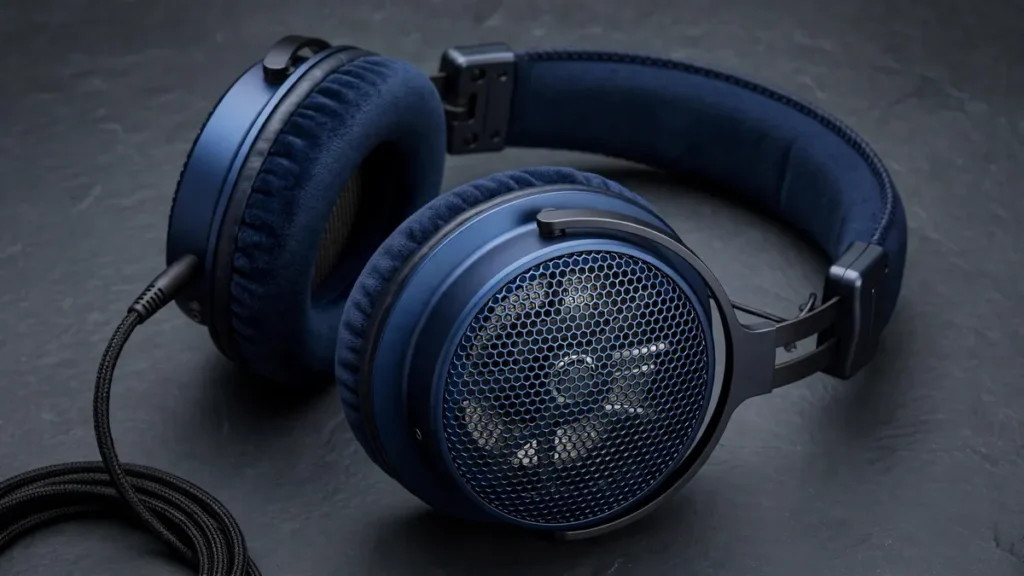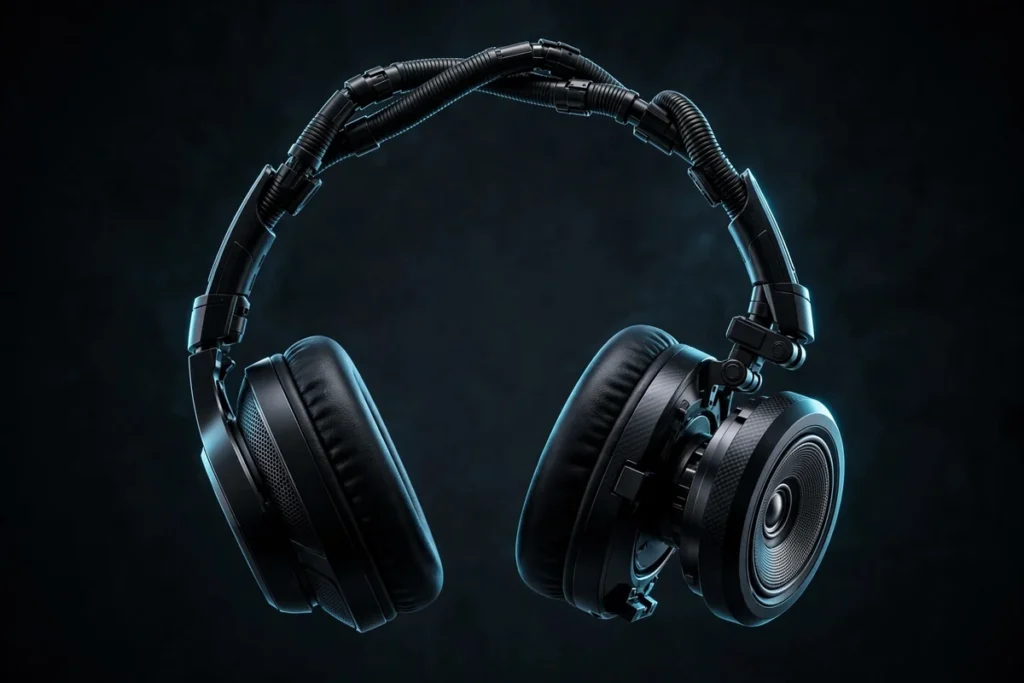
Every trip ends the same way: headphones for the journey, then a scramble for a speaker when you arrive and want to share what you were listening to. The TDM Neo is built to delete that second gadget. It looks like an ordinary pair of over-ear wireless headphones, but roll its flexible headband around the earcups and the whole thing folds into a compact Bluetooth speaker — twist it back and you are wearing headphones again. It is the debut product from Tomorrow Doesn’t Matter (TDM), first shown at CES in January 2026 and on sale in the US since October 6, 2026.
Our Early Verdict
On paper, the Neo is the most original audio product of the year: four 40mm drivers split between a headphone pair and a speaker pair, a battery rated in weeks rather than days, and user-replaceable battery modules. The honest caveat is that the twist is the easy part to fall for — whether it earns its keep depends on the sound in both modes, and that is exactly where the first full reviews disagree with the launch-day enthusiasm.
| Sound Quality (Headphones) | 7.6 |
| Speaker Mode | 7.4 |
| Innovation & Design | 9.4 |
| Battery Life | 9.6 |
| Comfort & Build | 7.4 |
| Value | 7.6 |
How we are reviewing this one: the Neo has only just reached buyers, so this is a research-based launch review built from TDM’s published specifications, its launch material, and the first independent hands-on and full reviews. We have not lived with a unit, and the score above is provisional — weighted toward the hardware, the battery engineering and the originality of the format, with a deliberate discount for a moving mechanism that has not yet proven itself over months of daily twisting.
TDM Neo Specifications
| Product | TDM Neo |
| Type | Over-ear wireless headphones that twist into a portable Bluetooth speaker |
| Drivers | 4 × 40mm — two inward-facing (headphone mode), two outward-facing (speaker mode), dual amplifiers |
| Speaker output | 2 × 5W (one outward driver per side) |
| Bluetooth | Bluetooth 6.0, multipoint, Auracast, Google Fast Pair |
| Codecs | SBC, AAC, LC3 — no LDAC or aptX |
| Noise cancelling | No ANC — passive isolation only; ENC microphone noise reduction for calls |
| Microphones | Four-microphone array with environmental noise cancellation for calls |
| Battery life | 200+ hours (headphone mode) / 16+ hours (speaker mode), manufacturer ratings |
| Charging | USB-C; five-minute charge adds up to eight hours of headphone playback |
| Batteries | Two user-replaceable 1,500mAh modules; replacement kits sold by TDM |
| Wired input | 3.5mm AUX (cable included) |
| Weight | Approx. 340 g |
| Water resistance | None — no IP rating |
| Frequency response | Not specified by TDM |
| Colours | Onyx Black, Cool White |
| In the box | Carry case, USB-C cable, 3.5mm AUX cable, quick start guide |
| Warranty | 1 year |
| Buy | Check Price on Amazon |
How the Twist Mechanism Works
The transformation is mechanical, not a software trick. The headband is flexible and segmented, designed to roll around the earcups so the two cups fold together into a palm-sized block with a stable base for a desk or table. It takes about a second, and the same motion that packs the Neo flat for travel is the one that turns it into a speaker — the folded shape is also its most compact carrying shape.
The cleverer half of the design is what happens to the sound. Each earcup carries two 40mm drivers, not one: a conventional inward-facing driver for headphone listening, and a second driver on the outside of the cup, behind its own grille, driven by its own amplifier. Twist the Neo into speaker form and the inward pair shuts off while the outward pair takes over as a two-channel speaker at 5 watts per side. That matters, because the lazy way to build a headphone-speaker hybrid is to blast the headphone drivers outward through the cups; TDM instead gave each mode its own purpose-built drivers and its own tuning, with separate EQ profiles stored in the companion app for headphone and speaker listening.
The twist itself is configurable. In the app you can have the gesture switch output modes automatically, pause playback, power the Neo down and wake it in whichever form it is in, lock it in speaker mode, or disable the gesture entirely. There are physical buttons for power, volume and play/pause if you would rather keep the mechanics purely mechanical. What nobody can tell you yet — us included — is how the flexible band feels after its five-hundredth twist. TDM offers a one-year warranty; the hinge-free band is the part of this design that has to earn trust over time, and early buyers are the ones who will find out.
Sound Quality as Headphones
Set expectations by the spec sheet first. The inward drivers are custom-tuned 40mm units fed by SBC, AAC or LC3 — there is no LDAC or aptX for high-resolution streaming — and there is no active noise cancellation at all. Isolation is purely passive, from memory foam cushions, so the Neo competes as a straightforward wireless headphone with an unusual party trick, not as a rival to the ANC flagships.
The review evidence so far splits by exposure time. Short hands-on sessions at CES came away charmed, describing clear, detailed sound and a design that felt more thought-through than gimmicky. The longer reviews published since the October launch are cooler. The most detailed of them found the headphone sound detailed and pleasant — clear bass, distinct vocals — but boxed-in: presentation and instrument separation a step behind good conventional headphones at this level, and fatiguing over long sessions. TechRadar’s two-week review went further, calling the audio disappointing in both modes and the Neo hard to recommend on sound alone.
Our read of that spread: this is a first-generation tuning from a brand-new company, judged against mature rivals. Nothing in the coverage suggests the headphone mode is broken — the recurring words are “pleasant”, “clear”, “detailed” — but nobody with extended time on the Neo has ranked it with the best conventional headphones near its price, and the tight, firm fit several reviewers noted will not help long-session listening. Treat headphone sound as competent and enjoyable, not class-leading, and the Neo’s real argument is everything else it does.
Sound Quality as a Speaker
Speaker mode is where physics sets the ceiling. Two 40mm drivers at 5 watts per side, in a block that fits in a palm, will fill a desk, a hotel room or a kitchen counter with perfectly listenable sound — podcasts over breakfast, a playlist while you unpack, a video call on loudspeaker. For near-field, small-group sharing, that is a genuinely useful amount of speaker, and it is always with you because it was your headphones a second ago.
What it cannot do is move air like a dedicated speaker. Bass is the first casualty in every small enclosure, and TechRadar’s review singled out exactly that: speaker playback lacking satisfying low end. A purpose-built portable speaker spends its entire size, weight and budget on one job; the Neo’s speaker half gets whatever room is left after being a headphone. If your shared listening is mostly music with friends in larger spaces, a model from our guide to the best large Bluetooth speakers will outplay it without breaking a sweat. Judge the Neo’s speaker as a bonus that replaces carrying a small speaker, and it looks strong; judge it as your only speaker, and it will feel thin.
Battery, Design and Controls
The battery story is the Neo’s second headline, and it is a strange one: TDM rates headphone playback at over 200 hours — several weeks of typical listening between charges — dropping to a still-respectable 16-plus hours in speaker mode, where the outward drivers and amplifiers draw far more power. A five-minute USB-C top-up buys up to eight hours of headphone use. However cynical you want to be about manufacturer ratings, even half the claimed headphone figure would embarrass every rival we track.
Better still, the batteries are two user-replaceable 1,500mAh modules, with replacement kits sold by TDM and a published swap guide; the ear cushions are replaceable too. In an industry that glues its batteries in, that is a genuine longevity argument — the most common way wireless headphones die has been designed out. The trade-off is size and weight: at roughly 340 g the Neo is about a third heavier than a typical flagship over-ear like the Sony WH-1000XM6, and long-term reviewers found the firm clamp noticeable. Four drivers, two amplifiers and two battery modules have to live somewhere.
Day-to-day controls are refreshingly conventional: physical buttons for power, volume and playback, a four-microphone array with environmental noise cancellation for calls, Bluetooth 6.0 with multipoint for two simultaneous connections, Auracast for broadcast audio, and Google Fast Pair. The app handles EQ (with those separate per-mode profiles), the twist-gesture settings, firmware updates and a find-my feature that shows the Neo’s last known location and can ping it. The 3.5mm input and included AUX cable cover in-flight screens and dead-battery emergencies. One gap to note: there is no water-resistance rating at all, so the Neo is a desk-and-travel device, not a poolside one.
Who the TDM Neo Is For
Buy the Neo if your listening life genuinely splits between solo and shared. Travellers who unpack in a hotel room and want music or a podcast out loud without packing a second device; students and flat-sharers who move between a desk and a common room; anyone whose bag currently holds both headphones and a small speaker. For that buyer, the Neo replaces two products with one, carries flatter than either, and its battery effectively removes charging from the routine. Battery anxiety sufferers and repairability fans get a bonus argument.
Buy conventional headphones instead if sound-per-dollar or silence is the priority. Commuters and frequent flyers should look at our guide to the best noise cancelling headphones for travel — the Neo’s passive isolation will not protect a flight the way real ANC does, and its weight and clamp work against it on long journeys. And if you mostly listen at home, a dedicated headphone plus a dedicated speaker, each chosen for one job, remains the better-sounding combination. The Neo is a brilliant answer to a specific packing problem; it is not a universal replacement.
TDM Neo FAQ
How does the TDM Neo turn into a speaker?
A flexible headband rolls around the earcups so the cups fold together into a compact block. The Neo has two driver pairs: when you twist it, the inward-facing headphone drivers switch off and the outward-facing drivers — 5 watts per side — take over as a stereo speaker. The twist gesture can also be reassigned in the app to pause playback, power down, or lock the Neo in speaker mode.
Does the TDM Neo have noise cancelling?
No. The Neo has no active noise cancellation; it relies on passive isolation from its memory foam cushions, which reviewers found only moderately effective. Its four microphones use environmental noise cancellation (ENC), but that only cleans up your voice on calls — it does not quiet the world around you.
How long does the TDM Neo battery last?
TDM rates the Neo at over 200 hours in headphone mode and over 16 hours in speaker mode, depending on volume. A five-minute USB-C charge adds up to eight hours of headphone playback. Unusually for modern headphones, the two 1,500mAh battery modules are user-replaceable, and TDM sells replacement kits.
Is the TDM Neo waterproof?
No. The Neo carries no IP water-resistance rating, so it should be kept away from rain, pools and heavy workouts. It is a desk, travel and living-room device rather than a beach speaker.
Can the TDM Neo play music wired?
Yes. Alongside Bluetooth 6.0 with multipoint and Auracast, the Neo has a 3.5mm AUX input, and an AUX cable is included in the box — handy for in-flight entertainment systems or a flat battery.
How heavy is the TDM Neo?
About 340 grams — roughly a third heavier than a typical flagship over-ear, because it carries four drivers, two amplifiers and two battery modules. Long-term reviewers found the firm clamp and weight noticeable on long listening sessions.
The Bottom Line
The TDM Neo is that rare thing: a genuinely new idea in a category of annual refreshes. Two driver sets, two tunings, a twist that takes a second, a battery measured in weeks, and parts you can replace yourself — the engineering brief has been thought through far beyond the gimmick. What holds our provisional score at 8.1 rather than higher is the evidence that matters most: extended reviews find the sound in both modes a step behind dedicated rivals, there is no ANC, and the twist mechanism’s durability is a promise, not a record. If the two-in-one life is yours, the Neo is the only product that lives it. Early adopters are, as ever, the ones who will tell the rest of us whether generation two is the one to wait for.

I am the founder of Sound Mavericks, where I provide the polite truth about audio equipment. I started this site because consumer electronics reviews are often too technical. Instead of using a silent lab, I test headphones, earbuds, and Bluetooth speakers in the real world – like on a noisy subway or in a busy coffee shop.
To stay independent, I buy my own review units (mostly from the United States) rather than accepting free gifts from brands. Once I finish testing a product, I sell it locally to our community. My goal is to help you understand sound quality, active noise cancellation (ANC), and battery life without the marketing hype.