Open-ear sport earbuds have a pricing problem. The big names in the category — Shokz and Soundcore — ask flagship money for a design whose whole job is to let the outside world in. The JLab JBuds Open Sport 2 attacks that problem head-on: earhook open-ear buds at a budget tier, with a claimed 45 hours of total playtime that beats most of the expensive rivals on the spec sheet, plus Bluetooth 6.0 and the unusual ability to stay connected to three devices at once. Announced at IFA in September 2026 ahead of a November launch, the Amazon listing is already live — so does the spec sheet survive scrutiny?
Our Early Verdict
On paper, the JBuds Open Sport 2 is the most complete budget open-ear package yet. The battery claim is not a rounding trick: JLab’s own specification lists 8 hours per bud and 45 hours total with the case, IP55 matches the premium end of the category, and Bluetooth 6.0 with three-device multipoint is a feature set rivals reserve for far pricier models. The honest caveats are the ones physics imposes on every open-ear design — no seal means no noise cancelling, and a bass ceiling no algorithm fully removes.
| Battery Life | 9.2 |
| Value | 9.0 |
| Comfort & Fit | 8.7 |
| Features & App | 8.6 |
| Sound Quality (on paper) | 8.2 |
| Call Quality (on paper) | 8.0 |

How we are reviewing this one: the JBuds Open Sport 2 launches in November 2026 and independent hands-on reviews do not exist yet, so this is a research-based launch review built from JLab’s published specification sheet, its official product material and the IFA launch coverage. We have not worn or listened to it, and we will not pretend otherwise. Where the verdict talks about fit, sound or calls, it is reading the hardware and the documented design — and our score is provisional for exactly that reason.
JLab JBuds Open Sport 2 Specifications
| Product | JLab JBuds Open Sport 2 |
| Design | Open-ear, rests in front of the ear canal; secure sport earhook; no ear tips |
| Driver | 14.2mm dynamic driver with SoundBoost algorithm and front-and-back sound tubes |
| Frequency response | 20Hz–20kHz |
| Battery (buds) | Up to 8 hours per bud (50mAh per bud); 5 hours talk time |
| Battery (total) | 45 hours with charging case (580mAh); quick charge: 10 minutes = 1 hour |
| Charging | USB-C; buds ~2 hours, case ~2.5 hours |
| Bluetooth | Bluetooth 6.0; Multipoint-3 (up to 3 devices); SBC / AAC; Google Fast Pair; Microsoft Swift Pair; 30+ ft range |
| Water / dust resistance | IP55 (sweat, rain and dust) |
| Microphones | 2 × MEMS with environmental noise cancelling; −38dB ± 1dB sensitivity |
| Controls & app | Customisable touch controls; JLab App with EQ4 presets + custom EQ, Lab Spatial Audio, interval timer, Movie Mode, Safe Hearing, OTA updates |
| Weight | 13.8 g per bud; case 44.5 g |
| In the box | Earbuds, charging case; 2-year JLab limited warranty |
| Buy | Check Price on Amazon |
Design and Fit: The Hook Does the Work
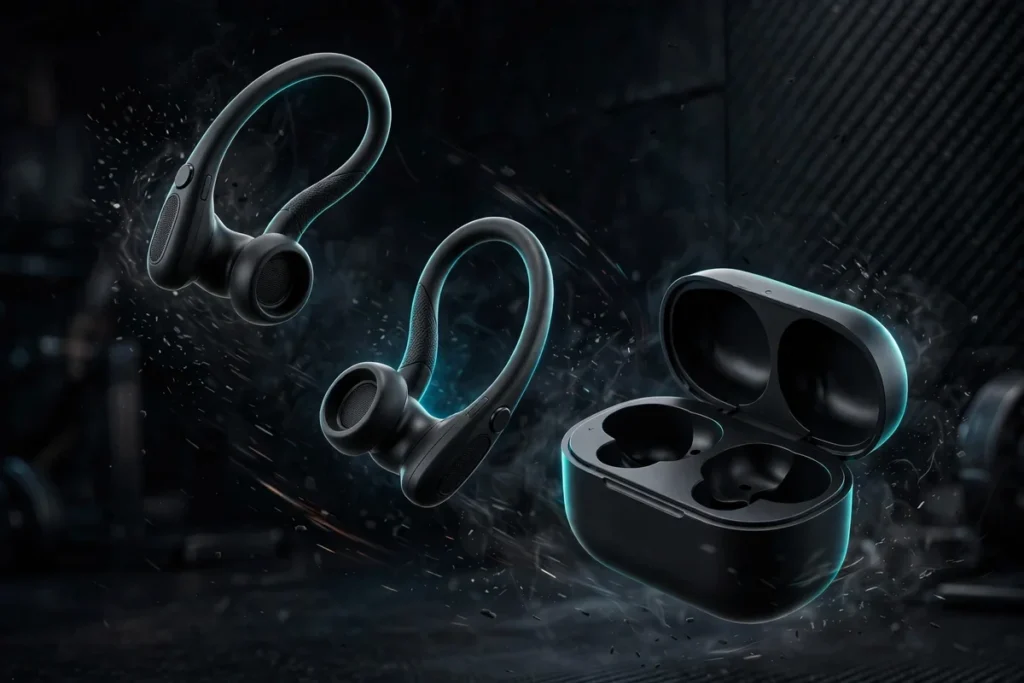
Fit is the whole product in an open-ear sport bud, and JLab’s approach is mechanical rather than electronic: a sport earhook wraps behind the ear and, in JLab’s description, locks in with one simple pinch. The 14.2mm driver housing rests in front of the ear canal instead of sealing it, so there are no ear tips, no insertion depth to get right, and none of the canal pressure that makes sealed buds uncomfortable over long sessions. At 13.8 g per bud there is real substance for the hook to hold — these are not flyweight clip-ons — which cuts both ways: more driver and battery per side, but more mass for the hook to keep stable at mile ten than the lightest rivals carry.
Two practical notes follow from the design. First, glasses: an earhook and a glasses arm both want the space behind your ear. Most wearers solve this by seating the hook first and resting the glasses arm over it, but if your frames are thick-armed, this is the fit question to check during the return window — no spec sheet can answer it for your ears. Second, awareness is total by design. Nothing seals, nothing cancels; traffic, trail noise and a training partner’s voice arrive unfiltered alongside the music. That is the point of the category, and JLab leans into it rather than apologising for it.
Sound: Honest Open-Ear Expectations
Set the expectation correctly and open-ear sound makes sense: you are listening to a speaker held near your ear, not a driver sealed inside it. Bass energy escapes instead of pressurising the canal, so low end is present but never physical, and overall volume competes with the environment rather than replacing it. Anyone promising sealed-bud bass from an open design is selling something.
Within those physics, JLab has thrown real engineering at the problem. The 14.2mm dynamic driver is large for the category, and JLab pairs it with front-and-back sound tubes and a SoundBoost algorithm that lifts the low end and adjusts on the fly to keep the presentation full at different volumes; launch coverage confirms SoundBoost is the headline audio feature this generation. The JLab App adds four EQ presets — Signature, Balanced, Bass Boost and a fully custom curve — plus a Lab Spatial Audio mode, so the tuning is not take-it-or-leave-it. There is even a Battery Boost mode in the app that trades some of that processing for longer runtime, a thoughtful option for ultra-distance days.
The trade-offs remain the category’s trade-offs. Sound leaks: at moderate volumes outdoors or in a gym it is a non-issue, but at high volume in a quiet room, people nearby will hear some of what you hear — JLab says as much in its own FAQ. And with SBC and AAC as the only codecs, this is a convenience-first wireless chain, not an audiophile one. For the job these buds are built for — pace, podcasts and playlists with the world still audible — the paper specification is well judged.
Battery Life: The Headline Claim, Checked
The 45-hour claim is the reason this model exists, so it deserves the closest reading. JLab’s specification sheet breaks it down plainly: up to 8 hours of playtime from each bud, and 45 hours in total once the 580mAh charging case’s reserves are counted — roughly four and a half full recharges in your pocket. Talk time is rated at 5 hours per charge. A 10-minute quick charge returns an hour of playtime, the buds take about 2 hours to refill and the case about 2.5 hours over USB-C.
One inconsistency is worth naming, because it is JLab’s own: the technical specification lists a flat 8 hours per bud, while the FAQ on the same official page says “8.5+ hours per bud.” We have used the more conservative specification-table figure throughout this review. Either way, the total is consistently stated as 45 hours everywhere JLab publishes it — product page, specification and retail listings agree — and that total is what matters in practice: a full week of daily training sessions between case charges, and a marathon block that sealed rivals at this tier do not match. Our roundup of the best running headphones shows how unusual a 45-hour total is anywhere near this end of the market.
IP55 and Training Durability
IP55 means the buds are protected against dust ingress and against water sprayed from any direction — sweat, rain and road spray are inside the rating; swimming and showering are not, and no open-ear sport bud at any tier should be treated as submersible. For runners and cyclists, IP55 is exactly the right rating: it matches what premium open-ear rivals carry and covers every condition training actually produces, including the dusty trail and the downpour commute. Durability beyond the rating comes down to the hook design: no tips to lose, no stems to snap, and a case that at 44.5 g disappears into a gym bag.
Controls, App and Calls
The connectivity package is where the Sport 2 most embarrasses its price tier. Bluetooth 6.0 is newer than what most open-ear rivals ship, and Multipoint-3 — simultaneous connection to three devices — is rarer still: phone, watch and laptop can all stay paired, with Google Fast Pair for Android setup and Microsoft Swift Pair covering Windows. Touch controls are customisable in the JLab App, which also carries the EQ, a workout interval timer, a Movie Mode that cuts latency below 200 ms for video, Safe Hearing volume limiting, and over-the-air firmware updates. That is a flagship app feature list wearing a budget badge.
Calls get a dual-MEMS microphone array with environmental noise cancelling — the microphones work to suppress the noise around your voice rather than cancelling anything for your ears. Open-ear buds are structurally decent call devices outdoors (you hear your own voice naturally, so you do not shout), but wind is the known enemy of every exposed-mic design, and only hands-on testing will show how the ENC copes on a breezy descent. On paper, the hardware is the right hardware.
What the “2” Changes vs the Original JBuds Open Sport
JLab sells this as a generational step, and the documented changes back that up. Bluetooth moves from the original’s 5.1 to 6.0. Multipoint grows from two devices to three. The battery story transforms: the original paired roughly 7 hours per bud with a total in the mid-20s of hours depending on which of JLab’s listings you read, while the Sport 2 delivers 8 hours per bud and a clean 45 hours total. And SoundBoost — the adaptive low-end processing with its front-and-back sound tubes — is new this generation, with JLab claiming a bigger, more balanced presentation than the original’s. The constants are the ones worth keeping: the same 14.2mm driver size, the same earhook fit philosophy, and the same IP55 rating.
Set against the wider category, the positioning sharpens. Premium open-ear models like the one in our Shokz OpenFit Pro review compete on driver refinement and finish; the Sport 2 competes on battery, connectivity and tier. For a fuller field, our guide to the best wireless sport earbuds covers the sealed alternatives as well.
Who the JBuds Open Sport 2 Is For
Buy the JBuds Open Sport 2 if you run, ride or train outdoors and awareness is non-negotiable. Road runners who need to hear traffic, cyclists who need to hear the bike behind them, gym users who want music without isolation, and anyone who trains daily and hates charging cases will find the 45-hour total, the IP55 rating and the hook fit aimed directly at them. It is also the natural pick for anyone who has priced the premium open-ear brands and balked: the spec sheet here concedes remarkably little.
Buy sealed buds instead if your listening happens on planes, trains or in a loud office, where an open design cannot compete with the environment and offers no cancellation at all. Bass-first listeners should also look elsewhere — that is physics, not a flaw in this product — as should swimmers, who need a genuinely submersible rating no earhook bud provides.
Wait if you need proof before purchase. Every figure in this review is a manufacturer’s claim until independent measurements and hands-on reviews land; our provisional 8.4/10 reflects an unusually strong specification for the tier, and it will move when testers have run in them.
JLab JBuds Open Sport 2 FAQ
How long does the battery last on the JBuds Open Sport 2?
JLab rates the buds at up to 8 hours of playtime per charge, with 45 hours in total including the charging case. A 10-minute quick charge adds about an hour of playtime, and the case refills over USB-C.
Are the JBuds Open Sport 2 waterproof?
They are rated IP55, which protects against sweat, rain, spray and dust — everything training produces. IP55 is not a submersion rating, so they are not made for swimming or showering.
Can the JBuds Open Sport 2 connect to multiple devices at once?
Yes. Bluetooth 6.0 with Multipoint-3 keeps up to three devices connected simultaneously — for example a phone, a watch and a laptop — and Google Fast Pair plus Microsoft Swift Pair speed up first-time pairing.
What is new compared with the original JBuds Open Sport?
Bluetooth 6.0 replaces 5.1, multipoint grows from two devices to three, total battery jumps from the mid-20-hour range to 45 hours, and the new SoundBoost processing with front-and-back sound tubes aims for fuller, more balanced sound. The 14.2mm driver size, earhook design and IP55 rating carry over.
Do open-ear earbuds leak sound?
Some leakage is inherent to the open design. At moderate volumes in active settings — a run, a ride, a gym session — it is minimal and unlikely to bother anyone. At high volumes in quiet spaces, people nearby may hear some of your audio.
Do the JBuds Open Sport 2 work with glasses?
The earhook wraps behind the ear, where glasses arms also sit. Most wearers seat the hook first and rest the glasses arm over it, but thick-armed frames can compete for the same space, so it is worth checking the fit early if you always train in glasses or sunglasses.
The Bottom Line
The open-ear category has been waiting for its budget disruption, and on paper the JLab JBuds Open Sport 2 is it: a 45-hour total that outlasts rivals at several times the tier, IP55 protection, Bluetooth 6.0 with three-device multipoint, and an app that reads like a flagship’s — wrapped around an honest open-ear design that never pretends to cancel noise or summon sealed-bud bass. The claims that matter most, battery above all, are stated consistently in JLab’s own specification, and the one figure JLab states two ways (8 vs 8.5 hours per bud) changes nothing about the total. Our provisional 8.4/10 says this is the new value reference in open-ear sport audio — pending the hands-on verdicts that will confirm or trim it.

I am the founder of Sound Mavericks, where I provide the polite truth about audio equipment. I started this site because consumer electronics reviews are often too technical. Instead of using a silent lab, I test headphones, earbuds, and Bluetooth speakers in the real world – like on a noisy subway or in a busy coffee shop.
To stay independent, I buy my own review units (mostly from the United States) rather than accepting free gifts from brands. Once I finish testing a product, I sell it locally to our community. My goal is to help you understand sound quality, active noise cancellation (ANC), and battery life without the marketing hype.