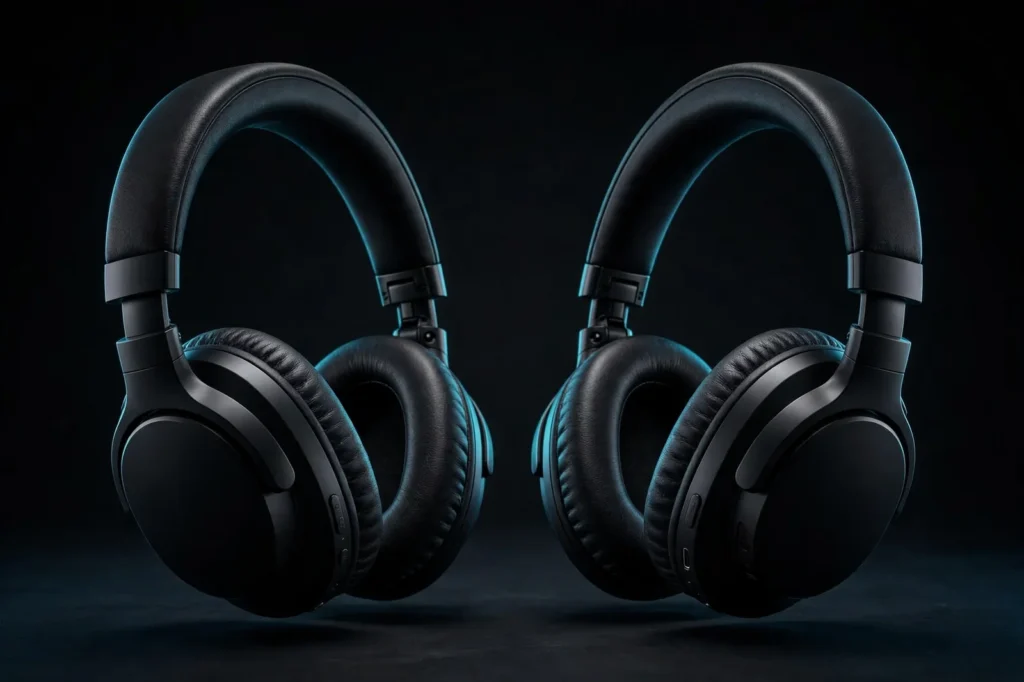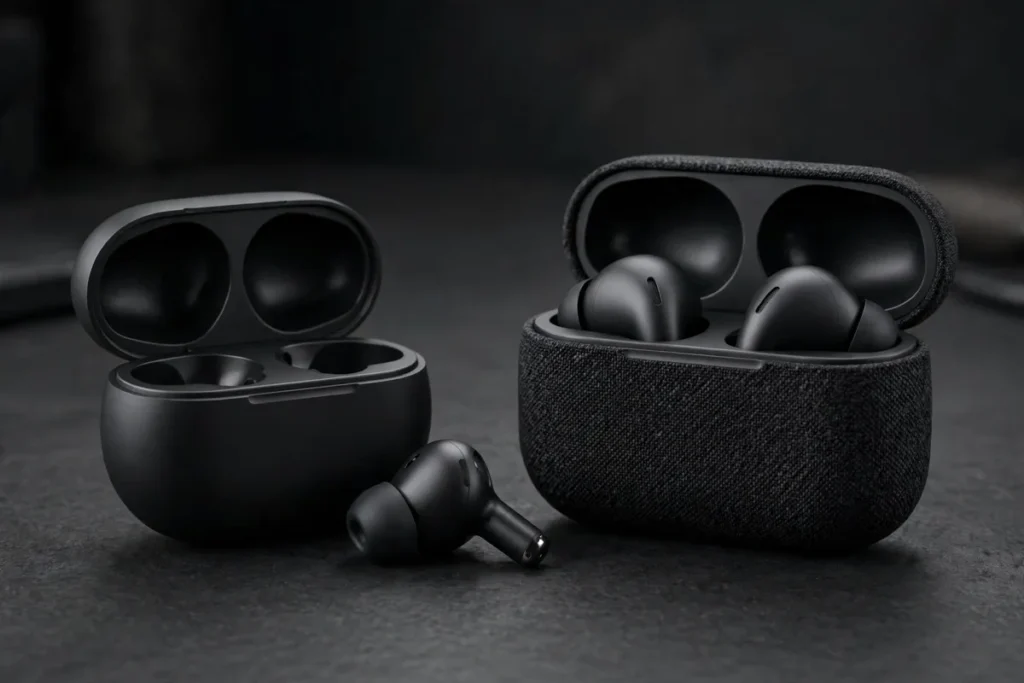
This sony wf-1000xm5 vs sennheiser momentum true wireless 4 comparison is the flagship argument Android listeners keep having. Both pairs carry adaptive noise cancelling, multipoint and wireless charging. Both sit at the top of our database. On our scores the Sony WF-1000XM5 takes the overall win, 9.0 against 8.8, because it leads on noise cancelling and calls. The Sennheiser Momentum True Wireless 4 leads on sound, comfort, battery and value. That split is the whole story here, and the category sections below work through it one bar at a time.
What Hi-Fi? reached a similar split in its head-to-head, calling the Sonys the best all-rounders while saying listeners who want more richness in their music could be better served by the Sennheisers. SoundGuys, in its own comparison, pointed to the codec gap as a deciding detail: the Momentum True Wireless 4 carries aptX Lossless and aptX Adaptive plus LE Audio support, while the Sony carries LDAC. Neither verdict is wrong. They are answers to two different questions, and which question you are asking decides this comparison.

Sony WF-1000XM5 9/10
Why you: you want the strongest all-round flagship. Sound scores 9.2, ANC 8.8 and calls 8.5, and LDAC is on board for hi-res listening on Android.
Trade-off: there is no aptX support, and the foam tips will not suit everyone. Value scores 7.8, the lowest bar on either card here.
Bluetooth 5.3 · SBC, AAC, LDAC · Adaptive ANC · Multipoint · 8 h buds, 24 h total · IPX4 · Wireless charging

Momentum True Wireless 4 8.8/10
Why you: you put sound and battery first. Sound leads this comparison at 9.3, comfort scores 9.0, and the case takes total battery to 30 hours.
Trade-off: ANC trails the absolute best, and the case is on the large side. Calls score 8.2, a step behind the Sony.
Bluetooth 5.4 · SBC, AAC, aptX Adaptive, aptX Lossless · Adaptive ANC · Multipoint · 30 h total · Wireless charging
Sound, silence and calls
Sound quality
The Sennheiser sounds a fraction richer. Its tuning gives strings and vocals more body, and acoustic recordings hold together with a sense of space the Sony does not quite match. Sound scores 9.3 reflect that. Feed it a well recorded jazz trio and the double bass has weight without blurring the piano above it. Cymbals decay naturally instead of turning into a hiss at the edge of the mix.
The Sony is close behind at 9.2 and takes a different route. Its presentation is tighter and more direct, with a low end that punches rather than blooms. Electronic music and hip-hop land harder on the Sony. Pop vocals sit forward and clear. Listeners who mostly stream from a phone at moderate volume may honestly prefer it, because its energy shows up earlier in a track.
Codecs widen or close that gap depending on your phone. The Sennheiser supports aptX Lossless and aptX Adaptive, which suits recent Android flagships with aptX on board. The Sony supports LDAC, the more widely carried hi-res option across Android. On a phone with neither, both fall back to AAC and the tuning difference is all that remains. Our full Sony WF-1000XM5 review and Momentum True Wireless 4 review dig into each tuning in more depth.
Winner: Sennheiser Momentum True Wireless 4
Noise cancelling
Sony wins this round on both parts of the job. Its active cancelling scores 8.8 and does the heavier work on steady low noise: train rumble, aircraft cabin drone and air conditioning all drop further than they do on the Sennheiser. Its foam tips then seal the canal and block a share of the higher noise before the electronics even start.
The Sennheiser scores 8.4 for ANC. That is a strong figure in isolation, and in an office it keeps keyboard clatter and nearby conversation at a distance. The gap shows on transport, where voices and brake squeal leak through a little more. Its silicone tips and fin tips also seal less completely than foam for many ears, which costs it passive isolation.
Transparency tells a friendlier story for Sennheiser. Its ambient mode sounds natural and its app gives fine control over how much outside sound comes in. Sony counters with a clear, usable ambient mode of its own and automatic switching based on your activity. For pure quiet, though, this round is not close enough to call a tie.
Winner: Sony WF-1000XM5
Calls and microphones
Calls score 8.5 for the Sony and 8.2 for the Sennheiser. In a quiet room both are clear and easy to understand, and neither caller will ask you to repeat yourself. Move outside and the Sony pulls ahead. Wind noise is handled better, and voices stay intact when a bus passes or a street gets busy.
The Sennheiser remains a solid calling earbud. Its microphones keep speech natural at a desk and in a calm street. Where it loses ground is in gusty wind and beside traffic, where the voice can thin out and background noise pushes forward. If your earbuds double as your work headset for outdoor calls, that difference matters more than the tenth of a point it costs on sound.
One ownership detail belongs here. The Sony foam tips are a consumable. They compress, pick up wax and lose their seal over time, and replacements are an ongoing cost of keeping that ANC and call performance. The Sennheiser uses silicone tips and fins, which wash clean and last far longer. It is a small point, but it is specific to this pairing, and frequent callers will feel it in the running cost.
Winner: Sony WF-1000XM5
Fit, battery and daily use
Comfort and fit
Comfort scores 9.0 for the Sennheiser and 8.7 for the Sony. SoundGuys noted in its comparison that the Sennheiser ships with fin tips that help lock the fit, and that detail shows in long sessions. The fins brace the bud in the outer ear, so it stays put without needing a deep, tight seal. Ears that dislike foam pressure tend to prefer this arrangement.
The Sony is smaller and lighter in the ear, and many listeners will find it disappears once the foam expands. The catch is in the feed record and it is worth repeating plainly: the foam tips will not suit everyone. Some ears find the expansion pressure tiring after an hour. Others never get a seal that survives a walk. Trying both tip styles, where you can, settles this round faster than any score can.
Winner: Sennheiser Momentum True Wireless 4
Battery and charging
Total battery is 30 hours for the Sennheiser against 24 hours for the Sony, and battery scores follow that order at 9.2 against 8.5. On a long trip or a heavy week of commuting, the Sennheiser case needs the cable less often. Both cases charge wirelessly, so topping up on a desk pad is equally simple.
Per charge, the picture flips a little. The Sony lists 8 hours from the buds, which covers a full workday of listening without a case visit. The Sennheiser feed record lists the 30 hour total without a buds-only figure, so we score the round on the totals we can verify. Frequent flyers who listen in long single stretches should weigh the Sony buds figure; everyone else gets more from the bigger total.
Winner: Sennheiser Momentum True Wireless 4
Features and apps
Both apps are mature. Sony offers a deep equaliser, adaptive sound control that reacts to your location and activity, and speak-to-chat style pauses. Sennheiser offers its own equaliser, sound personalisation that builds a profile from a listening test, and control over ANC and transparency levels. Neither app is a reason to reject the other earbud.
Multipoint works on both, holding a phone and a laptop at once. The Sennheiser adds Bluetooth 5.4 against the Sony Bluetooth 5.3, a small edge in connection handling. The Sony adds the more established track record in firmware polish. For a wider view of the class, our best true wireless earbuds roundup lines both up against the rest of the field.
Winner: Tie
Value
Value scores 8.7 for the Sennheiser and 7.8 for the Sony, the widest gap on either card. The Sennheiser gives you the better sound bar, the better comfort bar and the longer total battery, and its value score reflects how much of the flagship checklist it covers. The Sony asks you to pay for the strongest cancelling and call performance in this pairing, and its score reflects that narrower, more specialised appeal.
That does not make the Sony poor value for the right buyer. If ANC and calls are the reasons you are shopping at this level, its two winning bars are exactly the ones you are paying for. If they are not, the Sennheiser returns more across the rest of the card for the same kind of money.
Winner: Sennheiser Momentum True Wireless 4
Sony WF-1000XM5 vs Sennheiser Momentum True Wireless 4 specs
| Spec | Sony WF-1000XM5 | Momentum True Wireless 4 |
|---|---|---|
| Bluetooth | 5.3 | 5.4 |
| Codecs | SBC, AAC, LDAC | SBC, AAC, aptX Adaptive, aptX Lossless |
| ANC | Adaptive | Adaptive |
| Multipoint | Yes | Yes |
| Battery, buds | 8 h | Not listed in feed record |
| Battery, total | 24 h | 30 h |
| Water resistance | IPX4 | Not listed in feed record |
| Wireless charging | Yes | Yes |
Check Price on Amazon Check Price on Amazon
Scorecard
| Category | Sony WF-1000XM5 | Momentum True Wireless 4 |
|---|---|---|
| Sound | 9.2 | 9.3 |
| ANC | 8.8 | 8.4 |
| Calls | 8.5 | 8.2 |
| Comfort | 8.7 | 9 |
| Battery | 8.5 | 9.2 |
| Value | 7.8 | 8.7 |
| Overall | 9 | 8.8 |
Verdict
Buy the Sony WF-1000XM5 if noise cancelling and calls lead your list. It is the more complete flagship for commuting and working days, and its 9.0 overall reflects that balance. Buy the Sennheiser Momentum True Wireless 4 if sound, comfort and battery lead yours. It wins four of the seven rounds above, and for a listener who rarely takes calls outdoors, it is arguably the better buy. Our best wireless earbuds for Android guide shows where both sit against cheaper options worth considering.
Frequently asked questions
Which is better overall, the Sony WF-1000XM5 or the Sennheiser Momentum True Wireless 4?
The Sony WF-1000XM5, by a small margin. It scores 9.0 overall against 8.8 for the Sennheiser, and it wins noise cancelling and calls. The Sennheiser wins sound, comfort, battery and value, so listeners who put music first have a real case for picking it instead.
Which earbuds sound better, the WF-1000XM5 or the Momentum True Wireless 4?
The Sennheiser Momentum True Wireless 4, narrowly. Sound scores 9.3 against 9.2. Its aptX Lossless and aptX Adaptive support also gives it the stronger codec list on phones that carry aptX, while the Sony answers with LDAC.
Which has stronger noise cancelling?
The Sony WF-1000XM5. ANC scores 8.8 against 8.4 for the Sennheiser. Both use adaptive cancelling, but the Sony cuts low rumble and office chatter further, and its foam tips add passive isolation on top.
Which lasts longer on a charge?
The Sennheiser Momentum True Wireless 4 on total time. Its case brings the total to 30 hours against 24 hours for the Sony. Per charge the Sony lists 8 hours from the buds, so the gap depends on how often you are near the case.
Which is better for calls?
The Sony WF-1000XM5. Calls score 8.5 against 8.2 for the Sennheiser. The difference is small in a quiet room and clearer outdoors, where the Sony holds a voice together better in wind and traffic.

I am the founder of Sound Mavericks, where I provide the polite truth about audio equipment. I started this site because consumer electronics reviews are often too technical. Instead of using a silent lab, I test headphones, earbuds, and Bluetooth speakers in the real world – like on a noisy subway or in a busy coffee shop.
To stay independent, I buy my own review units (mostly from the United States) rather than accepting free gifts from brands. Once I finish testing a product, I sell it locally to our community. My goal is to help you understand sound quality, active noise cancellation (ANC), and battery life without the marketing hype.