
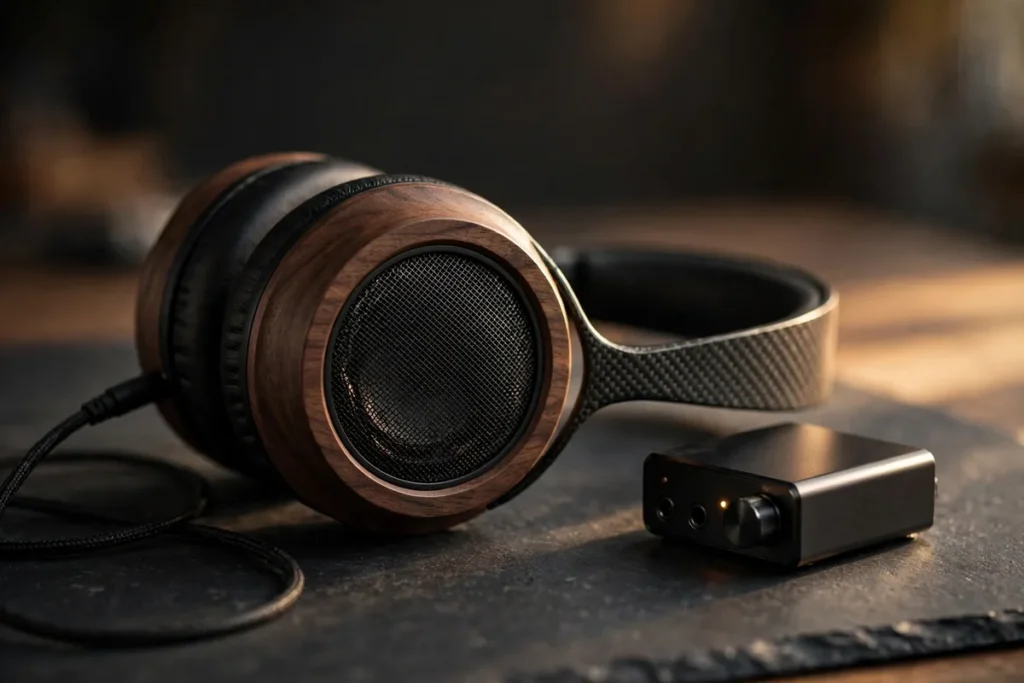
The FiiO FT15 is the direct successor to the FT5, sitting below the flagship FT7 in FiiO’s FT headphone line. It is a wired, open-back planar magnetic headphone built around a much larger 101 mm driver, a diaphragm just 800 nanometres thick with a full-surface diamond coating, and earcup frames of North American black walnut. FiiO announced it on September 17, 2026, and it is on sale now. There is no Bluetooth, no microphone and no noise cancelling. It is a headphone for a quiet room and a good source.
This review is built from FiiO’s published specifications, the verified US Amazon listing, show-floor impressions and the first hands-on coverage from other publications rather than our own testing. The scores are provisional.

FiiO FT15 6.0/10 provisional
Why you: you listen at home, you want a wide planar soundstage without flagship-tier cost, and you like the idea of a big driver that still runs happily from a dongle DAC or a DAP.
Trade-off: it is wired and open-back, so there is no microphone, no noise cancelling and almost no isolation. Sound leaks in and out. The stock cable is 1.5 m, which some desk setups will find short.
101 mm planar driver · 800 nm diamond-coated diaphragm · 24 Ω, 95 dB/mW · Walnut earcups, 425 g
What the FT15 is
FiiO’s FT line is the company’s run at serious wired headphones, and the FT15 is a generational step rather than a refresh. The driver grows, the diaphragm gets dramatically thinner, the metal shell of the FT5 gives way to walnut and carbon fibre, and the finished headphone ends up lighter than the model it replaces. It sits below the FT7 in the range, which stays the flagship, and above the FT5, which it succeeds.
It is also a specialist tool. Open-back headphones trade isolation for an open, spacious presentation, and our explainer on open-back vs closed-back headphones covers what that means in a shared room. The FT15 makes no attempt to be a travel headphone or a headset. There is nothing to charge or pair. You plug it in and listen.
The driver: an 800 nm diaphragm with a diamond coat
The FT5’s diaphragm was 6 microns thick, already thin by headphone standards. The FT15’s is 800 nanometres, which FiiO states is 86.7% thinner. Less moving mass means the diaphragm can start and stop faster, and FiiO then coats the whole surface with diamond to give the film back the rigidity that thinness takes away. The stated aim is to control high-frequency breakup and push the response out to 40 kHz. Treat that as FiiO’s engineering claim for now; the first measurements will tell.
The driver itself grows from 90 mm to 101 mm, with an effective radiating area of 6,443.5 mm² that FiiO puts at about 35% larger than the FT5’s. A custom-shaped magnet array is meant to keep the magnetic field even across that bigger surface, and the voice coil traces are electroplated onto the diaphragm with a 28 nm process carried over from the FT5. If you want the underlying technology in plain terms, our explainer on dynamic vs planar magnetic drivers walks through why a large, evenly driven film behaves the way it does.
Sound: what the early coverage reports
The first full hands-on review describes a spacious and detailed presentation with a balanced tuning, and singles out the bass: tight, full and controlled, with real extension when a recording asks for it. The soundstage drew the strongest praise, described as properly big and open in a way that uses the open-back design rather than just tolerating it. Treble stayed present without turning sharp, and the reviewer kept reaching for the FT15 after the testing was done, which is usually the most honest verdict a review contains.
The one reservation so far comes from the show floor. Listening to a pre-production unit at CanJam London, ecoustics found the FT15 balanced and easy to live with, but heard less macrodynamic punch and contrast than the strongest planar designs at the show. That was a prototype in a noisy hall, so it is a question to settle rather than a conclusion. It is why our sound score sits at 9.0 rather than higher: the reports are strong, and the dynamic-swing question is still open.
Design, walnut and comfort
The earcup frames are FAS-grade North American black walnut, chosen for consistent grain, so no two pairs look quite alike. The headband is carbon fibre, and the magnet structure uses a modified-plastic bracket that FiiO says matches aluminium’s rigidity at about two-thirds of the density. Those choices get a 101 mm planar down to 425 grams without the cable, light for a driver this size. FiiO rates the clamping force at 3.8 N, on the gentle side.
Two sets of pads come in the box, and they are a tuning choice rather than spares. FiiO describes the pre-fitted suede pads as warmer, with smoother treble, and the protein leather pads as the pick for top-end definition and vocal clarity. The early hands-on review liked the build but flagged some fit quirks: at 425 grams, weight distribution will suit some heads better than others. Our comfort score of 8.3 reflects the low weight for the class and that early fit caution in equal measure.
Driving it: easier than most big planars
Planar headphones have a reputation for demanding a serious amplifier. The FT15 mostly avoids it. Impedance is 24 ohms and sensitivity is 95 dB/mW (111 dB/Vrms), so a capable dongle DAC, a DAP or a phone with a decent USB-C adapter will drive it to full volume. FiiO makes that portability part of the pitch, and the early reviewers agree it runs well from portable sources while still improving on desktop gear.
The supplied cable helps. It is 6N monocrystalline copper, cryogenically treated, terminating in a 4.4 mm balanced plug with dual 3.5 mm connectors at the headphone end. Adapters for 6.35 mm and 4-pin XLR outputs are in the box, so it connects to almost any amplifier without a second cable purchase. If you do want to give it a proper desktop stage, our guide to the best headphone amps covers the sensible price tiers.
FiiO FT15 vs FT5: what actually changed
The FT15 replaces the FT5 rather than joining it, and the changes go well past the earcup material. The table below uses FiiO’s published figures for both models.
| FiiO FT15 | FiiO FT5 | |
|---|---|---|
| Driver | 101 mm planar magnetic | 90 mm planar magnetic |
| Diaphragm | 800 nm, full-surface diamond coating | 6 µm PAR, aluminium-silver alloy coil |
| Effective radiating area | 6,443.5 mm² | About 35% smaller (FiiO comparison) |
| Frequency response | 7 Hz to 40 kHz | 7 Hz to 40 kHz |
| Impedance | 24 Ω | 36 Ω |
| Sensitivity | 95 dB/mW · 111 dB/Vrms | 96 dB/mW · 110 dB/Vrms |
| Weight | 425 g without cable | 456 g without cable |
| Build | Walnut earcup frames, carbon fibre headband | Magnesium alloy shell |
| Cable | 1.5 m cryo-treated 6N copper, 4.4 mm plug, 6.35 mm and XLR-4 adapters | 1.5 m, swappable 3.5 mm and 4.4 mm plugs, 6.35 mm and XLR-4 adapters |
The pattern is consistent: a bigger radiating surface, far less moving mass, lower impedance and less weight. On paper the FT15 should stage larger, respond faster and ask less of your amplifier. Existing FT5 owners get a genuine upgrade path rather than a cosmetic one, although the FT5’s swappable-plug cable was arguably more flexible.
How it compares
Two headphones frame the FT15’s task. The HIFIMAN Edition XS is the planar in our best open-back headphones roundup, picked for stage and detail at a mid-tier price, with an 18-ohm impedance that runs from almost anything. The Sennheiser HD 660S2 is that roundup’s best overall pick, a 300-ohm dynamic headphone with reference tuning that rewards a proper amplifier; our HD 660S2 review has the full breakdown. The FT15 splits the difference: planar staging with walnut-and-carbon build quality the Edition XS does not attempt, and far easier driving than the Sennheiser asks for.
| Product | Driver | Impedance | Weight | Check Price |
|---|---|---|---|---|
| FiiO FT15 | 101 mm planar magnetic | 24 Ω | 425 g | Check Price |
 HIFIMAN Edition XS | Planar magnetic, Stealth Magnets | 18 Ω | 405 g | Check Price |
 Sennheiser HD 660S2 | 42 mm dynamic | 300 Ω | 260 g | Check Price |
Pick the FT15 for the biggest stage of the three and the most complete box. Pick the Edition XS if pure detail per dollar matters more than build and finish. Pick the HD 660S2 if you already own a good amplifier and want the lighter, reference-tuned option.
FiiO FT15 specifications
| Product | FiiO FT15 Check Price |
| Type | Full-size open-back planar magnetic, wired only |
| Driver | 101 mm proprietary planar; effective radiating area 6,443.5 mm² |
| Diaphragm | 800 nm ultra-thin, full-surface diamond coating, 28 nm electroplated voice coil |
| Frequency response | 7 Hz to 40 kHz (Hi-Res Audio certified) |
| Impedance | 24 Ω at 1 kHz |
| Sensitivity | 95 dB/mW at 1 kHz · 111 dB/Vrms at 1 kHz |
| Noise cancelling | None. Open-back design gives almost no passive isolation |
| Microphone | None fitted; the stock cable carries no microphone |
| Battery | None. Wired headphone, no battery |
| Cable | 1.5 m liquid-nitrogen-treated 6N monocrystalline copper; dual 3.5 mm TS headphone connectors; 4.4 mm balanced plug; 6.35 mm and XLR-4 adapters included |
| Ear pads | Two sets included: suede (fitted) and protein leather, with different tuning |
| Clamping force | 3.8 N ± 0.3 N (FiiO figure) |
| Weight | About 425 g without cable |
| In the box | FT15 headphones, Yaoli linen storage case, 4.4 mm cable, XLR-4 and 6.35 mm adapters, suede and protein leather pad sets, quick start guide |
A note on the scores
Three of the six scores need a word of explanation, because the FT15 does not compete in those categories at all. Battery is 5.0, the neutral placeholder we use for wired models: there is no battery to rate. Calls is 3.0, our standard mark for a headphone with no microphone. Noise cancelling is 2.0 because an open-back design blocks almost nothing by intent. Those three convention scores pull the overall mark down to 6.0, and we would rather publish that honest average than quietly change the scale for one product. Judge the FT15 on the categories it was built for: Sound 9.0, Comfort 8.3, Value 8.5.
What would move the scores: independent measurements, long-session comfort reports, and a settled answer on the macrodynamic question raised at CanJam. When those land, we will update the marks.
FAQ
Is the FiiO FT15 a replacement for the FT5?
Yes. The FT15 succeeds the FT5 in FiiO’s line, with a larger 101 mm driver, a far thinner diamond-coated diaphragm, lower impedance and a lighter walnut and carbon fibre build. The FT7 remains the flagship model above it.
Does the FiiO FT15 need a headphone amplifier?
Not strictly. At 24 ohms and 95 dB/mW it reaches full volume from a good dongle DAC, a DAP or a desktop amplifier’s low gain setting, and early reviewers found it easy to drive for a planar. A proper amplifier still gives it more headroom and control.
Does the FiiO FT15 have a microphone or noise cancelling?
Neither. It is a wired open-back headphone with no microphone on the unit or the stock cable, and no active noise cancelling. The open-back design also leaks sound in both directions, so it suits quiet rooms rather than calls or commutes.
What comes in the box with the FiiO FT15?
The headphones, a fabric storage case, the 4.4 mm balanced cable, adapters for 6.35 mm and XLR-4 outputs, two sets of ear pads (suede and protein leather) and a quick start guide.
What is the difference between the suede and protein leather pads?
FiiO tunes them differently. The suede pads, fitted out of the box, lean warmer with smoother treble. The protein leather pads put more emphasis on top-end definition and vocal clarity. Swapping pads is the quickest way to adjust the FT15’s balance.
Can you replace the cable and ear pads on the FT15?
Yes. The cable detaches at both earcups with standard dual 3.5 mm connectors, so aftermarket cables fit, and both included pad sets swap over without tools. A worn pad or a damaged cable is a spare part, not a dead headphone.
Verdict
The FT15 is FiiO doing the flagship homework properly: a much bigger driver, a diaphragm a fraction of the FT5’s thickness, and a build that swaps anonymous metal for walnut and carbon fibre while still coming in lighter. The early listening reports back the engineering, with a wide stage and controlled bass as the headline traits. The box is complete in a way rivals rarely match: two pad tunings, a balanced cryo-treated cable and both adapters. The limits are the ones printed on the category: it is wired, it leaks sound, it has no microphone, and its overall score carries three convention marks for features it never tried to offer. As a home listening headphone, it is one of the strongest new arrivals at its tier. Our provisional score is 6.0 out of 10, with Sound at 9.0.

I am the founder of Sound Mavericks, where I provide the polite truth about audio equipment. I started this site because consumer electronics reviews are often too technical. Instead of using a silent lab, I test headphones, earbuds, and Bluetooth speakers in the real world – like on a noisy subway or in a busy coffee shop.
To stay independent, I buy my own review units (mostly from the United States) rather than accepting free gifts from brands. Once I finish testing a product, I sell it locally to our community. My goal is to help you understand sound quality, active noise cancellation (ANC), and battery life without the marketing hype.
