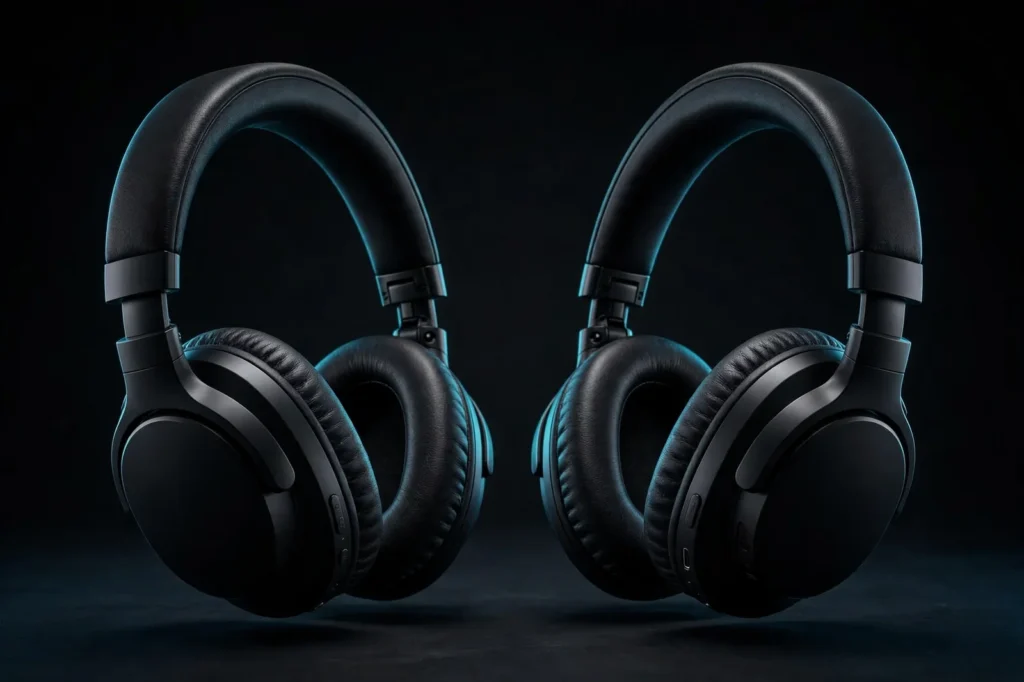
This sonos ace vs sony wh-1000xm5 comparison is the newcomer against the benchmark: Sonos first headphone, built around its soundbar ecosystem, against the Sony flagship that has anchored the premium noise cancelling class for a full product cycle. Our scores keep the crown with Sony. The WH-1000XM5 wins the overall 8.8 to 8.6, taking Sound, ANC, Calls and Value. The Sonos Ace takes Comfort and Battery and holds one feature Sony cannot answer. The question is whether that feature is worth more to you than the rounds it loses.
The short version is this. Buy the WH-1000XM5 if you want the best all-round premium headphone: quieter, better sounding, stronger on calls and lighter. Buy the Sonos Ace if you own a Sonos soundbar and watch films after dark, or if its fit suits your head better across long sessions. The rounds below price out both cases, and the scorecard at the end lines all six bars up side by side.

Sonos Ace 8.6/10
Why you: TV audio in your ears after dark. TV Audio Swap pulls sound from a compatible Sonos soundbar, and Comfort scores 9.2, the highest bar in this comparison, matching the best in the class hour for hour.
Trade-off: noise cancelling and call quality sit a clear step behind the class leaders, and at 312 grams it is the heavier of the two flagships here.
Adaptive ANC · SBC, AAC, aptX Lossless · Bluetooth 5.4 · Multipoint · 30 h battery · 312 g · TV Audio Swap

Sony WH-1000XM5 8.8/10
Why you: one pair that handles bass, travel and calls with equal polish. ANC scores 9.3 and Sound 9.1, the top bars in this comparison, and Calls at 8.8 make it the safer pick for a working day.
Trade-off: the bass is restrained by default and needs EQ for bass-led listening, and it does not fold flat, so the case takes real bag space.
ANC · SBC, AAC, LDAC · Multipoint · 30 h battery · 250 g · Wired 3.5 mm mode
Sound, silence and calls
Sound quality
Sound goes to the Sony, 9.1 to 8.8. The XM5 tuning is the more complete listen: a warm, controlled low end, a midrange that keeps voices natural, and treble detail that survives busy mixes. Its feed summary calls it one pair that handles bass, travel and calls with equal polish, and the sound bar is where that polish starts. The Ace sounds clean and spacious, with spatial audio and head tracking that flatter films, and its aptX Lossless support gives Android listeners a high-quality wireless path the Sony answers with LDAC. On plain stereo music the Sony resolves more and errs less. One honest note from the Sony feed record: its bass is restrained by default and needs the app EQ for bass-led listening, so the 9.1 assumes five minutes of setup.
Winner: Sony WH-1000XM5
Noise cancelling
ANC goes to the Sony by the clearest margin in this comparison after calls: 9.3 to 8.9. The XM5 system takes more out of the world at every frequency, engine drone, office chatter and the higher sounds many rivals leave behind. The Ace adaptive cancelling is genuinely good, a flagship-grade result that covers a commute and a cabin without complaint, and its feed caution still states the gap plainly: cancelling sits a clear step behind the leaders. What Hi-Fi? reached the same ordering in its head-to-head, finding the Ace unable to match the XM5 on noise cancelling. If quiet is the purchase, this round settles it.
Winner: Sony WH-1000XM5
Calls
Calls go to the Sony, 8.8 to 7.9, the widest gap on either card. The XM5 microphone system holds a voice clear and steady outdoors, in wind and against traffic, which is why it anchors so many work shortlists. The Ace handles a quiet room and a calm street well enough, then loses ground as conditions worsen, and the feed caution names call quality alongside cancelling as a clear step behind. Hybrid workers who take calls on the move should weight this round heavily. Listeners who take calls at a desk can afford to weight it lightly, and the Ace closes much of the overall gap for them.
Winner: Sony WH-1000XM5
Fit, battery and daily use
Comfort and fit
Comfort goes to the Sonos Ace, 9.2 to 8.8, the highest single bar in this comparison. The Ace pairs memory foam cushions with an even weight distribution that keeps it settled hour after hour, and its feed record says the comfort matches the best in the class. The paradox is mass: at 312 grams the Ace is the heavier headphone by a wide margin against the Sony at 250 grams, and the feed caution flags exactly that. Fit is personal enough that both statements hold. Bigger heads tend to love the Ace. Smaller heads tend to notice its weight by the end of a long flight, where the lighter Sony fades from attention. Try both if you can; if you cannot, our Sonos Ace review covers its fit in detail.
Winner: Sonos Ace
Battery and charging
Battery goes to the Ace, 8.8 to 8.5, on level headline figures: both headphones are rated at 30 hours with cancelling on. The bar edges to the Sonos on how that figure holds up across mixed use and standby. In practice this is the least decisive round on the card. Either headphone covers a long-haul return trip or a week of commuting between charges, and both charge over USB-C. Buy on the other rounds and let this one break a tie, nothing more.
Winner: Sonos Ace
Value
Value goes to the Sony, 8.4 to 8.0. The XM5 wins more rounds, posts the higher overall and sits in the same 200-plus band in our feed while asking less of it in the market. The Ace premium buys Sonos design, aptX Lossless and the TV Audio Swap feature, and two of those three only pay out inside a Sonos home. Value measures what arrives for the band you pay, and the Sony simply delivers more of the core job: sound, silence and calls. Our Sony WH-1000XM5 review covers where that value shows up across a working week.
Winner: Sony WH-1000XM5
Features and ecosystems
Features go to the Ace, and the round is not close for one specific household. TV Audio Swap pulls film and television sound from a compatible Sonos soundbar, the Arc, Beam and Ray in the feed record, straight into the Ace, with spatial audio and head tracking on top. For a Sonos owner who watches after dark in a shared home, that single feature can outweigh every bar the Ace loses. Outside that household, the picture balances: the Ace offers aptX Lossless over Bluetooth 5.4 and tactile controls, the Sony offers LDAC, a 3.5 mm wired mode and the deeper app EQ, and both hold multipoint connections. Our best noise cancelling headphones guide shows where both sit in the full flagship field.
Winner: Sonos Ace
Sonos Ace vs Sony WH-1000XM5 specs
| Spec | Sonos Ace | Sony WH-1000XM5 |
|---|---|---|
| Codecs | SBC, AAC, aptX Lossless | SBC, AAC, LDAC |
| Bluetooth | 5.4 | 5.2 |
| Multipoint | Yes | Yes |
| Noise cancelling | Adaptive ANC | ANC |
| Battery | 30 hours | 30 hours |
| Weight | 312 g | 250 g |
| Wired mode | USB-C audio | 3.5 mm cable |
| Signature feature | TV Audio Swap from Sonos soundbars | App EQ with LDAC hi-res support |
Scorecard
| Category | Sonos Ace | Sony WH-1000XM5 |
|---|---|---|
| Sound | 8.8 | 9.1 |
| ANC | 8.9 | 9.3 |
| Calls | 7.9 | 8.8 |
| Comfort | 9.2 | 8.8 |
| Battery | 8.8 | 8.5 |
| Value | 8 | 8.4 |
| Overall | 8.6 | 8.8 |
Verdict
Buy the Sony WH-1000XM5 if you want the strongest all-round premium headphone of the two. It wins the overall 8.8 to 8.6 with the better sound, the stronger cancelling and a call performance the Ace cannot match, at 62 grams less on your head. For travel, work and music in one pair, it remains the benchmark this comparison set out to test.
Buy the Sonos Ace if your living room already runs on Sonos. TV Audio Swap is a real, daily-use advantage no score bar captures, Comfort at 9.2 is the best in this comparison, and Battery edges the Sony. You accept weaker calls and a step less silence as the price of the ecosystem, and for the right household that price is worth paying.
A final practical note: both headphones travel well, but differently. The Sony folds flat into a slimmer case and weighs less in a bag, while the Ace feels the more solidly built of the two in the hand, with metal in the frame where the Sony uses recycled plastics. Neither build gives cause for concern across years of use, and neither headphone asks for babying. Pick on sound, silence, calls and the soundbar question, and the travel details will not reverse the decision.
The benchmark holds. The newcomer earns its place beside it, and in one kind of home, ahead of it.
Frequently asked questions
Which is better, the Sonos Ace or the Sony WH-1000XM5?
On our scores, the Sony WH-1000XM5, 8.8 overall against 8.6. It wins Sound 9.1 to 8.8, ANC 9.3 to 8.9 and Calls 8.8 to 7.9, plus Value 8.4 to 8.0. The Sonos Ace wins Comfort 9.2 to 8.8 and Battery 8.8 to 8.5, and adds TV Audio Swap for Sonos soundbar owners. The Sony is the stronger all-rounder; the Ace is the specialist pick for a Sonos home.
Which has better noise cancelling, the Sonos Ace or the WH-1000XM5?
The Sony WH-1000XM5. ANC scores 9.3 against 8.9, and the feed caution for the Ace states it plainly: its cancelling sits a clear step behind the class leaders. Both handle engine drone and office hum well, but the Sony removes more, especially on voices and higher-frequency noise.
What is TV Audio Swap on the Sonos Ace?
It is the Ace party trick for Sonos households. TV Audio Swap pulls the sound from a compatible Sonos soundbar, including the Arc, Beam and Ray, into the Ace at the press of a button, so films play in your ears after dark at full volume. No Sony headphone offers an equivalent, and it is the main reason a Sonos owner picks the Ace over the XM5.
Which lasts longer on a charge?
Close, with the edge to the Sonos Ace. Both are rated at 30 hours, and Battery scores 8.8 for the Ace against 8.5 for the Sony. In practice both cover a long-haul trip or a full working week of commutes between charges, so the round matters less than the headline gap suggests.
Which is more comfortable for long flights?
The Sonos Ace, on our card: Comfort scores 9.2 against 8.8, and its feed record says the comfort matches the best in the class hour for hour. The counterweight is mass, 312 grams against 250 grams for the Sony, so smaller heads may still prefer the lighter XM5 across a very long day.

I am the founder of Sound Mavericks, where I provide the polite truth about audio equipment. I started this site because consumer electronics reviews are often too technical. Instead of using a silent lab, I test headphones, earbuds, and Bluetooth speakers in the real world – like on a noisy subway or in a busy coffee shop.
To stay independent, I buy my own review units (mostly from the United States) rather than accepting free gifts from brands. Once I finish testing a product, I sell it locally to our community. My goal is to help you understand sound quality, active noise cancellation (ANC), and battery life without the marketing hype.