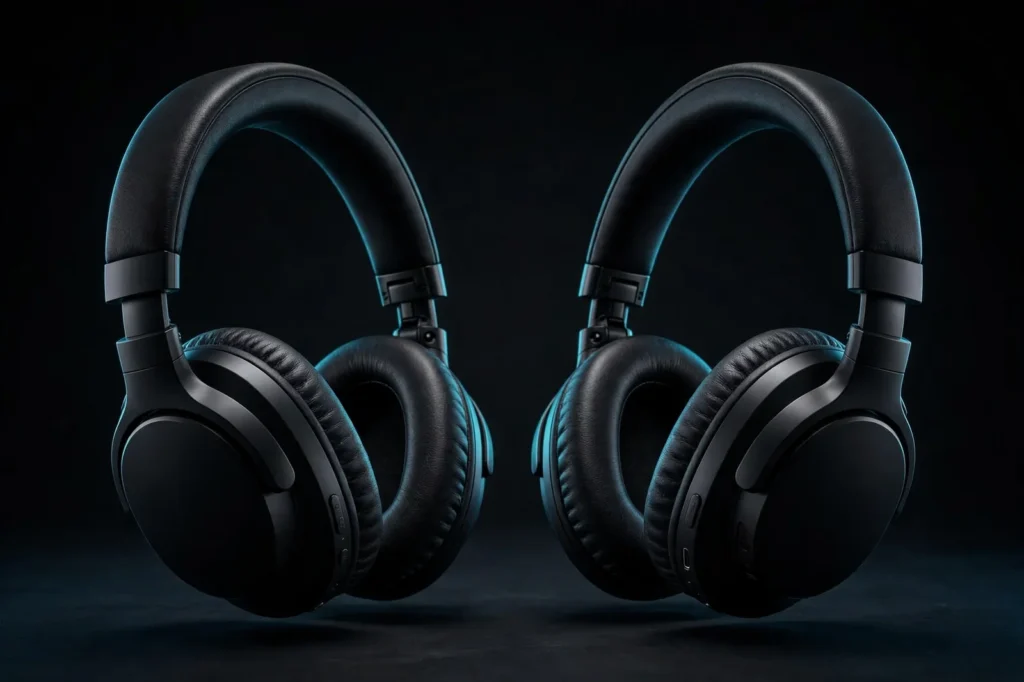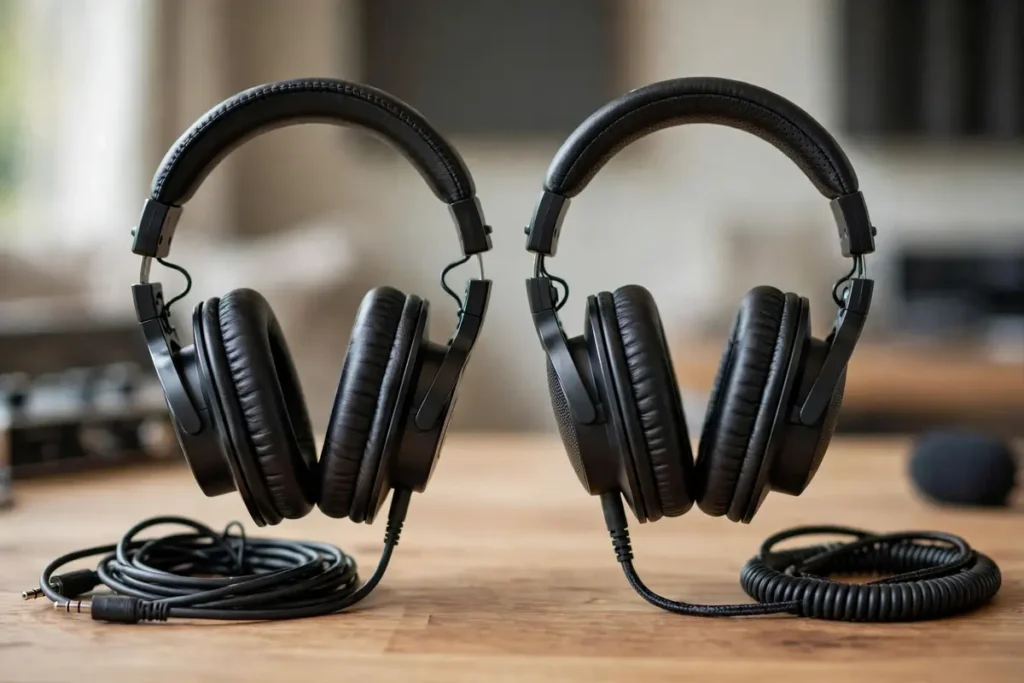
This ath m50x vs m40x comparison is the oldest sibling argument in studio headphones: two wired closed-backs from the same Audio-Technica family, sharing a design, a cable system and a job, separated by one driver size and one budget band. Our scores settle it by a hair for the cheaper headphone. The ATH-M40x takes the overall 6.3 to 6.2, built on a Value bar of 9.3 against 8.7. The ATH-M50x wins the round most buyers ask about first, Sound, 8.8 to 8.6. Everything else is a tie or a coin flip, which is exactly why this pair confuses people.
The short version is this. Buy the M40x if you track, record podcasts or mix on a firm budget; it is the more neutral headphone and the stronger value. Buy the M50x if the headphone is also your casual listener and you want the fuller low end and the extra cable. The rounds below show how thin the margins are, and the scorecard at the end lines all six bars up side by side.

Audio-Technica ATH-M50x 6.2/10
Why you: studio-trusted bass with definition, wired. The 45 mm driver posts the higher Sound bar at 8.8, the low end carries more weight, and three cables in the box cover desk, studio and travel lengths.
Trade-off: wired only, with no microphone. The bass is accurate rather than impactful next to the bass-led rivals, and the Value bar at 8.7 gives ground to its own sibling.
45 mm drivers · Closed-back · Wired only · Detachable locking cables · 38 ohms · Folding design
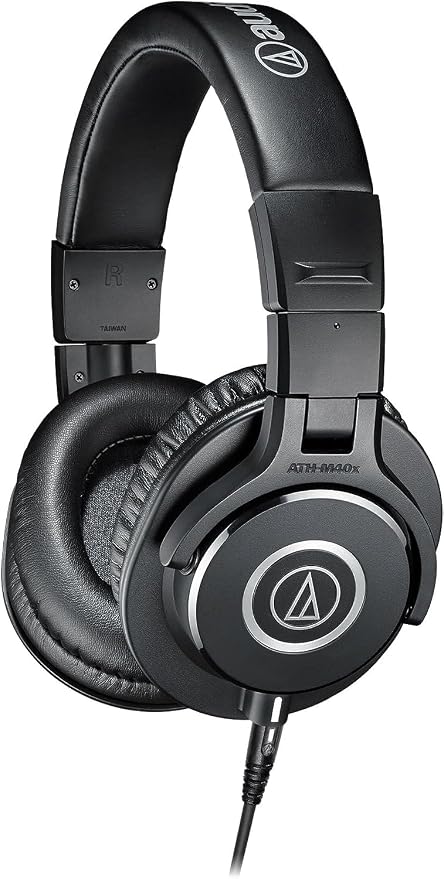
Audio-Technica ATH-M40x 6.3/10
Why you: neutral monitoring for podcasters on a budget. Value scores 9.3, the highest bar in this comparison, Sound holds at 8.6, and the lighter build edges Comfort.
Trade-off: the pads sit a step behind velour for true marathons. Wired only with no microphone, and the Battery bar is the neutral placeholder we use for wired models.
40 mm drivers · Closed-back · Wired only · Detachable locking cables · 35 ohms · Folding design
Sound, isolation and calls
Sound quality
Sound goes to the M50x, 8.8 to 8.6, and the driver sizes frame the difference: 45 mm in the M50x against 40 mm in the M40x. The M50x low end is fuller and extends with more authority, so kick drums and bass synths carry physical weight the M40x only outlines. Its feed summary puts it plainly: studio-trusted bass with definition. The M40x counters with balance. Its midrange sits closer to neutral, voices and acoustic instruments land where the recording put them, and for tracking vocals or editing speech that honesty is worth more than weight. Neither headphone has a wide stage; both are closed-backs built for isolation first. Pick the M50x for listening pleasure, the M40x for listening work, and know that the gap between them is two tenths of a bar, not a class.
One product-specific detail separates them in daily studio use. The M50x driver handles high playback levels with a little more composure, so a loud cue mix during tracking stays clean where the M40x begins to harden at the edges. Tracking engineers who monitor hot will hear that difference in the first session. Mixers who work at moderate levels, which is most home recordists most of the time, will likely never reach the point where it matters, and for them the M40x balance is the more useful tool.
Winner: Audio-Technica ATH-M50x
Noise isolation
Isolation ties at 3.5, because the number measures the same thing on both sides: passive blocking from a closed shell and a pad seal, with no active cancelling on either headphone. Both keep a click track out of a vocal microphone, both dull office noise while you edit, and both leak a little at high volume. There is no round to win here. If real cancelling is on your list, neither of these headphones belongs on it, and our best studio headphones guide marks which studio picks do offer it.
Winner: Tie
Calls
Calls tie at 3. Neither headphone has a microphone, neither has Bluetooth, and neither cable in either box carries an inline mic. A score of 3 is our floor for a headphone that simply cannot take a call, and both sit on it together. Podcasters record through a separate microphone, which is the workflow both were designed for. Anyone who needs one headphone for meetings and music should leave this comparison entirely and start from a wireless shortlist.
Winner: Tie
Fit, running costs and daily use
Comfort and fit
Comfort goes to the M40x, 8.2 to 8.1, and weight does most of the work: 240 grams against 285 grams is a difference you feel in hour three of an edit. Both headphones clamp firmly, both swivel a cup flat for one-ear monitoring, and both use synthetic pads that warm up over long sessions. The M40x feed caution names its pads as a step behind velour for true marathons, and the M50x pads behave the same way. Both accept replacement pads, so the long-session fix costs the same on either side. Across a normal working day the two are close enough that head shape decides; across a long one, the lighter headphone wins.
Winner: Audio-Technica ATH-M40x
Battery and running costs
Battery ties at 5, the neutral placeholder we assign to wired headphones, because there is no battery to score. Neither headphone charges, pairs or runs flat. The running costs that do exist are pads and cables, and both headphones keep them low: detachable locking cables that swap in seconds, pads that pull off by hand, and a design old enough that spares are everywhere. Our best wired headphones roundup covers the cable systems and pad behaviour of the wider wired field both belong to.
Winner: Tie
Value
Value is the round that flips the overall: 9.3 for the M40x against 8.7 for the M50x. The M40x sits a full budget band lower, keeps 8.6 of the M50x sound story, wins Comfort, and ties everything else. The M50x premium buys the bigger driver, the fuller bass and a third cable, and those are real things, but they are refinements rather than a different headphone. Value measures what arrives for the band you pay, and the M40x packs its band fuller. That six-tenths gap is the whole comparison in miniature: the M50x is the better listen, the M40x is the better buy, and our overall follows the buy.
Winner: Audio-Technica ATH-M40x
Build and cables
The M50x takes the build round on details. It ships with three detachable cables, two straight at different lengths and one coiled, where the M40x ships with two, a coiled and a straight three-metre cable plus the quarter-inch adapter both boxes include. The M50x build uses more metal in the headband and feels the more rugged of the two in the hand, and its 90-degree swivelling cups and folding frame match the M40x hinge for hinge. Both are plastic-forward designs that reward being treated as studio tools. Our best Audio-Technica headphones roundup shows where the pair sits in the wider M-series family.
Winner: Audio-Technica ATH-M50x
ATH-M50x vs ATH-M40x specs
| Spec | Audio-Technica ATH-M50x | Audio-Technica ATH-M40x |
|---|---|---|
| Driver | 45 mm dynamic | 40 mm dynamic |
| Form | Over-ear, closed-back, folding | Over-ear, closed-back, folding |
| Connection | Wired only, detachable locking cables | Wired only, detachable locking cables |
| Cables included | Three: coiled plus two straight | Two: coiled and straight, 3 m each, plus 6.3 mm adapter |
| Impedance | 38 ohms | 35 ohms |
| Sensitivity | 99 dB | 98 dB |
| Frequency response | 15 Hz to 28 kHz | 15 Hz to 24 kHz |
| Weight | 285 g | 240 g without cable |
| Noise cancelling | None, passive isolation only | None, passive isolation only |
| Microphone | None | None |
Scorecard
| Category | Audio-Technica ATH-M50x | Audio-Technica ATH-M40x |
|---|---|---|
| Sound | 8.8 | 8.6 |
| ANC | 3.5 | 3.5 |
| Calls | 3 | 3 |
| Comfort | 8.1 | 8.2 |
| Battery | 5 | 5 |
| Value | 8.7 | 9.3 |
| Overall | 6.2 | 6.3 |
Verdict
Buy the ATH-M40x if the headphone is a tool first. It wins the overall 6.3 to 6.2 on the strength of a 9.3 Value bar, keeps its midrange the more neutral of the two, and gives up only two tenths on Sound. For tracking, podcasting and mixing on a budget, it is the rational end of this family and the one our card backs.
Buy the ATH-M50x if the same headphone has to entertain you after the session ends. The 8.8 Sound bar is real, the low end is fuller, and the extra cable and sturdier feel repay the step up across years of daily use. You are paying for a better listen, not a better score, and that is a fair trade when listening is the point.
Owners who already hold one of the two should not switch to the other. The differences on this card are the kind you hear in a direct comparison and forget in a week of normal use, and the money is better spent on fresh pads or a second cable length. This comparison matters at the moment of first purchase, when the budget band is still a choice. At that moment the M40x makes the stronger case for work and the M50x makes it for pleasure, and our scores simply record that split honestly.
Same shell, same cables, same job. The M50x sounds a touch better. The M40x buys a touch smarter. The scorecard says the buying wins, by one tenth.
Frequently asked questions
Which is better, the ATH-M50x or the ATH-M40x?
On our scores, the ATH-M40x by the narrowest margin, 6.3 overall against 6.2. The M50x wins Sound, 8.8 to 8.6, but the M40x wins Value by more, 9.3 to 8.7, and edges Comfort 8.2 to 8.1. Cancelling, calls and battery all tie because both are wired closed-backs with no microphone and no battery.
Is the ATH-M50x worth the step up from the M40x?
Only if sound is the whole decision. The step up buys a 45 mm driver against 40 mm, a fuller low end and a third cable in the box. It does not buy a higher overall score here, and it gives back the value lead. Most buyers tracking or mixing on a budget keep the difference and lose nothing they will miss.
Which is more neutral, the M50x or the M40x?
The M40x. Its midrange stays closer to a monitoring balance, which is why it is the feed pick for neutral monitoring and podcast work. The M50x carries more low-end weight and a livelier top, a tuning that flatters casual listening and modern production at the cost of strict neutrality.
Do the M50x and M40x need an amplifier?
No. The M40x runs at 35 ohms and 98 dB sensitivity, the M50x at 38 ohms and 99 dB, so a phone, laptop or interface output drives either one loud. An amp adds a better volume control and headroom, not a different headphone.
Which is more comfortable for long sessions?
The M40x, by a hair: Comfort scores 8.2 against 8.1, and it is the lighter headphone at 240 grams against 285 grams. Both use synthetic pads that warm up over marathon sessions, and both accept replacement pads, which is the cheapest way to extend either one’s comfort.

I am the founder of Sound Mavericks, where I provide the polite truth about audio equipment. I started this site because consumer electronics reviews are often too technical. Instead of using a silent lab, I test headphones, earbuds, and Bluetooth speakers in the real world – like on a noisy subway or in a busy coffee shop.
To stay independent, I buy my own review units (mostly from the United States) rather than accepting free gifts from brands. Once I finish testing a product, I sell it locally to our community. My goal is to help you understand sound quality, active noise cancellation (ANC), and battery life without the marketing hype.