
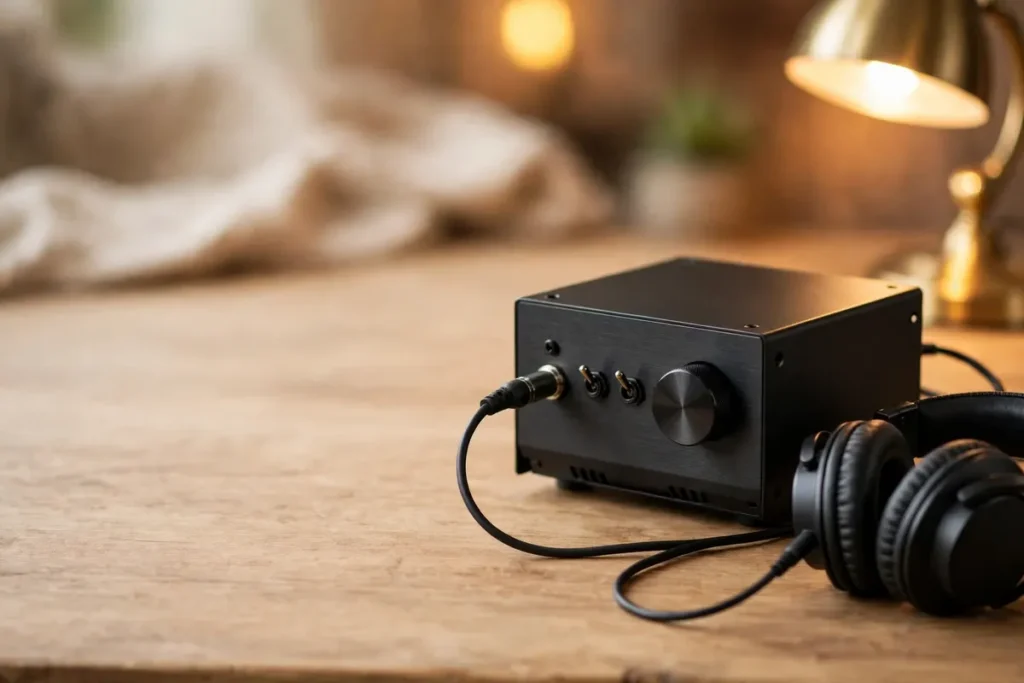
This smsl sp200 review covers the SP200, the compact desktop amplifier that put THX’s AAA-888 technology within reach of ordinary budgets: balanced and unbalanced inputs, up to 6 watts per channel, and distortion figures that read like misprints. Our provisional verdict is 8.0 overall on the source-gear scale, with Sound Quality at 9.3 and Value at 9.0. It is an amplifier only, with no DAC inside, and SMSL has since replaced it with the SH-9, which makes the remaining stock a value question as much as a performance one.
A note on method. This review is research-based. Scores are provisional, set from SMSL’s published specifications and independent measurement, principally Audio Science Review’s test of this amplifier, which is cited by name where its findings are used. Source gear is scored on five bars and never enters our headphone database.

SMSL SP200 8.0/10 provisional
Why you: you want amplification that adds nothing of its own. Measured distortion is vanishingly low, power is plentiful for any headphone, and the near-zero output impedance suits sensitive IEMs as well as planars.
Trade-off: it only amplifies. There is no DAC, no remote and no display, the volume knob is small, and the model has been succeeded, so you are buying remaining stock.
THX AAA-888 · XLR and RCA inputs · 6W ×2 at 16 Ω · Near-0Ω output impedance · Amp only, no DAC
Sound quality: the measured case
Sound Quality scores 9.3, and unusually for this site, the number rests on measurement more than impression. Audio Science Review’s Amir tested the SP200 and recommended it in plain terms, describing the THX approach as a winning combination of vanishingly low distortion and high power. SMSL’s own figures support the story: THD+N of 0.00007% at 1 kHz into 32 ohms, a 130 dB signal-to-noise ratio, and output noise low enough for sensitive IEMs. In listening terms the SP200 has no house sound to describe. It presents the DAC in front of it and the headphone after it, which is either exactly what you want or a reason to buy a warmer amplifier instead. Our best headphone amps guide keeps it among the measurement-led picks for that reason.
Power, gain and the balanced question
Output is rated at 6 watts per channel into 16 ohms, 3 watts into 32, 440 milliwatts into 300 ohms and 220 into 600, switched between low gain at +6 dB and high gain at +18 dB by a front toggle. There is no realistic headphone this amplifier cannot drive, and the near-zero output impedance means it will not reshape the frequency response of low-impedance multi-driver IEMs the way high-impedance outputs do. One clarification worth making, because listings blur it: the 4-pin XLR output is not more powerful than the 6.35mm beside it. SMSL quotes one power figure per channel, not two, so the XLR is there for cables you already own. Choose your DAC with the same care, starting from our best DACs guide or SMSL’s own partners such as the model in our SMSL SU-3 review.
Pairing guidance is simple. High-impedance classics such as the 300-ohm Sennheiser HD 600 series belong on high gain, where the SP200’s voltage swing is generous and the pairing is a known quantity in measurement threads. Current-hungry planars belong on whichever gain keeps the knob in its upper half, and sensitive IEMs belong on low gain, where the 2.8-microvolt output noise stays inaudible. Balanced sources should use the XLR inputs to keep the chain balanced end to end; single-ended sources lose nothing through the RCA inputs, because the amplification itself is the same.
Build, controls and everyday use
Build Quality scores 7.8. The case is a compact metal wedge, 160 by 149 by 73 millimetres and 772 grams, with toggle switches for power, input and gain, relay-based switching that stays pop-free, and a full set of protections against DC, over-voltage and short circuits. The persistent criticism in reviews is the volume knob: small, light and imprecise-feeling next to the amplifier’s own performance. It works, and the precision resistors behind it track channels well, but your fingers will know this is where money was saved. Features & Flexibility scores 6.6 for the same reason: no remote, no display, no preamp output, no USB anything. Connectivity scores 7.2 on the strength of having both XLR and RCA inputs and both headphone outputs in a box this size.
Buying an amplifier at end of life
The SP200’s situation deserves a plain paragraph. SMSL’s current THX model is the SH-9, and a major US retailer lists the SP200 as end of life; the verified Amazon listing linked here still sells it. For most electronics that would be a warning. For a fully analogue amplifier with no firmware, no app and no wireless radios, it mostly means the opposite: there is nothing in the SP200 that can be outdated by software, and its measured performance has not been beaten at its price so much as reboxed with a display and a remote. Buyers who want the newer controls should read our SMSL D400 MK2 review for where the brand’s current line is heading, and treat the SP200 as what it is: a finished design at a finished-design price. Value scores 9.0 on exactly that basis.
SMSL SP200 specs
| Spec | SMSL SP200 |
|---|---|
| Amplifier technology | THX AAA-888 |
| Inputs | Balanced XLR ×1, unbalanced RCA ×1 (analogue only, no DAC) |
| Outputs | 4-pin XLR balanced, 6.35mm single-ended (same rated power) |
| Output power | 6W ×2 at 16 Ω · 3W ×2 at 32 Ω · 440mW ×2 at 300 Ω · 220mW ×2 at 600 Ω |
| THD+N | 0.00007% (1 kHz, 32 Ω) |
| SNR / output impedance | 130 dB A-weighted / near 0 Ω |
| Gain | Low +6 dB, high +18 dB |
| Size and weight | 160 × 149 × 73 mm, 772 g |
Verdict
Buy the SP200 if you want measured, neutral amplification and your budget has a hard ceiling. Sound Quality 9.3 and Value 9.0 make it the standing recommendation in its class while stock lasts.
Skip it if you want an all-in-one with a DAC inside, a remote on the sofa, or the current model with a warranty story your retailer can tell simply. As a pure amplifier, the 8.0 overall undersells it slightly; the measurements are the review.
Set expectations for the first listen, too. Owners upgrading from a coloured or underpowered output sometimes describe the SP200 as plain, because the drama they were used to was distortion and rolled-off extremes leaving the sound. Give it a week: what remains is the headphone itself, which is the entire point of a THX amplifier and the reason this one keeps its following.
Frequently asked questions
Is the SMSL SP200 also a DAC?
No. The SP200 is a headphone amplifier only, with balanced XLR and unbalanced RCA analogue inputs. It needs a DAC or another source in front of it. SMSL’s own SU-series DACs are the natural partners, and any competent DAC with a line output will drive it properly.
Is the SP200 discontinued?
SMSL has moved on to the SH-9 as its current THX AAA-888 amplifier, and at least one major retailer lists the SP200 as end of life. Stock continues to sell through Amazon and audio retailers. Buying one is a stock decision rather than a support risk: it is a simple analogue amplifier with no firmware, no app and nothing to go obsolete.
How much power does the SP200 deliver to high-impedance headphones?
Plenty. SMSL rates it at 440 milliwatts per channel into 300 ohms and 220 milliwatts into 600 ohms, with 3 watts per channel into 32 ohms for planars and low-impedance models. A 300-ohm Sennheiser or a demanding planar reaches high volume with headroom to spare on the high gain setting.
Is the XLR output more powerful than the 6.35mm output?
No, and SMSL’s own figures say so: output power is quoted per channel without distinguishing the outputs. Treat the 4-pin XLR as a convenience for balanced cables you already own, not as an upgrade path. Choose the output that matches your cable.
SP200 or the newer SMSL SH-9?
Same THX AAA-888 technology and a similar measurement profile. The SH-9 adds a display, a remote and a nicer control experience; the SP200 answers with toggles, a smaller footprint and, while stock lasts, a simpler bill. If the controls matter, buy the SH-9. If only the amplification does, the SP200 remains the value pick of the two.

I am the founder of Sound Mavericks, where I provide the polite truth about audio equipment. I started this site because consumer electronics reviews are often too technical. Instead of using a silent lab, I test headphones, earbuds, and Bluetooth speakers in the real world – like on a noisy subway or in a busy coffee shop.
To stay independent, I buy my own review units (mostly from the United States) rather than accepting free gifts from brands. Once I finish testing a product, I sell it locally to our community. My goal is to help you understand sound quality, active noise cancellation (ANC), and battery life without the marketing hype.

