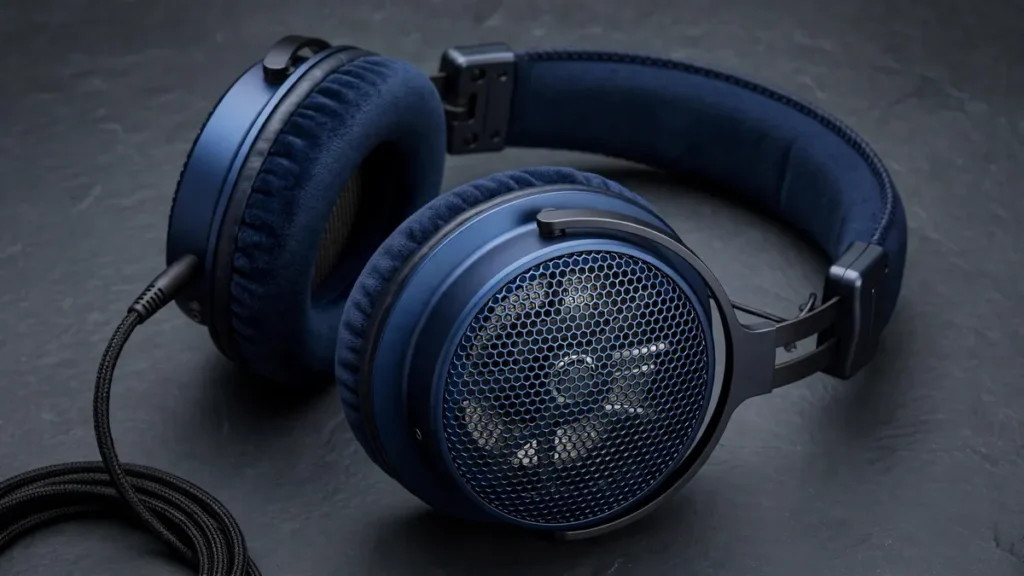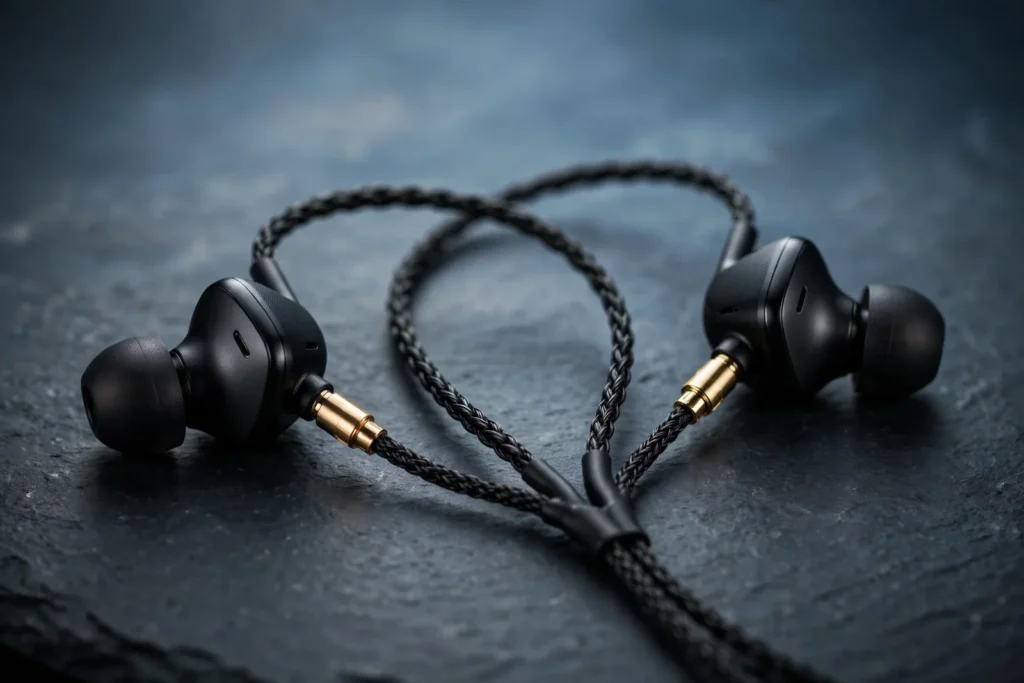
The Sennheiser IE 300 is one of those rare wired earphones that makes you question why you ever went wireless. Built around a German-made 7mm Extra Wide Band driver from Sennheiser’s flagship IE lineage, it delivers big, detailed, thoroughly engaging sound in a featherweight shell that disappears in your ear.
Our verdict: if you want audiophile-grade sound on the go without the bulk, battery anxiety, or compromises of wireless earbuds, the IE 300 remains one of the most enjoyable wired IEMs you can buy. The catch? It’s genuinely hard to find new in the US now, so knowing where to look matters. This guide covers the specs, the sound, how it stacks up, and how to get one.
| Sound Quality | 9.3 |
| Comfort & Fit | 8.8 |
| Build & Accessories | 8.2 |
| Value | 8.4 |
- Big, detailed sound from the 7mm XWB driver with genuine sub-bass reach
- Excellent stereo imaging and a wide, open soundstage for an IEM
- Featherweight 4g shells, comfortable for hours
- Detachable para-aramid cable with gold-plated MMCX
- Strong passive isolation with the right tips
- No microphone or inline remote on the stock cable
- Cable transmits some handling noise (microphonics)
- Recessed MMCX sockets limit third-party cable options
- Getting hard to find new from US retailers
Sennheiser IE 300 Specs
Every specification below comes straight from Sennheiser’s official spec sheet. The IE 300 sits in the middle of Sennheiser’s audiophile IE line, inheriting its 7mm Extra Wide Band transducer technology from the flagship IE 800 S.
| Driver | 7mm Extra Wide Band (XWB) dynamic transducer, German-made |
| Transducer principle | Single dynamic driver, pressure chamber |
| Frequency response | 6 Hz – 20,000 Hz |
| Impedance | 16 ohms |
| Sound pressure level | 124 dB (1 kHz, 1 Vrms) |
| Total harmonic distortion | < 0.08% (1 kHz, 94 dB) |
| Cable | 125 cm detachable, para-aramid reinforced, gold-plated Fidelity+ MMCX connectors, 3.5mm plug |
| Ear tips | Silicone and memory foam sets, S/M/L |
| Weight | Approx. 4g per earpiece (without cable) |
| Noise isolation | Up to -26 dB passive attenuation (with proper seal) |
| Microphone / remote | None on stock cable |
| In the box | IE 300 earphones, MMCX cable, silicone & foam tip sets, carry case, cleaning tool, user manual |
| Warranty | 2 years |
Three pieces of engineering do the heavy lifting inside that tiny shell. The 7mm XWB driver uses the full frequency spectrum for a natural, balanced presentation. A resonator chamber in front of the driver cancels the masking resonances that build up in your ear canal, keeping treble clean instead of harsh. And a newly developed membrane foil keeps distortion to a minimum, reflected in that sub-0.08% THD figure.
Sound Quality: Where the IE 300 Earns Its Keep
Sound is the entire reason the IE 300 exists, and it’s where our score peaks. This is not a neutral studio monitor and not a bass cannon either: a lively, detailed signature with real low-end authority and sparkling highs that never tip into fatigue.
Bass
The low end is the IE 300’s party trick. Thanks to that 6 Hz extension, sub-bass reaches deep with genuine physicality rather than mid-bass bloat. Kick drums hit with punch, bass lines stay textured and controlled, and the bass never bleeds into the midrange.
Mids
The midrange is where the IE 300 shows its tuning priorities. Vocals and instruments come through clearly with good presence, but the mids sit slightly behind the energetic treble and bass. This is the classic “fun” tuning trade-off: nothing sounds wrong, but if you want a dead-neutral vocal presentation, the step-up IE 600 leans further that way.
Treble
Treble is where the resonator chamber earns its place. Highs are crisp, extended, and highly detailed, with real air around instruments, and the detail doesn’t come with harshness. The IE 300 avoids the piercing, fatiguing top end that plagues many detail-forward IEMs, which is why it works for long sessions.
Soundstage and Imaging
This is the IE 300’s standout technical achievement. Stereo separation is excellent, with a strong sense of left and right that gives music genuine width and depth instead of the “inside your head” feeling of lesser in-ears. Instrument placement is precise, and complex tracks stay layered. For a single dynamic driver IEM, the imaging is superb.
Design, Fit, and Comfort
At around 4 grams per earpiece, the IE 300 is among the lightest audiophile IEMs you can buy, with small, smooth housings that sit flush in the ear.
Fit is secured by adjustable, bendable ear hooks. Sennheiser includes three sizes of silicone tips and three sizes of memory foam tips, and tip choice matters enormously: the right seal transforms both the bass response and the passive isolation.
With foam tips and a proper seal, the IE 300 blocks up to 26 dB of ambient noise, enough to make commutes and flights dramatically quieter without any active cancellation or batteries.
Cable and Accessories
The stock cable is a 125 cm detachable design with gold-plated Fidelity+ MMCX connectors in recessed sockets for strain relief. It’s reinforced with para-aramid fiber, rated to survive thousands of bend cycles, and ends in a standard 3.5mm plug.
Two things to know. First, the cable is somewhat stiff and transmits handling noise when it rubs against clothing, a common wired-IEM annoyance. Second, the recessed MMCX sockets mean standard MMCX cables won’t fit; you’ll need cables made for the IE 300, and Sennheiser offers balanced 2.5mm and 4.4mm options.
In the box you get the earphones, the cable, both tip sets, a carry case, a cleaning tool, and the manual. What you don’t get is any in-line remote or microphone, so the IE 300 is a music-only proposition. If you take calls on your earbuds, look elsewhere.
Who Should Buy the Sennheiser IE 300
Buy it if: you want true audiophile sound in a portable package and you’re happy to stay wired. The IE 300 suits commuters who value isolation without ANC, travelers who hate charging earbuds, and anyone building a first serious IEM setup. At 16 ohms it sounds excellent straight from a phone or laptop, no amp required.
Skip it if: you need a microphone, take frequent calls, or want wireless convenience. The lack of any remote is a hard dealbreaker for phone-centric users. Bass purists chasing a truly neutral reference tuning should audition the IE 600 or Shure’s Aonic line instead.
IE 300 vs the Competition
The IE 300 doesn’t exist in a vacuum. Here’s how it lines up against the alternatives shoppers cross-shop it with:
| Model | Driver | Signature | Best for |
|---|---|---|---|
| Sennheiser IE 300 | 7mm XWB dynamic | Lively, detailed, fun | Engaging all-round listening |
| Sennheiser IE 200 | 7mm TrueResponse dynamic | Neutral-leaning, dual tuning | Budget entry to the IE line |
| Sennheiser IE 600 | 7mm TrueResponse dynamic | Refined, neutral, technical | Step-up clarity and build |
| Shure SE215 | Single dynamic driver | Warm, bass-forward | Stage use, warm sound lovers |
The IE 200 is the current entry point to Sennheiser’s audiophile IE range and the easiest to buy new today. It trades some of the IE 300’s treble energy and soundstage width for a more neutral tuning. If you can’t find the IE 300 in stock, the IE 200 is the natural fallback.

Same 7mm TrueResponse driver DNA in a more neutral tuning, and it’s in stock on Amazon now.
Check Price on AmazonThe IE 600 is the true step up: tighter channel matching, lower distortion, and a more reference-grade tuning, with balanced cables included. The Shure SE215 remains the classic workhorse alternative, warmer and bassier, and often the pick for stage monitoring on a budget.
Buying Guide: How to Get the IE 300 in 2026
Here’s the honest part of this guide. The IE 300 has become difficult to find new from US retailers, and as of our latest check there is no live Amazon.com listing for it. It appears discontinued or delisted in the US market, though it still surfaces in other regions.
Your best options:
- Check Amazon listings directly. Stock comes and goes; third-party sellers list new and used pairs. Search Amazon for the IE 300 before assuming it’s gone.
- Consider reputable used markets. IEM drivers rarely fail, so used pairs hold up well. Buy from sellers with strong feedback, and budget for fresh ear tips.
- Verify authenticity. Counterfeit Sennheiser products exist. Stick to authorized dealers or sellers with long, clean histories.
- Don’t overpay out of nostalgia. If new-old-stock prices climb well past the IE 600’s street price, the smarter move is the IE 600 itself: a genuine upgrade, not an inflated legacy buy.
And if you’d rather buy new with full warranty today, the IE 200 is the straightforward answer from the same product family.
Sennheiser IE 300 FAQ
Is the Sennheiser IE 300 still worth buying in 2026?
Yes, for the right buyer. The sound hasn’t aged a day: the 7mm XWB driver, resonator chamber, and excellent imaging still compete with current IEMs. The main caveat is availability, since it’s hard to find new from US retailers. A genuine pair at a fair price is still an excellent buy.
Does the IE 300 have a microphone or inline remote?
No. The stock cable has no microphone and no inline remote, so the IE 300 can’t take calls or control playback. It’s a music-only earphone.
What’s the difference between the Sennheiser IE 300 and IE 200?
Both use 7mm Sennheiser dynamic drivers, but they’re tuned differently. The IE 300 is livelier and more energetic with a wider soundstage, while the IE 200 aims for a more neutral tuning with a dual-tuning feature. The IE 200 is also the current model and much easier to buy new.
Do I need a headphone amp for the IE 300?
No. At 16 ohms impedance and 124 dB sensitivity, the IE 300 sounds excellent straight from a phone, laptop, or basic dongle DAC. A dedicated amp can refine the sound slightly, but it’s not required.
Can you replace the cable on the IE 300?
Yes. The cable detaches via gold-plated Fidelity+ MMCX connectors. Note the sockets are recessed, so you’ll need replacement cables made for the IE 300’s socket depth. Sennheiser also offers optional balanced 2.5mm and 4.4mm cables.
Final Verdict
The Sennheiser IE 300 is a reminder of what wired earphones do best: no batteries, no Bluetooth compression, no app required, just a superb driver in a tiny shell delivering genuinely thrilling sound. Its lively tuning, deep-reaching bass, and outstanding imaging make it one of the most fun audiophile IEMs we’ve tested, and its featherweight comfort means you’ll wear it for hours.
The no-mic cable and availability headaches are real, and buyers who need calls or wireless convenience should look elsewhere. But for pure listening pleasure on the go, the IE 300 remains a SoundMavericks favorite.

I am the founder of Sound Mavericks, where I provide the polite truth about audio equipment. I started this site because consumer electronics reviews are often too technical. Instead of using a silent lab, I test headphones, earbuds, and Bluetooth speakers in the real world – like on a noisy subway or in a busy coffee shop.
To stay independent, I buy my own review units (mostly from the United States) rather than accepting free gifts from brands. Once I finish testing a product, I sell it locally to our community. My goal is to help you understand sound quality, active noise cancellation (ANC), and battery life without the marketing hype.