
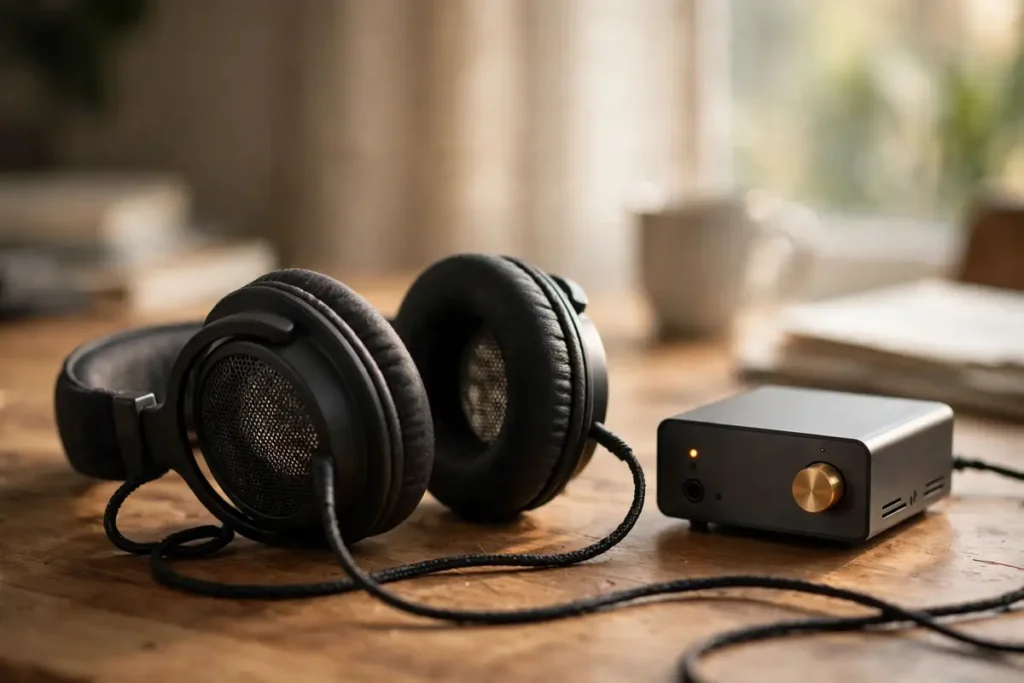
This sennheiser hd650 review covers the open-back reference headphone that has outlasted several generations of rivals. The HD 650 pairs a 300-ohm dynamic driver with a warm, mid-focused tuning, and it remains the default recommendation for listeners who value voices and long, fatigue-free sessions over spectacle. Our provisional score set puts it at 6.2 overall, and the shape of the bars explains the number: Sound at 9.2 and Comfort at 8.8 carry a headphone that scores low on the wired-model conventions for calls, battery and noise cancelling because it simply does not have those features.
A note on method. This review is research-based. The scores are a provisional SoundMavericks verdict built from published measurements and the long reviewer consensus on this model, cross-checked against the listings and specifications below. The HD 650 is not yet in our headphone database, so unlike a feed-verbatim review this page sets the score rather than repeating one, and the set will be confirmed when the model is added to the database.

Sennheiser HD 650 6.2/10
Why you: you want vocals and acoustic music presented with warmth and zero fatigue. Sound scores 9.2, built on a midrange that reviewers have used as a reference point for years, and comfort scores 8.8 for long evening sessions.
Trade-off: it needs a decent amplifier to reach its best. At 300 ohms a phone dongle leaves it quiet and flat, and the open-back design leaks sound in both directions, so this is a desk and living-room headphone only.
Open-back · Wired · 300 ohms · 42mm dynamic driver · Detachable cable
Sound quality
Sound scores 9.2, and the midrange is the reason. Voices sit forward without shouting, acoustic guitars carry body, and piano notes decay the way they do in a room. The HD 650 tuning rolls the treble down gently, which removes the glare that makes brighter headphones tiring after an hour. Listeners coming from consumer headphones often describe the first listen as understated, then notice a week later that they are reaching for the HD 650 every evening.
Bass is present and textured rather than boosted. Kick drums have weight, bass guitars have pitch definition, and the low end stays clear of the midrange. What the HD 650 does not do is sub-bass rumble: the open-back design rolls off the deepest frequencies, so electronic music built on infrasonic pressure sounds leaner here than on a closed-back or a planar rival. In our best open-back headphones coverage that trade is the defining split in the category.
Soundstage is intimate rather than vast. Instruments sit in a believable arc just outside the head, imaging is precise in the centre, and the presentation favours closeness over spectacle. Listeners who want a wide concert-hall spread should look at the wider-staging rivals in our best headphones for soundstage guide. Jazz and classical listeners are well served regardless, and our best headphones for jazz and best headphones for classical music lists both keep a place for this family.
The amplifier question
At 300 ohms, the HD 650 asks more of a source than most headphones. Sensitivity is respectable, so it reaches usable volume from many devices, but controlled volume is not the same as driven properly. On a weak output the bass softens and the soundstage flattens. On a competent desktop amplifier the low end firms up and quiet passages gain scale.
That requirement shapes who should buy it. If your listening happens at a desk with a DAC and amp already in place, the HD 650 slots straight in. If you want one headphone for a phone, a laptop and a games console with no extra boxes, a lower-impedance model is the easier life. Our explainer on what impedance means and whether you need an amp walks through the maths in plain terms, and our best headphone amps guide covers the sensible price tiers.
Comfort and build
Comfort scores 8.8. The clamp starts firm and relaxes with use, the velour pads breathe better than leather, and the weight distribution suits multi-hour sessions. The fit is the classic HD 6 series shape: oval cups, a padded headband and enough adjustment for most heads. Glasses wearers generally get on well once the clamp settles.
The build is mostly plastic, chosen for weight rather than luxury feel, and it has a long record of surviving daily use. Pads, headband padding and the cable are replaceable, which matters more for a decade-long product than exotic materials do. Buyers comparing siblings should read our Sennheiser HD 600 review for the leaner tuning and our Sennheiser HD 6XX review for the value-led variant of this same formula, while our best studio headphones guide shows where the family sits among work-focused rivals.
Everyday use and value
The HD 650 is a one-room headphone. It leaks, it has no microphone, and calls score 3.0 by the wired convention used across our reviews. Battery scores 5.0 as a neutral placeholder because there is no battery. ANC scores 1.5 because an open-back shell blocks almost nothing. None of that is a flaw in context: the score shape is what a pure listening tool looks like in a database built for every headphone type.
Value scores 8.4. The HD 650 sits above budget open-backs on price, and returns the difference in tuning maturity and parts support. Against newer rivals it gives up sub-bass extension and soundstage width, and it asks for an amplifier those rivals do not need. What it keeps, uniquely, is a midrange that has stayed relevant through every measurement era the hobby has passed through. Our best wired headphones guide places it accordingly.
Sennheiser HD 650 specs
| Spec | Sennheiser HD 650 |
|---|---|
| Design | Over-ear, open-back, wired |
| Driver | 42mm dynamic |
| Impedance | 300 ohms |
| Sensitivity | 102 dB |
| Frequency response | 10 Hz – 41,000 Hz |
| Cable | Detachable, 3.5mm with 6.35mm adapter |
| Microphone | None |
How the HD 650 holds up over time
Longevity is part of the HD 650 proposition in a way few headphones can claim. The design has been in continuous production with only running changes, which means pads, cables and headband parts remain easy to source, and any competent technician knows the model. Owners routinely report a decade of use from one pair with pad changes along the way, and the second-hand market is full of working examples, which tells its own story about the build.
The sound also ages well because it was never chasing a fashion. Tunings built on boosted bass or sharpened treble date quickly when tastes move on; a warm, mid-led balance simply sounds like music in any era. That is why the HD 650 keeps appearing in measurement databases and reviewer rigs as a sanity check. When a new flagship arrives claiming a revolutionary midrange, the comparison that settles the argument is usually this headphone, still sitting on the same desk it has occupied for years.
There are ownership costs to budget honestly. Pads flatten over a couple of years of heavy use and the sound shifts slightly as they do, so fresh pads are maintenance, not an upgrade path. The stock cable is long and desk-bound. None of this is hidden, and none of it has dented the model’s standing. A headphone does not stay a reference by accident; it stays one because thousands of listeners keep choosing it after trying the alternatives.
Verdict
Buy the HD 650 if your listening is vocal, acoustic or jazz-led, your sessions run long, and you already own or plan to own a decent amplifier. The 9.2 Sound score reflects a tuning that prioritises the middle of the music, and the 8.8 Comfort score means you can stay with it for an entire evening.
Skip it if you need isolation, a microphone, deep sub-bass or phone-only convenience. The 6.2 overall is a database-shaped number for a specialist tool, and on its own ground, warm reference listening at a desk, the HD 650 remains the headphone others are measured against.
Frequently asked questions
Does the HD 650 need an amplifier?
In practice, yes. It plays from a phone or laptop output, but quietly and with soft bass. A modest desktop amp or a strong dongle brings out the scale and low-end control the headphone is known for, which is why the 300-ohm impedance sits at the centre of most ownership advice.
How does the HD 650 differ from the HD 600?
The HD 650 is the warmer, more relaxed sibling. The HD 600 is a touch leaner and more neutral through the mids, while the HD 650 adds low-mid body and softens the treble. Both share the same family design, fit and detachable-cable layout, so the choice is tuning, not build.
Is the HD 650 good for mixing?
It is widely used for checking mixes and for relaxed mastering work because its midrange presentation is honest about vocal balance. The gentle treble means engineers often cross-check cymbals and sibilance on a brighter monitor, but for long sessions without fatigue it remains a studio staple.
Does the HD 650 leak sound?
Yes. It is fully open-back, so people nearby hear your music and you hear the room. That openness is the price of its soundstage, and it rules the HD 650 out for offices, commuting and shared quiet spaces.
Are the ear pads and cable replaceable?
Yes. The pads, headband padding and cable are all replaceable wear parts, and the dual-sided detachable cable uses the same connector family as the rest of the HD 6 series. That serviceability is a large part of why owners keep these headphones for many years.

I am the founder of Sound Mavericks, where I provide the polite truth about audio equipment. I started this site because consumer electronics reviews are often too technical. Instead of using a silent lab, I test headphones, earbuds, and Bluetooth speakers in the real world – like on a noisy subway or in a busy coffee shop.
To stay independent, I buy my own review units (mostly from the United States) rather than accepting free gifts from brands. Once I finish testing a product, I sell it locally to our community. My goal is to help you understand sound quality, active noise cancellation (ANC), and battery life without the marketing hype.
