
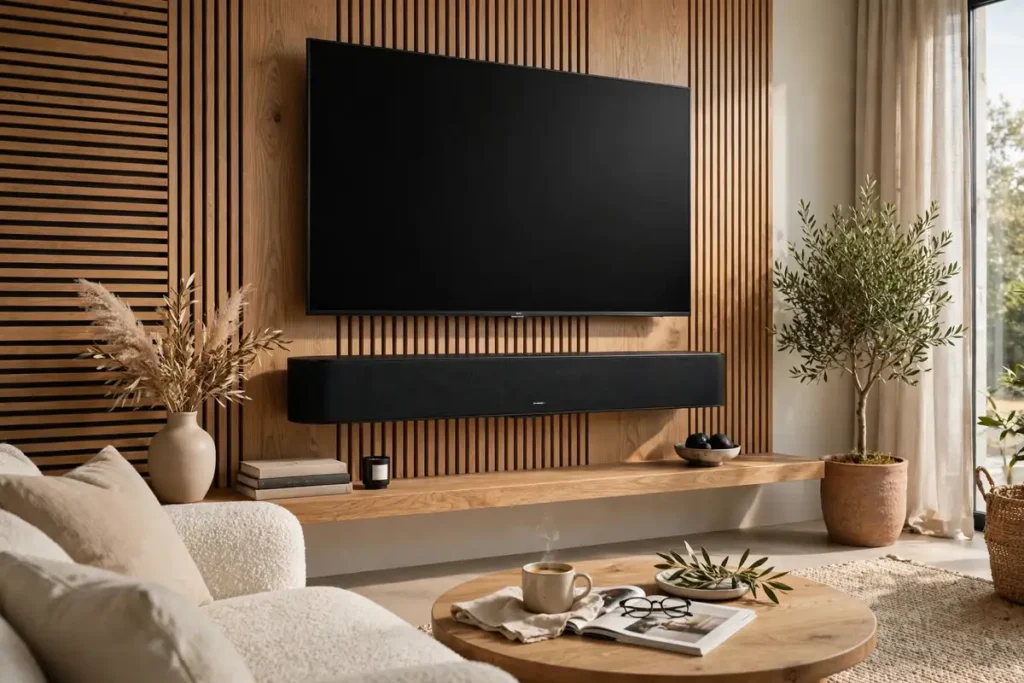
This sennheiser ambeo soundbar plus review covers the Ambeo Soundbar Plus, the smaller of Sennheiser’s two big Ambeo bars. To be clear on the model: this is the Plus, not the Ambeo Soundbar Max covered in our Sennheiser Ambeo Soundbar Max review. The Plus packs nine drivers and 400W RMS into a cabinet about a metre wide, and uses Sennheiser’s Ambeo processing to present virtual 7.1.4 sound from the single bar. The Amazon US listing linked here is ASIN B0B9CBWD95, verified as the Ambeo Soundbar Plus. Where the Max is a large-room statement piece, the Plus is the same idea scaled for normal living rooms and normal TV stands. This review judges whether the smaller bar keeps the parts of the Ambeo formula that matter.
A note on method. This is a research review, built from Sennheiser’s published specifications, the verified Amazon US listing for this exact model, and independent coverage. We have not had a unit on the desk, so nothing here claims hands-on testing, and speaker products on this site carry no scores.
The Ambeo Plus is the Ambeo idea in a size most rooms can actually house. Its virtual 7.1.4 presentation is wide and tall, dialogue is clear, format support is the broadest in its class, and the built-in microphones calibrate the bar to your room without extra hardware. Two HDMI inputs plus eARC make it a proper hub for a TV setup, which many single bars are not. The honest limits are bass depth and growth. The twin internal woofers do solid work, but film buyers chasing real low-end slam will want the optional Ambeo Sub, and there is no path to physical rear speakers at all. Gamers should also note the HDMI inputs pass 4K at 60Hz, not 120Hz. Buy it for immersive one-box sound in a medium room. Buy the Max, or a multi-speaker system, for a large room. Check Price on Amazon

Why you: Virtual 7.1.4 Atmos and DTS:X from nine drivers, with self-calibration, two HDMI inputs and eARC in a metre-wide bar.
Trade-off: Bass depth is limited without the optional subwoofer, there is no rear-speaker expansion, and HDMI passthrough tops out at 4K/60.
Sennheiser Ambeo Soundbar Plus specifications
| Spec | Sennheiser Ambeo Soundbar Plus |
|---|---|
| Product | Sennheiser Ambeo Soundbar Plus, single-bar immersive soundbar, model SB02M; the smaller Ambeo, distinct from the Ambeo Soundbar Max |
| Channels | Virtual 7.1.4 presentation from one bar via Ambeo 3D processing |
| Drivers | 9 total: 7 full-range aluminium-cone drivers and 2 long-throw woofers, each with its own Class D amplifier stage |
| Power and response | 400W RMS total; frequency response 38Hz to 20kHz |
| Connections | HDMI eARC output, 2 HDMI inputs (4K/60 and Dolby Vision passthrough), optical, RCA analogue in, Ethernet, USB, RCA subwoofer pre-out |
| Wireless and streaming | Wi-Fi, Bluetooth 5.0, AirPlay 2, Chromecast built-in, Spotify Connect, TIDAL Connect, UPnP |
| Formats | Dolby Atmos, DTS:X, MPEG-H and 360 Reality Audio, plus stereo upmixing |
| Calibration and expansion | Automatic room calibration from 4 built-in microphones; supports up to 4 wireless Ambeo Subs; no rear-speaker option |
| Size and weight | 1051 x 77 x 121 mm including feet; 6.3 kg; wall mountable |
Sound: the Ambeo bubble, scaled down
The Ambeo processing is the product. Developed with the Fraunhofer Institute, it builds a virtual room of speakers around the listener from the bar’s nine drivers, which fire forward, sideways and upward. Independent coverage of the Plus is consistent: the soundstage stretches well past the ends of the cabinet, height effects land overhead on Atmos mixes, and the effect holds together from a normal sofa position in a medium room. The four built-in microphones matter here. Self-calibration maps the room and tunes the virtual speakers to it, and unlike the Max, the Plus needs no external microphone puck to do the job.
Bass is where the scaling shows. The twin 4-inch woofers give the Plus a rated response to 38Hz and enough weight for TV, sport and most film scenes. What they cannot do is the deep physical pressure that a separate subwoofer produces in large rooms or action-heavy mixes. Sennheiser’s answer is the Ambeo Sub, and the Plus can run up to four of them wirelessly, plus a wired sub through the RCA pre-out. Budget for at least one sub if your room is big or your taste runs to blockbuster low end. Dialogue, meanwhile, is a strength: the centre information stays clear, and a centre level control in the app lets you lift voices without raising everything else. A few reviewers note that Ambeo processing can make voices sound slightly processed at its strongest settings, so the lighter modes are worth trying for news and drama.
Connections: a proper hub bar
Many flagship bars give you eARC and nothing else. The Plus gives you eARC plus two HDMI inputs, optical, analogue RCA, Ethernet and USB, which makes it the switching centre of a TV setup rather than a passenger on it. A Blu-ray player and a console can plug straight into the bar, with 4K/60 and Dolby Vision passed to the TV. The ceiling is the caveat: the inputs are HDMI 2.0, so 4K/120 gaming features do not pass through. Console owners should connect the console to the TV and return audio over eARC, which keeps the high frame rate and loses nothing on sound.
For music, the Plus doubles as a streaming speaker with Wi-Fi, AirPlay 2, Chromecast, Spotify Connect and TIDAL Connect, controlled from Sennheiser’s Smart Control app. Format support is the widest here: Dolby Atmos, DTS:X, MPEG-H and 360 Reality Audio all decode in the bar, so disc collections and streaming services both play in their native immersive formats. That breadth is a genuine edge over rivals that skip DTS:X, and it is one reason the Plus sits high in our best Dolby Atmos soundbar coverage.
Ambeo Plus or Ambeo Max?
The Max is bigger in every sense: a wider and much heavier cabinet, more drivers, deeper rated bass and a large-room brief. The Plus counters with a friendlier footprint at 1051 mm wide and 6.3 kg, self-calibration without an external microphone, newer streaming hardware and a lower price. In a medium room, the Plus gives up little that you will hear, and it fits under TVs the Max overwhelms. In a large room, the Max’s extra output and bass headroom earn their keep. Neither bar offers physical rear speakers, so buyers who want true surround channels behind them should look at the multi-speaker systems in our best soundbars guide, such as the Samsung package covered there, instead of either Ambeo.
Who should buy the Sennheiser Ambeo Soundbar Plus
Buy it if you want immersive Atmos and DTS:X sound from one bar in a small to medium room, you value broad format support and room calibration, and you like the option of adding wireless subwoofers later. It is also the Ambeo to buy if your TV stand or wall cannot take the Max.
Skip it if you need physical rear speakers, 4K/120 passthrough for gaming through the bar, or deep bass from the bar alone in a large room. The first two point to rival systems, and the third points to the Max or to budgeting for the Ambeo Sub from the start.
Frequently asked questions
What is the difference between the Ambeo Plus and the Ambeo Max?
The Plus is the smaller bar: 1051 mm wide, 6.3 kg, nine drivers and 400W RMS, with self-calibration from built-in microphones. The Max is wider and heavier, with more drivers and deeper bass, aimed at large rooms.
Does the Ambeo Soundbar Plus need a subwoofer?
Not for most rooms. Its twin built-in woofers reach a rated 38Hz. For deep film bass in larger rooms, add the wireless Ambeo Sub; the Plus supports up to four, plus a wired sub on its RCA pre-out.
Can you add rear speakers to the Ambeo Plus?
No. Surround sound on the Plus is virtual, produced by its Ambeo processing. Subwoofers are the only expansion the system accepts.
Does the Ambeo Plus pass through 4K/120 for gaming?
No. Its two HDMI inputs pass 4K at 60Hz with Dolby Vision. Connect a console to the TV instead and send audio back to the bar over eARC.
Which formats does the Ambeo Plus decode?
Dolby Atmos, DTS:X, MPEG-H and 360 Reality Audio, along with the standard Dolby and DTS formats and multichannel PCM. Stereo content can be upmixed by the Ambeo processing.

I am the founder of Sound Mavericks, where I provide the polite truth about audio equipment. I started this site because consumer electronics reviews are often too technical. Instead of using a silent lab, I test headphones, earbuds, and Bluetooth speakers in the real world – like on a noisy subway or in a busy coffee shop.
To stay independent, I buy my own review units (mostly from the United States) rather than accepting free gifts from brands. Once I finish testing a product, I sell it locally to our community. My goal is to help you understand sound quality, active noise cancellation (ANC), and battery life without the marketing hype.

