
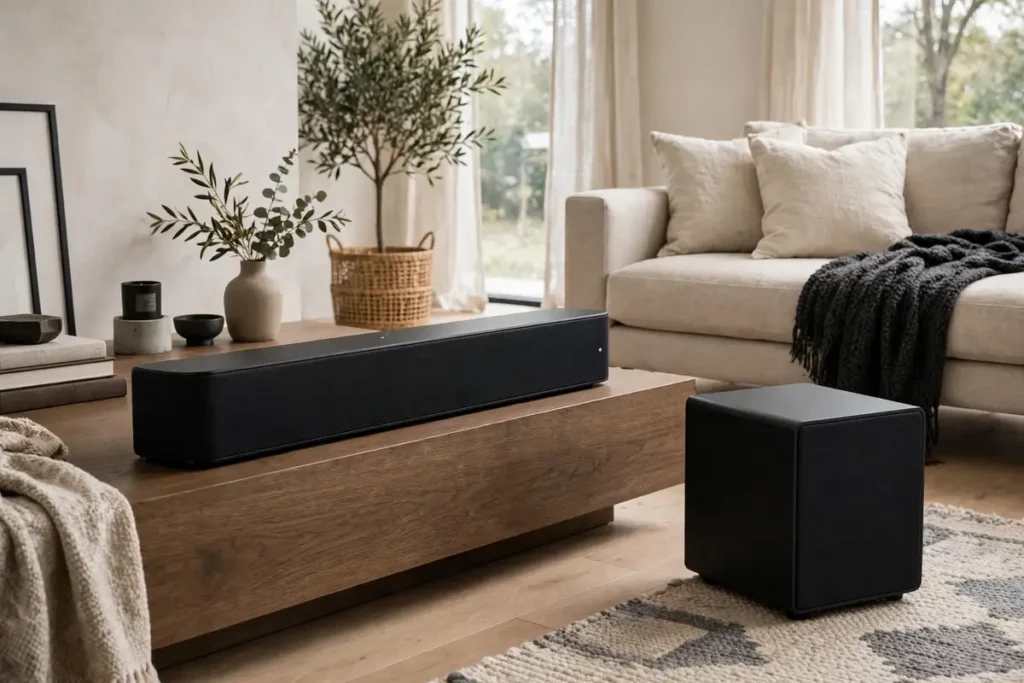
This samsung hw-q800c review covers the HW-Q800C on its own terms, because the Q800 line now has several generations on sale at once and they are easy to confuse. This review covers the Q800C: the 5.1.2-channel bar with a wireless subwoofer that sits one generation behind the Q800D and two behind the current model covered in our Samsung HW-Q800F review. The verified listing used here is ASIN B0BXQ118S8, titled for the Q800C exactly, not the D or the F. The package is a single bar with 11 speakers, an 8-inch wireless subwoofer, Wireless Dolby Atmos, DTS:X, Q-Symphony and SpaceFit Sound Pro room calibration. Judged as what it is, an earlier generation of a strong design, the Q800C’s case rests on how much of the current model’s sound it keeps.
A note on method. This is a research review, built from Samsung’s published specifications, the verified Amazon listing for this exact model, and independent coverage. We have not had a unit on the desk, so nothing here claims hands-on testing, and speaker products on this site carry no scores.
The Q800C is the value route into Samsung’s Q800 sound. You get true 5.1.2 channels rather than virtual processing: front, centre and side drivers in the bar, two up-firing drivers for height effects, and a wireless subwoofer with an 8-inch driver doing the heavy bass work. Independent reviews of this generation praised its scale, its precise placement of effects and a subwoofer that hits hard without losing control. Q-Symphony lets a compatible Samsung TV’s speakers join in instead of sitting idle, and SpaceFit Sound Pro tunes the system to the room. What you give up against newer generations is small: no 4K/120Hz passthrough for high-refresh gaming, and height effects that stay modest from the bar alone. In our best Dolby Atmos soundbar coverage, this is the generation to price first. Check Price on Amazon

Why you: True 5.1.2 Dolby Atmos and DTS:X from 11 speakers plus an 8-inch wireless subwoofer, with Q-Symphony and SpaceFit Sound Pro calibration.
Trade-off: An earlier generation, so no 4K/120Hz passthrough, and rear speakers are an optional extra rather than part of the box.
Samsung HW-Q800C specifications
| Spec | Samsung HW-Q800C |
|---|---|
| Product | Samsung HW-Q800C, soundbar with wireless subwoofer, model HW-Q800C/ZA |
| Channels | 5.1.2 channel, 11 speakers in the bar including side-firing and up-firing drivers |
| Power | 360W total system power |
| Subwoofer | Wireless subwoofer with 8-inch driver |
| Formats | Dolby Atmos, DTS:X, Dolby TrueHD, Dolby Digital Plus; Wireless Dolby Atmos over Wi-Fi with compatible Samsung TVs |
| Sound features | Q-Symphony, SpaceFit Sound Pro, Adaptive Sound, Active Voice Amplifier, Game Mode Pro |
| Connectivity | HDMI input and HDMI eARC output with 4K and HDR10+ passthrough, optical, Bluetooth, Wi-Fi, AirPlay 2, Alexa built in |
| Size | Bar about 1111 x 60 x 120 mm; subwoofer about 210 x 403 x 403 mm |
Sound: real channels, real width
The Q800C’s advantage over cheaper Atmos bars is that its channels are physical. The centre driver keeps dialogue anchored to the screen, the side-firing drivers push effects wide into the room, and the two up-firing drivers bounce height cues off the ceiling. Reviewers who measured and listened to this generation describe the same strengths: a large, cohesive soundstage, effects placed with unusual precision for a two-box system, and volume that stays clean when a film gets loud.
Height is the honest limit of any bar-only Atmos system, and the Q800C is no exception. Overhead effects are present and correctly placed, but they read as a layer above the front soundstage rather than a dome over the listener. That is the physics of reflected sound from a single bar, not a fault in this model. The fix, if you want it, is the optional Samsung SWA-9500S wireless rear kit, which adds rear channels and rear height drivers and takes the system to 7.1.4. Our Samsung HW-Q990C review covers the flagship route where those rears come in the box.
The subwoofer deserves its own mention. The 8-inch wireless unit gives the Q800C the low-end authority that bar-only systems cannot reach, and coverage of this generation singles out how well the sub blends with the bar rather than booming apart from it. It can dominate a small room if placed in a corner and left uncalibrated, which is what SpaceFit Sound Pro is for: the bar’s built-in microphone measures the room and trims the response, sub included.
Q-Symphony, Adaptive Sound and everyday use
Q-Symphony is the feature Samsung TV owners should weigh most. Instead of muting the TV’s speakers, a compatible Samsung TV plays alongside the soundbar, with the TV handling part of the soundstage and the bar handling the rest. The effect is a wider, taller front image, and it costs nothing extra if your TV supports it. With other TV brands the bar works as a normal eARC system and loses only that one trick.
Adaptive Sound analyses what is playing and adjusts on the fly, lifting dialogue in quiet scenes and giving action more weight. Active Voice Amplifier goes further during noisy moments, raising voices when the soundtrack or the room gets loud. For streaming, the bar carries Wi-Fi with AirPlay 2 and Spotify Connect, plus Alexa built in for voice control. Game Mode Pro tightens up sound placement for consoles, though the HDMI passthrough tops out at 4K/60 with HDR10+, and there is no Dolby Vision passthrough, so high-refresh and Dolby Vision gamers should connect consoles to the TV and use eARC for audio.
Music and streaming
Film is the Q800C’s brief, but music is where two-box systems often fall down, and this generation handles it better than its predecessors did. Stereo tracks keep a clear midrange and a stable image, the subwoofer fills the bottom end without calling attention to itself once SpaceFit has run, and Adaptive Sound can widen stereo into the bar’s extra drivers for a fuller room sound when you want it. Purists can run a standard mode and keep music in stereo. Streaming is covered properly: Wi-Fi carries AirPlay 2 and Spotify Connect, Bluetooth handles quick phone playback, and Alexa is built in for voice requests and smart home control. It is not a replacement for a dedicated stereo system, but as the main speaker in a living room it covers daily music without apology.
Setup is straightforward. The bar is wide at about 111 cm, so measure the TV stand and the screen width first; it suits larger TVs best. The subwoofer connects wirelessly and only needs a power socket, which gives real freedom in placement, though corners add boom that calibration then has to remove. Run SpaceFit Sound Pro after everything is in place, not before, and rerun it if you move the sub.
Q800C or a newer Q800?
The generations that followed this one changed the details more than the design. The channel layout, the subwoofer, the total power and the core features are shared across the C, the D and the current F, which is why this review exists separately rather than folding the C into a general Q800 page: buyers comparing listings need to know which box they are actually getting. The C is the earliest of the three still sold widely, and it is usually where the value sits, because earlier generations get discounted while the sound they make stays close to the newer models. If the price gap to a newer generation is small, buy newer for the longer update life. If the gap is wide, the Q800C gives up little that you can hear.
Who should buy the Samsung HW-Q800C
Buy it if you want genuine Atmos and DTS:X with a proper subwoofer, especially with a Samsung TV that can use Q-Symphony, and you would rather pay an earlier-generation price than a launch price. It suits medium and larger living rooms and film-led viewing.
Skip it if you need 4K/120Hz passthrough or Dolby Vision passthrough from the bar itself, or if you want rear speakers included from day one. Those needs point to the current model in our Samsung HW-Q800F review or to a full system in our best soundbars guide.
Frequently asked questions
Is the Samsung HW-Q800C the same as the Q800D or Q800F?
No. They are separate generations of the same Q800 design. This review covers the Q800C. The Q800D is the generation after it and the Q800F is the current model. The channel layout and subwoofer are shared, but they are different products with different listings.
Does the HW-Q800C support Dolby Atmos and DTS:X?
Yes. It decodes Dolby Atmos and DTS:X, with two up-firing drivers for height effects. With a compatible Samsung TV it can also receive Wireless Dolby Atmos over Wi-Fi, with no HDMI cable carrying the signal.
Does the Q800C come with rear speakers?
No. The box holds the bar and the wireless subwoofer. Samsung’s optional SWA-9500S wireless rear kit adds rear and rear height channels, expanding the system to 7.1.4.
What is Q-Symphony on the Q800C?
Q-Symphony lets a compatible Samsung TV’s speakers play together with the soundbar instead of switching off, widening the front soundstage. It needs a Samsung TV that supports the feature; other TVs use the bar normally over HDMI eARC.
Does the Q800C pass through 4K/120Hz or Dolby Vision?
No. Its HDMI passthrough handles 4K at 60Hz with HDR10+. For 4K/120Hz gaming or Dolby Vision sources, connect the device to the TV and send audio back to the bar over eARC.

I am the founder of Sound Mavericks, where I provide the polite truth about audio equipment. I started this site because consumer electronics reviews are often too technical. Instead of using a silent lab, I test headphones, earbuds, and Bluetooth speakers in the real world – like on a noisy subway or in a busy coffee shop.
To stay independent, I buy my own review units (mostly from the United States) rather than accepting free gifts from brands. Once I finish testing a product, I sell it locally to our community. My goal is to help you understand sound quality, active noise cancellation (ANC), and battery life without the marketing hype.

