
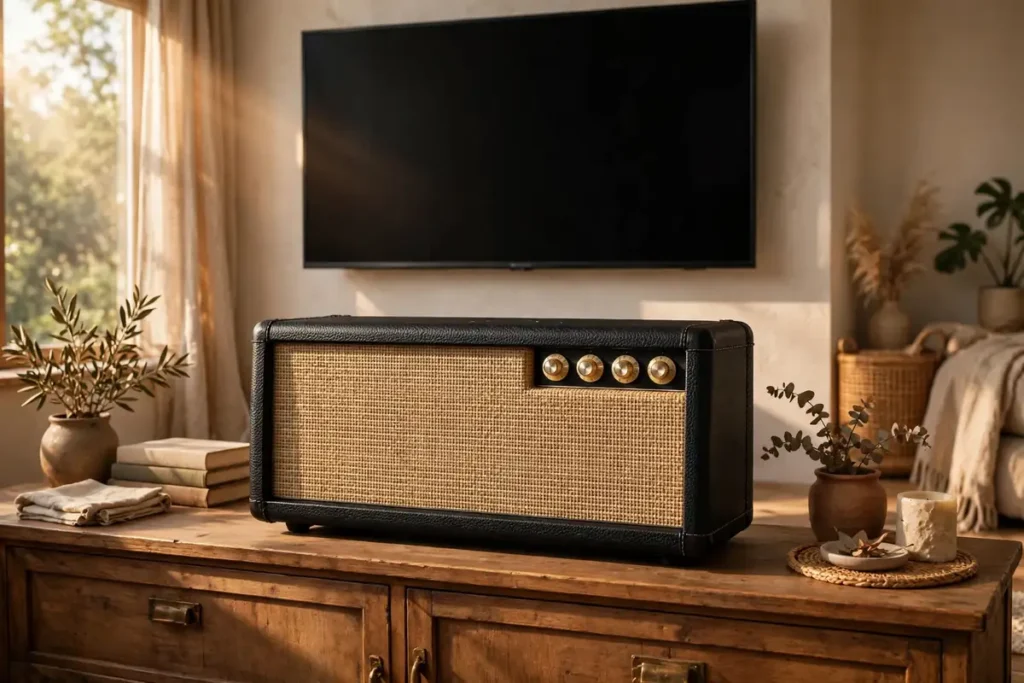
This Marshall Heston 60 review covers Marshall’s compact TV soundbar: a 5.1 channel Dolby Atmos and DTS:X bar with five full-range drivers, two built-in woofers, Wi-Fi 6 and Bluetooth 5.3 streaming, and the amp-inspired Marshall design, all in a cabinet 73 cm wide. It is the smaller sibling of the Heston 120 covered elsewhere on this site, built for bedrooms, apartments and smaller living rooms where the bigger bar is too wide or too much. This review judges it on that brief: how much cinema sound Marshall fits into 73 cm, and what the size leaves out.
A note on method. This is a research review, built from Marshall’s published specifications, the verified Amazon US listing for this exact model, and independent coverage. We have not had a unit on the desk, so nothing here claims hands-on testing, and speaker products on this site carry no scores.
The Heston 60 is the style-led way into Dolby Atmos for a smaller room, and it backs the looks with a sensible spec. Seven drivers and seven Class D amplifiers produce a wide 5.1 presentation with Atmos and DTS:X decoding, dialogue stays clear at normal volume, and the streaming package is complete: AirPlay 2, Google Cast, Spotify Connect and TIDAL Connect over Wi-Fi 6, plus Bluetooth 5.3. At 56W peak and 89 dB maximum output it is built for near-field rooms rather than big open spaces, and the limits follow from the brief. There is no HDMI passthrough, no subwoofer in the box, and bass from two 3 inch woofers is tidy rather than deep, with an optional wireless subwoofer in Marshall’s range for owners who want more. Buyers with a large room should step up to the model in our Marshall Heston 120 review. For a compact room, the 60 is the right size of Marshall. Check Price on Amazon
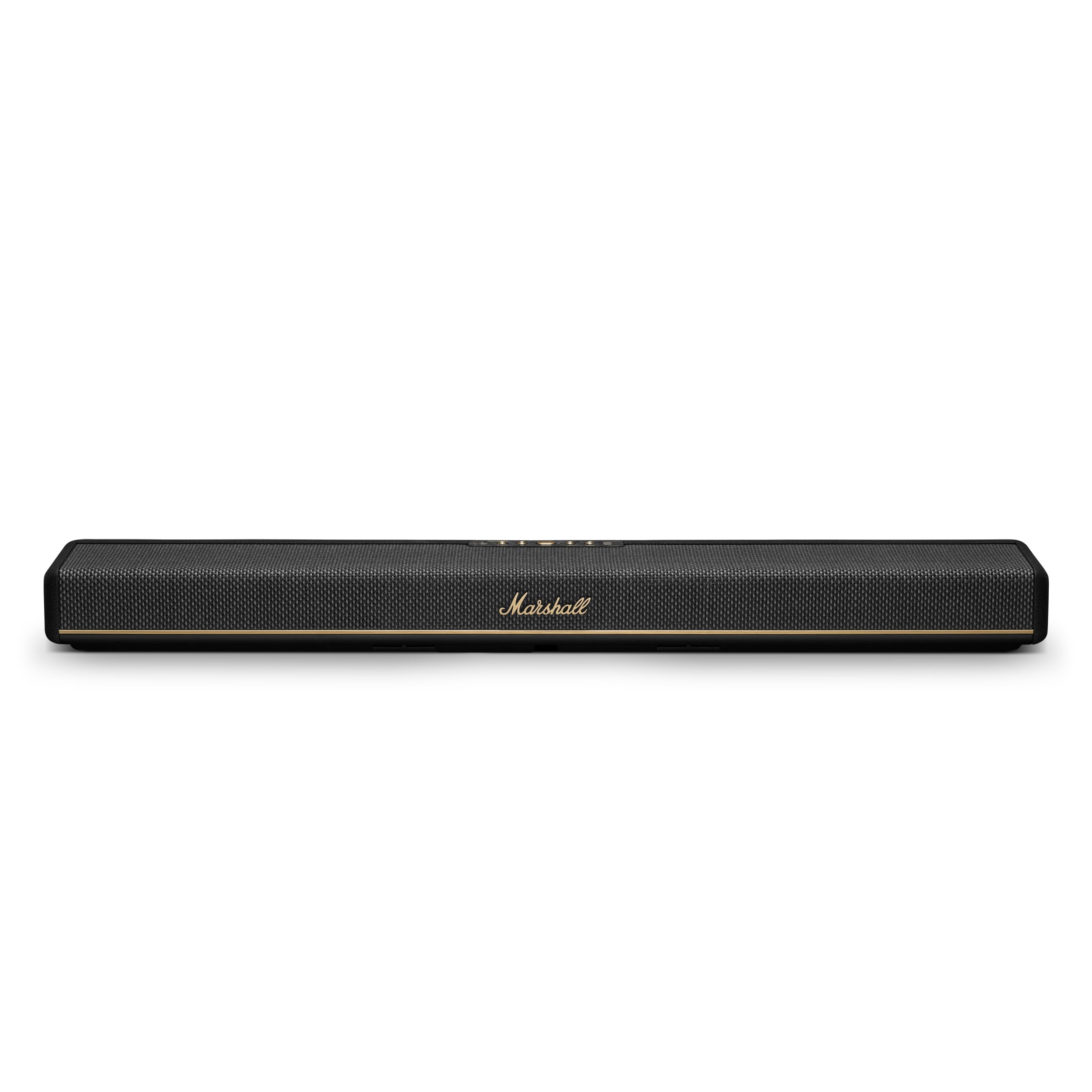
Why you: Dolby Atmos and DTS:X in a 73 cm bar with Marshall’s amp-style design, full Wi-Fi streaming, and sound modes for film, voice, music and night listening.
Trade-off: Output is modest at 56W peak, there is no HDMI passthrough, and deep bass needs the optional subwoofer rather than coming from the bar alone.
Marshall Heston 60 specifications
| Spec | Marshall Heston 60 |
|---|---|
| Product | Marshall Heston 60, Black finish (Cream also sold), all-in-one soundbar |
| Channels | 5.1 configuration |
| Drivers | 5 x 1.25 inch full-range drivers, 2 x 3 inch woofers |
| Amplification | 7 Class D amplifiers (2 x 25W, 5 x 5W), 56W peak total, 89 dB maximum SPL |
| Formats | Dolby Atmos, DTS:X |
| Frequency response | 45Hz to 20kHz |
| Connections | HDMI 2.1 eARC, 3.5 mm aux in, RCA mono subwoofer out, USB-C |
| Wireless | Wi-Fi 6 with AirPlay 2, Google Cast, Spotify Connect and TIDAL Connect; Bluetooth 5.3 |
| Size and weight | 730 x 124 x 68 mm, 2.76 kg |
Sound: big presentation, small-room power
Marshall tuned the Heston 60 for the rooms it will actually sit in. The 5.1 layout spreads film soundtracks well beyond the width of the bar, Atmos and DTS:X tracks gain height and movement that TV speakers flatten completely, and independent reviews of the 60 single out its punch and dialogue clarity for its size. The Voice mode earns its keep on ordinary television, where speech sits forward in the mix without pushing the volume up and down between scenes. Music mode gives the bar a warmer, wider stereo presentation for streaming, and Night mode compresses the dynamic swings for late viewing in flats and shared houses.
The numbers set the boundary honestly. Fifty-six watts peak and an 89 dB ceiling are enough for a bedroom or a compact living room at sensible distance. They are not enough to pressurise a large open-plan space, and the two 3 inch woofers reach down to a rated 45Hz on paper while delivering bass that reads as full rather than physical. Action films sound composed and clear; they do not thump the sofa. That is the correct trade for a 2.76 kg bar, and Marshall sells the Heston Sub 200 wireless subwoofer for owners who later decide the low end matters more than the minimal setup. The wired subwoofer output on the back also takes a powered sub from another system.
Design and everyday use
Design is half the reason this bar exists. The woven grille, brass-coloured controls and script logo borrow directly from Marshall’s guitar amps, and the top panel carries physical knobs for volume, bass and treble plus source and mode controls, so common adjustments happen without finding a phone or a remote. The control panel is reversible, which lets the bar sit on a bench or mount on the wall while keeping the controls readable, and the cabinet’s shallow depth keeps it clear of most TV stands. In a market of identical black boxes, the Heston 60 is the one guests notice, and for many buyers that is a legitimate part of the purchase.
Day-to-day operation runs through the Marshall app for setup, EQ and room adjustment, with the TV remote handling volume over eARC. One gap from the bigger model is worth naming: there is no HDMI passthrough, so sources connect to the TV and the TV feeds the bar. That is normal in this size class, but owners of several consoles should count their TV’s ports first. Set against other compact Atmos options in our best Dolby Atmos soundbar guide, the Heston 60 wins on design and streaming completeness and concedes raw output.
Four sound modes cover the main uses without menu diving. Movie mode is the default for television and film, Voice mode pushes dialogue forward for news, drama and sport commentary, Music mode widens the presentation for streaming, and Night mode trims the loud peaks so late viewing stops travelling through walls. Switching between them from the top panel becomes a habit within a week, and it is the feature set owners use most after the volume knob. The Marshall app adds finer EQ adjustment and firmware updates over Wi-Fi, and the bar is ready for Bluetooth LE Audio as that standard spreads through phones and televisions, which gives the wireless side a longer useful life than the spec sheet alone suggests.
Heston 60 or Heston 120?
The two bars share a design language and a streaming platform, and differ in scale. The Heston 120 is the larger, more powerful flagship with a 5.1.2 layout, dedicated height drivers and HDMI passthrough, aimed at main living rooms. The Heston 60 keeps the 5.1 presentation and the same services in a bar roughly three quarters of the width, at lower output, for smaller screens and rooms. Measure your TV bench and your room before choosing: if the seating sits close and the screen is mid-sized, the 60 covers the job and leaves money for the subwoofer later. If the room is the main cinema space, the 120 is the honest pick, as our best soundbars coverage sets out.
Who should buy the Marshall Heston 60
Buy it if your TV sits in a bedroom, apartment or compact living room, you want Atmos and DTS:X from one bar with no separate speakers, and you value how the thing looks as well as how it sounds. The physical controls and complete streaming support make it easy to live with as a music speaker too.
Skip it if your room is large, if deep bass is the point of the purchase and no subwoofer will follow, or if you need HDMI passthrough for multiple sources and your TV lacks the ports to take them instead.
Frequently asked questions
Does the Marshall Heston 60 support Dolby Atmos?
Yes. The Heston 60 decodes Dolby Atmos and DTS:X and presents them in a 5.1 configuration from its seven drivers. Connect over HDMI eARC to carry the full Atmos signal from the TV.
What is the difference between the Heston 60 and Heston 120?
The Heston 60 is the compact model: 73 cm wide, 5.1 channels and 56W peak output. The Heston 120 is the larger flagship with a 5.1.2 layout, more power and HDMI passthrough. The streaming platform and design are shared.
Can the Heston 60 work with a subwoofer?
Yes. The bar has an RCA mono subwoofer output for a wired powered subwoofer, and Marshall’s Heston Sub 200 wireless subwoofer is the matching option in its own range.
Does the Heston 60 stream music over Wi-Fi?
Yes. Wi-Fi 6 carries AirPlay 2, Google Cast, Spotify Connect and TIDAL Connect, and Bluetooth 5.3 covers direct playback from a phone or laptop.
Does the Heston 60 have HDMI passthrough?
No. The bar has a single HDMI 2.1 eARC connection, so consoles and players plug into the TV and the TV sends audio to the bar.

I am the founder of Sound Mavericks, where I provide the polite truth about audio equipment. I started this site because consumer electronics reviews are often too technical. Instead of using a silent lab, I test headphones, earbuds, and Bluetooth speakers in the real world – like on a noisy subway or in a busy coffee shop.
To stay independent, I buy my own review units (mostly from the United States) rather than accepting free gifts from brands. Once I finish testing a product, I sell it locally to our community. My goal is to help you understand sound quality, active noise cancellation (ANC), and battery life without the marketing hype.

