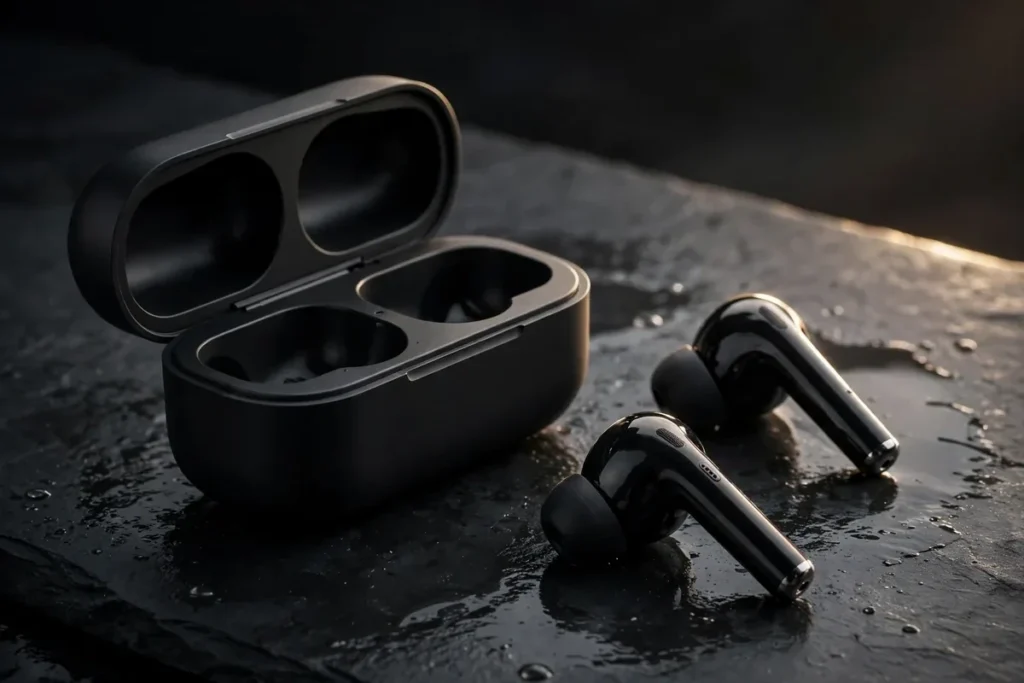
EarFun’s budget ANC line has never sat still for long, and the EarFun Air Pro 4i is the latest iteration — though not quite the one the name suggests. This is not a straight successor to the Air Pro 4. EarFun sells the two side by side, and the 4i is best understood as a leaner, cheaper sibling that rearranges the priorities: the noise cancelling and the fit get better, the codec list and the battery get smaller, and a couple of conveniences quietly disappear. Whether that trade is good depends on which list you care about — so this review concentrates on where the 4i gains, where it gives ground, and who should buy which.
Our Early Verdict
On paper — and in independent testing to date — the Air Pro 4i is the strongest noise canceller in its class, wrapped around a warm, easygoing sound and a fit its predecessor never nailed. The compromises are specific: no aptX, no in-ear detection, and a case that runs out of road sooner than the Air Pro 4’s. If ANC strength per dollar is your metric, this is the new budget benchmark. If you live on calls and long-haul battery, the older model still has a case to make.
| Sound Quality (on paper) | 8.5 |
| Noise Cancelling | 9.0 |
| Comfort & Design | 8.7 |
| Battery Life | 8.3 |
| Call Quality | 8.4 |
| Value | 8.8 |

How we are reviewing this one: the Air Pro 4i has only just reached Amazon US, so this is a research-based launch review built from EarFun’s published specifications and comparison data, the user manual, and the hands-on reviews and ANC measurements already published by independent testers. We have not listened to it ourselves, and the score is provisional for exactly that reason — it reflects the hardware, the documented differences from the Air Pro 4, and the early review consensus, and we will revisit it as more measurements land.
EarFun Air Pro 4i Specifications
| Product | EarFun Air Pro 4i |
| Driver | 11mm titanium-coated composite dynamic driver |
| Noise cancelling | QuietSmart 3.0 adaptive hybrid ANC, rated up to 50dB; Adaptive, Wind, Balanced and Max modes in the app |
| Bluetooth codecs | LDAC (Hi-Res Audio certified), SBC — no aptX |
| Bluetooth | 5.4, multipoint (two devices), Google Fast Pair |
| Battery life | 6.5 hours (ANC on) / 9.5 hours (ANC off); 40 hours total with the case |
| Charging | USB-C and wireless charging; fast charge adds ~2 hours from 10 minutes |
| Microphones | 6-mic AI call system with cVc 8.0 noise reduction |
| Water resistance | IP55 (dust-protected, water-jet resistant) |
| App | EarFun Audio app: 10-band custom EQ, presets, personal sound profile, ANC modes, touch remapping, Find My earbuds |
| Extras | Theater Mode 3D surround sound, game mode (<50ms), 5 pairs of oval dual-hardness ear tips |
| Weight | 51.3g (earbuds + case) |
| Buy | Check Price on Amazon |
What’s New vs the Air Pro 4 — and What Went Backwards
The naming invites you to read the 4i as a sequel. It isn’t. EarFun’s own comparison chart lists the 4i, the Air Pro 4 and the Air Pro 4+ as three current models at three ascending price tiers, and the 4i is the entry point of the three — an “Air Pro 4 lite” in the words of one long-term owner review. That framing matters, because the differences run in both directions, and several of them are removals.
Where the 4i improves on the Air Pro 4: the ANC, measurably. Both models carry the same QuietSmart 3.0 adaptive hybrid system with the same up-to-50dB rating, but in Scarbir’s controlled ANC tests the 4i out-scored the regular Pro 4 — and every other earbud in its price class — particularly on constant, low-frequency noise. The fit improves too: the 4i’s nozzle and ear tips are oval rather than round, with dual-hardness tips in five sizes, and testers consistently rate it the more comfortable long-session wear. The driver grows from 10mm to an 11mm titanium-coated unit, and the whole package is a little lighter at 51.3g.
Where the Air Pro 4 still wins: battery, codecs and small courtesies. The Pro 4 is rated for 11 hours per charge with ANC off and 52 hours total, against the 4i’s 9.5 and 40; with ANC on, testers put the Pro 4 near 8 hours against the 4i’s 6.5. The Pro 4’s codec list is the flagship one — aptX Lossless and aptX Adaptive alongside LDAC, plus LC3 and Auracast — while the 4i covers LDAC and SBC only. And the Pro 4 pauses your music when you take a bud out; the 4i drops in-ear detection entirely, along with the case’s three-LED battery gauge (one LED now does the job) and the slimmer case shape. Its sound is also the tighter of the two: more articulated bass, where the 4i is rounder and softer-edged, though the 4i holds its dynamics better at maximum volume.
| EarFun Air Pro 4i | EarFun Air Pro 4 | |
|---|---|---|
| Driver | 11mm titanium-coated composite | 10mm composite |
| ANC | QuietSmart 3.0, up to 50dB — stronger in independent tests | QuietSmart 3.0, up to 50dB |
| Codecs | LDAC, SBC | LDAC, aptX Lossless, aptX Adaptive, LC3, Auracast |
| Battery (buds) | 6.5h ANC on / 9.5h off | ~8h ANC on / 11h off |
| Battery (total) | 40 hours | 52 hours |
| In-ear detection | No | Yes |
| Fit | Oval nozzle, dual-hardness tips — comfort edge | Round nozzle, standard tips |
| Weight (with case) | 51.3g | 56g |
| Buy | Check Price on Amazon | Check Price on Amazon |
None of this makes the 4i a downgrade overall — it makes it a reallocation. EarFun spent the budget on the two things budget buyers actually feel, cancellation and comfort, and clawed it back from the spec-sheet lines fewer people use. The Air Pro 4 remains the budget standout in our best noise cancelling earbuds guide; the 4i’s argument is that it beats that standout at the headline job.
Sound Quality and Codecs
The 11mm titanium-coated driver is tuned warm and round: full low end, clean vocals, and a treble that rolls off early enough that several reviewers reached for the app’s 10-band EQ to add sparkle back. Cubed3’s reviewer heard a balanced signature with a slight bass lift and good clarity across genres; the longer owner reviews describe clear, separated bass that stays composed in complex tracks, with a little airiness in the mids. Two honest caveats recur. First, the bass is partly an ANC artefact — with cancellation on, the low end is rich; switch to transparency or off and the sound thins noticeably, a common budget-earbud trait that is especially visible here. Second, Theater Mode, EarFun’s 3D surround setting, genuinely widens the stage and is the preset several reviewers settled on.
On codecs, be clear-eyed: the 4i is Hi-Res certified with LDAC, and that is where the hi-res story ends. There is no aptX of any flavour — the Air Pro 4’s Snapdragon Sound stack (aptX Lossless, aptX Adaptive, LC3, Auracast) does not carry over. For Android listeners with LDAC sources, the practical loss is small; for anyone invested in aptX Lossless hardware, it is the single clearest reason to buy the older model instead. Our Bluetooth codecs explainer covers what each of those actually buys you. One operational quirk worth knowing, reported by owners: LDAC and multipoint are either/or — enabling the hi-res codec drops the second connection.
Noise Cancelling: The Headline Act
This is the section the 4i exists for. The hardware claim is familiar — QuietSmart 3.0 adaptive hybrid ANC rated up to 50dB, with Adaptive, Wind, Balanced and Max modes selectable in the app — but the independent results are not typical for the class. Scarbir’s ANC testing scored the 4i above every other earbud at its price level and one point behind Apple’s flagship in their rankings, with constant and sudden sounds heavily reduced; café chatter, air-conditioning and aircraft cabin noise all feature in owner reports as effectively erased once music is playing. Voices are reduced rather than removed, as with all ANC, and the transparency mode is the one place the budget shows: testers describe it as functional but electronic-sounding next to pricier buds. Judged purely as a silencer, though, the 4i performs a class above its tier — the strongest single reason it exists.
Battery Life and Charging
The numbers are good, not class-leading: 6.5 hours per charge with ANC on, 9.5 with it off, and 40 hours in total with the case. That is a full working week of commutes between case charges for most people, and the charging story is complete — USB-C, wireless charging (still not guaranteed at this level), and a 10-minute fast charge worth about two hours of playback. The context that matters is the family table: the Air Pro 4 runs meaningfully longer on every measure, so if your listening days regularly stretch past six hours with ANC engaged, the older model’s battery is not a spec-sheet nicety, it is the deciding factor. For everyone else, 6.5 hours with this ANC strength is a fair trade, honestly labelled.
Fit, Controls, App and Calls
The fit is the quiet success of this model. The oval nozzle and dual-hardness tips — five pairs in the box — match the shape of the ear canal better than the round tips on the Pro 4, and reviewers who struggled with the older model’s seal report wearing the 4i for hours without adjustment. The buds are light, stay put in motion, and the IP55 rating shrugs off workouts and rain. The case is the less happy story: squarer and chunkier than the Pro 4’s at roughly 56 × 53 × 31mm, with a spring-loaded lid that makes one-handed opening a small dexterity test and a single LED where the Pro 4 has three. Touch controls sit on a small dot rather than the Pro 4’s sensor disc and work fine; they are fully remappable in the app, or can be disabled outright.
The EarFun Audio app is unusually complete for the money: a 10-band custom EQ plus presets and a personal sound profile that builds an EQ from your hearing, the four ANC modes, game mode at under 50ms latency, Google Fast Pair on Android, and a Find My function that beeps a lost bud louder until you track it down. Call quality rides on six microphones with AI noise reduction and cVc 8.0; reviewers rate calls clear and well-isolated in most conditions, with strong wind the recurring exception. The one absence to plan around is in-ear detection — take a bud out and the music keeps playing until you tap pause, a small daily friction the Pro 4 doesn’t have.
Who It’s For — and Should Air Pro 4 Owners Upgrade?
Buy the Air Pro 4i if noise cancelling is the point. Commuters, open-plan office workers and frequent flyers on a budget get the strongest ANC its class has produced, a fit that survives long sessions, LDAC for Android hi-res, and wireless charging, in one package. It is also the EarFun to buy if the Air Pro 4’s fit never worked for your ears — the oval tips fix exactly that.
Buy the Air Pro 4 instead if your priorities are endurance and features: longer battery on every measure, aptX Lossless and Auracast, in-ear detection, and the slimmer case. It is also a fixture of our best budget earbuds rankings for a reason — when the two models sit close in price, the Pro 4 is arguably the better-equipped buy.
Air Pro 4 owners: skip the “upgrade.” The 4i is a side-step, not a step up. You would gain cancellation strength and comfort, and lose battery, codecs and auto-pause — a trade that only makes sense if ANC is your overriding priority and your current pair is dying. Everyone else should wait for a true successor.
EarFun Air Pro 4i FAQ
Is the EarFun Air Pro 4i better than the Air Pro 4?
At some things, not overall. The 4i has measurably stronger noise cancelling in independent tests, a more comfortable oval-tip fit, and a larger 11mm driver. The Air Pro 4 counters with longer battery life (about 8 hours with ANC on, 52 hours total), aptX Lossless and Auracast codec support, in-ear detection, and a slimmer case. EarFun sells them as three tiers of one line — the 4i is the value tier, not the replacement.
Does the EarFun Air Pro 4i support LDAC and aptX?
LDAC, yes — the 4i is Hi-Res Audio certified with LDAC support for high-resolution playback from compatible Android devices. aptX, no: the documented codec set is LDAC and SBC, so the aptX Lossless and aptX Adaptive support found on the Air Pro 4 does not carry over. Note that LDAC and multipoint cannot run at the same time — enabling LDAC drops the second device connection.
How long does the EarFun Air Pro 4i battery last?
EarFun rates the buds at 6.5 hours per charge with ANC on and 9.5 hours with ANC off, with 40 hours of total playtime including the charging case. The case charges over USB-C or wirelessly, and a 10-minute fast charge adds roughly two hours of listening — enough to rescue a forgotten overnight charge before a commute.
Are the EarFun Air Pro 4i waterproof?
They are rated IP55, which means dust protection and resistance to water jets — workouts, sweat and rain are all fine, and they are a sensible pick for running and the gym. IP55 is not a swimming rating, so don’t shower or swim in them; for water sports you want a fully waterproof model instead.
Do the EarFun Air Pro 4i pause when you take an earbud out?
No. The 4i drops the in-ear detection the Air Pro 4 has, so removing a bud does not auto-pause your music — you pause from the touch controls or your phone instead. It is one of the clearest cost-cutting tells on the model, and worth knowing about if auto-pause is part of your daily routine.
The Bottom Line
The EarFun Air Pro 4i is an honest piece of product design: a budget earbud that spends its money on the two things you can feel — cancellation strong enough to embarrass pricier models, and a fit you can wear all day — and pays for them with codec breadth, battery and one convenience feature. Read as the Air Pro 4’s cheaper sibling rather than its successor, it makes complete sense, and for ANC-first buyers it is the easiest budget recommendation EarFun has made. Our provisional 8.6/10 reflects exactly that: class-leading quiet and comfort, a specific and knowable list of trade-offs, and independent measurements that back the headline claim.

I am the founder of Sound Mavericks, where I provide the polite truth about audio equipment. I started this site because consumer electronics reviews are often too technical. Instead of using a silent lab, I test headphones, earbuds, and Bluetooth speakers in the real world – like on a noisy subway or in a busy coffee shop.
To stay independent, I buy my own review units (mostly from the United States) rather than accepting free gifts from brands. Once I finish testing a product, I sell it locally to our community. My goal is to help you understand sound quality, active noise cancellation (ANC), and battery life without the marketing hype.