
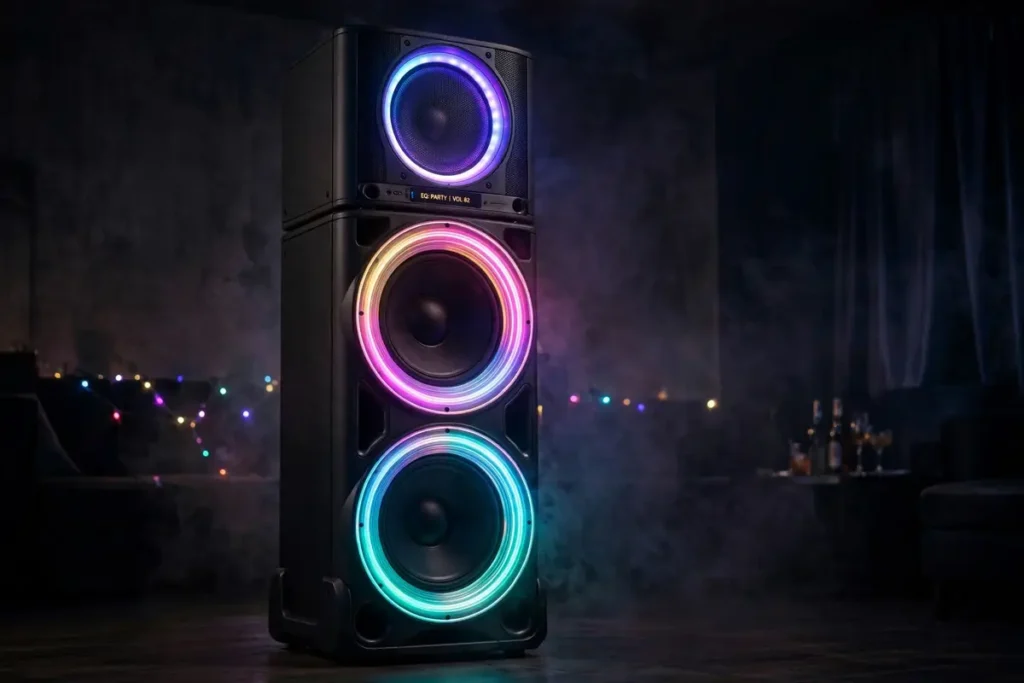
This jbl partybox 300 review covers JBL’s original big battery party speaker as a legacy model: 120W RMS on mains power, twin 6.5-inch woofers with three tweeters, a reactive light show, microphone and guitar inputs, and up to 18 hours of playtime from its built-in battery. The PartyBox 300 is discontinued and has no standard listing on Amazon US, so links here point to a tagged Amazon search for the model. Any stock that surfaces is third-party or renewed, judged on condition and battery health, not as new retail stock. This review covers what the 300 still offers a used buyer, and where its successors have moved past it.
A note on method. This is a research review, built from JBL’s published specifications and support documentation for this exact model, plus independent coverage. We have not had a unit on the desk, so nothing here claims hands-on testing, and speaker products on this site carry no scores.
The PartyBox 300 set the template the line still follows: serious output from a battery cabinet, lights that react to the music, and microphone and guitar inputs so the speaker doubles as a small PA. It is rated at 120W RMS on mains power, and its 18 hours of rated playtime remains competitive. The gaps against its successors are practical: no water resistance, no wheels on a cabinet of about 15.4 kg, older Bluetooth, and no app control. Bought cheaply in good condition it still fills a garden or a hall with sound. Bought at successor money, the newer models in our JBL PartyBox 110 review and wider PartyBox coverage are the better spend. Check Price on Amazon
Why you: 120W RMS on mains power, twin 6.5-inch woofers, a reactive light show and up to 18 hours of battery, with microphone and guitar inputs for karaoke and small events.
Trade-off: Discontinued with no standard Amazon US listing, no water resistance, no wheels, and an ageing battery in any used unit, so condition matters more than the spec sheet.
JBL PartyBox 300 specifications
| Spec | Details |
|---|---|
| Product | JBL PartyBox 300, legacy party speaker, discontinued; Amazon US links here are a tagged search because there is no standard listing |
| Power | 120W RMS on AC mains power; 90W on battery or 12V car power (JBL rated output figures) |
| Drivers | 2 x 6.5-inch woofers, 3 x 2.25-inch tweeters |
| Frequency response | 45Hz to 20kHz |
| Battery | Built-in rechargeable lithium-ion, 74.88Wh; up to 18 hours; about 5 hours to charge; USB output can charge a phone |
| Connectivity | Bluetooth 4.2, USB playback, 3.5mm input, microphone and guitar inputs, 12V DC car input |
| Pairing | Two PartyBox 300 units can pair for stereo |
| Water resistance | None. Keep it away from pool splash and rain |
| Size and weight | 330 x 688 x 323 mm; about 15.4 kg |
Sound: built to fill a space, not a desk
The PartyBox 300 is a PA cabinet in party clothes. Two 6.5-inch woofers move enough air for genuine low-end weight at outdoor distances, and three tweeters keep vocals and cymbals present when the volume climbs. JBL rates output at 120W RMS on mains power and 90W on battery, a detail worth knowing because the battery figure is the one that applies at most garden parties. A bass boost switch trades some battery life for extra low-end push, which helps outdoors where bass dissipates fast.
Clarity holds up better than the light show suggests. Independent coverage from its time on sale consistently described a clean top end without the harshness cheap party boxes show at high volume, and the cabinet size gives it headroom smaller speakers cannot match. It is not a hi-fi listen at close range, and it was never priced or shaped as one. Its job is volume with control across a lawn, a hall or a rehearsal room, and on that job the hardware still makes sense. Buyers who need more output and modern transport should look at the JBL PartyBox 710 review, which covers the larger current model.
Lights, inputs and the karaoke factor
The front light ring is the PartyBox signature. Meter, Pulse and Party modes react to the music, and the effect can be switched off when the speaker is working as a plain PA. Around the back, the microphone and guitar inputs each get level control, which turns the 300 into a workable busking and karaoke rig without a mixer. USB playback covers playlists from a stick, and the USB port also charges a phone from the speaker battery.
Two units can pair wirelessly for stereo or simply for more coverage. That pairing belongs to its own generation, so do not assume a PartyBox 300 will pair with the current range. Check pairing compatibility before buying a second unit to match a newer PartyBox, and the same caution applies in reverse.
Battery, power and the weight problem
The rated 18 hours is a moderate-volume figure, and lights plus bass boost shorten it. The useful flexibility is in the power options: mains for full output, battery for portability, and a 12V input that runs the speaker from a car, which suits tailgating and field events. Charging takes about five hours, so an overnight charge is the routine.
Portability is the honest weakness. At about 15.4 kg with carry handles but no wheels and no telescopic handle, the PartyBox 300 is a two-trip load-in once cables and a microphone are added. Its successors fixed exactly this, with wheels, handles and splash resistance. There is no water resistance rating here at all, so outdoor use means keeping it under cover and away from the pool edge, unlike the splash-proof models ranked in our best large Bluetooth speaker coverage.
Setup and running it at an event
Setup is refreshingly analogue. Power on, pair over Bluetooth or plug into the 3.5mm input, set the microphone and guitar levels from the rear panel, and pick a light mode or switch the lights off. There is no app to install and no account to create, which suits borrowed-venue and community-hall use where the speaker changes hands between events. Run it on mains where you can for the full rated output, keep a charged battery as the backup plan, and put it on a stand or a sturdy table edge so the tweeters clear the crowd.
Buying a discontinued PartyBox 300
Because the model is discontinued, the buying checks matter more than the specs. Ask about battery runtime on a full charge, since an aged lithium pack is the most likely failure point and replacements are not a casual purchase. Check the light ring, both inputs and the USB port, and confirm the mains lead and 12V cable are included. Compare the asking figure against the current smaller PartyBox models in our best Bluetooth speaker coverage before paying: a clean 300 at a low figure is a lot of speaker, while a tired one near new-model money is not.
Who should buy the JBL PartyBox 300
Buy it if you find a verified, good-condition unit at a clear discount and you want party volume, lights and live inputs without paying current-model money. It suits hosts, community events and karaoke setups where it will live in one venue most of the time.
Skip it if you need splash resistance, easy transport or app control, or if the only stock you can find is priced close to a new PartyBox. In that case the current range gives you wheels, sealing and a fresh battery for similar money, and the JBL PartyBox 1000 review covers the top of that range.
Frequently asked questions
Is the JBL PartyBox 300 still sold new?
No. The PartyBox 300 is discontinued, and it has no standard listing on Amazon US. Stock that appears is third-party or renewed, so check condition and battery health carefully before buying.
How long does the PartyBox 300 battery last?
JBL rates it at up to 18 hours from its built-in 74.88Wh battery. That is a moderate-volume figure; the light show, bass boost and high volume shorten it, and an aged used battery will hold less.
Is the JBL PartyBox 300 waterproof?
No. The PartyBox 300 has no water resistance rating. Keep it under cover outdoors and away from pool splash. Splash resistance arrived with its successors.
Can you connect a microphone or guitar to the PartyBox 300?
Yes. It has dedicated microphone and guitar inputs with level control, plus USB playback and a USB output that can charge a phone.
Can two PartyBox 300 speakers pair together?
Yes. Two PartyBox 300 units can pair wirelessly for stereo or wider coverage. Pairing is generation-specific, so do not assume it will pair with current PartyBox models.

I am the founder of Sound Mavericks, where I provide the polite truth about audio equipment. I started this site because consumer electronics reviews are often too technical. Instead of using a silent lab, I test headphones, earbuds, and Bluetooth speakers in the real world – like on a noisy subway or in a busy coffee shop.
To stay independent, I buy my own review units (mostly from the United States) rather than accepting free gifts from brands. Once I finish testing a product, I sell it locally to our community. My goal is to help you understand sound quality, active noise cancellation (ANC), and battery life without the marketing hype.

