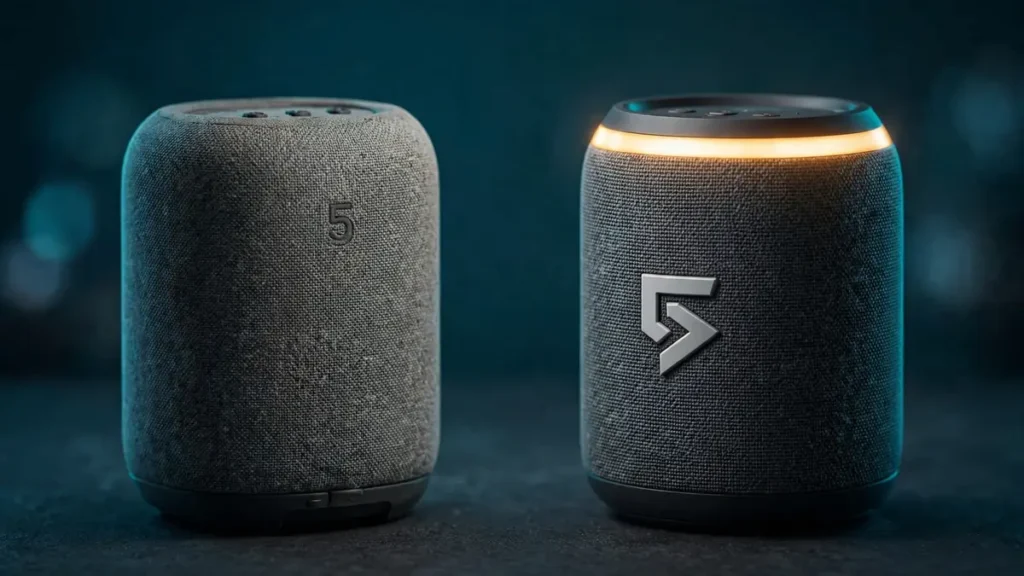
The JBL Flip 5 and Flip 6 look almost identical from across the room — but under the fabric, JBL quietly rebuilt the sound. The Flip 6 adds a dedicated tweeter, a full 2-way driver system, dustproofing, and newer Bluetooth, while keeping the same battery life and tank-like build that made the Flip 5 a hit. Our take at SoundMavericks: the Flip 6 is the clear pick for most buyers today, and the Flip 5 only makes sense if you find it steeply discounted. Below is our full side-by-side breakdown of the key differences.
Our Verdict: Flip 6 Wins — But the Flip 5 Is Still a Solid Speaker
After comparing specs, design, and real-world behavior side by side, we recommend the JBL Flip 6. The dedicated tweeter is the headline upgrade: it gives vocals, guitars, and cymbals noticeably more clarity than the Flip 5’s single full-range driver can manage, and the 2-way system simply sounds more grown-up at any volume. Add Bluetooth 5.1 for a stronger connection, full IP67 dust-and-waterproofing, and EQ control through the JBL Portable app, and the Flip 6 justifies the newer model number. The Flip 5 remains a good speaker — the same 12-hour battery, the same bold bass-forward JBL tuning — so if you spot it at a meaningful discount, it’s still one of the most fun portable speakers you can grab. Otherwise, go with the Flip 6.
Quick Comparison: JBL Flip 5 vs Flip 6 at a Glance
| Specification | JBL Flip 5 | JBL Flip 6 |
|---|---|---|
| Driver system | Single 44 × 80 mm racetrack woofer | 2-way: 45 × 80 mm woofer + 16 mm tweeter |
| Output power | 20W RMS | 30W total (20W woofer + 10W tweeter) |
| Bluetooth | 4.2 | 5.1 |
| IP rating | IPX7 (waterproof only) | IP67 (dustproof + waterproof) |
| Playtime | Up to 12 hours | Up to 12 hours |
| Battery | 4,800 mAh Li-Po | 4,800 mAh Li-Po |
| Charging | USB-C (2.5 hr charge) | USB-C (2.5 hr charge) |
| EQ / app | None | EQ via JBL Portable app |
| PartyBoost | Yes — stereo pair or multi-speaker link | Yes — stereo pair or multi-speaker link |
| Frequency response | 65 Hz – 20 kHz | 63 Hz – 20 kHz |
| Size / weight | 181 × 74 × 69 mm, 540 g | 178 × 72 × 68 mm, 550 g |
JBL Flip 5: The Proven Crowd-Pleaser

The Flip 5 built its reputation on one simple formula: big JBL bass in a go-anywhere tube that can survive a pool party. Its single 44 × 80 mm racetrack driver with dual passive radiators delivers the punchy, bass-forward JBL signature sound at up to 20 watts, and it gets genuinely loud for its size — enough to carry a backyard or a beach setup. With IPX7 waterproofing it shrugs off rain and full submersion, and the 12-hour battery keeps the music going all day. PartyBoost lets you pair two Flip 5s for stereo sound or chain multiple PartyBoost-compatible JBL speakers together.
Where the Flip 5 shows its age is in the details: Bluetooth 4.2 (older and shorter-range than modern standards), no app support, and a single full-range driver that can sound congested on busy tracks at high volume. If you want a proper JBL alternative in the headphone world, check out our JBL Tune 720BT review for how the brand’s tuning carries over to its headphones.
JBL Flip 6: The Smarter Upgrade

The Flip 6 keeps everything people loved about the Flip 5 — the same cylindrical shape, the same 12-hour battery, the same party-friendly loudness — and fixes the weak spots. The star of the show is the new 2-way driver system: the familiar racetrack woofer now works alongside a dedicated 16 mm tweeter with 10 watts of its own amplification. In practice, that means highs are clearer and less strained, stereo imaging feels more open, and the speaker stays composed at volumes where the Flip 5 starts to blur. Total system power rises to 30 watts.
JBL also modernized the connectivity: Bluetooth 5.1 for a more stable connection at longer range, and full IP67 rating — waterproof and dustproof — so beach sand and trail dust are no longer a concern. The JBL Portable app adds EQ control that the Flip 5 simply doesn’t offer, letting you shape the signature bass-heavy tuning to taste. Curious how driver design affects sound in general? Our 2-way vs 3-way speaker guide explains what a dedicated tweeter actually buys you.
Sound Quality: The Tweeter Makes the Difference
This is where our testing-style analysis says the money goes. The Flip 5’s single full-range driver does one job: push as much loud, punchy sound as possible through one membrane. It succeeds at fun — bass-heavy playlists, hip-hop, and EDM all hit hard — but complex mixes (think layered rock or acoustic folk) can feel muddy in the upper mids, and treble rolls off earlier. Push it near maximum volume and the highs harden noticeably.
The Flip 6’s 2-way design splits the workload: the woofer handles mids and bass while the dedicated tweeter takes the highs. The result we keep coming back to is clarity at volume — vocals sit forward instead of fighting the bass, cymbals and strings keep their shimmer, and the speaker sounds bigger than its tube size suggests. Bass is still unmistakably JBL — deep and energetic thanks to the dual passive radiators — but it’s better controlled and doesn’t swallow the rest of the music. If audio quality is your priority, the Flip 6 is not a subtle upgrade; it’s the whole point of the new model.
Design and Durability: Same Tube, Tougher Inside
Set them side by side and you’d be forgiven for mixing them up. Both use the same cylindrical, fabric-wrapped body, the same button layout on top, and the same rugged end caps. The Flip 6 shaves a couple of millimeters off the length (178 vs 181 mm) and actually gains 10 grams (550 g vs 540 g) thanks to the extra tweeter hardware. The most visible change is the larger, bolder JBL logo stretched across the Flip 6’s grille versus the smaller badge on the Flip 5 — purely cosmetic, but it does make the newer model easier to spot.
The meaningful change is the IP rating. The Flip 5 is IPX7: fully waterproof, but with no official dust protection. The Flip 6 earns the full IP67 rating, adding certified dustproofing. For pool-and-beach use, both survive the water; for camping, festivals, or construction-site playlists, the Flip 6’s dust seal is a genuine advantage. Both charge over USB-C with a full charge in about 2.5 hours.
Looking for JBL’s more pocketable option instead? See our JBL Clip 4 vs Clip 5 comparison for the carabiner-style alternative.
Battery Life and Charging: A Tie
No upgrade here — and frankly, none was needed. Both speakers pack a 4,800 mAh battery rated for up to 12 hours of playtime, and in practice both land in that range depending on volume. Both charge over USB-C, taking roughly 2.5 hours for a full charge. If battery is your main concern, either model will get you through a full day outdoors; the Flip 6’s newer Bluetooth 5.1 may sip slightly less power during streaming, but it’s not a difference you’ll notice in real use.
Bluetooth and Features: The Flip 6 Pulls Ahead
The Flip 5’s Bluetooth 4.2 is the oldest link in its chain — workable, but with shorter range and a less robust connection than modern phones and laptops are built for. The Flip 6’s Bluetooth 5.1 is the more meaningful connectivity spec: better range, a more stable link through walls and crowds, and more efficient pairing with two devices at once (both models support two simultaneous connections).
The bigger feature gap is the app. The Flip 6 works with the JBL Portable app, which unlocks EQ presets and custom tuning plus firmware updates — a real upgrade path that the Flip 5 lacks entirely. The Flip 5 does have a basic bass-boost-style tuning baked in, but you can’t adjust it. The Flip 6 also inherits USB charging protection: if the port detects water or residue, it alerts you to unplug before charging, a small but thoughtful safety touch.
PartyBoost and Stereo Pairing
Both speakers support JBL PartyBoost, so you’re not locked out of the multi-speaker party trick on the older model. Pair two of the same model for true wireless stereo, or link multiple PartyBoost-compatible JBL speakers for bigger coverage — and Flip 5 and Flip 6 can join the same PartyBoost chain. One thing to note: stereo pairing works between identical models, so if you plan to buy two speakers for a stereo setup, match them. If you need even more output than the Flip line offers, our best large Bluetooth speaker roundup covers the bigger guns.
Who Should Buy Which?
Get the JBL Flip 6 if: you want the best-sounding Flip, clearer highs, dustproofing for outdoor adventures, stronger Bluetooth, and app-based EQ. This is our default recommendation for anyone buying new in 2026.
Get the JBL Flip 5 if: you find it at a clear discount and mostly play bass-heavy music at moderate volume. It’s still loud, waterproof, and fun — the older tech just shows in refinement and connectivity. Also worth considering if you already own a Flip 5 and want a cheap second unit for stereo pairing.
Upgrading from the Flip 5? Only if sound clarity matters to you. If your Flip 5 still works and you’re happy with it, the battery life and party features are identical — the upgrade is about audio quality, not new tricks. But if you regularly push the volume and wish the highs kept up, the Flip 6’s tweeter earns its keep.
Frequently Asked Questions
Is the JBL Flip 6 better than the Flip 5?
Yes, in our analysis the Flip 6 is the better speaker. The dedicated tweeter and 2-way driver system deliver clearly better high-end detail, Bluetooth 5.1 gives a stronger connection, the IP67 rating adds dustproofing, and the JBL Portable app adds EQ control. The Flip 5 remains good value only when discounted.
Is the JBL Flip 5 still worth buying in 2026?
It can be, at the right discount. The Flip 5 still offers loud JBL sound, IPX7 waterproofing, and 12-hour battery life. Its weaknesses are refinement-related — older Bluetooth 4.2, no app or EQ, and a single driver that can’t match the Flip 6’s clarity. Buy it for the deal, not as a first choice.
Can you pair a Flip 5 and Flip 6 together?
Yes. Both models support PartyBoost, so a Flip 5 and Flip 6 can join the same multi-speaker chain. True wireless stereo pairing, however, requires two identical models — so a Flip 5 pairs in stereo only with another Flip 5, and a Flip 6 with another Flip 6.
Does the Flip 6 have better bass than the Flip 5?
Bass quantity is similar — both use a racetrack woofer with dual passive radiators and the same 12-hour battery. The difference is quality: on the Flip 6, the dedicated tweeter takes over the highs, leaving the woofer free to handle bass and mids more cleanly, so low end sounds tighter and less muddy at high volume.
What is the difference between IPX7 and IP67?
IPX7 (Flip 5) means waterproof up to 1 meter for 30 minutes, with no official dust protection. IP67 (Flip 6) adds the “6” dust rating — fully sealed against dust — while keeping the same waterproofing. For beach, camping, or dusty environments, IP67 is meaningfully tougher.

I am the founder of Sound Mavericks, where I provide the polite truth about audio equipment. I started this site because consumer electronics reviews are often too technical. Instead of using a silent lab, I test headphones, earbuds, and Bluetooth speakers in the real world – like on a noisy subway or in a busy coffee shop.
To stay independent, I buy my own review units (mostly from the United States) rather than accepting free gifts from brands. Once I finish testing a product, I sell it locally to our community. My goal is to help you understand sound quality, active noise cancellation (ANC), and battery life without the marketing hype.