
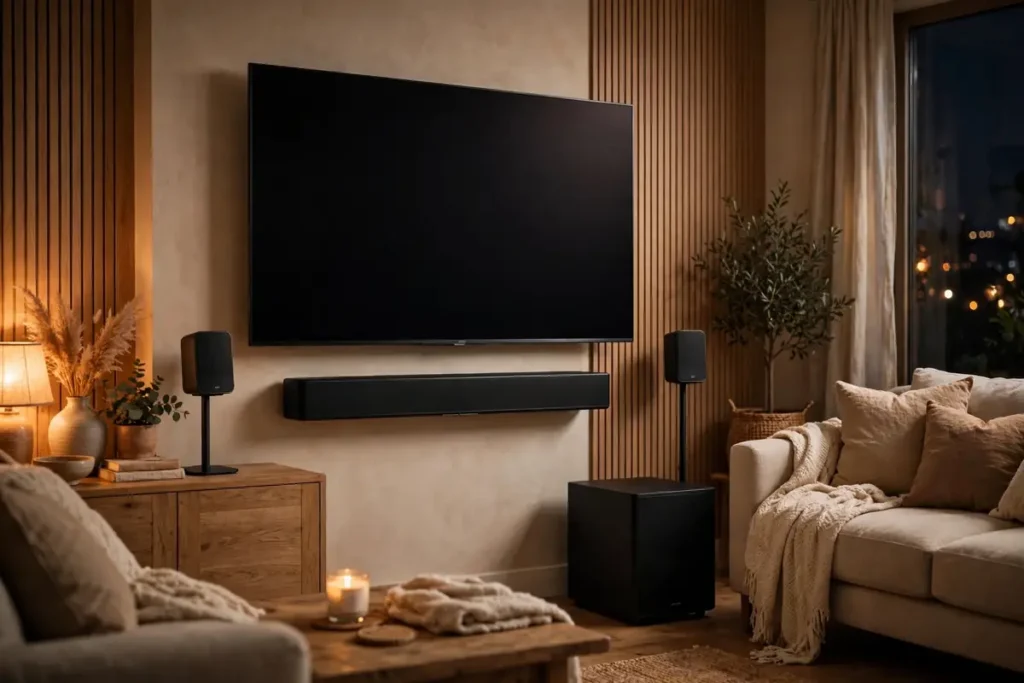
This JBL Bar 1000 review covers the original Bar 1000 soundbar system, model JBLBAR1000PROBLKAM: a 7.1.4 Dolby Atmos setup whose two end sections detach and work as battery powered rear speakers, backed by a 10 inch wireless subwoofer and 880W of total system power. It is not the Bar 1000MK2, which is a later revision sold under a different model number. This review covers the original only, and judges it on the question that decides most soundbar purchases in this class: do the detachable rears deliver surround sound that a single bar cannot fake?
A note on method. This is a research review, built from JBL’s published specifications, the verified Amazon US listing for this exact model, and independent coverage. We have not had a unit on the desk, so nothing here claims hands-on testing, and speaker products on this site carry no scores.
The Bar 1000 solves the oldest soundbar problem in the simplest way. A single bar can widen the front stage and bounce height effects off the ceiling, but it cannot put sound behind you. JBL’s answer is to make the ends of the bar removable: pull them off, set them behind the sofa, and you have real rear channels for the length of a film, with no speaker cable crossing the room. Add the 10 inch wireless subwoofer, Dolby Atmos and DTS:X decoding, three HDMI inputs plus eARC, and Wi-Fi streaming, and the system covers films, games and music from one box. The compromises are size and routine. The assembled bar is wide, the rears need docking to recharge after roughly ten hours of use, and the room calibration matters more here than on a plain stereo bar. For buyers comparing systems in our best Dolby Atmos soundbar coverage, it is the pick for true surround without a receiver. Check Price on Amazon

Why you: Real rear surround from detachable battery speakers, a 10 inch wireless subwoofer, and full Dolby Atmos and DTS:X decoding in one system with no speaker wire to run.
Trade-off: The bar is wide when assembled, the rear speakers need re-docking to recharge, and best results depend on a flat ceiling and a few minutes of calibration.
JBL Bar 1000 specifications
| Spec | JBL Bar 1000 |
|---|---|
| Product | JBL Bar 1000, original model JBLBAR1000PROBLKAM, Black |
| Channels | 7.1.4 with detachable surround speakers docked or placed as rears |
| Total power | 880W total system power (JBL rating) |
| Subwoofer | 10 inch wireless subwoofer, included |
| Formats | Dolby Atmos, DTS:X, MultiBeam processing, PureVoice dialogue enhancement |
| Connections | HDMI eARC plus 3 HDMI inputs, optical, Ethernet, USB (service) |
| Wireless | Wi-Fi streaming with Chromecast built-in and AirPlay, Bluetooth 5.0 |
| Rear speakers | Detachable, battery powered, recharge when docked on the bar |
The detachable rears are the whole point
Most soundbar surround is a processing trick. The bar fires sound at the walls, the reflections arrive late and wide, and your brain reads width as envelopment. It can work well, but the sound still starts in front of you. The Bar 1000 takes the direct route. The left and right ends of the bar are complete speakers with their own batteries and up-firing drivers. Lift them off, place them behind or beside the seats, and the system runs as a genuine 7.1.4 layout: front channels from the shortened bar, surround and rear height from the satellites, low bass from the subwoofer.
The daily routine is simpler than it sounds. The satellites live docked on the bar, where they charge and work as part of the front array for ordinary television. Movie night means moving two small speakers to the back of the room and pressing through the room calibration so the system can measure distances and balance levels. Independent coverage of the Bar 1000 returns to the same conclusion: the effect with the rears placed is in a different class from virtual surround, particularly for games and action films where effects pan behind the listener. When the film ends, the satellites go back on the bar. There are no stands to buy, no cable runs, and no permanent furniture rearrangement.
Battery life is the working limit. JBL’s detachable speakers are built for sessions, not for permanent off-dock duty, and owners who leave them undocked for days will find them flat at the wrong moment. Treat docking as part of switching the system off and the design works as intended. Buyers who want permanently placed wireless rears with mains power at each speaker should look at systems in our best soundbars roundup instead, where that trade is made the other way.
Sound: scale first, then height
With 880W of rated system power and a 10 inch subwoofer, the Bar 1000 plays loud without strain in medium and large rooms, and the subwoofer gives action scenes the physical weight that compact bars approximate with processing. Bass is adjustable, and it needs to be: at default settings in a small room the low end can dominate dialogue. PureVoice, JBL’s dialogue enhancement, lifts speech in busy mixes, and it earns its place on news, sport and dialogue heavy drama where the centre information matters most.
Height effects depend on the ceiling, as they do for every up-firing system. The bar carries up-firing drivers of its own, and each satellite adds another, so Atmos and DTS:X tracks get four height channels fed from real positions rather than two. Flat, standard height ceilings give the cleanest result. Vaulted or very high ceilings soften the effect, and no calibration routine changes that geometry. Music over Wi-Fi is a secondary use for most buyers, but the system handles it with the rears docked, where it behaves as a wide, confident stereo bar with subwoofer support.
Connections and streaming
Connectivity is a strength next to minimalist rivals. Three HDMI inputs plus an eARC output mean a console, a player and a streaming box can connect to the bar directly, which suits TVs with few ports or older eARC implementations. Optical covers legacy sets. Wi-Fi streaming runs through Chromecast built-in and AirPlay, with voice assistant support through compatible speakers and devices on the network. Bluetooth 5.0 handles direct phone playback. The JBL One app covers setup, calibration and sound adjustment. Shoppers comparing this approach with a single bar and no inputs can set it against our JBL Bar 1300X review, which covers JBL’s larger detachable system, and the Sonos Arc Ultra review for the single bar alternative.
Bar 1000 or Bar 1000MK2?
The two systems share a name, an idea and a shape, which is why listings confuse buyers. The MK2 is the later revision, with updated processing and a higher power rating on paper. The original Bar 1000 covered here, model JBLBAR1000PROBLKAM, keeps the same 7.1.4 layout, the same detachable rear concept and the same 10 inch subwoofer formula. Check the model number on any listing before buying, because photographs of the two are near identical and the suffix is the only reliable tell. On sound per money, the original is often the value buy when both are on sale, since the core experience, real rears plus Atmos height, is present in full.
Who should buy the JBL Bar 1000
Buy it if you want surround sound that actually comes from behind you, you rent or simply refuse to run speaker cable, and your room has a flat ceiling for the height channels to bounce from. It suits film and gaming setups in medium to large rooms where a receiver and separate speakers are not on the table.
Skip it if your TV bench cannot take a wide bar, if you know the detach-and-dock routine will annoy you within a month, or if your listening is mostly music and news at modest volume, where a smaller bar does the same job for less money and less space.
Frequently asked questions
Is the JBL Bar 1000 the same as the Bar 1000MK2?
No. This review covers the original Bar 1000, model JBLBAR1000PROBLKAM. The Bar 1000MK2 is a later revision with updated processing. Both use detachable battery powered rear speakers and a 10 inch wireless subwoofer, so check the model number on the listing.
Do the detachable speakers need power cables?
No. Each detachable speaker runs on its own battery while placed as a rear speaker, then recharges when docked back onto the ends of the bar. Docking them after use keeps them ready for the next session.
Does the Bar 1000 support DTS:X as well as Dolby Atmos?
Yes. The Bar 1000 decodes Dolby Atmos and DTS:X, and uses up-firing drivers in the bar and in both detachable speakers for the height channels of each format.
How many HDMI devices can connect to the Bar 1000?
Three sources can connect to the bar’s HDMI inputs, and the bar connects to the TV over HDMI eARC. An optical input covers TVs without eARC.
Can the Bar 1000 stream music over Wi-Fi?
Yes. Built-in Wi-Fi supports Chromecast built-in and AirPlay streaming, and Bluetooth covers direct playback from a phone or tablet.

I am the founder of Sound Mavericks, where I provide the polite truth about audio equipment. I started this site because consumer electronics reviews are often too technical. Instead of using a silent lab, I test headphones, earbuds, and Bluetooth speakers in the real world – like on a noisy subway or in a busy coffee shop.
To stay independent, I buy my own review units (mostly from the United States) rather than accepting free gifts from brands. Once I finish testing a product, I sell it locally to our community. My goal is to help you understand sound quality, active noise cancellation (ANC), and battery life without the marketing hype.

