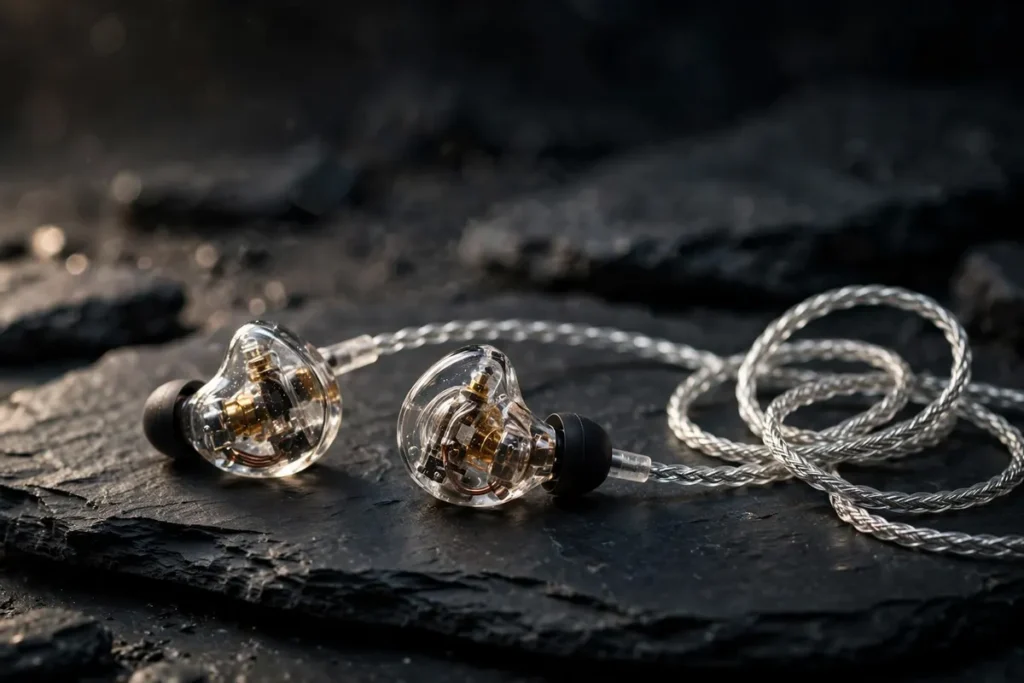
The DUNU Vitruvian is the successor to the DaVinci, the 2024 hybrid built around JM-1 tuning. It keeps the dual dynamic driver bass section, adds a fifth balanced armature for seven drivers per side, and reverses the tuning direction: less bass shelf, clearer vocals, more treble air. DUNU launched it on November 1, 2026 at the same price the DaVinci launched at, sold through HiFiGo.
This is a launch review, built from DUNU’s published launch materials carried by HiFiGo and the DaVinci’s published specifications. We have not listened to the Vitruvian, and nothing here pretends otherwise. What follows is paper analysis: the hardware, what changed, and who should buy or wait. This page will be updated as independent measurements and reviews appear.

DUNU Vitruvian Launched Nov 1, 2026
What it is: the DaVinci successor: two dynamic drivers on bass, five balanced armatures above them, and a tuning rebalanced toward vocal clarity and treble air.
Watch out: it is not on Amazon US yet, and DUNU has not published its impedance, sensitivity or weight, so drivability is unproven on paper.
2DD + 5BA hybrid · 0.78mm 2-pin · modular 3.5mm / 4.4mm plugs · gear-pattern faceplates
DUNU Vitruvian quick facts
| Drivers | 2 dynamic drivers + 5 balanced armatures (hybrid), redesigned crossover |
| Launch price | $299.99 |
| Status | On sale now; launched November 1, 2026 |
| Where to buy | HiFiGo |
| Amazon US | Not listed as of November 3, 2026; this page updates when it lists |
| Tuning | JM-1 lineage, rebalanced toward neutrality (per DUNU) |
What the Vitruvian is
The Vitruvian began life as the DaVinci 2, and the first prototype turned everything up: the same heavy bass, extra treble drivers and a bone-conduction driver on top. Then DUNU showed it at the Shenzhen International Audio Show, took the feedback, and changed direction. The bass came down, vocal clarity went up, and the bone-conduction driver was dropped. The new name, borrowed from Leonardo’s Vitruvian Man, is the design brief in one word: proportion. DUNU frames the set as the DaVinci’s balance corrected, not amplified.
The hardware is a seven-driver hybrid. Two dynamic drivers split the low end between sub-bass and bass. Five balanced armatures cover the midrange and treble, one more treble driver than the DaVinci carried, there to buy smooth, open extension rather than brightness. A redesigned crossover ties the seven drivers together; DUNU does not publish a way count for it, where the DaVinci’s five-way network was a headline feature. The connector is the standard 0.78mm 2-pin.
The faceplates mark the visual break from the original: the DaVinci wore stabilized wood, the Vitruvian wears vintage-inspired metal with detailed gear patterns. The stock cable is a high-purity design with modular termination: both 3.5mm and 4.4mm plugs are in the box, along with 13 pairs of ear tips.
Vitruvian vs DaVinci: what changed
The DaVinci was a warm, bass-led set built with reviewer Timmy of Gizaudio: two bio-cellulose dynamic drivers (10mm sub-bass, 8mm bass), four custom balanced armatures, a five-way crossover with five acoustic tubes, and a wooden faceplate. It became a reference point for the warm side of JM-1 tuning. The Vitruvian keeps the architecture’s outline and changes the voicing and the driver count.
| DUNU Vitruvian | 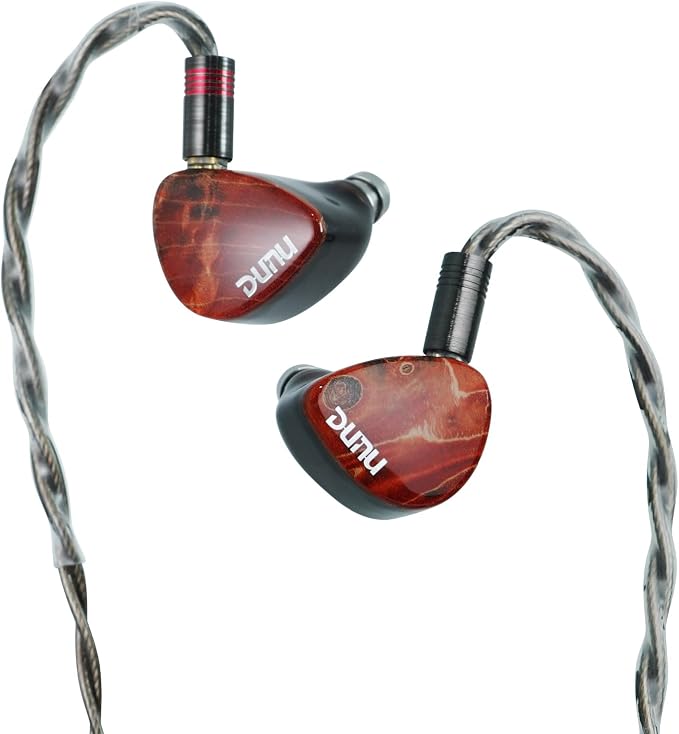 DUNU x Gizaudio DaVinci | |
|---|---|---|
| Drivers | 2 DD + 5 BA (7 per side) | 2 DD + 4 BA (6 per side) |
| Bass drivers | Two dynamic drivers, split sub-bass and bass (sizes not published) | 10mm + 8mm bio-cellulose dynamic drivers |
| Crossover | Redesigned multi-driver system (way count not published) | 5-way crossover, 5 independent acoustic tubes |
| Tuning direction | Cleaner and more balanced: reduced bass, forward vocal clarity, added treble air | Warm and bass-led, JM-1 with a relaxed top end |
| Impedance | Not published in launch materials | 35Ω @ 1kHz |
| Sensitivity | Not published in launch materials | 109 dB/mW |
| Weight | Not published in launch materials | 6.6g per earpiece |
| Faceplates | Vintage-inspired metal, gear patterns | Stabilized natural wood |
| Cable and plugs | High-purity cable, modular 3.5mm and 4.4mm plugs | LEO cable, Q-Lock Mini modular 3.5mm and 4.4mm plugs |
| Check Price | Check Price | Check Price |
The gaps in the left column are the honest story of this launch. The DaVinci’s 35Ω impedance and 109 dB/mW sensitivity made it an easy drive from a phone dongle, with a full spec sheet public since 2024. Until DUNU publishes the Vitruvian’s figures, drivability and fit weight stay open questions; we will add them here when the official sheet lands.
DUNU Vitruvian specifications
| Product | DUNU Vitruvian Check Price |
| Driver configuration | 2 dynamic drivers + 5 balanced armatures per side (7 drivers) |
| Dynamic drivers | Two, dedicated to sub-bass and bass (sizes not published) |
| Balanced armatures | Five, covering midrange and treble, including a dedicated treble unit |
| Crossover | Redesigned multi-driver crossover system (way count not published) |
| Connector | 0.78mm 2-pin |
| Cable | High-purity stock cable, modular termination |
| Plugs | 3.5mm and 4.4mm, both included |
| Faceplates | Vintage-inspired metal with precision gear designs |
| Eartips | 13 pairs included |
| Impedance | Not published in launch materials |
| Sensitivity | Not published in launch materials |
| Weight | Not published in launch materials |
| Launch price | $299.99 |
Tuning: the JM-1 warmth, rebalanced
The DaVinci was one of the early high-profile IEMs built around the JM-1 target and the New Meta tuning trend, and its warmth was the point: a heavy, enveloping low end with a relaxed top. Its critics wanted the same midrange with less bass weight and more air. Per DUNU’s launch materials, the Vitruvian is the answer: a cleaner, more balanced version of the same sound. That is the manufacturer’s stated intent, not a measurement of ours.
Read the claims with the prototype story in mind. DUNU still promises enveloping warmth and deep bass presence, so this is a nudge toward neutral, not a new curve: bass that hits faster with less of it, denser vocals, and extension without harshness from the extra treble driver. Those are exactly the claims that only measurements and production-unit reviews can settle.
Early coverage
As of November 3, 2026, coverage of the Vitruvian is announcement-level: DUNU’s launch materials through HiFiGo and news write-ups of the launch. There are no independent measurements or full production-unit reviews to cite yet. The most informative reporting so far is the prototype history from the Shenzhen show floor, because it explains why the tuning moved. This section updates when the first measured reviews land.
Should you buy, or wait?
The buy case is for the DaVinci listener who wanted the retune. On paper the Vitruvian keeps the dual-driver bass hardware and midrange focus, corrects the two common complaints (bass weight, treble air), and holds the 2024 launch price, adding a modular plug system.
The wait case is strong, and it is mostly about missing information: no Amazon US listing yet (buying means HiFiGo shipping and returns), no published electrical specifications, no measurements. The DaVinci remains on sale as a verified Amazon US listing at the same launch price, with two years of reviews behind it. Our read: DaVinci owners gain little by moving first; new buyers should wait for the spec sheet and first graphs, unless the rebalanced brief is exactly what they were holding out for.
Also consider
Three covered sets that frame its tier: the closest rival, and two cheaper known quantities.

The other New Meta tribrid in our coverage: a microplanar tweeter, a three-way crossover and hand-finished resin shells, fully reviewed by us.

One dynamic driver done the premium way: metal shells, a warm-neutral tune, and swappable 3.5mm and 4.4mm plugs in the box.

The proven hybrid all-rounder: a dynamic driver plus four balanced armatures, tuned for gaming and music.
FAQ
When was the DUNU Vitruvian released?
It launched on November 1, 2026, through HiFiGo. It is on sale now, not a pre-order.
How much does the DUNU Vitruvian cost?
The launch price is in the quick facts box at the top of this page. It matches the price the original DaVinci launched at in 2024.
Where can I buy the DUNU Vitruvian?
HiFiGo is the launch retailer. The button at the top of this page goes to the HiFiGo listing. It is not on Amazon US yet.
Is the DUNU Vitruvian on Amazon?
Not as of November 3, 2026. Our check of Amazon US returns other DUNU models, including the DN242, the Vulkan 2 and the original DaVinci, but no Vitruvian listing. This page updates when one appears.
What drivers does the DUNU Vitruvian use?
Seven per side: two dynamic drivers split between sub-bass and bass, and five balanced armatures for the midrange and treble. That is one more balanced armature than the DaVinci, added on the treble side.
DUNU Vitruvian vs DaVinci: which should you buy?
The DaVinci is the warm, bass-led original and the proven pick, with published specs, measurements and two years of reviews behind it. The Vitruvian is the same recipe rebalanced on paper: less bass shelf, clearer vocals, an extra treble driver. DaVinci owners who like its warmth gain little; listeners who found it too thick should wait for Vitruvian measurements before spending.

I am the founder of Sound Mavericks, where I provide the polite truth about audio equipment. I started this site because consumer electronics reviews are often too technical. Instead of using a silent lab, I test headphones, earbuds, and Bluetooth speakers in the real world – like on a noisy subway or in a busy coffee shop.
To stay independent, I buy my own review units (mostly from the United States) rather than accepting free gifts from brands. Once I finish testing a product, I sell it locally to our community. My goal is to help you understand sound quality, active noise cancellation (ANC), and battery life without the marketing hype.