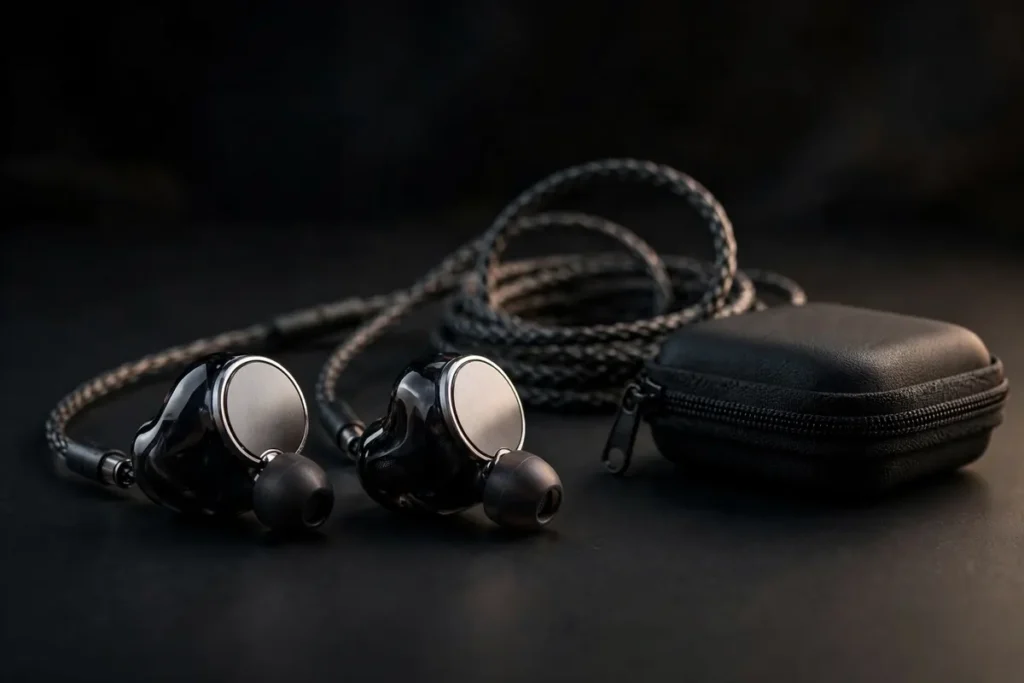
Some sequels exist to sell you the same product twice. The Kiwi Ears KE4 II is not one of them. The original KE4 became a genuine reference point in the IEM hobby — the set widely credited with championing the “New Meta” tuning, a neutral-with-bass-boost signature that a generation of rivals has been measured against ever since. Announced on October 24, 2026, the KE4 II keeps the four-driver framework but rebuilds what each driver does: out goes the dual-dynamic isobaric bass array, and in come a single 10mm biocellulose dynamic driver, two custom balanced armatures, and a microplanar tweeter handling the very top end.
Our Early Verdict
On paper, the KE4 II reads like a thoughtful evolution rather than a reboot. Kiwi Ears kept the tuning philosophy that made the original a reference — an 8dB sub-bass shelf that rolls off cleanly at 200Hz, a flat, studio-like midrange, and controlled treble — then attacked the two areas where the KE4 had the least headroom: treble extension and instrument separation.
| Sound Quality (on paper) | 8.8 |
| Build & Craft | 8.7 |
| Comfort & Fit | 8.4 |
| Features & Cable | 8.3 |
| Value | 8.6 |

A microplanar tweeter that reaches beyond 20kHz, a true 3-way crossover, and hand-matched drivers in hand-finished medical-grade resin shells are serious hardware for a follow-up act. If the execution matches the specification, this is the new benchmark in its class.
How we are reviewing this one: the KE4 II has only just launched, and at the time of writing there are no independent hands-on reviews in the wild — this is a research-based launch review built from Linsoul’s published specifications, the official launch material, and the original KE4’s well-documented track record. We have not listened to it, and we will not pretend otherwise. Where the verdict talks about sound, it is talking about what the hardware and the published tuning targets say on paper. Our score is provisional for exactly that reason, and we will revisit it as independent measurements and listening reports land.
Kiwi Ears KE4 II Specifications
| Product | Kiwi Ears KE4 II |
| Driver configuration | 1 dynamic driver + 2 balanced armature drivers + 1 planar (microplanar) driver |
| Bass driver | 10mm biocellulose dynamic driver |
| Mid / high drivers | 2 custom balanced armature drivers (midrange and lower treble) |
| Treble driver | Custom microplanar ultrasonic tweeter (extends beyond 20kHz) |
| Crossover | 3-way crossover with 3 acoustic tubes |
| Impedance | 15Ω @ 1kHz (±1Ω) |
| Sensitivity | 104dB @ 1kHz (±1dB) |
| Frequency response | 20Hz–20kHz (rated) |
| Shell | Medical-grade resin, handcrafted and hand-polished, individually finished faceplates |
| Cable | Detachable, standard 0.78mm 2-pin connectors |
| Buy | Check Price on Amazon |
What Changed vs the Original KE4
The original Kiwi Ears KE4 built its reputation on a 2DD+2BA isobaric hybrid design: two dynamic drivers working in an isobaric arrangement for bass, two balanced armatures above them. Reviewers praised its deep, powerful low end, natural midrange, airy treble and wide, holographic stage — and, above all, its balance. The criticisms were smaller but consistent: a plain single-ended 3.5mm stock cable in a world moving toward modular and balanced options, and build details around the case that felt a step behind the sound.
The KE4 II answers with architecture, not cosmetics. The dual-dynamic isobaric array is replaced by one dedicated 10mm biocellulose dynamic driver, freeing the design brief: instead of two dynamics sharing bass duty, a single purpose-built woofer handles the low end while a completely separate driver type — a microplanar tweeter — takes over the ultra-high frequencies that balanced armatures traditionally struggle to extend. The two balanced armatures in the middle are customs, voiced for the midrange and lower treble. Load distribution is the whole story here: each driver works in the band it is best at, which is precisely how you buy separation and resolution without changing the tuning target.
The cable criticism is answered structurally as well. Where the original shipped with a basic single-ended cable that reviewers singled out as the weak point of the package, the KE4 II standardises on a 0.78mm 2-pin detachable system — the connector the aftermarket is built around. That does not tell us how good the stock cable itself is, and we will not guess; it tells us the ceiling on the problem is low, because any owner who dislikes the included cable can replace it in seconds with anything from a budget balanced cable to a premium modular one. On a sequel where the headline changes are all inside the shell, removing the original’s most-cited external annoyance is a quiet but real part of the brief.
| Kiwi Ears KE4 II | Kiwi Ears KE4 | |
|---|---|---|
| Drivers | 1DD + 2BA + 1 microplanar (tribrid) | 2DD + 2BA hybrid |
| Bass architecture | Single 10mm biocellulose dynamic driver, 8dB sub-bass shelf rolling off at 200Hz | Dual dynamic drivers in an isobaric arrangement |
| Treble driver | Microplanar ultrasonic tweeter, extending beyond 20kHz | Balanced armature |
| Crossover | 3-way, 3 acoustic tubes (1 ultra-high, 2 mid-high, 1 low) | Hybrid crossover for 2DD+2BA array |
| Tuning | Refined “New Meta”: flat mids 200Hz–1kHz, controlled 3kHz peak, smoother upper treble | Original “New Meta” reference: neutral with bass boost |
| Shell & cable | Hand-finished medical-grade resin; detachable 0.78mm 2-pin cable | Resin shell; detachable cable (3.5mm single-ended stock cable drew reviewer criticism) |
| Buy | Check Price on Amazon | Check Price on Amazon |
The Driver Architecture, Explained
Three driver technologies in one shell only works if each is given a job it is genuinely good at, so it is worth being precise about the division of labour. The 10mm biocellulose dynamic driver is the woofer. Dynamic drivers move the most air, which is what sub-bass impact and texture need, and biocellulose diaphragms are prized for controlled, low-distortion excursion. Linsoul rates the KE4 II’s low end with a dedicated 8dB sub-bass shelf that rolls off precisely at 200Hz — the same trick the original KE4 used to get satisfying bass weight without bleeding warmth into the midrange.
The two custom balanced armatures cover the midrange and lower treble. Balanced armatures are small, fast and efficient, and they excel at articulation and layering in the vocal and instrumental bands. Kiwi Ears keeps the midrange flat from 200Hz to 1kHz, a studio monitor-style presentation with minimal tonal colouration — again, the KE4 philosophy carried forward. The treble is tuned around a 3kHz peak aligned to the ear’s natural acoustics, with the upper treble deliberately controlled for a smoother, less fatiguing top end.
The headline addition is the microplanar tweeter. Planar drivers use a flat diaphragm driven across its whole surface, which gives them very fast transient response. As an ultrasonic tweeter, the KE4 II’s microplanar unit extends response beyond the rated 20kHz ceiling with, per Linsoul, lower distortion than a conventional balanced-armature tweeter and a smoother, more natural timbre than the sometimes metallic character of BA or electrostatic top ends. Whether that advantage is audible at the margins of human hearing is exactly the kind of claim only measurements and listening can settle — but the engineering logic, dedicating the hardest band to the driver type with the fastest response, is sound.
Tying it together is a true 3-way crossover feeding three separate acoustic tubes — one ultra-high, two mid-high, one low in the frequency allocation — so each driver’s output reaches the nozzle through its own path. Kiwi Ears also measures and pairs the drivers before assembly for channel balance, and every finished unit gets a final measurement check. That is the kind of unglamorous quality control that separates a reference-grade IEM from a spec-sheet gamble. If you are comparing architectures across the market, our guide to the best IEMs breaks down how hybrid and tribrid designs differ at every level.
Craftsmanship, Fit and the Details That Matter
Multi-driver IEMs live or die on execution, and the KE4 II’s build process is unusually labour-intensive for a series product. Each shell is made from medical-grade resin, handcrafted, individually finished and polished by hand, with each faceplate decorated individually. Inside, the drivers are measured and paired before assembly so the left and right channels match, and every completed unit passes a final measurement before it leaves. None of that guarantees great sound on its own — but channel matching and unit-to-unit consistency are exactly where cheaper multi-driver IEMs cut corners, and they are the difference between a design that measures well once and a product that measures well every time.
Fit should follow the familiar Kiwi Ears pattern: a contoured resin shell of the kind the original KE4 used, which reviewers consistently found lightweight and comfortable over long sessions. The detachable cable uses the standard 0.78mm 2-pin system, the most widely supported connector in the hobby, so the upgrade path is wide open — balanced cables for desktop amps and DAPs, microphone cables for calls, or Bluetooth neckband adapters for commuting. That ecosystem matters for a wired IEM in 2026: the earphones are the fixed investment, and everything attached to them can evolve. Two honest unknowns at launch: Linsoul’s launch material does not detail the stock cable’s termination options or the included ear tip selection, so buyers who need a specific plug or tip style should confirm the retail box contents before ordering rather than assume.
Who the KE4 II Is For
Buy the KE4 II if you want the modern reference tuning with more on top. Listeners who found the original KE4’s treble a touch polite, detail-focused listeners who chase separation and layering, and anyone who uses one IEM across music, stage monitoring, production and gaming should find the sequel aimed squarely at them. The easy 15Ω / 104dB electrical profile means it will run happily from a phone dongle or a basic audiophile setup without a dedicated amp.
Stick with the original KE4 if you already own it and love it. The sequel refines the same signature rather than replacing it — the tuning target is deliberately continuous. Owners whose only gripe was the stock cable can solve that for far less than a new IEM, since the KE4’s cable is detachable too. And if you specifically love the dual-dynamic isobaric bass character, that is the one thing the KE4 II does not carry over.
Wait if you need proof before purchase. This launch review is necessarily provisional: the KE4 II’s claims — microplanar treble beyond 20kHz, improved separation, smoother timbre — are manufacturer claims until independent measurements and listening reviews confirm them. The original KE4 earned its reputation the slow way, through reviewers and measurements. The KE4 II deserves the same scrutiny, and early adopters are, as ever, the ones funding it.
Kiwi Ears KE4 II FAQ
When is the Kiwi Ears KE4 II available, and where can I buy it?
The KE4 II was announced on October 24, 2026 and is available now through the official Kiwi Ears website, Linsoul, and authorized retailers, including Amazon US, where the listing is live.
What is the difference between the KE4 II and the original KE4?
The original KE4 is a 2DD+2BA hybrid with dual dynamic drivers in an isobaric arrangement for bass. The KE4 II is a tribrid: a single 10mm biocellulose dynamic driver for bass, two custom balanced armatures for the midrange and lower treble, and a new microplanar tweeter for the ultra-high frequencies, all split by a 3-way crossover with three acoustic tubes. The tuning philosophy — the “New Meta” neutral-with-bass-boost signature — is deliberately kept, with the changes aimed at treble detail and separation.
Is the KE4 II worth upgrading to if I own the KE4?
On paper, it is a refinement rather than a reinvention: same tuning family, better treble hardware. If your KE4 leaves you wanting more top-end extension and separation, the KE4 II targets exactly that. If you are happy with your KE4’s balance, there is no urgency — and the honest caveat is that no independent measurements exist yet to confirm the size of the step up.
Does the KE4 II use a standard 2-pin cable?
Yes. The KE4 II uses a standard 0.78mm 2-pin detachable cable system, so aftermarket cables, balanced cables and Bluetooth adapter cables built for 0.78mm 2-pin IEMs will fit.
Does the KE4 II need an amplifier?
No dedicated amp is required. At 15Ω impedance and 104dB sensitivity, the KE4 II is easy to drive and will reach comfortable listening levels from a phone, a USB-C dongle DAC, a DAP or a laptop output. A clean source is still worthwhile — easy to drive also means it will faithfully pass through whatever noise floor your source has.
The Bottom Line
The original KE4 set the tuning template half the hobby now follows. The KE4 II’s bet is that the template was never the problem — the hardware ceiling was. A biocellulose woofer with a disciplined sub-bass shelf, customs BAs holding a flat monitor midrange, and a microplanar tweeter chasing the octaves the original could not reach: on paper, that is the correct shopping list for a sequel, executed in hand-finished shells with matched drivers. Our provisional 8.6/10 reflects strong specifications, a proven tuning pedigree, and claims that still need independent verification. If the measurements back Linsoul up, expect this score to climb — and expect the KE4 II to become the new reference its predecessor was.

I am the founder of Sound Mavericks, where I provide the polite truth about audio equipment. I started this site because consumer electronics reviews are often too technical. Instead of using a silent lab, I test headphones, earbuds, and Bluetooth speakers in the real world – like on a noisy subway or in a busy coffee shop.
To stay independent, I buy my own review units (mostly from the United States) rather than accepting free gifts from brands. Once I finish testing a product, I sell it locally to our community. My goal is to help you understand sound quality, active noise cancellation (ANC), and battery life without the marketing hype.