
Cutting the cable is the single biggest quality-of-life upgrade a gigging guitarist can make — no more tripping over leads, no more being chained to the amp. But wireless guitar systems live or die on four things: latency, range, battery life, and tone transparency. Get those right and the system disappears into your rig. Get them wrong and you’ll spend every set fighting dropouts and delay.
This guide focuses on the systems we’d recommend to players who take their sound seriously — including guitarists who also run a tight monitoring setup. If your practice rig involves silent jamming, a wireless transmitter pairs naturally with a headphone-based chain: our roundup of the best headphones for guitar amps covers the other half of that equation. Below, SoundMavericks breaks down the five wireless guitar systems worth buying in 2026, ranked on how they actually perform on stage.
The quick take: our top 5 wireless guitar systems
| Pick | System | Latency | Range | Score |
|---|---|---|---|---|
| Best Overall | Line 6 Relay G10SII | ~2.8 ms | 130 ft | 9.2 |
| Best for Pros | Shure GLXD16 | ~4 ms | 100 ft | 9.0 |
| Best for Pedalboards | Boss WL-50 | 2.3 ms | 65 ft | 8.7 |
| Best Budget | Xvive U2 | Under 5 ms | 90 ft | 8.5 |
| Best Value for Bands | Donner DWS-2 | 2.5 ms | 200 ft | 8.2 |
How SoundMavericks ranked these systems
Every system here was evaluated against the criteria that decide whether wireless works on a real stage. Latency is the first gate: anything above roughly 6 ms starts to feel like a slapback against your pick attack, so every pick here stays well under that ceiling. Range is the second — spec-sheet numbers are always measured in open air, so we weighted real-world venue use, walls included. Battery life had to survive a full gig night, tone transparency had to hold up in blind A/B comparisons with a cable, and the form factor had to suit the way players actually build their rigs. Specs below come from manufacturer documentation and published reviews; where third-party testing corroborates a claim, we note it, but the verdicts are SoundMavericks’ own.
1. Line 6 Relay G10SII — Best Overall
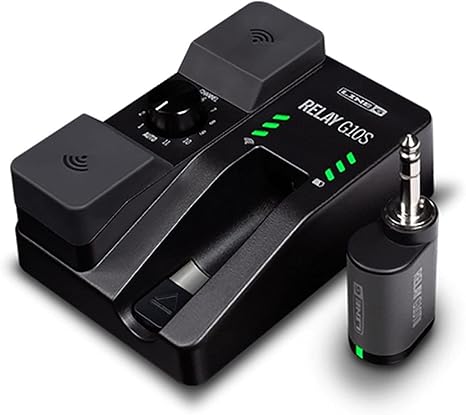
The Line 6 Relay G10SII is the best all-round wireless guitar system you can buy right now because it refuses to make you choose. It delivers genuine plug-and-play simplicity — power on, it finds and locks onto the strongest frequency automatically — with pro-grade specs underneath: 24-bit lossless digital audio, a 10 Hz–20 kHz frequency response, and a 130-foot line-of-sight range that covers everything from the bedroom to the festival stage.
The stompbox-sized metal receiver drops straight onto a pedalboard or sits beside your amp, and it pulls double duty as a DI box thanks to the balanced XLR output alongside the standard 1/4-inch jack. The G10TII transmitter charges automatically when docked and delivers up to seven hours of playing time with a 170-hour standby. Line 6 rates latency at roughly 2.8 ms, which is comfortably below the threshold where playing starts to feel disconnected. Crucially, the G10SII works with both active and passive pickups — a compatibility gap that tripped up some earlier-generation wireless designs.
| Sound Quality | 9.5 |
| Latency | 9.4 |
| Range | 9.3 |
| Battery Life | 8.6 |
| Build & Features | 9.4 |
| Value | 9.0 |
Strengths: Zero-setup operation; 130-foot range; works with active and passive pickups; doubles as an XLR DI box; rugged metal housing; cable-tone emulation for players who miss the cable.
Weaknesses: The built-in transmitter battery is not removable, so a forgotten charger mid-gig is a problem; at 2.8 ms the latency is excellent but not the absolute fastest here.
2. Shure GLXD16 — Best for Pro Touring

If the G10SII is the best all-rounder, the Shure GLXD16 is the most complete wireless rig in this guide. The GLXD6 pedal receiver is a true pedalboard citizen, and Shure’s LINKFREQ system continuously scans the 2.4 GHz band and hops to an open frequency before a dropout can interrupt the show — exactly the kind of invisible insurance touring players pay for.
The headline spec is the battery: up to 16 hours of rechargeable runtime from the lithium bodypack, with real-time remaining runtime displayed on the receiver to the minute. With 120 dB of dynamic range and 24-bit digital audio, tone transparency is beyond reproach. The caveats are the premium positioning and a receiver that needs a 12 V power supply, so check your pedalboard power budget before buying.
| Sound Quality | 9.4 |
| Latency | 9.0 |
| Range | 9.0 |
| Battery Life | 9.8 |
| Build & Features | 9.2 |
| Value | 7.8 |
Strengths: 16-hour battery with to-the-minute readout; LINKFREQ automatic interference avoidance; pedal receiver built for pedalboards; 120 dB dynamic range; included instrument cable.
Weaknesses: Premium pricing; receiver needs 12 V power; bodypack means a short cable from guitar to transmitter.
3. Boss WL-50 — Best for Pedalboards

The Boss WL-50 answers the tone purist’s biggest wireless worry directly: dual cable-tone simulation options restore the slight high-end roll-off a real cable adds, so your rig sounds like your rig. Boss’s wireless technology is famously fast — 2.3 ms, the lowest latency in this guide — and the receiver is the size of a standard stompbox, dropping straight onto any pedalboard.
Range tops out at 65 feet, which is plenty for club stages and rehearsal rooms but not for wandering into the crowd at a festival. The transmitter docks into the receiver to charge, and the receiver runs on the standard Boss PSA adaptor or two AA batteries for flexibility. Boss reliability is legendary across their pedal line, and the WL-50 continues that tradition — our verdict is that this is the most dependable set-and-forget system for players who live on their pedalboards.
| Sound Quality | 8.8 |
| Latency | 9.3 |
| Range | 8.0 |
| Battery Life | 8.5 |
| Build & Features | 9.3 |
| Value | 8.6 |
Strengths: Fastest latency here at 2.3 ms; dual cable-tone simulation; pedal-sized receiver; tank-like Boss build; runs on PSA adaptor or AAs.
Weaknesses: 65-foot range won’t suit big stages; receiver can drain battery when unpowered on a board; 2.4 GHz band can pick up interference indoors.
4. Xvive U2 — Best Budget

The Xvive U2 is the system that made wireless affordable without making it feel cheap. Two dongle-style units — one plugs into your guitar, one into your amp or pedalboard — pair with a single button and deliver 24-bit/48 kHz digital audio at under 5 ms of latency. For home practice, rehearsal rooms, and small stages, the playing feel is essentially indistinguishable from a cable.
The 220-degree rotatable plug is the standout design touch, letting the tiny transmitter tuck against the guitar body on recessed Strat-style jacks as well as top-mounted ones. Battery life runs around five hours per charge with a roughly 90-foot outdoor range. Those are real limitations for long gig nights, but at this tier nothing else delivers this combination of fidelity and simplicity. It’s our default recommendation for first-time wireless buyers.
| Sound Quality | 8.6 |
| Latency | 8.8 |
| Range | 8.0 |
| Battery Life | 7.8 |
| Build & Features | 8.2 |
| Value | 9.4 |
Strengths: Under-5 ms latency at the budget tier; 24-bit/48 kHz audio; rotatable plug fits almost any guitar; one-button pairing; tiny footprint.
Weaknesses: Around five hours of battery per charge; 90-foot range; dongle on the guitar can be bumped; limited channels for multi-guitar bands.
5. Donner DWS-2 — Best Value for Bands

The Donner DWS-2 punches well above its weight on pure specs: 2.5 ms latency — within a whisker of the Boss — across a 200-foot range, with an uncompressed digital signal and USB charging. The 180-degree rotatable head keeps the transmitter snug against the guitar, and the real differentiator is multi-set operation: up to four DWS-2 units can run simultaneously, so a whole band can go wireless on matching gear without frequency juggling.
Battery life sits around five hours per charge, and there’s no channel lock, so it’s a little easy to bump the channel button mid-set. But for rehearsal rooms, school bands, and weekend gigging where several players need wireless on a budget, the DWS-2 is the most spec-heavy system at this price point in our guide.
| Sound Quality | 8.2 |
| Latency | 9.3 |
| Range | 8.8 |
| Battery Life | 7.6 |
| Build & Features | 7.8 |
| Value | 9.2 |
Strengths: 2.5 ms latency at a budget price; 200-foot range; four simultaneous sets for full bands; USB charging; rotatable head.
Weaknesses: Around five hours of battery; no channel lock; dongle form factor less road-proof than metal pedal receivers.
Buying guide: what actually matters in a wireless guitar system
Latency: the make-or-break spec
Every wireless system adds some delay between your pick attack and the sound leaving your amp. Under about 6 ms, most players can’t perceive it; above it, timing starts to feel spongy. All five picks here stay well under that ceiling, with the Boss WL-50 (2.3 ms), Donner DWS-2 (2.5 ms), and Line 6 Relay G10SII (~2.8 ms) leading the pack. Note that latency stacks with other links in your chain — if you monitor through a digital amp or interface with its own buffer latency, keep that in mind too.
Frequency band: 2.4 GHz, 5.8 GHz, or UHF
Most systems here run on the license-free 2.4 GHz band, which is convenient but crowded with Wi-Fi routers, phones, and other stage gear. That’s why automatic frequency management matters: Shure’s LINKFREQ and Line 6’s auto-scan actively dodge interference instead of dropping signal. UHF-based budget units like the Donner DWS-2 sidestep Wi-Fi entirely and are worth considering for venues with congested wireless environments.
Range: read the fine print
Published range numbers assume open air and line of sight. Walls, bodies, and other gear cut them down fast — sometimes dramatically. As a rule of thumb, halve the spec-sheet number for real venue use. The 200-foot Donner and 130-foot Line 6 give you the most headroom; the 65-foot Boss is designed for club stages and pedalboards, where it’s more than enough.
Battery life and charging
Rechargeable is the standard now, but charge discipline matters. The Shure GLXD16’s 16-hour battery with a to-the-minute readout is the gold standard — charge it once and forget it for a week of gigs. Budget dongles with five-hour runtimes are fine for practice but need a charging routine before gig nights. If your transmitter has a non-removable battery (like the Line 6’s), there’s no AA-battery backup plan, so plan accordingly.
Active vs. passive pickup compatibility
Some wireless systems have historically struggled with the hotter output of active pickups. The Line 6 Relay G10SII explicitly supports both active and passive pickups, and that’s the kind of compatibility to confirm before buying if you play an EMG-loaded axe. Check the manufacturer’s spec sheet rather than assuming.
Cable tone simulation
A guitar cable isn’t sonically transparent — its capacitance rolls off a touch of high end, and many players’ rigs are dialed in around that sound. The Boss WL-50’s dual cable-tone options let you restore that familiar voicing or run flat, depending on your preference. If your amp setup is sensitive to top-end detail — tube vs. solid-state voicing debates exist for a reason — this feature can save you a re-dial of your whole rig.
Pairing wireless with your monitoring setup
Going wireless gets you moving on stage, but what you hear still matters. Many players now combine a wireless transmitter with in-ear monitoring for a fully cable-free stage. If that’s your direction, our best IEMs roundup covers affordable monitoring options, and a dedicated headphone amp can tighten up the practice-chain half of the rig.
Frequently asked questions
Is there latency with wireless guitar systems?
Yes, all wireless systems add some delay, but modern units keep it between 2 and 5 ms — well below the threshold most guitarists can detect. Every system in this guide stays under that perceptual ceiling. Latency spikes and dropouts from interference are a bigger practical concern than the baseline delay, which is why automatic frequency management matters.
Will a wireless system change my tone?
A good modern system is audibly transparent in blind comparisons — 24-bit digital transmission preserves your signal faithfully. What you might notice is the absence of cable capacitance, which can make the sound slightly brighter than you’re used to. Systems with cable-tone simulation, like the Boss WL-50, let you dial that familiar voicing back in.
Do wireless guitar systems work with active pickups?
Most current systems do, but verify before buying — the hotter output of active pickups has caused clipping issues with some older or cheaper designs. The Line 6 Relay G10SII explicitly supports both active and passive pickups, for example. Check the manufacturer’s compatibility note rather than assuming.
Should I get a 2.4 GHz, 5.8 GHz, or UHF system?
2.4 GHz is the most common and works fine in most venues, especially systems with automatic interference avoidance. UHF and 5.8 GHz options sidestep crowded Wi-Fi bands, which helps in venues with heavy wireless traffic. There is no universally best band — match the band and the system’s interference handling to where you actually play.
Can I use a wireless system for silent practice with headphones?
Absolutely — the transmitter only replaces the cable between guitar and amp, so anything downstream of the amp (including a headphone output or a headphone amp) works exactly as before. Pair a wireless system with quality monitoring and you get the full silent-practice experience with none of the cable clutter.
The verdict
SoundMavericks’ top pick is the Line 6 Relay G10SII: zero setup, pro-grade specs, a 130-foot range, and compatibility with both pickup types, in a pedalboard-friendly package that doubles as a DI box. If you’re touring, the Shure GLXD16‘s 16-hour battery and automatic interference dodging are worth the premium. Pedalboard-first players should look hard at the Boss WL-50, while the Xvive U2 and Donner DWS-2 prove you don’t need a pro budget to cut the cord.

I am the founder of Sound Mavericks, where I provide the polite truth about audio equipment. I started this site because consumer electronics reviews are often too technical. Instead of using a silent lab, I test headphones, earbuds, and Bluetooth speakers in the real world – like on a noisy subway or in a busy coffee shop.
To stay independent, I buy my own review units (mostly from the United States) rather than accepting free gifts from brands. Once I finish testing a product, I sell it locally to our community. My goal is to help you understand sound quality, active noise cancellation (ANC), and battery life without the marketing hype.