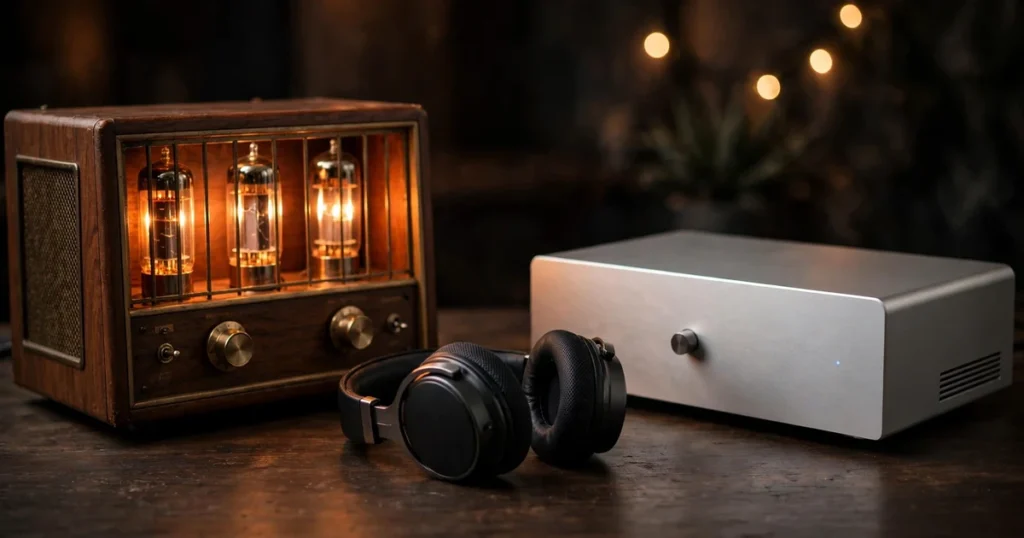
If you are shopping for a headphone amplifier, you will hit the same fork audio enthusiasts have argued over for decades: tube amps vs solid-state amps. One glows like a 1960s radio and promises warmth and texture; the other is silent, cold, and measures near-perfect in a lab. Which one sounds better with headphones in 2026? SoundMavericks compares them head-to-head — sound character, distortion, headphone pairing, maintenance, cost — and delivers a clear verdict.
The Short Answer
There is no universal winner, but there is a right answer for you. Choose a tube headphone amp if you want warm, textured, harmonically rich sound and own high-impedance dynamic headphones like the Sennheiser HD 600 series — and you don’t mind occasional tube replacements. Choose a solid-state headphone amp if you want the cleanest, most accurate signal possible, drive hard-to-power planar magnetics or sensitive IEMs, or want an amp you can switch on and forget about for a decade.
Tube Amp vs Solid State: Head-to-Head Comparison
| Category | Tube Headphone Amp | Solid-State Headphone Amp |
|---|---|---|
| Sound character | Warm, rich, slightly colored; smooths harsh recordings | Clean, neutral, transparent; reveals the source as-is |
| Distortion type | Higher THD, mostly even-order (2nd) harmonics — perceived as pleasant | Extremely low THD, mostly odd-order (3rd) harmonics at very low levels |
| Power delivery | High voltage swing — excels with high-impedance headphones | High current delivery — excels with low-impedance and planar headphones |
| Output impedance | Higher (a few ohms), which can alter bass and frequency response on some headphones | Near-zero (under 0.1 ohm), drives almost anything without altering its tuning |
| Maintenance | Needs it: tubes wear out, tube rolling invites tinkering | Virtually none: switch on and listen |
| Tube life | Typically around 3,000–5,000 hours before replacement is wise | N/A — solid-state devices last decades |
| Warm-up | Needs a few minutes to sound its best | Instant — sounds the same from the first second |
| Heat and size | Runs warm to hot; usually bulkier due to transformers | Runs cool; compact desktop footprints are common |
| Cost of ownership | Higher over time: replacement tubes and rolling add up | Lower: buy once, done |
| Best for | High-impedance dynamics, vocal and jazz lovers, tinkerers | Planars, IEMs, detail chasers, set-and-forget listeners |
How Each One Works
A tube headphone amp uses vacuum tubes to amplify the signal. Most affordable tube headphone amps are OTL (output-transformerless) designs: the tube stage drives your headphones directly. Tubes naturally produce large voltage swings, which is why OTL designs pair so well with high-impedance headphones (the classic 300-ohm Sennheiser HD 600/650/800 families). The defining trait is coloration: the amp deliberately imparts a warm signature through even-order harmonic distortion.
A solid-state headphone amp uses transistors instead of tubes, engineered to add essentially nothing to the signal: vanishingly low distortion, near-zero output impedance, and a flat frequency response. The philosophy is fidelity — what goes in comes out, only louder. High current delivery and tight driver control mean punchy, precise bass and razor-sharp transients, rendered exactly as recorded.
A third option worth knowing: hybrid amps pair a tube input stage with a solid-state output stage — tube-flavored sound with solid-state driving power, which suits low-impedance headphones. They still need tube maintenance, though.
Sound Character: Warmth vs Accuracy
Tube amps sound warm and forgiving. Midrange — vocals, acoustic guitar, saxophone — gains body and presence, and harsh or bright recordings get smoothed over, making long sessions less fatiguing. The trade-off: absolute detail and transient speed take a small step back.
Solid-state amps sound clean and revealing: you’ll hear deeper into a recording — subtle reverb tails, the texture of a bowed string. The trade-off cuts the other way, since a poorly mastered recording has nowhere to hide. As headphone-amp retailers have long noted, there is no right or wrong between the two; it comes down to the sound coloration you want at the end of your chain.
Distortion and Harmonics: Why Tubes Sound the Way They Do
Harmonic distortion is simply the amplifier adding quiet overtones on top of the original note. Tubes produce mostly even-order harmonics (2nd, 4th) — octaves and musical intervals that blend in, sounding rich rather than wrong. Total distortion is higher (around 0.1–0.3% in typical tube headphone amps), but it reads as warmth. Solid-state produces mostly odd-order harmonics (3rd, 5th), which sound harsher in theory — but at the vanishingly low levels modern amps operate, hundreds of times less distortion than a tube amp, they are effectively inaudible. What you hear is the recording, unaltered.
The honest technical bottom line: solid-state measures better on almost every metric. Tube amps exist for a different reason — the subjective presentation. Both approaches are valid; they serve different listeners and different moods.
Power, Impedance, and Headphone Pairing
This is the most practical part of the comparison, because the wrong pairing can genuinely sound bad.
High-impedance dynamics (120–600 ohms)
Headphones like the Sennheiser HD 600 series, Beyerdynamic DT 880/990 (250-ohm), and AKG K701-family models need voltage more than current. Tube amps — particularly OTL designs — deliver voltage swings naturally, and the classic Head-Fi wisdom holds up: good OTL amps are a superb match for Sennheisers.
Low-impedance and planar magnetic headphones (under 50 ohms)
Planars like the HIFIMAN Sundara/Ananda and virtually all IEMs need current and low output impedance for proper driver control. This is solid-state territory: near-zero output impedance keeps the headphone’s frequency response exactly as tuned and delivers the tight bass control planars demand. A tube amp’s higher output impedance can make bass sound bloated and loose here.
The simple rule
High-impedance dynamics lean tube; low-impedance planars and IEMs lean solid-state. It’s not a law of physics, but it’s the most reliable starting point we know.
Maintenance: Tube Rolling, Tube Life, and Warm-Up
Tube rolling — swapping stock tubes for vintage or premium equivalents to change the sound — is the tube amp’s signature hobby: more treble air, more bass weight, a wider stage. For tinkerers, a feature; for everyone else, a cost and a rabbit hole.
Tube life is finite: small-signal tubes last around 3,000–5,000 hours — several years of normal listening — before noise, channel imbalance, or a dull sound says it’s time to replace them. Tubes also need a few minutes of warm-up to sound their best. Solid-state amps, by contrast, sound identical from the first second and need nothing from you, ever — no rolling, no biasing, no replacements. They run cool, stay consistent, and keep working for decades.
Cost, Size, and Reliability
Entry-level tube headphone amps start at genuinely affordable prices, but total cost of ownership climbs: replacement tube sets, rolling experiments, and higher power draw. Solid-state amps cost what they cost, once — and pack reference-level performance into compact chassis. Reliability favors solid-state without contest: tubes are glass, they can fail and slowly degrade; transistors don’t.
Real Products: Tube Examples
Little Dot MK II — the classic first tube amp

The Little Dot MK II is the entry-level OTL tube amp that has introduced countless listeners to tube sound: 6J1 driver and 6N6 power tubes, 32–600-ohm headphone support, and extensive tube-rolling options. Its high voltage output makes it a natural partner for 250–300-ohm Sennheisers and Beyerdynamics.
Apos Gremlin — modern tube amp with balanced output

The Apos Gremlin is a newer take on the tube headphone amp: a Class A design with replaceable 12AU7/6922 tubes and XLR plus 4.4mm balanced interfaces — tube character in a modern, compact package. Availability note: as a niche enthusiast product, Amazon stock can fluctuate.
Honest availability note: some of the most beloved tube amps don’t sell on Amazon at all. The Bottlehead Crack — arguably the most famous OTL pairing for Sennheiser HD 600-series headphones — is sold direct from Bottlehead as a DIY kit, and the Schiit Valhalla line sells direct from Schiit’s own store. Worth knowing before you go hunting.
Real Products: Solid-State Examples
Topping L30 II — the measurement champion

The Topping L30 II is the poster child for what solid-state does best: distortion below 0.00006%, output impedance under 0.1 ohm, and enough power to drive nearly anything from sensitive IEMs to power-hungry planars. Three gain settings cover delicate in-ears to full-size flagships. In SoundMavericks’ assessment, it’s the default recommendation for anyone wanting a transparent, do-everything desktop amp with zero maintenance.
iFi Zen CAN 3 — solid-state with flavor on tap

The iFi Zen CAN 3 proves solid-state doesn’t have to be sterile: a fully analog solid-state amp with XBass+ and XSpace modes that add warmth and soundstage width at the touch of a button — tube-like coloration, but switchable and maintenance-free. With 4.4mm balanced and 6.35mm outputs, it suits listeners who want solid-state reliability with a taste of tube-style fun on demand.
Verdict: Which Should You Buy?
1. What headphones do you own? High-impedance dynamics (Sennheiser HD 600/650/800, Beyerdynamic 250/600-ohm models) → lean tube. Planar magnetics, low-impedance headphones, and IEMs → lean solid-state. If you own both, solid-state is the safer single-amp choice, since near-zero output impedance drives everything correctly.
2. What kind of listener are you? If you chase emotional engagement, listen mostly to vocals and acoustic music, and enjoy tinkering, a tube amp will make you happy in ways a spec sheet can’t capture. If you chase detail or listen across every genre, solid-state is the honest choice.
3. How much maintenance will you tolerate? Tube amps reward attention — rolling, warm-up, eventual replacement. Solid-state amps ask for nothing. Many enthusiasts eventually own both: solid-state as the daily driver, tube as the weekend indulgence. That’s not indecision — it’s the hobby’s most common endgame.
If you must pick one: solid-state for versatility and peace of mind, tube for character and the classic high-impedance dynamic pairing. For more on how amps fit into a full chain, see our preamp vs amp guide and our best headphone amps of 2026.
Frequently Asked Questions
Do tube amps sound better than solid-state amps?
Not objectively — solid-state measures better on distortion, noise, and frequency response. Tube amps sound different: warmer, with even-order harmonic richness many listeners prefer for vocals and acoustic music. “Better” is taste, not measurements.
Are tube amps good for headphones?
Yes — especially high-impedance dynamic headphones (120–600 ohms), which benefit from the high voltage swing tube amps produce. For low-impedance planars and IEMs, solid-state generally offers better driver control and a more accurate frequency response.
How long do tubes last in a headphone amp?
Small-signal tubes typically last around 3,000–5,000 hours — several years of normal listening. Worn tubes show up as increased hiss, channel imbalance, or a dull, lifeless sound, and replacement is straightforward on most designs.
What is tube rolling?
Swapping an amp’s stock vacuum tubes for different brands or vintage equivalents to change the sound signature — more treble air, more bass weight, a wider stage. It’s the defining hobby of tube-amp ownership, and an ongoing cost.
Do tube amps need warm-up time?
Yes — tubes need a few minutes to reach stable operating temperature, and most tube amps sound noticeably better once warmed up. Solid-state amps sound the same from the moment you switch them on.
Can a solid-state amp sound warm?
Yes. Some solid-state amps are deliberately tuned warm, and models like the iFi Zen CAN 3 include bass-boost and soundstage modes that add tube-like coloration at the touch of a button — no tubes to maintain.
Which is better for a first headphone amp?
For most beginners, solid-state: cheaper to own long-term, drives any headphone correctly, needs zero maintenance, and teaches you what your headphones actually sound like. Buy a tube amp as your second amp, once you know what flavor you want to add.

I am the founder of Sound Mavericks, where I provide the polite truth about audio equipment. I started this site because consumer electronics reviews are often too technical. Instead of using a silent lab, I test headphones, earbuds, and Bluetooth speakers in the real world – like on a noisy subway or in a busy coffee shop.
To stay independent, I buy my own review units (mostly from the United States) rather than accepting free gifts from brands. Once I finish testing a product, I sell it locally to our community. My goal is to help you understand sound quality, active noise cancellation (ANC), and battery life without the marketing hype.