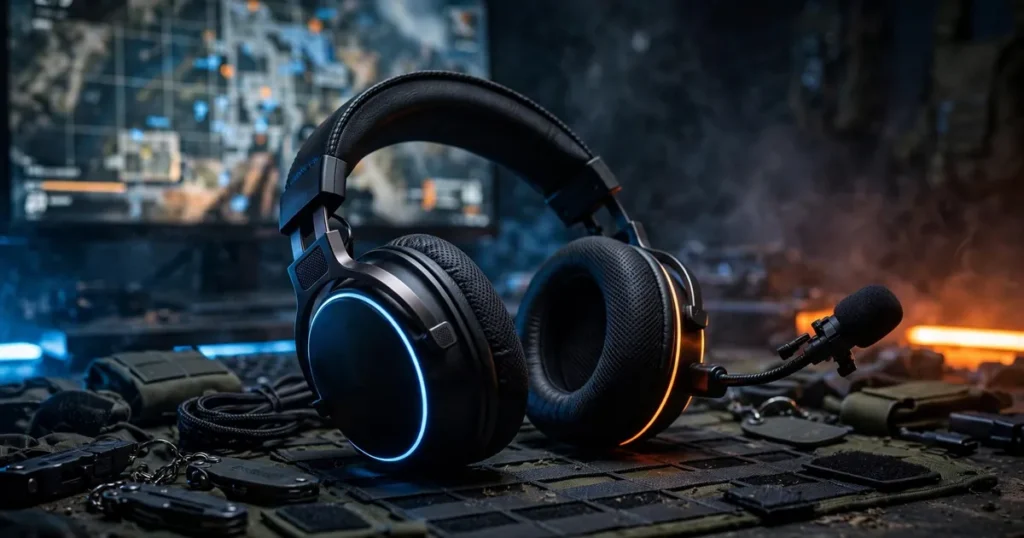
Rainbow Six Siege is one of the most audio-dependent shooters ever made. Ubisoft’s sound propagation system models how noise reflects off walls, diffracts around corners, and gets muffled through barricades — which means a footstep above you, a defuser plant behind a soft wall, or a breaching charge on the floor below all arrive as genuinely directional cues. In our research, the players who consistently win gunfights they “shouldn’t” win almost always credit the same thing: a headset that images well enough to turn those cues into information.
This guide ranks the best headsets for Rainbow Six Siege for 2026, based on our research into specifications, competitive-player feedback, and how each headset maps to what Siege demands: precise imaging, clear callout mics, and comfort that survives long ranked sessions.
Best Headsets for Rainbow Six Siege: Quick Comparison
| Headset | Driver | Connection | Mic | Surround |
|---|---|---|---|---|
| SteelSeries Arctis Nova Pro Wireless Best overall | 40mm dynamic | 2.4GHz wireless, Bluetooth, USB wired | Retractable ClearCast Gen 2 | 360° spatial audio (Sonar) |
| Audeze Maxwell Best planar audio | 90mm planar magnetic | 2.4GHz wireless, Bluetooth 5.1, USB-C/3.5mm wired | Detachable boom, AI noise filtering | Dolby Atmos license included |
| HyperX Cloud III Best wired mid-range | 53mm angled dynamic | Wired (USB-C, USB-A, 3.5mm) | Detachable 10mm noise-cancelling | DTS Headphone:X |
| Razer BlackShark V2 Pro (2023) Best for esports | 50mm TriForce Titanium | 2.4GHz wireless, Bluetooth 5.2 | Detachable HyperClear Super Wideband | THX Spatial Audio |
| beyerdynamic MMX 300 PRO Best audiophile wired | STELLAR.45 dynamic | Wired (3.5mm) | Condenser boom | Stereo (positional tuning) |
| EPOS | Sennheiser GSP 600 Best wired tank | Dynamic, 28Ω | Wired (3.5mm, exchangeable cables) | Noise-cancelling broadcast mic | Stereo (positional tuning) |
| Logitech G Astro A10 Gen 2 Best budget | 32mm dynamic | Wired (3.5mm, detachable cable) | Flip-to-mute boom | Stereo |
What Actually Matters in a Siege Headset
Headset marketing talks about explosions. Siege rewards the opposite. Here’s what to prioritize, in order.
Imaging and soundstage
Imaging is the ability to place a sound precisely in space — is that footstep above, below, or behind the wall to your left? Soundstage is the perceived width and depth of that space. Siege’s audio engine already produces genuinely positional stereo, so you want drivers and tuning that preserve separation in the midrange and treble where footsteps, reloads, and gadget beeps live. Bloated bass masks exactly the cues you need.
Microphone clarity for callouts
Your teammates need to hear “one pushing blue stairs” without also hearing your keyboard, fan, and roommate. Noise-rejecting boom mics separate the contenders from the pretenders — mic quality matters as much as audio quality here.
Comfort for long sessions
Ranked queues and scrims run for hours. Clamp force, earcup depth, and weight decide whether a headset disappears on your head or distracts you by round five.
Wired vs. wireless
Modern 2.4GHz wireless adds no perceptible delay, so wireless is no longer the handicap it once was — provided the battery won’t die mid-match. Wired still wins on simplicity and cost; if you go wireless, look for long battery life or hot-swap batteries.
1. SteelSeries Arctis Nova Pro Wireless — Best Overall for Rainbow Six Siege

| Imaging & Detail | 9.6 |
| Mic Clarity | 9.4 |
| Comfort | 9.2 |
| Features (ANC, 360 audio) | 9.5 |
| Value | 8.2 |
The SteelSeries Arctis Nova Pro Wireless is our top pick because it nails every Siege priority at once. Its 40mm drivers are tuned for clarity over bass bloat, and 360-degree spatial audio (via SteelSeries’ Sonar software on PC) layers useful directionality over Siege’s already-positional mix — footsteps, defuser plants, and breach cues stay separated instead of smearing together.
The retractable ClearCast Gen 2 mic is one of the best noise-rejecting mics on a wireless headset — vital when callouts must cut through a noisy room. Hybrid ANC on the earcups blocks household distractions, with transparency mode for awareness. The hot-swap dual battery system means a dead battery never ends a ranked session. Multi-system support (PC, PlayStation, Switch, mobile) makes it a one-headset solution.
Key specs: 40mm dynamic drivers · 2.4GHz wireless + Bluetooth + USB wired · Hybrid ANC with transparency · Retractable ClearCast Gen 2 mic · Hot-swap dual batteries · Sonar software with 360° spatial audio
Pros: reference-grade imaging for footsteps and gadgets; superb noise-rejecting mic; ANC keeps you focused; battery swap ends charging anxiety.
Cons: premium pricing; the full feature set (Sonar EQ, spatial audio) is PC-centric.
2. Audeze Maxwell — Best Planar Audio for Siege

| Imaging & Detail | 9.7 |
| Mic Clarity | 9.5 |
| Comfort | 8.6 |
| Battery Life | 9.4 |
| Value | 8.0 |
If pure audio fidelity is your priority, the Audeze Maxwell is in a class of its own. Its 90mm planar magnetic drivers — roughly three times the area of typical gaming headset drivers — render Siege’s subtle cues (a rappel rope, a drone above) unmistakable. Planar speed keeps transients crisp when rounds get loud, so gunfire doesn’t swallow the footstep you need to hear next.
The detachable boom mic, designed in collaboration with Shure, pairs with AI noise filtering for broadcast-clean callouts. Battery life is a standout: 80+ hours of low-latency wireless, plus Bluetooth and wired USB-C/3.5mm options, with a free Dolby Atmos license included. The tradeoff is weight — around 490g, so heft-sensitive players should take note.
Key specs: 90mm planar magnetic drivers · 2.4GHz wireless + Bluetooth 5.1 + USB-C/3.5mm wired · 80+ hour battery · Detachable boom mic with AI noise filtering · Dolby Atmos license included · ~490g
Pros: unmatched detail and positional accuracy; elite mic with AI filtering; enormous battery; versatile connectivity.
Cons: heavy at ~490g; premium price.
3. HyperX Cloud III — Best Wired Mid-Range Pick

| Imaging & Detail | 8.8 |
| Mic Clarity | 8.8 |
| Comfort | 9.4 |
| Build Quality | 9.0 |
| Value | 9.0 |
The HyperX Cloud III is the wired sweet spot: angled 53mm drivers, DTS Headphone:X spatial audio, and legendary Cloud comfort, without flagship cost or wireless complexity. The angled drivers aim sound more naturally into the ear, which helps front-back localization — the axis that trips up most players in Siege’s vertical maps.
The detachable 10mm noise-cancelling mic captures clean voice and includes an LED mute indicator. HyperX’s signature memory foam and aluminum frame make it one of the most comfortable headsets here for marathon sessions, and triple connectivity (USB-C, USB-A, 3.5mm) covers PC, console, and phone with zero fuss.
Key specs: 53mm angled dynamic drivers · Wired via USB-C, USB-A, and 3.5mm · DTS Headphone:X spatial audio · Detachable 10mm noise-cancelling mic with LED mute indicator · Memory foam earcups, aluminum frame · 308g
Pros: excellent comfort for long sessions; clean, balanced tuning for cues; versatile connectivity; strong value.
Cons: no wireless option; DTS spatial processing is PC-dependent.
4. Razer BlackShark V2 Pro (2023) — Best for Esports Players

| Imaging & Detail | 9.2 |
| Mic Clarity | 9.3 |
| Comfort | 8.8 |
| Battery Life | 9.3 |
| Value | 8.4 |
Designed with esports pro input, the Razer BlackShark V2 Pro (2023) is built for information-dense FPS audio. Its 50mm TriForce Titanium drivers split highs, mids, and lows into individually tuned chambers, keeping footstep frequencies distinct from explosions. THX Spatial Audio widens the soundstage, and Razer’s pro-tuned FPS EQ profiles emphasize exactly the frequencies competitive players listen for.
The detachable HyperClear Super Wideband mic is a standout — wideband capture keeps callouts natural instead of tinny. Up to 70 hours of battery over low-latency 2.4GHz wireless (plus Bluetooth 5.2) survives a full tournament weekend. At 320g it’s reasonably light for a wireless flagship, with breathable memory foam for overtime comfort.
Key specs: 50mm TriForce Titanium drivers · 2.4GHz wireless + Bluetooth 5.2 · THX Spatial Audio with pro-tuned FPS EQ profiles · Detachable HyperClear Super Wideband mic · Up to 70-hour battery · 320g
Pros: esports-tuned driver design and EQ; excellent wideband mic; huge battery; strong positional audio.
Cons: no 3.5mm wired fallback on this revision; THX features are software-dependent.
5. beyerdynamic MMX 300 PRO — Best Audiophile Wired Headset

| Imaging & Detail | 9.4 |
| Mic Clarity | 9.0 |
| Comfort | 8.8 |
| Build Quality | 9.2 |
| Value | 8.0 |
For players who want studio-grade sound, the beyerdynamic MMX 300 PRO brings beyerdynamic’s German-engineered driver expertise to a pure wired gaming headset. The STELLAR.45 driver delivers the balanced, detailed presentation the brand is known for — refined treble and mids, exactly where Siege hides its critical cues. Localization is accurate rather than exaggerated, rewarding players who’ve learned to read the game’s audio.
The condenser boom mic offers excellent speech intelligibility with a wide, natural response. Handmade in Germany with replaceable ear pads, headband, and cable, it’s built to be serviced rather than replaced. As a pure analog wired headset it rewards a decent source — our headphone amp guide covers pairings if your motherboard audio is weak.
Key specs: STELLAR.45 dynamic driver · Closed-back wired design · Condenser boom microphone · Replaceable pads, headband, and cable · Handmade in Germany
Pros: refined, accurate imaging; superb condenser mic; serviceable, long-life build.
Cons: no surround processing built in; benefits from a good source/amp.
6. EPOS | Sennheiser GSP 600 — Best Wired Tank

| Imaging & Detail | 8.6 |
| Mic Clarity | 9.0 |
| Comfort | 8.4 |
| Build Quality | 9.1 |
| Value | 8.2 |
The EPOS | Sennheiser GSP 600 is the old soldier of competitive headsets: a closed-back wired design with warm, controlled tuning that keeps midrange detail forward without fatiguing treble. Its noise-cancelling broadcast-quality mic remains one of the clearest in this class, and the adjustable headband dials in contact pressure — a small feature that matters across long sessions.
Exchangeable cables (dedicated PC and console cables included) keep it versatile, and the metal hinge system has a reputation for surviving years of daily use. One honest note: the GSP 600 is an older model and its Amazon listing was unavailable when we checked, so the button below goes to a tagged Amazon search — availability may vary.
Key specs: Dynamic drivers, 28Ω impedance · Wired with exchangeable PC/console cables · Noise-cancelling broadcast-quality mic · Adjustable contact-pressure headband · Closed acoustic design
Pros: excellent broadcast mic; tank-like build; comfortable adjustable fit; proven competitive pedigree.
Cons: older model with spotty availability; heavier tuning than the imaging-first picks above.
7. Logitech G Astro A10 Gen 2 — Best Budget Headset for Siege

| Imaging & Detail | 7.8 |
| Mic Clarity | 8.4 |
| Comfort | 8.2 |
| Build Quality | 8.8 |
| Value | 9.2 |
You don’t need flagship money to hear Siege properly. The Logitech G Astro A10 Gen 2 is the budget pick we’d recommend to a new ranked player: 32mm custom-tuned drivers with a clean, un-hyped presentation, a flip-to-mute boom mic, and a durable closed-back build with replaceable cushions. A simple 3.5mm wired connection means zero latency across PC, PlayStation, Xbox, and Switch.
It won’t resolve audio with flagship finesse — expect solid left-right imaging rather than surgical verticality — but for learning Siege’s audio language it’s more than enough. The HyperX Cloud III above is the natural upgrade path.
Key specs: 32mm dynamic drivers · Wired 3.5mm with detachable cable · Flip-to-mute boom mic · Closed-back, replaceable cushions · Inline volume control · Cross-platform (PC, PS5/PS4, Xbox, Switch, Mac)
Pros: outstanding value; durable, simple, zero-latency wired design; works with everything.
Cons: imaging is good, not elite; no surround processing; plastic build.
Buying Guide: Getting the Most From Your Siege Audio
Wired vs. wireless, settled
Modern 2.4GHz wireless adds no perceptible delay, so the Nova Pro Wireless, Maxwell, and BlackShark V2 Pro are all fully competitive. Choose wired for simplicity and value; choose wireless for freedom of movement. Avoid Bluetooth-only for ranked play — its latency is noticeably higher.
Surround processing: helpful, not mandatory
Siege’s native stereo mix is already genuinely positional, so a great stereo headset can outperform a mediocre “surround” one. Virtual surround (DTS Headphone:X, THX Spatial, Dolby Atmos) can widen the stage and help vertical cues — treat it as a bonus on top of good drivers, not a substitute.
EQ tips for footsteps
Most competitive players slightly cut sub-bass and boost the upper-midrange/treble where footsteps and gadgets live. Start with your software’s FPS preset and adjust to taste — and keep volumes moderate. Louder isn’t clearer; distortion destroys the fine detail you’re listening for.
Platform notes
On PC you get the full feature set: Sonar, THX, DTS, custom EQ. PlayStation 5’s Tempest 3D Audio adds spatial processing for any stereo headset; Xbox supports Dolby Atmos and DTS:X for Headphones via apps. All seven picks work across PC and current consoles — check each listing for the exact cable or dongle your platform needs.
If you’re also curious about in-ear options for competitive play, see our best IEMs for gaming guide, and for a broader look beyond Siege, our best gaming headsets under 400 roundup covers more genres and budgets. For players comparing over-ear philosophies, our open-back vs. closed-back explainer is worth a read, and if you’re weighing a headset against headphones plus a standalone mic, see headset vs. headphones.
Frequently Asked Questions
Do I need surround sound for Rainbow Six Siege?
Not strictly. Siege’s audio engine produces genuinely positional stereo, so imaging quality matters more than any surround label. Virtual surround (DTS Headphone:X, THX Spatial, Dolby Atmos) can help with vertical and rear cues, but a great stereo headset beats a mediocre surround one. Prioritize driver clarity and tuning first.
Is wired or wireless better for Rainbow Six Siege?
Both are viable. Modern 2.4GHz wireless has effectively no perceptible latency, making headsets like the Arctis Nova Pro Wireless and BlackShark V2 Pro fully competitive. Wired wins on simplicity, cost, and zero battery anxiety. Avoid Bluetooth-only connections for ranked play due to higher latency.
Are noise-cancelling headsets good for Siege?
Yes, with a caveat. ANC on the earcups (like the Arctis Nova Pro Wireless) helps you focus by removing household noise — it doesn’t affect in-game audio positioning. What matters more is mic-side noise rejection so your callouts stay clean. See our gaming noise-cancelling headphones guide for more ANC options.
What EQ settings help hear footsteps in Siege?
Competitive players typically reduce sub-bass slightly and lift the upper mids and treble where footsteps, reloads, and gadget sounds sit. Start with your headset software’s FPS preset, then fine-tune. Keep overall volume moderate — distortion at high volume masks the fine detail you’re trying to hear.
Can I use earbuds or IEMs instead of a headset for Siege?
You can, and some competitive players prefer IEMs for their detail and isolation — but you’ll need a separate microphone for team comms, since most IEMs lack a proper boom mic. Our best IEMs for gaming guide covers the top options if you want to go that route.
Which headset do Siege pros use?
Pro players use a variety of headsets, and sponsorships heavily influence what you see on stage. What matters more than any pro’s logo is matching the headset to your needs: imaging for cues, a noise-rejecting mic for callouts, and comfort for long sessions. Any of the seven picks in this guide covers those bases — SteelSeries fans can also check our best SteelSeries headsets roundup.
Our Verdict
The SteelSeries Arctis Nova Pro Wireless is our overall pick: elite imaging, a superb noise-rejecting mic, ANC focus, and a battery system that never interrupts a session. If audio fidelity is everything, the Audeze Maxwell‘s planar drivers are unmatched. The HyperX Cloud III is the wired value sweet spot, the BlackShark V2 Pro is the esports-tuned wireless option, the MMX 300 PRO serves audiophile purists, the GSP 600 remains a wired tank (check availability), and the Astro A10 Gen 2 proves you can hear Siege properly on a budget.
Whichever you choose, remember the real upgrade is learning to read the game’s audio: play a few rounds focused only on sound, and you’ll start winning fights you used to lose.

I am the founder of Sound Mavericks, where I provide the polite truth about audio equipment. I started this site because consumer electronics reviews are often too technical. Instead of using a silent lab, I test headphones, earbuds, and Bluetooth speakers in the real world – like on a noisy subway or in a busy coffee shop.
To stay independent, I buy my own review units (mostly from the United States) rather than accepting free gifts from brands. Once I finish testing a product, I sell it locally to our community. My goal is to help you understand sound quality, active noise cancellation (ANC), and battery life without the marketing hype.