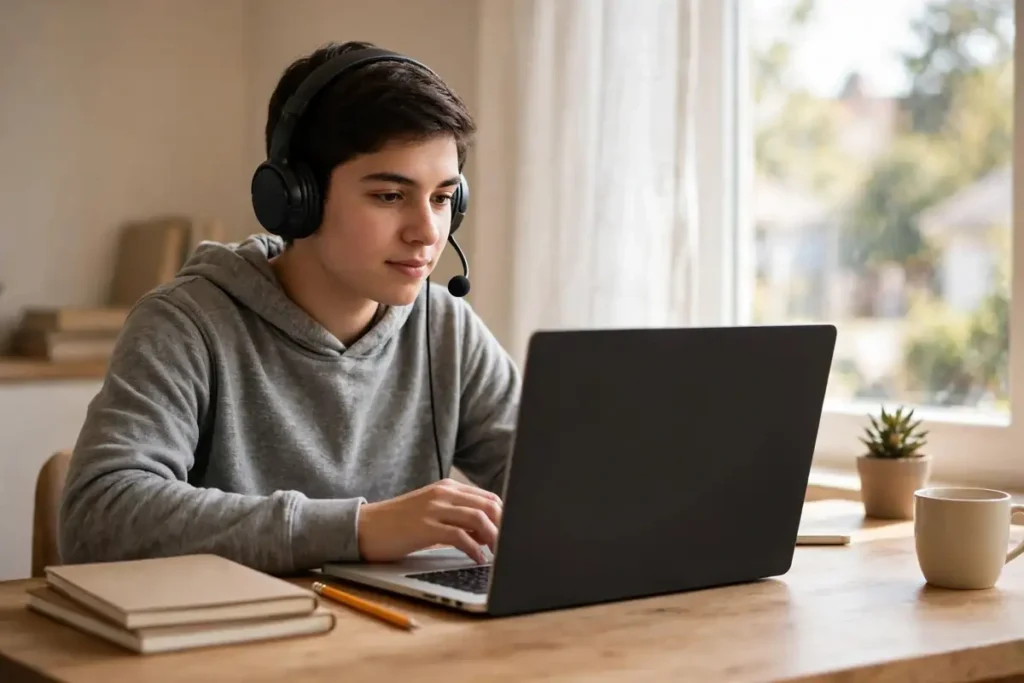
Choosing the best headphones for online classes is not really about music. It is about whether a teacher can hear your child answer a question the first time, whether a headset still feels comfortable in the third hour of lectures, and whether it survives being stuffed into a school bag five days a week. A great gaming or music headphone can fail all three tests, which is why this guide is built around virtual learning — from kids in virtual school on a school-issued Chromebook to college students splitting time between seminars, lectures and study sessions.
SoundMavericks ranked these six headsets on what decides a school day: microphone clarity for class participation, all-day comfort, durability, compatibility with Chromebooks and laptops, and — for younger learners — proper volume limiting. Every pick is a research-based editorial selection built from manufacturer specifications and verified listings, matched to a specific age group and learning setup.
Our Top Picks at a Glance
Best overall for online classes: Logitech H390 — plug-and-play USB with a noise-cancelling boom mic that works on almost any school laptop or Chromebook.
Best for young kids: Puro Sound Labs BT2200s Plus — volume limited to a safe 85dB, with a built-in mic and a wired backup mode.
Best wireless for teens and college: Sony WH-CH520 — up to 50 hours of battery and multipoint Bluetooth for long lecture days.
Best Headphones for Online Classes Compared
Here is how the six picks stack up on connection, microphone style and the job each does best. If your learner’s school issued a specific device, check the connection column first — it is the fastest way to rule out a headset that will not plug in.
| Headset | Best For | Connection | Microphone | Key Strength | Check Price |
|---|---|---|---|---|---|
| Logitech H390 | Best overall | Wired USB-A | Rotating boom, noise-cancelling | Plug-and-play on Chromebooks | Check Price |
| Logitech H111 | Best budget wired | Wired 3.5mm | Rotating boom, noise-cancelling | Works with almost any device | Check Price |
| Puro Sound Labs BT2200s Plus | Best for young kids | Bluetooth + wired | Built-in | 85dB volume limiting | Check Price |
| iClever BTH20 | Best wireless for kids | Bluetooth + wired | Built-in | Switchable 85dB / 94dB limits | Check Price |
| Sony WH-CH520 | Best for teens & college | Bluetooth, multipoint | Built-in, noise reduction | Up to 50-hour battery | Check Price |
| Soundcore Life Q30 | Best for noisy homes | Bluetooth + 3.5mm wired | Built-in | Hybrid active noise cancelling | Check Price |
What Matters Most in Headphones for Virtual Learning
Microphone clarity comes first
In a physical classroom, a quiet answer still reaches the teacher. On a video call, a weak microphone turns that same answer into “sorry, can you repeat that?” — and shy students quickly stop volunteering. A boom microphone near the mouth, like the ones on the two Logitech picks, captures voice far more reliably than a laptop mic across a desk, and noise-cancelling mic processing cuts out siblings, pets and kitchen noise behind the speaker. Built-in mics on wireless headphones suit older students in quieter rooms, but for younger children who mumble or turn away from the screen, a boom mic is the single biggest upgrade you can buy.
Comfort for a full school day
Virtual learners wear headphones far longer than most adults wear them for music. Padded, adjustable headbands, swivelling ear cups and low weight matter more than driver size. On-ear designs run cooler and suit shorter class blocks; over-ear designs spread pressure better for older students in back-to-back lectures. If a headset hurts after forty minutes, concentration goes with it — fit is a learning feature.
Durability for bags, desks and drops
School headphones live a hard life: tossed in backpacks, dropped on floors, sat on, and yanked by the cable. Flexible headbands, reinforced cables and fold-flat ear cups survive that treatment far better than delicate designs. Wired models have a hidden durability advantage too — no battery to wear out mid-year.
Chromebook and laptop compatibility
Most school-issued devices are Chromebooks, and the safest connections are the simplest. USB-A and 3.5mm headsets are recognised instantly by Chrome OS — no drivers, no pairing, no permissions — exactly what a school IT department wants. Bluetooth works well on personal laptops and tablets, but some schools restrict pairing on managed devices, so check the school’s policy before buying a wireless-only headset for a school-issued machine.
Volume limiting for younger kids
Children cannot judge safe listening levels, and a volume limiter set at 85dB is the widely recommended ceiling for young ears. Both kids’ picks build that limit into the hardware rather than relying on a settings menu a child can change. Our guide to kids’ headphones goes deeper on safe listening for the youngest learners.
1. Logitech H390 — Best Overall Headset for Online Classes

The Logitech H390 is the headset schools and families keep coming back to, for a simple reason: it removes every point of failure. Plug the USB-A connector into a Chromebook, Windows laptop or Mac and it works — no drivers, no pairing, no battery to charge the night before. For a student logging in five minutes before the bell, that reliability beats any premium feature.
The rotating boom microphone is the star. It is noise-cancelling, so the class hears the student’s voice rather than the television in the next room, and it tucks up out of the way during listening-only lessons. Voice capture is clear and forward in a way built-in headphone mics rarely match, making this our top recommendation for class participation, oral exams, language lessons and presentations. In-line controls on the generous 1.9-metre cable handle volume and mute without hunting through software menus — a small detail younger students genuinely benefit from.
Comfort is built for long sessions: a padded headband and swivelling leatherette ear cushions that wipe clean easily — parents of younger kids will appreciate that. The honest trade-offs are that it is wired only, and the USB-A plug needs an adapter on the newest USB-C-only laptops. If your learner’s main machine has a USB-A port — most school Chromebooks still do — this is the default buy. We cover the design in more depth in our Logitech H390 review.
2. Logitech H111 — Best Budget Wired Headset for Chromebooks

If the H390 is the default, the Logitech H111 is the smart budget alternative — and in one way it is even more versatile. Its standard 3.5mm plug works with virtually everything a student might use: Chromebooks, older laptops, tablets and phones. That makes it an excellent spare, a classroom-set candidate for schools buying in quantity, and the safest gift when you do not know which device it will be used with.
You still get a proper rotating boom microphone with noise cancelling, wearable on the left or right side — genuinely useful for left-handed students. The mic tucks away when not needed, the headband adjusts across a wide range of head sizes, and foam ear cushions keep the lightweight frame comfortable through a normal school day.
Where the H111 gives ground to the H390 is in polish: the fit feels more basic, the cable is slightly shorter at 1.8 metres, and a 3.5mm connection passes through the device’s own audio hardware, so sound quality depends a little more on the laptop. None of that stops it doing its actual job — clear voice, clear teacher audio, zero setup — extremely well.
3. Puro Sound Labs BT2200s Plus — Best for Young Kids

For younger children, the buying priorities flip: hearing safety and simplicity matter more than features. The Puro Sound Labs BT2200s Plus is volume limited to a maximum of 85dB — the level widely recommended as safe for young ears — built into the headphones, not buried in an app a child can override. Parents never have to police the volume slider, and kids still hear lessons clearly at sensible levels.
Unlike many kids’ headphones that are listening-only toys, the BT2200s Plus includes a built-in microphone, so your child can answer questions, read aloud and join discussions — the whole point of a class headset. It connects over Bluetooth for tidy, cable-free desks, and also works wired with the included cable — the mode to use on school Chromebooks that restrict Bluetooth, or when the battery runs flat before class. A daisy-chain sharing port even lets a sibling or parent listen in on the same device, handy for homework help.
The build is sized and padded for smaller heads, folds for storage, and shrugs off the drops and bag-tossing of daily school life better than adult headphones resized as an afterthought. It will not satisfy an older teen — the fit and styling are unmistakably for kids — but for the elementary years, it is the most complete learning headphone in this guide.
4. iClever BTH20 — Best Wireless Headphones for Kids

The iClever BTH20 takes a cleverer approach to volume safety: switchable limiting modes. An 85dB mode protects younger children during lessons, while a 94dB mode gives older kids more headroom in noisier environments such as a busy kitchen-table classroom — with the parent, not the child, choosing the mode. That flexibility lets one headset span several school years instead of being outgrown in one.
It is a genuinely practical class headphone beyond the limiter. The built-in microphone handles class answers and group projects clearly, Bluetooth removes the cable that younger kids inevitably twist or catch on chair arms, and a wired mode is there as backup for school devices and flat-battery mornings. Battery life covers days of classes between charges rather than needing a nightly top-up routine.
Comfort and durability are where the BTH20 earns its place: soft cushioned ear cups, an adjustable headband sized for kids, and a foldable design that travels between home, school and grandparents’ houses without drama. If you want wireless freedom for a child but are not ready to hand them adult headphones with unlimited volume, this is the balanced middle ground.
5. Sony WH-CH520 — Best Wireless Headphones for Teens and College Students

Older students have a different problem: not one class, but a whole day blending live seminars, recorded lectures, library study and music between sessions. The Sony WH-CH520 fits that rhythm beautifully. Its battery runs up to 50 hours, so charging becomes a weekly habit instead of a daily chore, and a three-minute quick charge adds around an hour and a half of playback — enough to rescue a forgotten charge before a morning lecture.
Multipoint Bluetooth is the feature students end up loving most: stay connected to a laptop for class and a phone at the same time, switching between them without re-pairing. The built-in microphone uses noise reduction to keep voice clear for seminar participation and group-project calls, and at roughly 147 grams with soft on-ear cushions, it stays comfortable through long study blocks. Sony’s app EQ and DSEE upscaling also make it the most enjoyable pick here for music once the school day ends, and the ear cups swivel flat so it slips into a bag without bulk.
Two honest caveats. There is no wired connection and no active noise cancelling, so it relies on your laptop or tablet allowing Bluetooth — fine for personal devices and most college setups, but check before buying for a locked-down school Chromebook. And in a genuinely noisy house, the noise-cancelling pick below helps concentration more.
6. Soundcore Life Q30 — Best for Noisy Homes and Focused Study

Some students do not get a quiet room. They get a shared bedroom, a parent working in the next seat and a sibling in a class of their own. For them, the Soundcore Life Q30 and its hybrid active noise cancelling is the difference between hearing the teacher and hearing the household. Three ANC modes — Transport, Outdoor and Indoor — tune the cancelling to the environment, and the Indoor mode is aimed at exactly the voices-and-activity hum of a busy home.
The over-ear design with cushioned cups suits long lectures and revision sessions, and the 40mm drivers deliver clear, detailed speech as well as strong music playback for study playlists. Battery life runs up to 50 hours in noise-cancelling mode, multipoint Bluetooth connects two devices at once, and the Soundcore app’s custom EQ lets older students tame the bass-heavy default tuning toward clearer voices. A built-in microphone covers class participation, though like most wireless over-ears it will not match a boom mic for absolute voice clarity.
Crucially for school use, the Q30 also works wired via 3.5mm — plugging into a Chromebook or exam laptop when Bluetooth is off the table, though noise cancelling only works in wireless mode. Students whose main challenge is focus in a distracting home may also want our guide to the best noise-cancelling headphones for studying, which goes deeper on concentration-focused picks.
Wired vs Wireless Headphones for Online Classes: Which Should You Choose?
This is the decision that matters most, and the right answer depends on age more than budget. For elementary and middle-school students on school-issued Chromebooks, we recommend wired first. A USB or 3.5mm headset never needs charging before class, cannot fail to pair, and is the connection schools officially support. The cable is a feature at this age: it keeps the headset attached to the learning device instead of migrating around the house.
Wireless earns its place for older students and home-based learners. High-schoolers and college students move between rooms, devices and study spaces, join calls from phones as well as laptops, and wear headphones for music far beyond class hours. For them, long battery life and multipoint Bluetooth remove real friction. The sensible compromise — and the reason several picks above offer both — is a wireless headset with a wired backup mode, which covers school restrictions and flat batteries in one purchase. Whichever you choose, buy for the device your learner actually logs into class from. And if the headset is also a gift, our roundup of headphone gifts for students has more ideas by age and budget.
Frequently Asked Questions
What are the best headphones for online classes?
The best headphones for online classes combine a clear microphone, all-day comfort and a connection your school device supports. The Logitech H390 is our best overall pick for its plug-and-play USB connection and noise-cancelling boom mic, while younger kids are better served by a volume-limited model such as the Puro Sound Labs BT2200s Plus.
Do students need a headset with a microphone for virtual learning?
Yes, if they are expected to participate. A headset microphone — especially a boom mic positioned near the mouth — captures a student’s voice far more clearly than a laptop’s built-in mic, which also picks up keyboard noise, echo and household sounds. Listening-only headphones are fine for recorded lessons, but live classes, language work and presentations all go better with a proper mic.
Are wired or wireless headphones better for school Chromebooks?
Wired headsets are usually better for school-issued Chromebooks. USB-A and 3.5mm models like the Logitech H390 and H111 work instantly with no pairing, charging or permissions, and many schools restrict Bluetooth on managed devices. Wireless models suit personal laptops and tablets, and several picks in this guide offer a wired backup mode for school use.
What volume limit is safe for kids in online classes?
A maximum of 85dB is the widely recommended safe listening level for children. Hardware-limited headphones such as the Puro BT2200s Plus enforce that ceiling automatically, while the iClever BTH20 adds a switchable 94dB mode for older kids in noisier settings. Hardware limiting is safer than app or device settings because a child cannot accidentally override it.
Do online class headphones need noise cancelling?
Not for most students. A noise-cancelling microphone — which cleans up the voice the class hears — matters more than active noise cancelling, which only affects what the wearer hears. ANC becomes genuinely valuable when a student learns in a noisy home or studies in busy shared spaces, which is where a model like the Soundcore Life Q30 earns its place.
The Bottom Line
Match the headset to the learner. For most students, the Logitech H390’s boom mic and plug-and-play USB connection solve online classes outright. Younger kids should start with volume-limited protection from Puro or iClever, teens and college students will live in the Sony WH-CH520’s battery life and multipoint freedom, and anyone learning in a noisy home should step up to the Soundcore Life Q30’s noise cancelling. Buy the connection your school device supports, prioritise the microphone, and the school day takes care of itself.

I am the founder of Sound Mavericks, where I provide the polite truth about audio equipment. I started this site because consumer electronics reviews are often too technical. Instead of using a silent lab, I test headphones, earbuds, and Bluetooth speakers in the real world – like on a noisy subway or in a busy coffee shop.
To stay independent, I buy my own review units (mostly from the United States) rather than accepting free gifts from brands. Once I finish testing a product, I sell it locally to our community. My goal is to help you understand sound quality, active noise cancellation (ANC), and battery life without the marketing hype.