
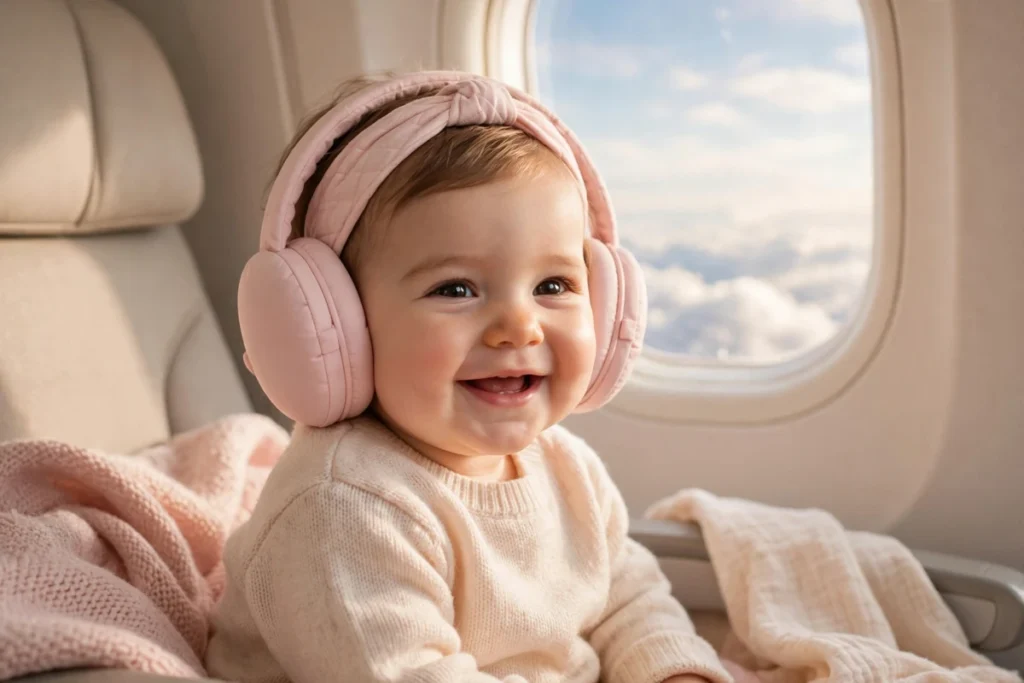
Flying with a baby for the first time? The headphones question is usually the first one parents ask — and it hides a trap. Most products sold as “baby headphones for planes” are not headphones at all. They are ear defenders: padded ear muffs with no speakers, no Bluetooth and no sound of their own. That is deliberate, and for a baby it is exactly right. Infants should not be listening through in-ear or over-ear music headphones. What they need on a plane is less noise reaching small, developing ears — and that is a different product, bought for different reasons.
This guide keeps that distinction crisp: our top ear-muff picks, what the noise and pressure science actually says (including one popular claim that is simply not true), how to fit muffs so a baby will tolerate them, and — in a clearly separate section — the volume-limited headphones that only become appropriate for an older toddler who watches a tablet on flights.
Our Verdict: The Best Picks at a Glance
Best overall for babies: the Alpine Muffy Baby Comfort — a soft fabric headband that avoids pressure on the fontanelle, certified noise reduction, and a fit that works from around 3 months up to 4 years.
Best classic muff: the BANZ Baby Earmuffs — the long-established rigid-band design with plush cups, sized for ages 0–2+ years.
Best value first pair: the Mumba Baby Earmuffs — lightweight, compact and easy to pack for ages 3–24+ months.
Ear Defenders vs Headphones: The Distinction That Matters
Everything in the main part of this guide is an ear defender. It plays nothing. Two foam-lined cups seal gently around your baby’s ears and physically block part of the sound before it arrives — the same principle as the ear muffs worn on building sites, scaled down, softened and lightened for a tiny head. There are no drivers, no volume knob and nothing entering the ear canal.
Music headphones are the opposite: they exist to deliver sound, directly at the ear. For babies, that is the problem, not the solution. A baby cannot tell you the volume is too loud, cannot reliably keep a headset positioned safely, and gains nothing from in-flight audio anyway. That is why no product in our main picks makes sound, and why the tablet-headphone section further down is labelled for older toddlers only. If a listing aimed at newborns promises Bluetooth, speakers or “soothing music” for a baby under two, treat that as a reason to walk away, not a feature. Our broader guide to kids’ headphones covers the age-by-age picture in more depth.
Why Do Babies Need Ear Protection on Planes?
How loud is a plane cabin for a baby?
An airliner cabin is a genuinely loud environment. Cruise noise typically sits around 75–80 dB, and take-off and climb can push higher, into the mid-80s dB near the engines and rear rows. Adults experience that as tiring background drone. For a baby, whose ear canals are smaller and whose hearing is still developing, sustained noise at that level is worth reducing — and the peaks matter too: a startled, overstimulated baby who cannot settle or sleep is the reality most parents are actually trying to avoid. Ear defenders do not silence the cabin. A well-fitted pair takes the edge off — typically in the region of 20–25 dB of reduction — which turns a harsh roar into a much softer wash of sound that many babies will nap through.
What about ear pressure on take-off and landing?
Here is where we need to be straight with you, because a lot of product marketing is not. Ear muffs do not equalise ear pressure. The discomfort babies feel during descent comes from pressure differences across the eardrum as the cabin pressure changes, and no external muff can change the pressure inside your baby’s middle ear. What actually helps is swallowing: feeding, a bottle, a pacifier or small sips of water during descent encourage the swallowing that opens the Eustachian tubes and balances pressure naturally. Time feeds for descent where you can, and keep a pacifier handy for the last 30 minutes of the flight.
So why wear muffs at all during take-off and landing? Because those are also the loudest phases of the flight, and because a calmer baby feeds and settles more easily. Noise reduction and pressure relief are two separate jobs on a flight — muffs handle the first, feeding handles the second. For the fuller background, see our explainer on whether babies need noise cancelling headphones on planes.
The Best Baby Ear Muffs for Flights, Compared
| Product | Age range | Rating | Headband style | Check price |
|---|---|---|---|---|
| Alpine Muffy Baby Comfort | 3–48 months | 24 dB reduction (CE & ANSI certified) | Soft fabric band, Velcro adjust | Check Price |
| BANZ Baby Earmuffs | 0–2+ years | NRR 21 dB (US rating) | Classic padded band | Check Price |
| Mumba Baby Earmuffs | 3–24+ months | SNR 26 dB (manufacturer rating) | Padded band, folding cups | Check Price |
| BBTKCARE Baby Ear Protection | 3 months–3 years | CE & CPC certified | Padded arched band | Check Price |
Ratings note: SNR (European) and NRR (US) are measured under different test standards, so figures are not directly interchangeable between brands. Fit matters as much as the number — a muff that seals properly beats a higher-rated muff that gaps.
1. Alpine Muffy Baby Comfort — Best Overall for Babies on Planes
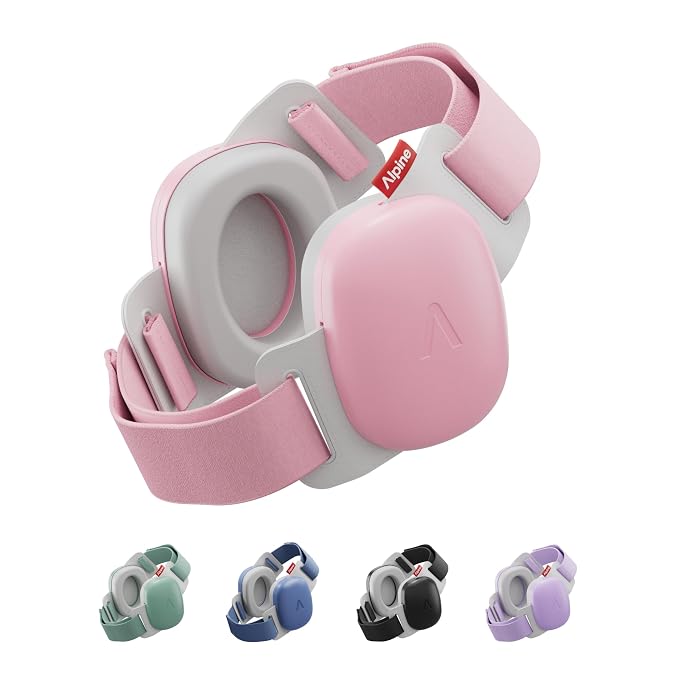
The Alpine Muffy Baby Comfort is the pick we would hand to a first-time flyer, and the design explains why. Instead of a rigid band pressing over the top of the skull, Alpine uses a soft, contoured fabric headband with a Velcro closure. That routes pressure around the head rather than onto the fontanelle — the soft spot that makes parents rightly nervous about conventional muffs on young babies. The cups come pre-attached (the older Classic version made you slide them on yourself), the whole thing weighs just 4.2 ounces, and the current Comfort model is rated by Alpine at 24 dB of noise reduction, up from 23 dB on the Classic, with CE and ANSI certification behind it.
The age range is the other headline: 3 to 48 months. Most baby muffs age out around the second birthday; this one realistically covers the entire baby-and-toddler flying window, so it is one purchase rather than two. The trade-offs are honest ones: the fabric band takes a little practice to fit the first time (do a trial run at home, ideally with two adults), and determined toddlers can still pull any muff off — no design fixes that. But for fit, certification and longevity in one package, nothing else in this guide matches it.
2. BANZ Baby Earmuffs — Best Classic Muff Design

If you prefer the traditional muff shape, the BANZ Baby Earmuffs (the Bubzee line) are the established name. BANZ has sold baby hearing protection for years, and this design pairs a padded, adjustable headband with generously cushioned cups that seal well on small heads. The US listing carries an NRR of 21 dB — a reminder that the conservative American rating often reads lower than European SNR figures for similar real-world performance, which is why fit and seal deserve as much attention as the headline number.
Sized for ages 0–2+ years, these suit younger babies particularly well and come in a wide spread of colours and prints. The classic band does pass over the crown of the head, so on the youngest newborns be extra careful about positioning and session length, and the design does not fold as flat as some rivals. As a proven, durable all-rounder, though, it earns its place.
3. Mumba Baby Earmuffs — Best Value First Pair

Not sure whether your baby will tolerate muffs at all? The Mumba Baby Earmuffs are the sensible first experiment. They are rated by the manufacturer at SNR 26 dB, use noise-dampening sponge inside solid ABS cups, and weigh only around 3.6 ounces — the lightest feel in this guide. The padded headband is designed to spread pressure rather than concentrate it, the cups fold into a compact shape for a changing bag, and the sizing covers 3 to 24+ months.
The honest caveats: this is not the pair for a true newborn (the range starts at 3 months), and the padding is a step below the premium picks. But as a flight-day tool that does the core job — taking the roar down so a baby can feed, settle and sleep — Mumba’s design brief is exactly right.
4. BBTKCARE Baby Ear Protection — Widest Toddler Fit

The BBTKCARE Baby Ear Protection muffs stretch the sizing furthest at the top end: the adjustable pin-and-band system is specified from 3 months to 3 years, making this a good option for a bigger toddler who has outgrown newborn-sized muffs but is not ready for kids’ models. The design uses an ergonomically padded, arched headband with soft, well-cushioned cups intended to seal without squeezing, and the muffs carry CE and CPC certification.
At around 7 ounces this is the heaviest option here — the flip side of that wider, sturdier fit. Think of BBTKCARE as the pick for the upper half of the age range: the 18-month to 3-year flyer who needs a muff that still fits properly and seals well.
How to Fit Baby Ear Muffs (and Get Through the Flight)
Fit decides everything. A muff works by sealing around the ear; hair, hat edges or a twisted band break the seal and quietly throw away much of the protection. Practise at home before the trip — several short, happy sessions with the muffs on beats one first attempt in a noisy departure hall. Position the cups fully over the ears, adjust the band so it is snug but never tight, and keep fabric-band models like the Alpine routed so they do not press on the fontanelle.
On the day: put the muffs on before boarding if your baby is noise-sensitive, or once seated as the cabin noise builds. Expect to re-seat them — babies grab, wriggle and nap against them. Take breaks during quiet cruise periods, and always supervise a sleeping baby wearing muffs. Pair them with a feed or pacifier for descent. Your own ears deserve a plan too — see our guide to the best noise cancelling headphones for airplanes and long flights.
What to Look for When Buying Baby Ear Protection for Flying
SNR and NRR ratings, explained simply
You will see two rating systems. NRR is the US standard; SNR is the European one. They are tested differently, and SNR figures usually read a few decibels higher for equivalent protection, so never compare an SNR number from one brand directly against an NRR number from another. For baby muffs, look for a published, certified rating in the low-to-mid 20s dB and recognised certification (CE, ANSI, CPC) rather than an unqualified “noise cancelling” badge — passive muffs do not cancel noise electronically at all, whatever the listing says.
Headband pressure and the fontanelle
For babies under about a year, how the muff is held on matters as much as how much noise it blocks. Soft fabric bands that wrap around the head avoid concentrated pressure on the soft spot; rigid bands should be padded, sit correctly and be used for sensible session lengths. Light weight helps too — every pick in this guide is under half a pound, and the lightest are close to a quarter of that.
Adjustability and growing room
Babies’ heads grow fast. Look for a genuinely adjustable band (Velcro or sliding pins), cups that can be repositioned, and an age range that will not expire before your next trip. If your baby is already 18 months old, prioritise the models sized to 3 or 4 years. And if you are comparing wider shortlists, our roundup of the best baby noise cancelling headphones covers more of the market beyond flying.
For Older Toddlers Only (2+): Volume-Limited Headphones for Tablets
This section is deliberately separate, because it answers a different question. Once a child is an older toddler — realistically two, and for most models three and up — watching a downloaded cartoon on a tablet becomes a legitimate flight survival tool, and that needs actual headphones. The non-negotiables at this age are a hard volume limit (85 dB is the widely used ceiling; some models default lower), over-ear cups sized for small heads, and a wired option for the seat-back screen or a tablet with a headphone jack. Never hand a toddler adult headphones, earbuds, or anything without a volume cap.
| Product | Volume limit | Connection | Battery | Check price |
|---|---|---|---|---|
| Puro Sound Labs BT2200 Plus | 85 dB limited | Bluetooth + wired cable | Up to 20 hours | Check Price |
| iClever BTH20 | 80 dBA safe-volume default | Bluetooth 5.4 + AUX cord | Up to 60 hours | Check Price |

The Puro Sound Labs BT2200 Plus is the specialist kids’-audio option: volume limited to 85 dB, Bluetooth with a wired cable in the box for seat-back systems, around 20 hours of battery, and a daisy-chain feature that lets two children share one tablet — genuinely useful with siblings.

The iClever BTH20 adds active noise cancellation to the formula, which lets the volume stay low even in a loud cabin — the safest listening is the quietest listening that still sounds clear. It defaults to an 80 dBA safe volume, runs for up to 60 hours, folds flat, and includes an AUX cord for wired use. It is sized for kids rather than toddlers at the smallest end, so treat it as a 3+ option in practice. Whichever you choose, download everything before you fly, charge the night before, and keep listening sessions broken up with breaks — the same common sense as screen time at home, at 38,000 feet. For the grown-up version of the same decision, see headphones vs earbuds on airplanes.
Frequently Asked Questions
Can babies wear headphones on a plane?
Babies can and should wear ear defenders — passive ear muffs — on a plane, but they should not wear music headphones. Muffs simply reduce the cabin noise reaching the ears and involve no sound being played. Music headphones, earbuds and in-ear products are not appropriate for infants; volume-limited over-ear headphones only become an option for older toddlers, from around age two to three.
Do baby ear muffs help with ear pressure when flying?
No — and be wary of any listing that claims otherwise. Ear muffs reduce noise; they cannot equalise the pressure across your baby’s eardrum during descent. What helps with pressure is swallowing, so feed, offer a bottle or use a pacifier during descent. Muffs still earn their place on take-off and landing because those are the loudest parts of the flight.
What age can a baby start wearing ear defenders?
It depends on the model’s sizing. Some, like the BANZ Baby Earmuffs, are sized from newborn (0 months); others start at 3 months, including the Alpine Muffy Baby Comfort, Mumba and BBTKCARE. Always follow the manufacturer’s age range, fit the band so it avoids pressure on the fontanelle, and supervise your baby while they are wearing them.
How many decibels do baby ear muffs block?
Certified baby ear muffs typically carry ratings in the low-to-mid 20s dB — for example 24 dB for the Alpine Muffy Baby Comfort, NRR 21 dB for the BANZ Baby Earmuffs under the US system, and SNR 26 dB for the Mumba under the European system. The two systems are tested differently, so compare like with like, and remember that a good seal around the ear matters as much as the number.
Will ear muffs help my baby sleep on a plane?
They often help. By softening the cabin roar and sudden announcements, muffs remove many of the sounds that startle babies awake, and parents commonly report longer naps on flights when muffs are used. They do not guarantee sleep — hunger, pressure discomfort and routine changes still apply — so combine them with a feed during descent and your usual sleep cues.
Are noise cancelling headphones safe for toddlers?
For toddlers aged two and up, purpose-built kids’ headphones with a hard volume limit (85 dB or lower) are the appropriate choice, ideally over-ear and used in supervised sessions with breaks. Active noise cancelling models like the iClever BTH20 can actually support safer listening, because reducing cabin noise means the volume does not need to be turned up. Adult headphones and earbuds are not suitable for toddlers.

I am the founder of Sound Mavericks, where I provide the polite truth about audio equipment. I started this site because consumer electronics reviews are often too technical. Instead of using a silent lab, I test headphones, earbuds, and Bluetooth speakers in the real world – like on a noisy subway or in a busy coffee shop.
To stay independent, I buy my own review units (mostly from the United States) rather than accepting free gifts from brands. Once I finish testing a product, I sell it locally to our community. My goal is to help you understand sound quality, active noise cancellation (ANC), and battery life without the marketing hype.

