
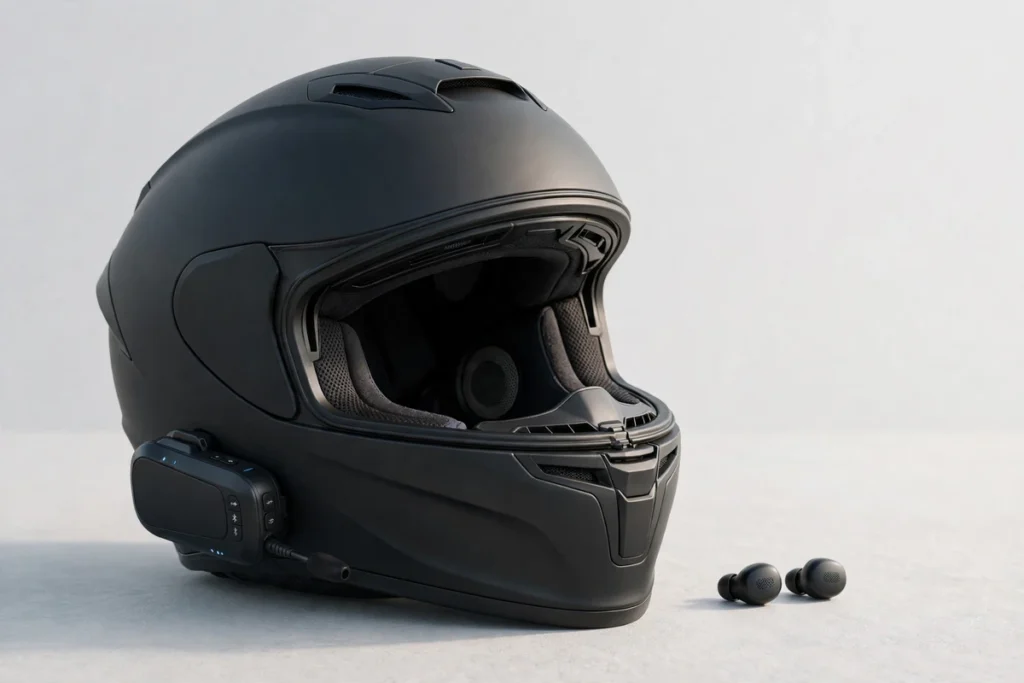
Most earbuds were never designed to live inside a motorcycle helmet. Anything with a stem or a proud outer shell gets pressed into your ear by the liner, and a hotspot that feels minor in the driveway dominates your thoughts after forty minutes on the motorway. The best headphones for motorcycle helmet use solve that problem first: they either sit almost flat against your ear, like the low-profile earbuds in this guide, or they remove the earbud entirely and put slim speakers inside the helmet itself.
Slim earbuds give you the strongest seal against wind roar and work with any helmet. In-helmet speaker systems give you glove-friendly controls, a microphone that works at speed, and rider-to-rider intercom — and, as we explain below, usually firmer legal ground. Our six picks cover both routes.
Read this before you buy: Laws on earbuds while riding vary widely by state and country. Some places allow a single earpiece only, some ban earbuds in both ears, and some treat helmet speakers differently from anything that seals the ear canal. Check your local law before riding with any device in this guide, and keep the volume low enough to hear horns, sirens and traffic.
Our verdict: For most riders, a helmet speaker system is the smarter buy. The Cardo Packtalk Edge is our top pick for group riding, the LEXIN B4FM delivers intercom features for far less, and the Syphon SoundPro suits music and navigation only. Prefer earbuds? The wired Shure SE215 PRO fits flatter than almost anything wireless, and the Jabra Elite 7 Active is the true wireless option most likely to stay comfortable under a tight liner.
Best Headphones for Motorcycle Helmet Use at a Glance
| Pick | Type | Best for | Key strength | Link |
|---|---|---|---|---|
| Cardo Packtalk Edge | Helmet comm system | Group touring | Mesh intercom, JBL speakers | Check Price |
| Sena 50S | Helmet comm system | Premium audio and mesh | Harman Kardon speakers, jog dial | Check Price |
| Syphon SoundPro | Helmet speakers | Music and GPS only | Ultra-thin 9.6mm speakers | Check Price |
| LEXIN B4FM | Helmet comm system | Budget intercom | 10-rider intercom, IP67 shell | Check Price |
| Shure SE215 PRO | Wired earbuds | Flat fit and isolation | Low-profile shell, earplug-like seal | Check Price |
| Jabra Elite 7 Active | True wireless earbuds | Wireless earbud fit | Compact shell, ShakeGrip coating | Check Price |
Earbuds or Helmet Speakers: Which Is Better Under a Helmet?
Earbuds seal in your ear canal, so they block more wind noise passively and usually sound fuller at a given volume. That seal is also their weakness: it blocks traffic sound along with the wind, the liner presses on the shell for the whole ride, and touch controls are useless once your gloves are on. Getting a helmet on and off over earbuds without dragging one out is a skill in itself.
Helmet speaker systems take the opposite approach. Thin speakers sit in the liner’s ear pockets, in front of your ears rather than inside them, and a control unit clips to the shell where gloved fingers can find it. You keep more ambient awareness and gain a proper microphone and, on the Cardo and Sena systems below, rider-to-rider intercom. The trade-off: speakers fight wind noise in open air inside the helmet, so voice and navigation stay clear at speed while music sounds thinner than a sealed earbud. Riders who also cycle will recognise the same fit-versus-awareness balance we cover in our guide to the best headphones for cycling.
Are Headphones Legal in a Motorcycle Helmet?
There is no single answer, because there is no single law. In the United States there is no federal ban; rules are set state by state, and they differ in ways that matter. Several states prohibit headphones or earbuds covering or inserted in both ears while operating a vehicle, some allow a single earpiece, and others have no headphone restriction at all. Outside the US the picture is just as mixed, country by country. Treat any list — including this one — as a starting point and check the current rule where you actually ride, including states or countries you tour through.
One distinction does recur: helmet-mounted speakers are treated differently from earbuds in many restrictive jurisdictions, because the speaker sits in the helmet lining rather than sealing the ear canal, and some laws carve out exceptions for helmet communication equipment. That is a genuine reason to favour a speaker system if your local rule is strict — but not a guarantee, so verify before you rely on it. And legality is only the floor: even where two earbuds are permitted, riding with both ears sealed and the volume up removes warnings you need. Options that leave some ambient hearing — helmet speakers, a transparency mode, or a single earpiece where legal — are what we have prioritised here. For an even more open option, it is worth understanding how bone conduction works, though wind noise limits it at highway speed.
Wind Noise and Your Hearing at Highway Speed
Wind, not your engine, is the loudest thing on most rides. Turbulence around a helmet at highway speed commonly pushes noise at the ear past 100 decibels, a level where regular exposure without protection risks permanent hearing damage — and the damage accumulates quietly, ride after ride. This changes the headphone calculation. A sealed earbud or a well-fitting foam tip reduces the wind level reaching your ear, which means you can also keep your music volume lower. A helmet speaker adds sound on top of the wind, tempting you to turn it up to compete, which is exactly the pattern to avoid.
Our practical advice: treat hearing protection as the base layer and audio as the add-on. With earbuds, choose foam tips and the lowest volume that stays intelligible. With helmet speakers, consider filtered earplugs underneath — the speakers sit outside the ear, so the two combine naturally. The difference between electronic cancellation and a physical seal matters here too, as our explainer on active noise cancellation vs passive isolation breaks down. If your ears ring after a ride, your setup was too loud.
The Best Headphones and Helmet Audio Systems for Riders
1. Cardo Packtalk Edge — Best Overall Helmet System
The Packtalk Edge is the system we would buy first for group riding. Its second-generation Dynamic Mesh Communication intercom reconnects automatically when riders drift apart and regroup — the feature that separates mesh from ordinary Bluetooth pairing on a real tour. The 40mm speakers are tuned by JBL and sound noticeably fuller than most helmet speakers, while the magnetic Air Mount base makes the unit easy to clip on and off with gloves on. Voice commands cover the common controls, so your hands stay on the bars.
Fit is rarely an issue because the speakers sit in the helmet’s ear pockets — the main check is that your helmet has speaker recesses, as most modern full-face and modular helmets do. Battery life covers a long touring day, the unit is waterproof rather than merely splash-resistant, and it still pairs by Bluetooth when needed. It is a premium system, but for group tourers it earns it.
2. Sena 50S — Best for Premium Sound and Big Groups
Sena’s 50S is the Packtalk Edge’s direct rival, and some riders will prefer it. Its speakers and microphone are developed with Harman Kardon and deliver the clearest voice performance in this roundup, which matters if calls and intercom chat matter more to you than music. Mesh Intercom connects large groups, Bluetooth intercom covers smaller ones, and the chunky jog dial is the easiest control in this guide to operate precisely in thick winter gloves — a small detail that becomes a big one on a cold ride.
The listing we link is the dual pack, which suits couples and riding pairs who want two matched units. Like the Cardo, the speakers mount in the helmet’s ear pockets and the unit is weather-resistant for wet rides. Choose between the two flagships on controls and ecosystem: if your riding group already uses Sena mesh, the 50S is the obvious fit; if they run Cardo, match them instead.
3. Syphon SoundPro — Best Helmet Speakers for Music and GPS
Not everyone wants an intercom. If your riding is solo and your audio needs are music, podcasts and navigation prompts, the SoundPro strips the idea down to its essentials: a pair of Bluetooth helmet speakers just 9.6mm thick, among the slimmest available, so they disappear into helmets with shallow ear pockets where thicker speakers press and ache. With no boom microphone or intercom hardware, there is less to fit, less to charge-manage and less to go wrong.
The control is a glove-friendly twist dial rather than small buttons — the right call for winter gloves. Output is strong for the format, built to stay intelligible over wind noise at sensible volumes, and the sealed design shrugs off rain. What you give up versus Cardo and Sena is rider-to-rider communication and high-quality calls. For a solo rider who never uses intercom, that trade is worth making.
4. LEXIN B4FM — Best Budget Intercom System
The B4FM is the value benchmark in helmet audio. It offers intercom for groups of up to ten riders, music sharing, an FM radio and noise cancellation on the microphone, in a unit with an IP67-rated shell that handles serious rain. The speakers are not at Cardo or Sena level for music richness, and the controls take a ride or two to memorise, but for navigation prompts, calls and group chat it does the jobs most riders actually need.
It is also a sensible first system if you are unsure whether helmet audio suits you: the cost of finding out is low, and it uses the same ear-pocket layout as the premium systems, so upgrading later is painless. If you ride in all weathers, our guide to understanding IP ratings explains what IP67 does and does not promise.
5. Shure SE215 PRO — Best Wired Earbuds Under a Helmet
The SE215 has been the rider’s earbud answer for years for one simple reason: shape. The shell is small, rounded and worn with the cable looped over the ear, so it sits almost flush and slides under a liner without the pressure hotspots that stem-style earbuds create. Its sound-isolating design works like an earplug with a speaker in it — with the foam tips fitted properly, wind roar drops dramatically, which protects your hearing and lets you run lower volumes. Shure includes both foam and silicone tips so you can tune the seal.
Being wired is a genuine feature here, not a compromise: no battery to die mid-tour, no pairing to drop, and the detachable cable can be replaced if it wears. The compromises are equally real: a cable to route, no controls you can feel through gloves, and a sealed ear canal — so check your local law, consider a single earpiece where that is the legal pattern, and keep volumes disciplined. For helmets too tight for any true wireless bud, this remains the fit benchmark.
6. Jabra Elite 7 Active — Best True Wireless Earbuds for Helmet Fit
If you want true wireless earbuds that can survive helmet life, the Elite 7 Active is the strongest fit candidate we verified. The shell is compact and stemless, and Jabra’s ShakeGrip coating — a grippy liquid silicone finish — helps the buds stay seated when the liner drags over them as you pull the helmet on. Adjustable active noise cancellation takes the edge off steady wind and engine drone, and the HearThrough transparency mode is the setting to use at lower speeds and in traffic, restoring the ambient sound that a sealed fit removes.
Battery life covers a full day of riding with case top-ups between stops, and the buds are rated for sweat and rain. Two honest cautions apply to every true wireless pick: touch controls are unusable with gloves, so set your playlist before you set off, and fit varies with helmet tightness — if your liner presses hard on your ears, the wired Shure above is the safer choice. Where both earbuds are restricted locally, a single bud with transparency on is the more defensible way to ride.
How to Choose Headphones for a Motorcycle Helmet
Start With Fit Inside Your Helmet
Measure the room you actually have. Helmets with deep ear pockets suit any speaker system; tight race-style liners push you toward the slimmest speakers or flattest earbuds. For earbuds, profile matters more than any audio specification: stemless, rounded shells survive helmet use, while stems and wings get levered by the liner. Test the full routine at home — buds in, helmet on, helmet off — before a long ride, and consider a thin balaclava, which helps earbuds stay in place as the helmet slides over them.
Controls You Can Use With Gloves On
Assume touch panels do not exist once you are riding. Physical dials and large buttons — the Sena jog dial, the Syphon twist control, Cardo’s roller and voice commands — are what glove-friendly really means. With earbuds, plan on controlling everything from the phone before departure or a handlebar remote, and use voice assistants for navigation changes rather than reaching for a bud.
Battery for the Riding You Actually Do
Commutes forgive small batteries; touring does not. Helmet systems generally outlast earbuds per charge and are easier to top up at a fuel stop. True wireless buds need their case for a full day, and cold shortens every battery here. Wired earbuds like the SE215 remove the question entirely.
Wired vs True Wireless Under a Helmet
Wired means no charging, no dropouts and the flattest fits, at the cost of a cable to route. True wireless adds freedom off the bike, but demands charging discipline and the near-certainty of fishing a dropped bud out of a helmet at least once. Helmet speakers sidestep the argument: nothing in your ear, nothing to drop, cables hidden inside the liner.
Frequently Asked Questions
Are earbuds legal in a motorcycle helmet?
It depends where you ride. There is no US federal ban, but state laws vary: several states prohibit earbuds or headphones in both ears, some allow a single earpiece, and others have no restriction. Many other countries have their own rules, and helmet speaker systems are treated differently from earbuds in many places because they do not seal the ear canal. Check your local law before riding with any audio device.
Do noise-cancelling earbuds block wind noise on a motorcycle?
Partly. Active noise cancellation reduces steady low-frequency drone, but wind noise is turbulent and broadband, so the physical seal matters most. Foam tips with a deep, earplug-like fit, as on the Shure SE215 PRO, cut more wind roar than ANC alone, and combining a good seal with ANC, as on the Jabra Elite 7 Active, gives the best result.
What is better for a motorcycle helmet: earbuds or helmet speakers?
For awareness, controls and legality, helmet speakers usually win: they sit outside the ear, keep more ambient sound, and offer glove-friendly controls and microphones. For hearing protection and sound quality at lower volumes, sealed earbuds win, because they reduce wind noise before it reaches your ear. Your local law and helmet fit should decide it.
How do I stop earbuds falling out when I put my helmet on?
Choose low-profile, stemless earbuds with foam tips or a grippy coating, seat them before the helmet goes on, and pull the helmet on slowly using the straps to widen the opening. A thin balaclava or helmet liner worn over the ears holds buds in place during the pull-on and makes removal far less likely to drag a bud out.
Can wind noise damage my hearing on a motorcycle?
Yes. Wind turbulence around a helmet at highway speed commonly exceeds 100 decibels at the ear, and regular exposure at that level can cause permanent hearing damage. Sealed earbuds, filtered earplugs under helmet speakers, and keeping music volume as low as possible all reduce the risk. Ringing ears after a ride are a warning sign your setup was too loud.
Can I take calls and hear GPS directions with helmet headphones?
Yes. Helmet communication systems such as the Cardo Packtalk Edge, Sena 50S and LEXIN B4FM pair with your phone for calls, navigation prompts and music, and their microphones are designed to work at riding speed. Helmet speakers like the Syphon SoundPro and ordinary earbuds handle music and GPS prompts well, but call quality at highway speed is much weaker without a dedicated helmet microphone.

I am the founder of Sound Mavericks, where I provide the polite truth about audio equipment. I started this site because consumer electronics reviews are often too technical. Instead of using a silent lab, I test headphones, earbuds, and Bluetooth speakers in the real world – like on a noisy subway or in a busy coffee shop.
To stay independent, I buy my own review units (mostly from the United States) rather than accepting free gifts from brands. Once I finish testing a product, I sell it locally to our community. My goal is to help you understand sound quality, active noise cancellation (ANC), and battery life without the marketing hype.

