
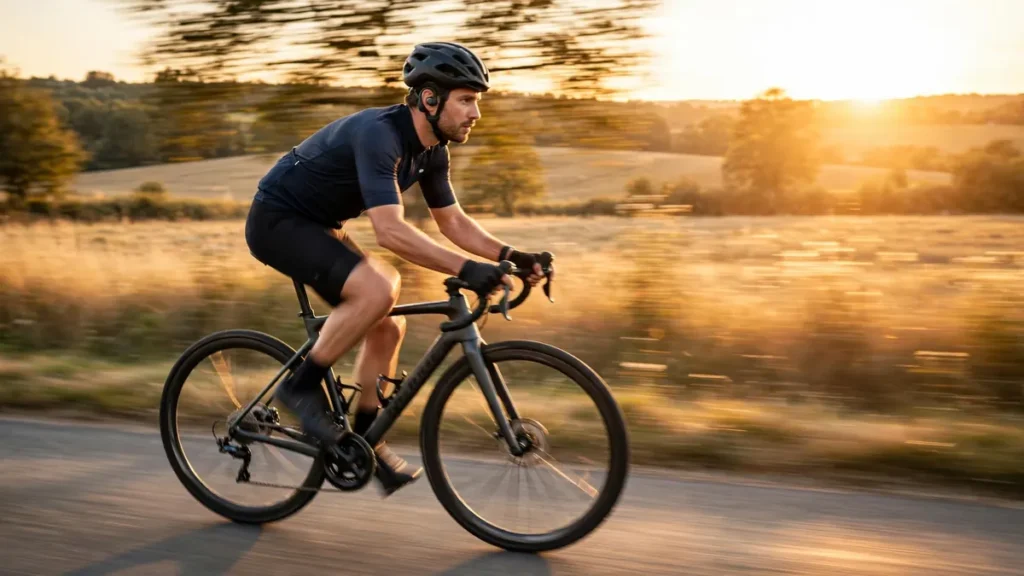
The best headphones for cycling are not the best-sounding headphones you own — they are the ones that let you hear the car behind you. Cycling with sealed noise-cancelling earbuds is genuinely dangerous on open roads, which is why the entire cycling world has converged on two designs: bone conduction and open-ear. Both keep your ear canals open to traffic, wind and warning shouts while still delivering your music, podcasts and turn-by-turn directions.
After comparing spec sheets, manufacturer documentation, Amazon listing data and cycling-press reviews, SoundMavericks has ranked the eight headphones that make the strongest case for riders in 2026. Every pick is verified live on Amazon, sweat-resistant, and chosen for the thing that matters most on two wheels: situational awareness. If you want the short version — get the Shokz OpenRun Pro 2. If you want the full reasoning, keep reading.
Best headphones for cycling: our top picks at a glance
| Pick | Best for | Design | Battery | Weatherproofing |
|---|---|---|---|---|
| Shokz OpenRun Pro 2 | Best overall | Bone conduction | 12 hours | IP55 |
| Shokz OpenFit 2+ | Best open-ear comfort | Open-ear earbuds | 11 hrs + 48 hrs case | IP55 |
| Beats Powerbeats Pro 2 | Best secure fit | Ear-hook earbuds, ANC | 45 hrs total with case | Sweat & water resistant |
| JBL Endurance Race 2 | Best for all-weather riding | Earbuds, ANC + Smart Ambient | 12 hrs + 36 hrs case | IP68 |
| JLab Epic Air Sport ANC 3 | Best value ANC sport pick | Ear-hook earbuds, ANC | 12+ hrs + 52 hrs total | IP66 |
| Soundcore Sport X20 | Best for training rides | Ear-hook earbuds, ANC | All-day with charging case | SweatGuard sealed |
| TOZO OpenReal | Best budget open-ear | Air conduction open-ear | 16 hours | Sweat-resistant |
| Suunto Sonic | Best budget bone conduction | Bone conduction | 10 hours | Sport build |
The best headphones for cycling in 2026
1. Shokz OpenRun Pro 2 — Best overall

The OpenRun Pro 2 is the benchmark cycling headphone for a simple reason: it solves the safety equation better than anything else here. Shokz pairs bone conduction drivers for clear highs with air conduction drivers for actual bass — a dual-driver setup that fixes the thin, tinny sound bone conduction was once known for. Your ears stay completely open, so traffic, wind and other riders are never masked.
For cyclists, the details line up: a unibody frame with nickel-titanium memory wire that sits stable under a helmet strap, dedicated EQ modes in the Shokz app, and dual wind-resistant microphones with AI noise reduction that filters a claimed 96.5% of background noise on calls. Twelve hours of battery covers even long weekend rides, and IP55 sealing handles sweat and rain.
Pros:
- Maximum situational awareness — ears stay fully open
- Dual-driver sound is a big step up from older bone conduction
- Stable under a helmet; 12-hour battery
Cons:
- Bass still can’t match sealed earbuds
- Some sound leakage at high volumes in quiet areas
2. Shokz OpenFit 2+ — Best open-ear comfort

If you want richer sound than bone conduction without sealing your ears, the OpenFit 2+ is the sweet spot. These are open-ear earbuds — small speakers that hover just outside the ear canal — so you get fuller audio with Dolby Audio tuning and a large low-frequency driver while staying aware of the road. At 9.4 grams per bud with Shokz’s soft silicone coating, they are the most forget-you’re-wearing-them option in this guide.
Cycling-relevant specs are strong: 11 hours per charge with 48 hours total from the wireless-charging case, IP55 sweat and splash resistance, physical buttons that work with gloves, and four AI-enhanced microphones for calls. This is our pick for commuters and riders who prioritize comfort on long days in the saddle.
Pros:
- Best-in-class comfort for long rides
- Fuller sound than bone conduction, ears still open
- 11-hour battery + wireless charging case
Cons:
- Less secure than ear-hook designs on rough terrain
- Open-ear sound fades a bit at high speed in wind
3. Beats Powerbeats Pro 2 — Best secure fit

Nothing stays put like an ear hook. The Powerbeats Pro 2’s nickel-titanium earhooks — 20% lighter than the previous generation — lock the buds in place over cobbles, trails and out-of-the-saddle sprints where other earbuds migrate. Add the Apple H2 chip, Adaptive EQ, and heart-rate sensors that read your pulse over 100 times per second, and this is the most feature-packed training earbud you can ride with.
One honest caveat: this is the only sealed pick on our list, and it has active noise cancelling. On open roads, keep ANC off (or skip it for road riding entirely) — this pick earns its place for indoor trainers, velodromes and off-road trails where traffic isn’t a factor, plus riders who want one earbud for everything. Forty-five hours of total battery with the case and full Apple/Android feature parity round out the package.
Pros:
- Unbeatable stability from the ear-hook design
- Heart-rate tracking, Adaptive EQ, 45-hour total battery
- Works fully with both Apple and Android
Cons:
- Sealed design + ANC needs care around traffic — not for busy roads
- Bulkier than open-ear options under a helmet
4. JBL Endurance Race 2 — Best for all-weather riding

Rain is when most sport earbuds give up. The Endurance Race 2 doesn’t: a full IP68 rating means complete dust and waterproofing, the toughest weather sealing on this list. The Twistlock wing enhancer twists into the ear for a locked-in fit, and 12 hours per charge (36 more in the case) means a week of commutes without hunting for a charger.
The killer feature for cyclists is Smart Ambient — JBL’s transparency mode — paired with active noise cancelling you can toggle. Use ANC on the indoor trainer, flip to Smart Ambient on the road, and you get both worlds. Four beamforming microphones keep calls clear at speed, and speed charging tops you up fast before a ride.
Pros:
- IP68 — the best weatherproofing here, full stop
- ANC for the trainer + Smart Ambient transparency for the road
- Secure Twistlock fit; 48 hours total battery
Cons:
- Transparency mode still isn’t as natural as true open-ear
- Must dry buds before charging (per JBL’s own guidance)
5. JLab Epic Air Sport ANC 3 — Best value ANC sport pick

The Epic Air Sport ANC 3 is the spec-sheet overachiever of this list. Hybrid dual drivers (a Knowles balanced armature plus a dynamic driver) with LDAC support deliver genuinely hi-res-capable sound, battery runs 12+ hours per bud with ANC off and 52+ hours total, and the ergonomic earhooks are shaped to fit even small ears. IP66 sealing and Bluetooth multipoint — laptop and phone simultaneously — make it a strong all-rounder.
For cycling, the same honesty as the Powerbeats applies: it’s a sealed ANC earbud, so save the noise cancelling for the trainer and use ambient-aware modes on the road. But as a do-everything sport earbud with an interval timer built into the JLab app for structured workouts, the value here is hard to argue with.
Pros:
- Hybrid Knowles BA + dynamic drivers with LDAC — serious sound
- 52+ hour total battery; earhooks fit small ears
- Multipoint + workout interval timer in the app
Cons:
- Sealed ANC design — keep awareness modes on around traffic
- JLab’s tuning favors bass over neutrality
6. Soundcore Sport X20 — Best for training rides

Anker’s Sport X20 is built for the grind: extendable, rotatable ear hooks that dial in a custom fit, noise cancelling for focused indoor sessions, and BassUp-powered 11mm drivers that keep tempo high when the intervals get ugly. The standout is SweatGuard — a sealed, submarine-inspired cavity design built specifically to survive corrosive sweat over years of training.
This is the pick for riders whose “cycling headphones” mostly serve structured training: Zwift sessions, turbo workouts and gym cross-training, where the ANC earns its keep and traffic isn’t a concern. For outdoor miles, pair it with our gym workout headphone guide logic — awareness first, always. The soundcore app adds HearID personalized EQ and firmware updates.
Pros:
- Adjustable ear hooks for a truly custom fit
- SweatGuard sealing built for years of sweaty sessions
- Strong ANC + BassUp sound for indoor training
Cons:
- Sealed design — a trainer/gym pick first, road pick second
- Battery specs less clearly documented than rivals
7. TOZO OpenReal — Best budget open-ear

You don’t need to spend flagship money for safe cycling audio. The TOZO OpenReal uses air conduction — tiny speakers directing sound at your ears without sealing them — to deliver open-ear awareness at a fraction of the Shokz price. Sixteen hours of continuous playback is the longest single-charge battery among the open-ear picks here, and the 16.2mm drivers are large for this form factor.
Bluetooth 5.3 keeps the connection stable on the bike, dual-mic noise reduction handles calls, and the ergonomic design avoids ear fatigue on long rides. Sound quality won’t trouble the Shokz picks, but for the money this is the easiest safe-cycling upgrade you can make.
Pros:
- Open-ear awareness at a budget price
- 16-hour battery — longest open-ear playtime here
- Lightweight, fatigue-free fit
Cons:
- Sound quality a clear step below Shokz
- Less wind-resistant mic performance than premium picks
8. Suunto Sonic — Best budget bone conduction

True bone conduction on a budget. The Suunto Sonic sends audio vibrations through your cheekbones to your inner ear, leaving your ear canals completely open — the same safety-first principle as our top pick, at a much lower price. Ten hours of battery from the 140mAh cell covers most riding weeks, and the 30.6g silicone-and-titanium frame is light enough to forget.
Under the hood there’s a Qualcomm QCC3044 chip with Bluetooth 5.2 multipoint, so you can stay connected to your phone and bike computer simultaneously, plus app-based customization through the Suunto app. Sound is tuned with an optimized frequency curve for stronger lows and highs than budget bone conduction usually manages. If the OpenRun Pro 2 is out of reach, this is where to start.
Pros:
- True bone conduction awareness at a budget price
- 10-hour battery; featherweight 30.6g frame
- Bluetooth multipoint + app customization
Cons:
- Sound quality trails the Shokz flagship
- Older Bluetooth 5.2 versus 5.3+ on rivals
How to choose the best headphones for cycling
Situational awareness comes first
This is the non-negotiable. On a bike you are traffic, and traffic kills. Bone conduction headphones transmit sound through your cheekbones; open-ear (air conduction) earbuds hover outside the ear canal. Both leave you able to hear cars, emergency vehicles and other riders. Sealed earbuds with ANC do the opposite — fine for the indoor trainer, questionable everywhere else. If you want the full explainer on the technology, our guide to how bone conduction works breaks it down.
Fit: it must work with a cycling helmet
Bluetooth headphones for helmet cycling live or die by fit. Bone conduction neckbands slide neatly under helmet straps and play well with sunglasses. Ear-hook earbuds (Powerbeats Pro 2, JLab, Soundcore) add security for rough roads but create more contact points with straps and glasses arms — try the combination before a big ride. Whatever you choose, it should stay put when you look over your shoulder at a junction.
Wind noise: the cyclist’s real enemy
Wind noise ruins more rides than bad sound quality. It hits hardest with sealed earbuds, where the ear canal becomes a little wind tunnel, and on exposed microphones during calls. Open-ear and bone conduction designs suffer less in-ear wind roar by nature. Practical fixes: wear a thin headband or cap over the buds in heavy wind, keep volume moderate (you’ll hear better anyway with open ears), and favor models with wind-resistant mics — the Shokz picks’ AI mic filtering is specifically built for this.
Sweat and weather resistance
Cycling headphones live in sweat, rain and road spray. Check the IP rating before you buy: IP55 shrugs off sweat and rain, IP66 handles heavy spray, and IP68 (JBL Endurance Race 2) survives full immersion. Our IP ratings explainer decodes what each number actually means. One maintenance note from JBL itself: dry your earbuds before dropping them back in the charging case.
Best headphones for cycling: FAQs
Is it legal to wear headphones while cycling?
It depends on where you ride. Some states and countries restrict or ban wearing headphones that cover both ears while cycling; others have no specific law at all. Because the rules vary so much, check your local regulations before you ride — and regardless of the law, open-ear and bone conduction models that keep you aware of traffic are the responsible choice.
Are bone conduction headphones good for cycling?
They’re the best type for road cycling. Bone conduction leaves your ear canals completely open, so you hear traffic, pedestrians and warning shouts while still getting your audio. The trade-off is bass response — sealed earbuds sound fuller — but for safety on shared roads, nothing beats them.
Can you wear earbuds under a bike helmet?
Yes, with the right design. Bone conduction neckbands and slim open-ear buds fit comfortably under helmet straps. Bulky ear-hook earbuds can clash with straps and sunglasses arms, so test the full setup — helmet, glasses, earbuds — before committing to a long ride.
How can I reduce wind noise when cycling with headphones?
Start with the design: open-ear and bone conduction headphones generate less in-ear wind roar than sealed earbuds. Then add practical steps — a thin skullcap or headband over the buds breaks up airflow, moderate volume keeps you from fighting the wind, and wind-resistant microphones (like the Shokz dual-mic arrays) keep calls intelligible at speed.
Should I use noise cancelling while cycling?
Not on open roads. Noise cancelling is designed to remove exactly the sounds — engines, horns, sirens — that keep you alive in traffic. Save ANC for the indoor trainer and gym, and ride outside with open-ear, bone conduction, or transparency modes that let the world in.
What is the safest type of headphone for road cycling?
Bone conduction first, open-ear second. Both keep your ear canals unobstructed so you maintain full situational awareness. If you must use sealed earbuds, choose a model with a good transparency mode (like the JBL Endurance Race 2’s Smart Ambient) and keep it engaged whenever traffic is around.
The verdict
The best headphones for cycling in 2026 are the Shokz OpenRun Pro 2: the safest design, genuinely improved sound from its dual drivers, helmet-friendly fit and a 12-hour battery. Riders who want richer audio and all-day comfort should step to the Shokz OpenFit 2+, and anyone riding through real weather should look hard at the IP68-rated JBL Endurance Race 2. On a budget, the TOZO OpenReal (open-ear) and Suunto Sonic (bone conduction) deliver the safety essentials for far less.
Whatever you choose, remember the rule that governs this whole category: if you can’t hear the road, the headphones don’t belong on the bike. Ride aware.

I am the founder of Sound Mavericks, where I provide the polite truth about audio equipment. I started this site because consumer electronics reviews are often too technical. Instead of using a silent lab, I test headphones, earbuds, and Bluetooth speakers in the real world – like on a noisy subway or in a busy coffee shop.
To stay independent, I buy my own review units (mostly from the United States) rather than accepting free gifts from brands. Once I finish testing a product, I sell it locally to our community. My goal is to help you understand sound quality, active noise cancellation (ANC), and battery life without the marketing hype.

